talk-data.com talk-data.com

Event

O'Reilly Data Science Books

2013-08-09 – 2026-02-25 Oreilly Visit website ↗

Activities tracked

794

Collection of O'Reilly books on Data Science.

Filtering by: data-science-tasks ×

Sessions & talks

Showing 526–550 of 794 · Newest first

Search within this event →
Getting Started with Beautiful Soup

"Getting Started with Beautiful Soup" is your practical guide to website scraping using Python. It teaches you how to use Beautiful Soup and the urllib2 module to extract data from websites efficiently and effectively. Through hands-on examples and clear explanations, you'll gain the skills to navigate, search, and modify HTML content. What this Book will help me do Navigate and scrape web pages using the Beautiful Soup Python library. Understand and implement the urllib2 module to access web content programmatically. Search and analyze HTML structures efficiently to extract the needed data. Modify and format extracted HTML and XML content effectively. Handle encoding and manage output formats for diverse scraping requirements. Author(s) Vineeth G. Nair is an experienced Python developer with a strong focus on web technologies, data extraction, and automation. His expertise in Python's Beautiful Soup library has helped countless learners and professionals tackle the challenges of web scraping. Vineeth combines a methodical approach to teaching with practical examples, making complex concepts accessible and actionable. Who is it for? This book is ideal for Python enthusiasts, data analysts, and budding developers looking to explore web scraping. Whether you're a beginner or have some programming experience, this book will guide you through the fundamental concepts of extracting web data. If you're aiming to delve into practical, real-world implementations of web scraping, this is the book for you.
Forecasting Offertory Revenue at St. Elizabeth Seton Catholic Church

This new business analytics case study challenges readers to forecast donations, plan budgets, and manage cash flow for a religious institution suffering rapidly falling contributions. Crystallizing realistic analytical challenges faced by non-profit and for-profit organizations of all kinds, it exposes readers to the entire decision-making process, providing opportunities to perform analyses, interpret output, and recommend the best course of action. Author: Matthew J. Drake, Duquesne University.

Forecasting Sales at Ska Brewing Company

This new business analytics case study challenges readers to project trends and plan capacity for a fast-growing craft beer operation, so it can make the best possible decisions about expensive investments in brewing capacity. Crystallizing realistic analytical challenges faced by companies in many industries and markets, it exposes readers to the entire decision-making process, providing opportunities to perform analyses, interpret output, and recommend the best course of action. Author: Eric Huggins, Fort Lewis College.

Statistics for Mining Engineering

Many areas of mining engineering gather and use statistical information, provided by observing the actual operation of equipment, their systems, the development of mining works, surface subsidence that accompanies underground mining, displacement of rocks surrounding surface pits and underground drives and longwalls, amongst others. In addition, the actual modern machines used in surface mining are equipped with diagnostic systems that automatically trace all important machine parameters and send this information to the main producer’s computer. Such data not only provide information on the technical properties of the machine but they also have a statistical character. Furthermore, all information gathered during stand and lab investigations where parts, assemblies and whole devices are tested in order to prove their usefulness, have a stochastic character. All of these materials need to be developed statistically and, more importantly, based on these results mining engineers must make decisions whether to undertake actions, connected with the further operation of the machines, the further development of the works, etc. For these reasons, knowledge of modern statistics is necessary for mining engineers; not only as to how statistical analysis of data should be conducted and statistical synthesis should be done, but also as to understanding the results obtained and how to use them to make appropriate decisions in relation to the mining operation. This book on statistical analysis and synthesis starts with a short repetition of probability theory and also includes a special section on statistical prediction. The text is illustrated with many examples taken from mining practice; moreover the tables required to conduct statistical inference are included.

Growth Curve Modeling: Theory and Applications

Features recent trends and advances in the theory and techniques used to accurately measure and model growth Growth Curve Modeling: Theory and Applications features an accessible introduction to growth curve modeling and addresses how to monitor the change in variables over time since there is no "one size fits all" approach to growth measurement. A review of the requisite mathematics for growth modeling and the statistical techniques needed for estimating growth models are provided, and an overview of popular growth curves, such as linear, logarithmic, reciprocal, logistic, Gompertz, Weibull, negative exponential, and log-logistic, among others, is included. In addition, the book discusses key application areas including economic, plant, population, forest, and firm growth and is suitable as a resource for assessing recent growth modeling trends in the medical field. SAS is utilized throughout to analyze and model growth curves, aiding readers in estimating specialized growth rates and curves. Including derivations of virtually all of the major growth curves and models, Growth Curve Modeling: Theory and Applications also features: Statistical distribution analysis as it pertains to growth modeling Trend estimations Dynamic site equations obtained from growth models Nonlinear regression Yield-density curves Nonlinear mixed effects models for repeated measurements data Growth Curve Modeling: Theory and Applications is an excellent resource for statisticians, public health analysts, biologists, botanists, economists, and demographers who require a modern review of statistical methods for modeling growth curves and analyzing longitudinal data. The book is also useful for upper-undergraduate and graduate courses on growth modeling.

Metric Dashboards for Operations and Supply Chain Excellence

Over the last decade Lean and Six Sigma methods and tools have helped organizations improve to historic productivity levels with the data driven, systematic elimination of waste and improvement of flow. Today many organizations have enjoyed the benefits of Lean and Six sigma initiatives, and are looking more to sustain the gains, and aggressively drive a systematic and on-going approach to improvement and problem solving. The concept of diminishing returns applies here, when in the early stages, organizations were able to find "low-hanging fruit" and to quickly make significant improvements. Now the easy work is done, and organizations need a simple yet systematic approach to continuing their continuous improvement efforts. Operations and supply chain leaders will benefit from this book by developing a clear understanding of why and how metric scorecards and dashboards can be used as a powerful data driven improvement tool. This book illustrates visual management, scorecards, and dashboards for a full range of organizations, and focuses on Operations and Supply Chain Management areas. By covering these tools in these environments in a story book format, organization leaders can begin to understand how these methods and tools can be applied in their organizations.

Rapid Graphs with Tableau 8: The Original Guide for the Accidental Analyst

Tired of boring spreadsheets and data overload from confusing graphs? Master the art of visualization with Rapid Graphs with Tableau 8! Tableau insiders Stephen and Eileen McDaniel expertly provide a hands-on case study approach and more than 225 illustrations that will teach you how to quickly explore and understand your data to make informed decisions in a wide variety of real-world situations. Rapid Graphs with Tableau 8 includes best practices of visual analytics for ideas on how to communicate your findings with audience-friendly graphs, tables and maps. "A picture is worth a thousand words" is a common saying that is more relevant today than ever as data volumes grow and the need for easy access to answers becomes more critical. This book covers the core of Tableau capabilities in easy-to-follow examples, updated and expanded for Version 8. Learn how to be successful with Tableau from the team that started the original training program as the founding Tableau Education Partner! "A must read for anyone interested in Tableau. Clear explanations, practical advice and beautiful examples!" Elissa Fink – Chief Marketing Officer, Tableau Software What you'll learn Connect to and review data visually Create insightful maps and take advantage of view shifting Understand the types of views available in Tableau Take advantage of the powerful Marks card and much more Who this book is for Rapid Graphs with Tableau 8 is a great resource for those new to Tableau, and also contains useful tips and tricks for advanced users as well.

Nonlinear Option Pricing

New Tools to Solve Your Option Pricing Problems For nonlinear PDEs encountered in quantitative finance, advanced probabilistic methods are needed to address dimensionality issues. Written by two leaders in quantitative research—including Risk magazine’s 2013 Quant of the Year— Nonlinear Option Pricing compares various numerical methods for solving high-dimensional nonlinear problems arising in option pricing. Designed for practitioners, it is the first authored book to discuss nonlinear Black-Scholes PDEs and compare the efficiency of many different methods. Real-World Solutions for Quantitative Analysts The book helps quants develop both their analytical and numerical expertise. It focuses on general mathematical tools rather than specific financial questions so that readers can easily use the tools to solve their own nonlinear problems. The authors build intuition through numerous real-world examples of numerical implementation. Although the focus is on ideas and numerical examples, the authors introduce relevant mathematical notions and important results and proofs. The book also covers several original approaches, including regression methods and dual methods for pricing chooser options, Monte Carlo approaches for pricing in the uncertain volatility model and the uncertain lapse and mortality model, the Markovian projection method and the particle method for calibrating local stochastic volatility models to market prices of vanilla options with/without stochastic interest rates, the a + bλ technique for building local correlation models that calibrate to market prices of vanilla options on a basket, and a new stochastic representation of nonlinear PDE solutions based on marked branching diffusions.

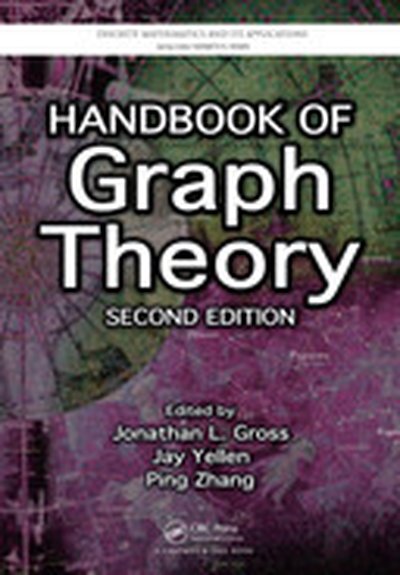
Handbook of Graph Theory, 2nd Edition

With 34 new contributors, this best-selling handbook provides comprehensive coverage of the main topics in pure and applied graph theory. This second edition incorporates 14 new sections. Each chapter includes lists of essential definitions and facts, accompanied by examples, tables, remarks, and, in some cases, conjectures and open problems.

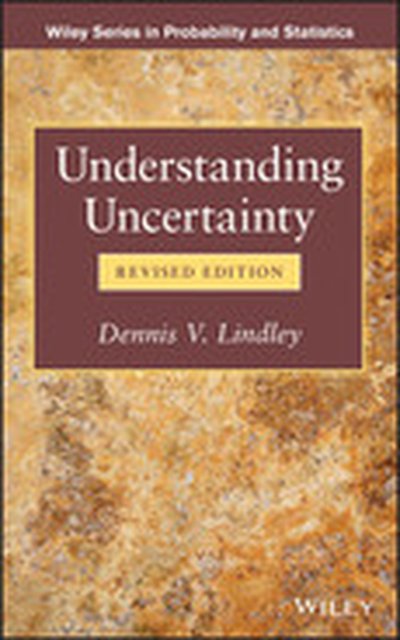
Understanding Uncertainty, Revised Edition

Praise for the First Edition "...a reference for everyone who is interested in knowing and handling uncertainty." —Journal of Applied Statistics The critically acclaimed First Edition of Understanding Uncertainty provided a study of uncertainty addressed to scholars in all fields, showing that uncertainty could be measured by probability, and that probability obeyed three basic rules that enabled uncertainty to be handled sensibly in everyday life. These ideas were extended to embrace the scientific method and to show how decisions, containing an uncertain element, could be rationally made. Featuring new material, the Revised Edition remains the go-to guide for uncertainty and decision making, providing further applications at an accessible level including: A critical study of transitivity, a basic concept in probability A discussion of how the failure of the financial sector to use the proper approach to uncertainty may have contributed to the recent recession A consideration of betting, showing that a bookmaker's odds are not expressions of probability Applications of the book's thesis to statistics A demonstration that some techniques currently popular in statistics, like significance tests, may be unsound, even seriously misleading, because they violate the rules of probability Understanding Uncertainty, Revised Edition is ideal for students studying probability or statistics and for anyone interested in one of the most fascinating and vibrant fields of study in contemporary science and mathematics.

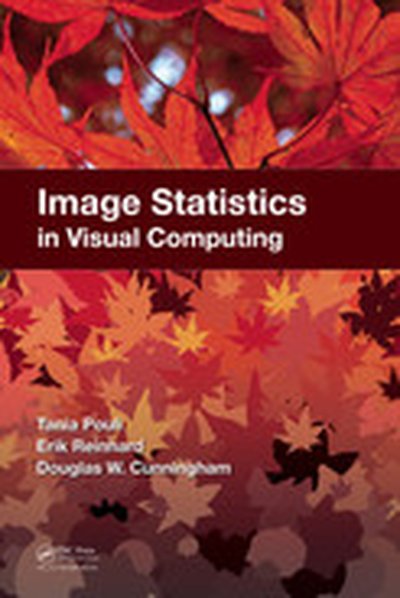
Image Statistics in Visual Computing

To achieve the complex task of interpreting what we see, our brains rely on statistical regularities and patterns in visual data. Knowledge of these regularities can also be considerably useful in visual computing disciplines, such as computer vision, computer graphics, and image processing. The field of natural image statistics studies the regularities to exploit their potential and better understand human vision. With numerous color figures throughout, Image Statistics in Visual Computing The authors keep the material accessible, providing mathematical definitions where appropriate to help readers understand the transforms that highlight statistical regularities present in images. The book also describes patterns that arise once the images are transformed and gives examples of applications that have successfully used statistical regularities. Numerous references enable readers to easily look up more information about a specific concept or application. A supporting website also offers additional information, including descriptions of various image databases suitable for statistics. Collecting state-of-the-art, interdisciplinary knowledge in one source, this book explores the relation of natural image statistics to human vision and shows how natural image statistics can be applied to visual computing. It encourages readers in both academic and industrial settings to develop novel insights and applications in all disciplines that relate to visual computing.

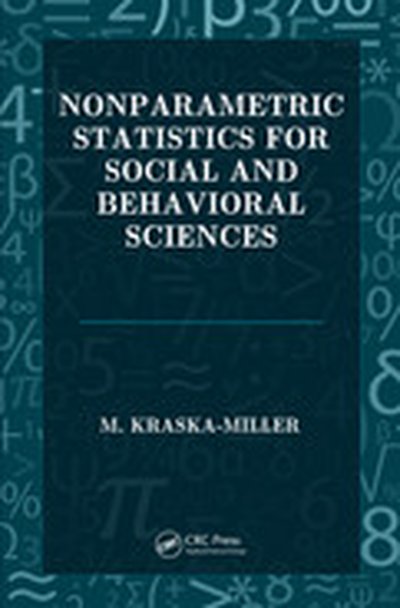
Nonparametric Statistics for Social and Behavioral Sciences

Incorporating a hands-on pedagogical approach, this text presents the concepts, principles, and methods used in performing many nonparametric procedures. It also demonstrates practical applications of the most common nonparametric procedures using IBM's SPSS software. The text is the only current nonparametric book written specifically for students in the behavioral and social sciences. With examples of real-life research problems, it emphasizes sound research designs, appropriate statistical analyses, and accurate interpretations of results.

Understanding Business Statistics

Written in a conversational tone, presents topics in a systematic and organized manner to help students navigate the material. Demonstration problems appear alongside the concepts, which makes the content easier to understand. By explaining the reasoning behind each exercise, students are more inclined to engage with the material and gain a clear understanding of how to apply statistics to the business world. Freed, Understanding Business Statistics is accompanied by Freed, Understanding Business Statistics WileyPLUS, a research-based, online environment for effective teaching and learning. This online learning system gives students instant feedback on homework assignments, provides video tutorials and variety of study tools, and offers instructors thousands of reliable, accurate problems (including every problem from the book) to deliver automatically graded assignments or tests. Available in or outside of the Blackboard Learn Environment, WileyPLUS resources help reach all types of learners and give instructors the tools they need to enhance course material. WileyPLUS sold separately from text.

Early Estimation of Project Determinants

The study initiated with underlying principles of construction production which is an impetus to ill-conditioned prediction of project determinants at the early phases of building projects. To enhance the precision of these estimations, unique solutions relying on the statistical evidences were offered. Two alternative methods of analysis, namely linear regression and artificial neural networks, were employed to recognize the patterns in the sampled projects. Comparison was conducted on the basis of prediction measurements that were computed with the help of unseen test sample. The evidences of the empirical investigation suggest offered solutions provide superior prediction accuracy when compared to current practices. Last but not least, implementation of the solutions was illustrated on a random office development.

Fast Sequential Monte Carlo Methods for Counting and Optimization

A comprehensive account of the theory and application of Monte Carlo methods Based on years of research in efficient Monte Carlo methods for estimation of rare-event probabilities, counting problems, and combinatorial optimization, Fast Sequential Monte Carlo Methods for Counting and Optimization is a complete illustration of fast sequential Monte Carlo techniques. The book provides an accessible overview of current work in the field of Monte Carlo methods, specifically sequential Monte Carlo techniques, for solving abstract counting and optimization problems. Written by authorities in the field, the book places emphasis on cross-entropy, minimum cross-entropy, splitting, and stochastic enumeration. Focusing on the concepts and application of Monte Carlo techniques, Fast Sequential Monte Carlo Methods for Counting and Optimization includes: Detailed algorithms needed to practice solving real-world problems Numerous examples with Monte Carlo method produced solutions within the 1-2% limit of relative error A new generic sequential importance sampling algorithm alongside extensive numerical results An appendix focused on review material to provide additional background information Fast Sequential Monte Carlo Methods for Counting and Optimization is an excellent resource for engineers, computer scientists, mathematicians, statisticians, and readers interested in efficient simulation techniques. The book is also useful for upper-undergraduate and graduate-level courses on Monte Carlo methods.

Microsoft Visio 2013 Business Process Diagramming and Validation - Second Edition

This book, "Microsoft Visio 2013 Business Process Diagramming and Validation," is your comprehensive guide to leveraging the features of Microsoft Visio 2013 Professional for creating and validating structured diagrams. Through practical tutorials and code examples, it helps you master process diagramming and validation techniques for a range of business needs. What this Book will help me do Understand and utilize structured diagram functionality including basic and cross-functional flowcharts. Develop and apply custom validation rules to ensure diagram correctness and compliance using Visio 2013. Create and use advanced tools such as the Rules Tools add-on to enhance diagram validation. Learn to integrate Visio with platforms like SharePoint 2013 and Office365. Gain technical skills to build, publish, and share Visio templates and rule sets. Author(s) The authors of this book bring rich technical expertise in Microsoft Visio and business process management. They have extensive experience developing user-focused tutorials and tools, ensuring you gain both theoretical knowledge and practical skills. Their accessible writing makes complex topics approachable for a variety of learners. Who is it for? This book is for Microsoft Visio 2013 Professional Edition users who want to advance their skills in diagramming and validation. It's ideal for professionals who seek to improve diagram compliance and efficiency, including developers, analysts, and project managers. If you're already familiar with Visio basics, this book will take your skills to the next level by introducing advanced techniques for automation and standardization.

Nonparametric Statistical Methods, 3rd Edition

Praise for the Second Edition "This book should be an essential part of the personal library of every practicing statistician."—Technometrics Thoroughly revised and updated, the new edition of Nonparametric Statistical Methods includes additional modern topics and procedures, more practical data sets, and new problems from real-life situations. The book continues to emphasize the importance of nonparametric methods as a significant branch of modern statistics and equips readers with the conceptual and technical skills necessary to select and apply the appropriate procedures for any given situation. Written by leading statisticians, Nonparametric Statistical Methods, Third Edition provides readers with crucial nonparametric techniques in a variety of settings, emphasizing the assumptions underlying the methods. The book provides an extensive array of examples that clearly illustrate how to use nonparametric approaches for handling one- or two-sample location and dispersion problems, dichotomous data, and one-way and two-way layout problems. In addition, the Third Edition features: The use of the freely available R software to aid in computation and simulation, including many new R programs written explicitly for this new edition New chapters that address density estimation, wavelets, smoothing, ranked set sampling, and Bayesian nonparametrics Problems that illustrate examples from agricultural science, astronomy, biology, criminology, education, engineering, environmental science, geology, home economics, medicine, oceanography, physics, psychology, sociology, and space science Nonparametric Statistical Methods, Third Edition is an excellent reference for applied statisticians and practitioners who seek a review of nonparametric methods and their relevant applications. The book is also an ideal textbook for upper-undergraduate and first-year graduate courses in applied nonparametric statistics.

Financial and Actuarial Statistics, 2nd Edition

This work enables readers to obtain the mathematical and statistical background required in the current financial and actuarial industries. It also advances the application and theory of statistics in modern financial and actuarial modeling. This second edition adds a substantial amount of new material, including Excel exercises with solutions; nomenclature and notations standard to the actuarial field; a new chapter on Markov chains and actuarial applications; expanded discussions on simulation, surplus models, and ruin computations; and much more.

Applied Statistics and Probability for Engineers, 6th Edition

This best-selling engineering statistics text provides a practical approach that is more oriented to engineering and the chemical and physical sciences than many similar texts. It is packed with unique problem sets that reflect realistic situations engineers will encounter in their working lives. This text shows how statistics, the science of data is just as important for engineers as the mechanical, electrical, and materials sciences.

Handbook of Probability

THE COMPLETE COLLECTION NECESSARY FOR A CONCRETE UNDERSTANDING OF PROBABILITY Written in a clear, accessible, and comprehensive manner, the Handbook of Probability presents the fundamentals of probability with an emphasis on the balance of theory, application, and methodology. Utilizing basic examples throughout, the handbook expertly transitions between concepts and practice to allow readers an inclusive introduction to the field of probability. The book provides a useful format with self-contained chapters, allowing the reader easy and quick reference. Each chapter includes an introduction, historical background, theory and applications, algorithms, and exercises. The Handbook of Probability offers coverage of: Probability Space Probability Measure Random Variables Random Vectors in Rn Characteristic Function Moment Generating Function Gaussian Random Vectors Convergence Types Limit Theorems The Handbook of Probability is an ideal resource for researchers and practitioners in numerous fields, such as mathematics, statistics, operations research, engineering, medicine, and finance, as well as a useful text for graduate students.

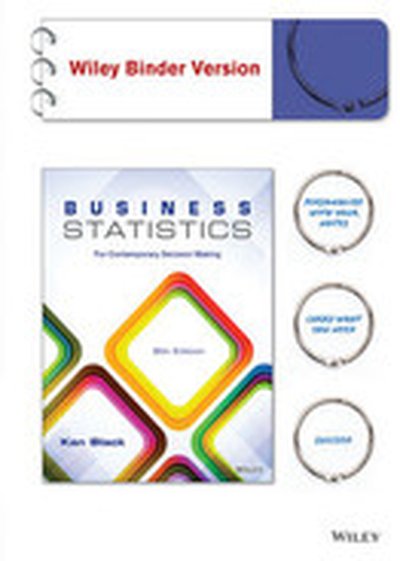
Business Statistics: For Contemporary Decision Making, 8th Edition

This text is an unbound, binder-ready edition. Business Statistics: For Contemporary Decision Making, 8th Edition continues the tradition of presenting and explaining the wonders of business statistics through the use of clear, complete, student-friendly pedagogy. Ken Black's text equips readers with the quantitative decision-making skills and analysis techniques you need to make smart decisions based on real-world data.

IBM SPSS Modeler Cookbook

"IBM SPSS Modeler Cookbook" is your practical guide to mastering data mining with IBM SPSS Modeler. This comprehensive book takes you beyond the basics, offering expert insights, time-saving techniques, and powerful workflows to grow your skills and elevate your analytical abilities. You will learn to apply the CRISP-DM methodology, efficiently prepare and explore data, build advanced models, and confidently incorporate analytical results into your business decisions. What this Book will help me do Effectively apply the CRISP-DM standard process to organize your data mining projects. Leverage efficient techniques for data extraction, transformation, and preparation. Develop and evaluate predictive models for practical applications in your organization. Enhance your models by utilizing advanced features and expert tips. Automate and streamline your data mining process with scripting for ultimate control. Author(s) Keith McCormick and None Abbott are seasoned data mining professionals with deep expertise in IBM SPSS Modeler and predictive analytics. Together, they have extensive experience in consulting, training, and applying advanced analytical techniques across industries. Through their approachable and insightful writing style, they share practical knowledge and expert workflows to empower readers. Who is it for? This book is designed for individuals who have basic experience with IBM SPSS Modeler and aspire to deepen their expertise. Whether you are a data analyst looking to advance your analytical capabilities or a professional aiming to integrate data-driven solutions into your organization, this book provides the knowledge and practical guidance you need to take the next step in your data mining journey.

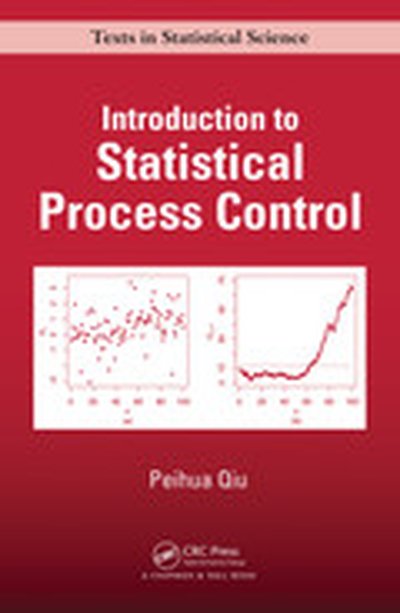
Introduction to Statistical Process Control

A major tool for quality control and management, statistical process control (SPC) monitors sequential processes, such as production lines and Internet traffic, to ensure that they work stably and satisfactorily. Along with covering traditional methods, Introduction to Statistical Process Control describes many recent SPC methods that improve upon the more established techniques. The author—a leading researcher on SPC—shows how these methods can handle new applications. After exploring the role of SPC and other statistical methods in quality control and management, the book covers basic statistical concepts and methods useful in SPC. It then systematically describes traditional SPC charts, including the Shewhart, CUSUM, and EWMA charts, as well as recent control charts based on change-point detection and fundamental multivariate SPC charts under the normality assumption. The text also introduces novel univariate and multivariate control charts for cases when the normality assumption is invalid and discusses control charts for profile monitoring. All computations in the examples are solved using R, with R functions and datasets available for download on the author’s website. Offering a systematic description of both traditional and newer SPC methods, this book is ideal as a primary textbook for a one-semester course in disciplines concerned with process quality control, such as statistics, industrial and systems engineering, and management sciences. It can also be used as a supplemental textbook for courses on quality improvement and system management. In addition, the book provides researchers with many useful, recent research results on SPC and gives quality control practitioners helpful guidelines on implementing up-to-date SPC techniques.

Risk Scoring for a Loan Application on IBM System z: Running IBM SPSS Real-Time Analytics

When ricocheting a solution that involves analytics, the mainframe might not be the first platform that comes to mind. However, the IBM® System z® group has developed some innovative solutions that include the well-respected mainframe benefits. This book describes a workshop that demonstrates the use of real-time advanced analytics for enhancing core banking decisions using a loan origination example. The workshop is a live hands-on experience of the entire process from analytics modeling to deployment of real-time scoring services for use on IBM z/OS®. In this IBM Redbooks® publication, we include a facilitator guide chapter as well as a participant guide chapter. The facilitator guide includes information about the preparation, such as the needed material, resources, and steps to set up and run this workshop. The participant guide shows step-by-step the tasks for a successful learning experience. The goal of the first hands-on exercise is to learn how to use IBM SPSS® Modeler for Analytics modeling. This provides the basis for the next exercise "Configuring risk assessment in SPSS Decision Management". In the third exercise, the participant experiences how real-time scoring can be implemented on a System z. This publication is written for consultants, IT architects, and IT administrators who want to become familiar with SPSS and analytics solutions on the System z.