talk-data.com talk-data.com

Event

O'Reilly Data Science Books

2013-08-09 – 2026-02-25 Oreilly Visit website ↗

Activities tracked

333

Collection of O'Reilly books on Data Science.

Filtering by: AI/ML ×

Sessions & talks

Showing 176–200 of 333 · Newest first

Search within this event →
Microsoft Power Apps Cookbook

Microsoft Power Apps Cookbook provides a comprehensive set of step-by-step recipes for creating efficient and customized business applications using Power Apps' low-code capabilities. Through this book, you'll gain practical skills to build apps that address real-world business needs with increased agility and speed. What this Book will help me do Create and integrate canvas apps effectively, enhancing collaborative solutions. Leverage Microsoft Dataverse to design robust, model-driven app solutions. Utilize automated workflows through Power Automate, including business process automations and RPAs. Incorporate advanced components such as AI Builder capabilities into your designed apps. Develop web experiences for users with Microsoft Power Pages, extending the reach beyond the organization. Author(s) Eickhel Mendoza is a seasoned expert in Microsoft Power Platform who has been involved in numerous enterprise projects utilizing Power Apps and related technologies. With extensive experience in low-code solutions, Eickhel is passionate about simplifying complex business processes and empowering readers to achieve business agility through practical application. He focuses on clear guidance and real-world applicability in this hands-on resource to enhance your learning experience. Who is it for? This book is suited for both citizen developers and business users who want to create tailored apps meeting specific organizational needs, and for traditional app developers interested in maximizing productivity with low-code development tools. Beginners in Power Apps with basic familiarity will find actionable knowledge to overcome challenges in real-world cases. Experienced professionals will appreciate the advanced techniques shared.
Predictive Analytics: Data Mining, Machine Learning and Data Science for Practitioners, 2nd Edition

Use Predictive Analytics to Uncover Hidden Patterns and Correlations and Improve Decision-Making Using predictive analytics techniques, decision-makers can uncover hidden patterns and correlations in their data and leverage these insights to improve many key business decisions. In this thoroughly updated guide, Dr. Dursun Delen illuminates state-of-the-art best practices for predictive analytics for both business professionals and students. Delen provides a holistic approach covering key data mining processes and methods, relevant data management techniques, tools and metrics, advanced text and web mining, big data integration, and much more. Balancing theory and practice, Delen presents intuitive conceptual illustrations, realistic example problems, and real-world case studiesincluding lessons from failed projects. It is all designed to help you gain a practical understanding you can apply for profit. * Leverage knowledge extracted via data mining to make smarter decisions * Use standardized processes and workflows to make more trustworthy predictions * Predict discrete outcomes (via classification), numeric values (via regression), and changes over time (via time-series forecasting) * Understand predictive algorithms drawn from traditional statistics and advanced machine learning * Discover cutting-edge techniques, and explore advanced applications ranging from sentiment analysis to fraud detection .

Exam Ref PL-900 Microsoft Power Platform Fundamentals

Prepare for Microsoft Exam PL-900: Demonstrate your real-world knowledge of the fundamentals of Microsoft Power Platform, including its business value, core components, and the capabilities and advantages of Power BI, Power Apps, Power Automate, and Power Virtual Agents. Designed for business users, functional consultants, and other professionals, this Exam Ref focuses on the critical thinking and decision-making acumen needed for success at the Microsoft Certified: Power Platform Fundamentals level. Focus on the expertise measured by these objectives: Describe the business value of Power Platform Identify the Core Components of Power Platform Demonstrate the capabilities of Power BI Demonstrate the capabilities of Power Apps Demonstrate the capabilities of Power Automate Demonstrate the capabilities of Power Virtual Agents This Microsoft Exam Ref: Organizes its coverage by exam objectives Features strategic, what-if scenarios to challenge you Assumes you are a business user, functional consultant, or other professional who wants to improve productivity by automating business processes, analyzing data, creating simple app experiences, or developing business enhancements to Microsoft cloud solutions. About the Exam Exam PL-900 focuses on knowledge needed to describe the value of Power Platform services and of extending solutions; describe Power Platform administration and security; describe Common Data Service, Connectors, and AI Builder; identify common Power BI components; connect to and consume data; build basic dashboards with Power BI; identify common Power Apps components; build basic canvas and model-driven apps; describe Power Apps portals; identify common Power Automate components; build basic flows; describe Power Virtual Agents capabilities; and build and publish basic chatbots. About Microsoft Certification Passing this exam fulfills your requirements for the Microsoft Certified: Power Platform Fundamentals certification, demonstrating your understanding of Power Platforms core capabilitiesfrom business value and core product capabilities to building simple apps, connecting data sources, automating basic business processes, creating dashboards, and creating chatbots. With this certification, you can move on to earn specialist certifications covering more advanced aspects of Power Apps and Power BI, including Microsoft Certified: Power Platform App Maker Associate and Power Platform Data Analyst Associate. See full details at: microsoft.com/learn

Exam Ref PL-900 Microsoft Power Platform Fundamentals

Prepare for Microsoft Exam PL-900: Demonstrate your real-world knowledge of the fundamentals of Microsoft Power Platform, including its business value, core components, and the capabilities and advantages of Power BI, Power Apps, Power Automate, and Power Virtual Agents. Designed for business users, functional consultants, and other professionals, this Exam Ref focuses on the critical thinking and decision-making acumen needed for success at the Microsoft Certified: Power Platform Fundamentals level. Focus on the expertise measured by these objectives: Describe the business value of Power Platform Identify the Core Components of Power Platform Demonstrate the capabilities of Power BI Demonstrate the capabilities of Power Apps Demonstrate the capabilities of Power Automate Demonstrate the capabilities of Power Virtual Agents This Microsoft Exam Ref: Organizes its coverage by exam objectives Features strategic, what-if scenarios to challenge you Assumes you are a business user, functional consultant, or other professional who wants to improve productivity by automating business processes, analyzing data, creating simple app experiences, or developing business enhancements to Microsoft cloud solutions. About the Exam Exam PL-900 focuses on knowledge needed to describe the value of Power Platform services and of extending solutions; describe Power Platform administration and security; describe Common Data Service, Connectors, and AI Builder; identify common Power BI components; connect to and consume data; build basic dashboards with Power BI; identify common Power Apps components; build basic canvas and model-driven apps; describe Power Apps portals; identify common Power Automate components; build basic flows; describe Power Virtual Agents capabilities; and build and publish basic chatbots. About Microsoft Certification Passing this exam fulfills your requirements for the Microsoft Certified: Power Platform Fundamentals certification, demonstrating your understanding of Power Platforms core capabilitiesfrom business value and core product capabilities to building simple apps, connecting data sources, automating basic business processes, creating dashboards, and creating chatbots. With this certification, you can move on to earn specialist certifications covering more advanced aspects of Power Apps and Power BI, including Microsoft Certified: Power Platform App Maker Associate and Power Platform Data Analyst Associate. See full details at: microsoft.com/learn

Information Theory Meets Power Laws

Discover new theoretical connections between stochastic phenomena and the structure of natural language with this powerful volume! Information Theory Meets Power Laws: Stochastic Processes and Language Models presents readers with a novel subtype of a probabilistic approach to language, which is based on statistical laws of texts and their analysis by means of information theory. The distinguished author insightfully and rigorously examines the linguistic and mathematical subject matter while eschewing needlessly abstract and superfluous constructions. The book begins with a less formal treatment of its subjects in the first chapter, introducing its concepts to readers without mathematical training and allowing those unfamiliar with linguistics to learn the book’s motivations. Despite its inherent complexity, Information Theory Meets Power Laws: Stochastic Processes and Language Models is a surprisingly approachable treatment of idealized mathematical models of human language. The author succeeds in developing some of the theory underlying fundamental stochastic and semantic phenomena, like strong nonergodicity, in a way that has not previously been seriously attempted. In doing so, he covers topics including: Zipf’s and Herdan’s laws for natural language Power laws for information, repetitions, and correlations Markov, finite-state,and Santa Fe processes Bayesian and frequentist interpretations of probability Ergodic decomposition, Kolmogorov complexity, and universal coding Theorems about facts and words Information measures for fields Rényi entropies, recurrence times, and subword complexity Asymptotically mean stationary processes Written primarily for mathematics graduate students and professionals interested in information theory or discrete stochastic processes, Information Theory Meets Power Laws: Stochastic Processes and Language Models also belongs on the bookshelves of doctoral students and researchers in artificial intelligence, computational and quantitative linguistics as well as physics of complex systems.

Applied Regression Modeling, 3rd Edition

Master the fundamentals of regression without learning calculus with this one-stop resource The newly and thoroughly revised 3rd Edition of Applied Regression Modeling delivers a concise but comprehensive treatment of the application of statistical regression analysis for those with little or no background in calculus. Accomplished instructor and author Dr. Iain Pardoe has reworked many of the more challenging topics, included learning outcomes and additional end-of-chapter exercises, and added coverage of several brand-new topics including multiple linear regression using matrices. The methods described in the text are clearly illustrated with multi-format datasets available on the book's supplementary website. In addition to a fulsome explanation of foundational regression techniques, the book introduces modeling extensions that illustrate advanced regression strategies, including model building, logistic regression, Poisson regression, discrete choice models, multilevel models, Bayesian modeling, and time series forecasting. Illustrations, graphs, and computer software output appear throughout the book to assist readers in understanding and retaining the more complex content. Applied Regression Modeling covers a wide variety of topics, like: Simple linear regression models, including the least squares criterion, how to evaluate model fit, and estimation/prediction Multiple linear regression, including testing regression parameters, checking model assumptions graphically, and testing model assumptions numerically Regression model building, including predictor and response variable transformations, qualitative predictors, and regression pitfalls Three fully described case studies, including one each on home prices, vehicle fuel efficiency, and pharmaceutical patches Perfect for students of any undergraduate statistics course in which regression analysis is a main focus, Applied Regression Modeling also belongs on the bookshelves of non-statistics graduate students, including MBAs, and for students of vocational, professional, and applied courses like data science and machine learning.

Leading with AI and Analytics: Build Your Data Science IQ to Drive Business Value

Lead your organization to become evidence-driven Data. It’s the benchmark that informs corporate projections, decision-making, and analysis. But, why do many organizations that see themselves as data-driven fail to thrive? In Leading with AI and Analytics, two renowned experts from the Kellogg School of Management show business leaders how to transform their organization to become evidence-driven, which leads to real, measurable changes that can help propel their companies to the top of their industries. The availability of unprecedented technology-enabled tools has made AI (Artificial Intelligence) an essential component of business analytics. But what’s often lacking are the leadership skills to integrate these technologies to achieve maximum value. Here, the authors provide a comprehensive game plan for developing that all-important human factor to get at the heart of data science: the ability to apply analytical thinking to real-world problems. Each of these tools and techniques comes to powerful life through a wealth of powerful case studies and real-world success stories. Inside, you’ll find the essential tools to help you: Written for anyone in a leadership or management role—from C-level/unit team managers to rising talent—this powerful, hands-on guide meets today’s growing need for real-world tools to lead and succeed with data. Develop a strong data science intuition quotient Lead and scale AI and analytics throughout your organization Move from “best-guess” decision making to evidence-based decisions Craft strategies and tactics to create real impact

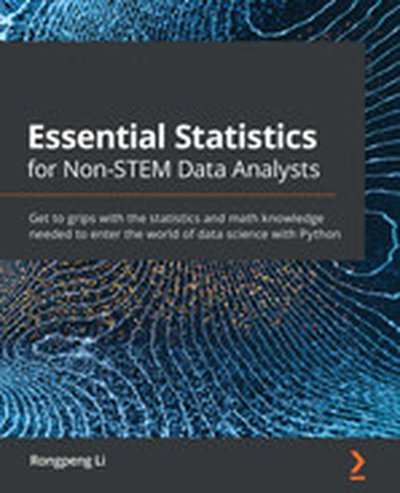
Essential Statistics for Non-STEM Data Analysts

Essential Statistics for Non-STEM Data Analysts is your comprehensive guide to mastering the statistical concepts needed for data science. By working through real-world datasets and Python-based examples, you'll learn how to interpret data and build insightful analyses. This book demystifies statistics, making it accessible to anyone aiming to become proficient in data analysis. What this Book will help me do Learn how to preprocess, clean, and prepare data for analysis using Python. Master the foundations of statistical methods such as hypothesis testing and probability theory. Develop skills to interpret and explain statistical results in the context of data science. Understand how statistical concepts apply to machine learning tasks like classification and regression. Build confidence in statistical principles to tackle interviews and enhance your career prospects. Author(s) None Li is an experienced data scientist and educator with a strong focus on making abstract statistical concepts intuitive and applicable. With a background in designing data science curriculums, None has a passion for teaching statistics to individuals from diverse and often non-mathematical backgrounds. Through clear explanations and practical examples, None aims to empower everyone to excel in data analysis and machine learning. Who is it for? This book caters specifically to data analysts, data science enthusiasts, and developers eager to enhance their statistical knowledge. It's crafted for readers transitioning into data science who may lack a strong mathematical or statistics background. If you have a basic grasp of Python programming and a keen interest in understanding how to work effectively with data, this book is a perfect fit. Beginners and students aiming to familiarize themselves with statistical foundations for data-oriented careers will greatly benefit from this resource.

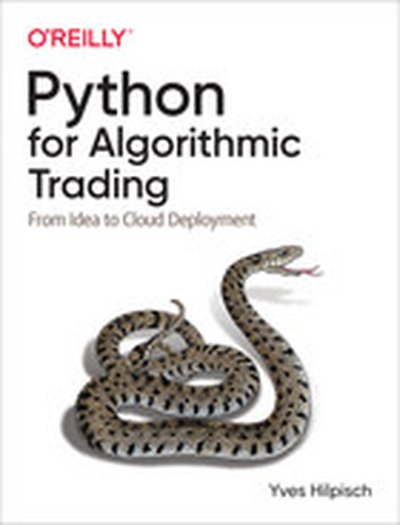
Python for Algorithmic Trading

Algorithmic trading, once the exclusive domain of institutional players, is now open to small organizations and individual traders using online platforms. The tool of choice for many traders today is Python and its ecosystem of powerful packages. In this practical book, author Yves Hilpisch shows students, academics, and practitioners how to use Python in the fascinating field of algorithmic trading. You'll learn several ways to apply Python to different aspects of algorithmic trading, such as backtesting trading strategies and interacting with online trading platforms. Some of the biggest buy- and sell-side institutions make heavy use of Python. By exploring options for systematically building and deploying automated algorithmic trading strategies, this book will help you level the playing field. Set up a proper Python environment for algorithmic trading Learn how to retrieve financial data from public and proprietary data sources Explore vectorization for financial analytics with NumPy and pandas Master vectorized backtesting of different algorithmic trading strategies Generate market predictions by using machine learning and deep learning Tackle real-time processing of streaming data with socket programming tools Implement automated algorithmic trading strategies with the OANDA and FXCM trading platforms

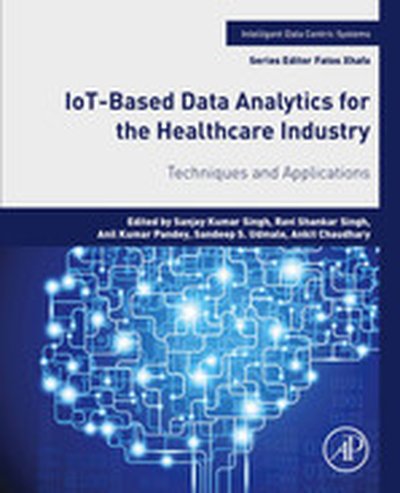
IoT-Based Data Analytics for the Healthcare Industry

IoT Based Data Analytics for the Healthcare Industry: Techniques and Applications explores recent advances in the analysis of healthcare industry data through IoT data analytics. The book covers the analysis of ubiquitous data generated by the healthcare industry, from a wide range of sources, including patients, doctors, hospitals, and health insurance companies. The book provides AI solutions and support for healthcare industry end-users who need to analyze and manipulate this vast amount of data. These solutions feature deep learning and a wide range of intelligent methods, including simulated annealing, tabu search, genetic algorithm, ant colony optimization, and particle swarm optimization. The book also explores challenges, opportunities, and future research directions, and discusses the data collection and pre-processing stages, challenges and issues in data collection, data handling, and data collection set-up. Healthcare industry data or streaming data generated by ubiquitous sensors cocooned into the IoT requires advanced analytics to transform data into information. With advances in computing power, communications, and techniques for data acquisition, the need for advanced data analytics is in high demand. Provides state-of-art methods and current trends in data analytics for the healthcare industry Addresses the top concerns in the healthcare industry using IoT and data analytics, and machine learning and deep learning techniques Discusses several potential AI techniques developed using IoT for the healthcare industry Explores challenges, opportunities, and future research directions, and discusses the data collection and pre-processing stages

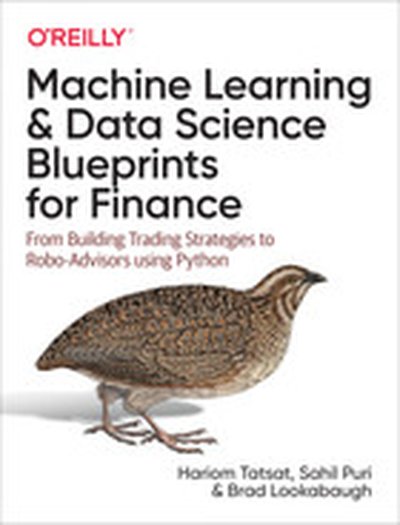
Machine Learning and Data Science Blueprints for Finance

Over the next few decades, machine learning and data science will transform the finance industry. With this practical book, analysts, traders, researchers, and developers will learn how to build machine learning algorithms crucial to the industry. You'll examine ML concepts and over 20 case studies in supervised, unsupervised, and reinforcement learning, along with natural language processing (NLP). Ideal for professionals working at hedge funds, investment and retail banks, and fintech firms, this book also delves deep into portfolio management, algorithmic trading, derivative pricing, fraud detection, asset price prediction, sentiment analysis, and chatbot development. You'll explore real-life problems faced by practitioners and learn scientifically sound solutions supported by code and examples. This book covers: Supervised learning regression-based models for trading strategies, derivative pricing, and portfolio management Supervised learning classification-based models for credit default risk prediction, fraud detection, and trading strategies Dimensionality reduction techniques with case studies in portfolio management, trading strategy, and yield curve construction Algorithms and clustering techniques for finding similar objects, with case studies in trading strategies and portfolio management Reinforcement learning models and techniques used for building trading strategies, derivatives hedging, and portfolio management NLP techniques using Python libraries such as NLTK and scikit-learn for transforming text into meaningful representations

Microsoft Power BI Quick Start Guide - Second Edition

"Microsoft Power BI Quick Start Guide" is your essential companion to mastering data visualization and analysis using Microsoft Power BI. This book offers step-by-step guidance on exploring data sources, creating effective dashboards, and leveraging advanced features like dataflows and AI insights to derive actionable intelligence quickly and effectively. What this Book will help me do Connect and import data from various sources using Power BI tools. Transform and cleanse data using the Power BI Query Editor and other techniques. Design optimized data models with relationships and DAX calculations. Create dynamic and visually compelling reports and dashboards. Implement row-level security and manage Power BI deployments within an organization. Author(s) Devin Knight, Erin Ostrowsky, and Mitchell Pearson are seasoned Power BI experts with extensive experience in business intelligence and data analytics. They bring a hands-on approach to teaching, focusing on practical skills and real-world applications. Their joint experience ensures a thorough and clear learning experience. Who is it for? This book is tailored for aspiring business intelligence professionals who wish to harness the power of Microsoft Power BI. If you have foundational knowledge of business intelligence concepts and are eager to apply them practically, this guide is for you. It's also ideal for individuals looking to upgrade their BI skill set and adopt modern data analysis tools. Whether a beginner or looking to enhance your current skills, you'll find tremendous value here.

The Big R-Book

Introduces professionals and scientists to statistics and machine learning using the programming language R Written by and for practitioners, this book provides an overall introduction to R, focusing on tools and methods commonly used in data science, and placing emphasis on practice and business use. It covers a wide range of topics in a single volume, including big data, databases, statistical machine learning, data wrangling, data visualization, and the reporting of results. The topics covered are all important for someone with a science/math background that is looking to quickly learn several practical technologies to enter or transition to the growing field of data science. The Big R-Book for Professionals: From Data Science to Learning Machines and Reporting with R includes nine parts, starting with an introduction to the subject and followed by an overview of R and elements of statistics. The third part revolves around data, while the fourth focuses on data wrangling. Part 5 teaches readers about exploring data. In Part 6 we learn to build models, Part 7 introduces the reader to the reality in companies, Part 8 covers reports and interactive applications and finally Part 9 introduces the reader to big data and performance computing. It also includes some helpful appendices. Provides a practical guide for non-experts with a focus on business users Contains a unique combination of topics including an introduction to R, machine learning, mathematical models, data wrangling, and reporting Uses a practical tone and integrates multiple topics in a coherent framework Demystifies the hype around machine learning and AI by enabling readers to understand the provided models and program them in R Shows readers how to visualize results in static and interactive reports Supplementary materials includes PDF slides based on the book’s content, as well as all the extracted R-code and is available to everyone on a Wiley Book Companion Site The Big R-Book is an excellent guide for science technology, engineering, or mathematics students who wish to make a successful transition from the academic world to the professional. It will also appeal to all young data scientists, quantitative analysts, and analytics professionals, as well as those who make mathematical models.

Advanced Analytics in Power BI with R and Python: Ingesting, Transforming, Visualizing

This easy-to-follow guide provides R and Python recipes to help you learn and apply the top languages in the field of data analytics to your work in Microsoft Power BI. Data analytics expert and author Ryan Wade shows you how to use R and Python to perform tasks that are extremely hard, if not impossible, to do using native Power BI tools. For example, you will learn to score Power BI data using custom data science models and powerful models from Microsoft Cognitive Services. The R and Python languages are powerful complements to Power BI. They enable advanced data transformation techniques that are difficult to perform in Power BI in its default configuration but become easier by leveraging the capabilities of R and Python. If you are a business analyst, data analyst, or a data scientist who wants to push Power BI and transform it from being just a business intelligence tool into an advanced data analytics tool, then this is the book to help you do that. What You Will Learn Create advanced data visualizations via R using the ggplot2 package Ingest data using R and Python to overcome some limitations of Power Query Apply machine learning models to your data using R and Python without the need of Power BI premium capacity Incorporate advanced AI in Power BI without the need of Power BI premium capacity via Microsoft Cognitive Services, IBM Watson Natural Language Understanding, and pre-trained models in SQL Server Machine Learning Services Perform advanced string manipulations not otherwise possible in Power BI using R and Python Who This Book Is For Power users, data analysts, and data scientists who want to go beyond Power BI’s built-in functionality to create advanced visualizations, transform data in ways not otherwise supported, and automate data ingestion from sources such as SQL Server and Excel in a more concise way

Big Data Meets Survey Science

O ffers a clear view of the utility and place for survey data within the broader Big Data ecosystem This book presents a collection of snapshots from two sides of the Big Data perspective. It assembles an array of tangible tools, methods, and approaches that illustrate how Big Data sources and methods are being used in the survey and social sciences to improve official statistics and estimates for human populations. It also provides examples of how survey data are being used to evaluate and improve the quality of insights derived from Big Data. Big Data Meets Survey Science: A Collection of Innovative Methods shows how survey data and Big Data are used together for the benefit of one or more sources of data, with numerous chapters providing consistent illustrations and examples of survey data enriching the evaluation of Big Data sources. Examples of how machine learning, data mining, and other data science techniques are inserted into virtually every stage of the survey lifecycle are presented. Topics covered include: Total Error Frameworks for Found Data; Performance and Sensitivities of Home Detection on Mobile Phone Data; Assessing Community Wellbeing Using Google Street View and Satellite Imagery; Using Surveys to Build and Assess RBS Religious Flag; and more. Presents groundbreaking survey methods being utilized today in the field of Big Data Explores how machine learning methods can be applied to the design, collection, and analysis of social science data Filled with examples and illustrations that show how survey data benefits Big Data evaluation Covers methods and applications used in combining Big Data with survey statistics Examines regulations as well as ethical and privacy issues Big Data Meets Survey Science: A Collection of Innovative Methods is an excellent book for both the survey and social science communities as they learn to capitalize on this new revolution. It will also appeal to the broader data and computer science communities looking for new areas of application for emerging methods and data sources.

Predictive Analytics for Healthcare

Before the onset of COVID-19, the healthcare community was already moving to meet the challenges of a growing global population. By collecting record amounts of clinical data electronically and making significant progress on neural network-based AI approaches, the industry now has the potential to build powerful predictive analytics systems. The focus will accelerate the shift from a one-size-fits-all approach to individualized medicine. But several questions remain. What are the plausible outcomes for the world of predictive analytics in both the short and long term? What does the care pathway look like if everything is predicted? And with patient populations and healthcare needs increasing exponentially, how can the industry deliver care in a sustainable and cost-effective way? This comprehensive report, written by Jaquie Finn and Dr. Gavin Troughton with Cambridge Consultants, explores the possibilities. You’ll learn: How predictive analytics plays a part across all stages of the care pathway The foundational enablers for predictive analytics How healthcare economics figure into the equation Predictive analytics and today’s healthcare system The future of predictive analytics in healthcare

Workflow Automation with Microsoft Power Automate

Discover how Microsoft Power Automate can transform business processes by enabling you to automate workflows with minimal coding. This book introduces the core concepts and practical applications of workflow automation using Power Automate, making it an essential guide for enhancing productivity and efficiency in digital processes. What this Book will help me do Gain foundational knowledge of Microsoft Power Automate and how its components work together. Build automation flows that integrate with popular Microsoft 365 and third-party applications. Create efficient workflows like automated email processes and file management systems. Learn to enhance workflows with features like approvals, conditions, and triggers. Understand the basics of robotic process automation and artificial intelligence applications. Author(s) Aaron Guilmette leverages his extensive experience with Microsoft 365 to provide practical, user-friendly guides to the platform's tools. His expertise in workflow optimization ensures that readers can efficiently implement the concepts discussed. Aaron's teaching style emphasizes clarity and accessibility, making complex topics understandable for readers of all levels. Who is it for? This book is for technologists, system administrators, and power users eager to learn Microsoft Power Automate from scratch or enhance their workflow capabilities. It is ideal for those familiar with Microsoft 365 looking to streamline business processes. The book aims to help readers achieve automation goals, from simple workflows to more complex solutions.

Self-Service AI with Power BI Desktop: Machine Learning Insights for Business

This book explains how you can enrich the data you have loaded into Power BI Desktop by accessing a suite of Artificial Intelligence (AI) features. These AI features are built into Power BI Desktop and help you to gain new insights from existing data. Some of the features are automated and are available to you at the click of a button or through writing Data Analysis Expressions (DAX). Other features are available through writing code in either the R, Python, or M languages. This book opens up the entire suite of AI features to you with clear examples showing when they are best applied and how to invoke them on your own datasets. No matter if you are a business user, analyst, or data scientist – Power BI has AI capabilities tailored to you. This book helps you learn what types of insights Power BI is capable of delivering automatically. You will learn how to integrate and leverage the use of the R and Python languages for statistics, how to integrate with Cognitive Services andAzure Machine Learning Services when loading data, how to explore your data by asking questions in plain English ... and more! There are AI features for discovering your data, characterizing unexplored datasets, and building what-if scenarios. There’s much to like and learn from this book whether you are a newcomer to Power BI or a seasoned user. Power BI Desktop is a freely available tool for visualization and analysis. This book helps you to get the most from that tool by exploiting some of its latest and most advanced features. What You Will Learn Ask questions in natural language and get answers from your data Let Power BI explain why a certain data point differs from the rest Have Power BI show key influencers over categories of data Access artificial intelligence features available in the Azure cloud Walk the same drill down path in different parts of your hierarchy Load visualizations to add smartness to your reports Simulate changes in data and immediately see the consequences Know your data, even before you build your first report Create new columns by giving examples of the data that you need Transform and visualize your data with the help of R and Python scripts Who This Book Is For For the enthusiastic Power BI user who wants to apply state-of-the-art artificial intelligence (AI) features to gain new insights from existing data. For end-users and IT professionals who are not shy of jumping into a new world of machine learning and are ready to make that step and take a deeper look into their data. For those wanting to step up their game from doing simple reporting and visualizations by making the move into diagnostic and predictive analysis.

The Data Science Workshop - Second Edition

The Data Science Workshop provides a comprehensive introduction to building real-world data science projects. Through a hands-on approach, you will learn how to analyze data, build machine learning models, and deploy them effectively in various scenarios. This book is designed to equip you with the skills to confidently tackle data science challenges. What this Book will help me do Understand the differences between supervised and unsupervised learning to select the appropriate technique. Master data manipulation and analysis using popular Python libraries like pandas and scikit-learn. Develop skills in regression, classification, and clustering to solve diverse data science problems. Learn advanced methods to improve model accuracy, including hyperparameter tuning and feature engineering. Implement and deploy machine learning models efficiently in production workflows. Author(s) The authors of The Data Science Workshop are experienced professionals and educators in the field of data science and machine learning. They have extensive expertise in using practical methods to solve data challenges and have a passion for teaching others through engaging and clear instructional material. Who is it for? This book is ideal for aspiring data analysts, data scientists, and business analysts who wish to build foundational skills in data science. It caters to those new to the field and professionals transitioning to a data-centric role, providing practical knowledge without requiring an advanced mathematical background. Familiarity with Python is recommended.

Smart Data Discovery Using SAS Viya

Whether you are an executive, departmental decision maker, or analyst, the need to leverage data and analytical techniques in order make critical business decisions is now crucial to every part of an organization. Gain Powerful Insights with SAS Viya! Smart Data Discovery with SAS Viya: Powerful Techniques for Deeper Insights provides you with the necessary knowledge and skills to conduct a smart discovery process and empower you to ask more complex questions using your data. The book highlights key components of a smart data discovery process utilizing advanced machine learning techniques, powerful capabilities from SAS Viya, and finally brings it all together using real examples and applications. With its step-by-step approach and integrated examples, the book provides a relevant and practical guide to insight discovery that goes beyond traditional charts and graphs. By showcasing the powerful visual modeling capabilities of SAS Viya, it also opens up the world of advanced analytics and machine learning techniques to a much broader set of audiences.

The Applied Data Science Workshop - Second Edition

Embark on an interactive journey into the world of data science with 'The Applied Data Science Workshop'. By following real-world scenarios and hands-on exercises, you will explore the fundamentals of data analysis and machine learning modeling within Jupyter Notebooks, leveraging Python libraries like pandas and sci-kit learn to draw meaningful insights from data. What this Book will help me do Master the process of setting up and using Jupyter Notebooks effectively for data science tasks. Learn to preprocess, analyze, and visualize data using Python libraries such as pandas, Matplotlib, and Seaborn. Discover methods to train and evaluate machine learning models using real-world data scenarios. Apply techniques to assess model performance and optimize them with advanced validation. Gain the skills to communicate insights through well-documented analyses and stakeholder-ready reports. Author(s) None Galea, an accomplished author in the data science domain, focuses on making technical concepts understandable and relatable. With this book, Galea leverages years of experience to introduce readers to practical applications of data science using Python. The author's approach ensures that readers not only learn the concepts but also apply them hands-on. Who is it for? This book caters to aspiring data scientists and developers interested in data analysis and practical applications of data science techniques. Beginners will find the step-by-step methodology approachable, while those with a basic understanding of Python programming or machine learning can quickly extend their skills. It suits anyone eager to apply data science in their professional toolbox.

Building Analytics Teams

In "Building Analytics Teams," author John K. Thompson draws from over three decades of experience in analytics and management to guide you through creating an impactful analytics team. The book emphasizes key strategies for hiring, managing, and leading analytics experts to drive business improvements and achieve organizational success. What this Book will help me do Develop the skills to build and lead high-performing analytics and AI teams. Gain insights into selecting impactful projects that drive measurable business outcomes. Understand how to cultivate successful collaborations with cross-functional business teams. Learn techniques to effectively communicate analytics-driven strategies to executives. Master strategies to navigate organizational and technological challenges in data initiatives. Author(s) John K. Thompson is a seasoned analytics and AI practitioner with over 30 years of experience leading data-driven transformations for dynamic organizations. Renowned for his strategic and pragmatic approach, John crafts hands-on methodologies to unlock the potential of analytics teams. His passion for mentoring fuels his engaging and insightful writing style. Who is it for? This book is ideal for senior executives and managers aiming to harness analytics and AI to transform their organizations. It's also tailored for analytics professionals who want to elevate their team's operational success. No matter your current experience, you'll find strategies to optimize your analytics initiatives and deliver impactful results.

End-to-End Data Science with SAS

Learn data science concepts with real-world examples in SAS! End-to-End Data Science with SAS: A Hands-On Programming Guide provides clear and practical explanations of the data science environment, machine learning techniques, and the SAS programming knowledge necessary to develop machine learning models in any industry. The book covers concepts including understanding the business need, creating a modeling data set, linear regression, parametric classification models, and non-parametric classification models. Real-world business examples and example code are used to demonstrate each process step-by-step. Although a significant amount of background information and supporting mathematics are presented, the book is not structured as a textbook, but rather it is a user’s guide for the application of data science and machine learning in a business environment. Readers will learn how to think like a data scientist, wrangle messy data, choose a model, and evaluate the model’s effectiveness. New data scientists or professionals who want more experience with SAS will find this book to be an invaluable reference. Take your data science career to the next level by mastering SAS programming for machine learning models.

Smarter Data Science

Organizations can make data science a repeatable, predictable tool, which business professionals use to get more value from their data Enterprise data and AI projects are often scattershot, underbaked, siloed, and not adaptable to predictable business changes. As a result, the vast majority fail. These expensive quagmires can be avoided, and this book explains precisely how. Data science is emerging as a hands-on tool for not just data scientists, but business professionals as well. Managers, directors, IT leaders, and analysts must expand their use of data science capabilities for the organization to stay competitive. Smarter Data Science helps them achieve their enterprise-grade data projects and AI goals. It serves as a guide to building a robust and comprehensive information architecture program that enables sustainable and scalable AI deployments. When an organization manages its data effectively, its data science program becomes a fully scalable function that’s both prescriptive and repeatable. With an understanding of data science principles, practitioners are also empowered to lead their organizations in establishing and deploying viable AI. They employ the tools of machine learning, deep learning, and AI to extract greater value from data for the benefit of the enterprise. By following a ladder framework that promotes prescriptive capabilities, organizations can make data science accessible to a range of team members, democratizing data science throughout the organization. Companies that collect, organize, and analyze data can move forward to additional data science achievements: Improving time-to-value with infused AI models for common use cases Optimizing knowledge work and business processes Utilizing AI-based business intelligence and data visualization Establishing a data topology to support general or highly specialized needs Successfully completing AI projects in a predictable manner Coordinating the use of AI from any compute node. From inner edges to outer edges: cloud, fog, and mist computing When they climb the ladder presented in this book, businesspeople and data scientists alike will be able to improve and foster repeatable capabilities. They will have the knowledge to maximize their AI and data assets for the benefit of their organizations.

Machine Learning with SAS Viya

Master machine learning with SAS Viya! Machine learning can feel intimidating for new practitioners. Machine Learning with SAS Viya provides everything you need to know to get started with machine learning in SAS Viya, including decision trees, neural networks, and support vector machines. The analytics life cycle is covered from data preparation and discovery to deployment. Working with open-source code? Machine Learning with SAS Viya has you covered – step-by-step instructions are given on how to use SAS Model Manager tools with open source. SAS Model Studio features are highlighted to show how to carry out machine learning in SAS Viya. Demonstrations, practice tasks, and quizzes are included to help sharpen your skills. In this book, you will learn about: Supervised and unsupervised machine learning Data preparation and dealing with missing and unstructured data Model building and selection Improving and optimizing models Model deployment and monitoring performance