talk-data.com talk-data.com

Topic

data-science-tasks

849

tagged

Activity Trend

1 peak/qtr
2020-Q1 2026-Q1

Activities

849 activities · Newest first

Tableau 10 Complete Reference

Explore and understand data with the powerful data visualization techniques of Tableau, and then communicate insights in powerful ways Key Features Apply best practices in data visualization and chart types exploration Explore the latest version of Tableau Desktop with hands-on examples Understand the fundamentals of Tableau storytelling Book Description Graphical presentation of data enables us to easily understand complex data sets. Tableau 10 Complete Reference provides easy-to-follow recipes with several use cases and real-world business scenarios to get you up and running with Tableau 10. This Learning Path begins with the history of data visualization and its importance in today's businesses. You'll also be introduced to Tableau - how to connect, clean, and analyze data in this visual analytics software. Then, you'll learn how to apply what you've learned by creating some simple calculations in Tableau and using Table Calculations to help drive greater analysis from your data. Next, you'll explore different advanced chart types in Tableau. These chart types require you to have some understanding of the Tableau interface and understand basic calculations. You'll study in detail all dashboard techniques and best practices. A number of recipes specifically for geospatial visualization, analytics, and data preparation are also covered. Last but not least, you'll learn about the power of storytelling through the creation of interactive dashboards in Tableau. Through this Learning Path, you will gain confidence and competence to analyze and communicate data and insights more efficiently and effectively by creating compelling interactive charts, dashboards, and stories in Tableau. This Learning Path includes content from the following Packt products: Learning Tableau 10 - Second Edition by Joshua N. Milligan Getting Started with Tableau 2018.x by Tristan Guillevin What you will learn Build effective visualizations, dashboards, and story points Build basic to more advanced charts with step-by-step recipes Become familiar row-level, aggregate, and table calculations Dig deep into data with clustering and distribution models Prepare and transform data for analysis Leverage Tableau's mapping capabilities to visualize data Use data storytelling techniques to aid decision making strategy Who this book is for Tableau 10 Complete Reference is designed for anyone who wants to understand their data better and represent it in an effective manner. It is also used for BI professionals and data analysts who want to do better at their jobs. Downloading the example code for this book You can download the example code files for all Packt books you have purchased from your account at http://www.PacktPub.com. If you purchased this book elsewhere, you can visit http://www.PacktPub.com/support and register to have the files e-mailed directly to you.
Linear Models and Time-Series Analysis

A comprehensive and timely edition on an emerging new trend in time series Linear Models and Time-Series Analysis: Regression, ANOVA, ARMA and GARCH sets a strong foundation, in terms of distribution theory, for the linear model (regression and ANOVA), univariate time series analysis (ARMAX and GARCH), and some multivariate models associated primarily with modeling financial asset returns (copula-based structures and the discrete mixed normal and Laplace). It builds on the author's previous book, Fundamental Statistical Inference: A Computational Approach, which introduced the major concepts of statistical inference. Attention is explicitly paid to application and numeric computation, with examples of Matlab code throughout. The code offers a framework for discussion and illustration of numerics, and shows the mapping from theory to computation. The topic of time series analysis is on firm footing, with numerous textbooks and research journals dedicated to it. With respect to the subject/technology, many chapters in Linear Models and Time-Series Analysis cover firmly entrenched topics (regression and ARMA). Several others are dedicated to very modern methods, as used in empirical finance, asset pricing, risk management, and portfolio optimization, in order to address the severe change in performance of many pension funds, and changes in how fund managers work. Covers traditional time series analysis with new guidelines Provides access to cutting edge topics that are at the forefront of financial econometrics and industry Includes latest developments and topics such as financial returns data, notably also in a multivariate context Written by a leading expert in time series analysis Extensively classroom tested Includes a tutorial on SAS Supplemented with a companion website containing numerous Matlab programs Solutions to most exercises are provided in the book Linear Models and Time-Series Analysis: Regression, ANOVA, ARMA and GARCH is suitable for advanced masters students in statistics and quantitative finance, as well as doctoral students in economics and finance. It is also useful for quantitative financial practitioners in large financial institutions and smaller finance outlets.

Mastering Matplotlib 2.x

Mastering Matplotlib 2.x guides you through the art and science of creating sophisticated data visualizations with Python's powerful Matplotlib library. You will start by learning the basics of plotting and customizing your charts, progressing to more advanced topics such as 3D visualization, geospatial data display, and creating interactive plots using Jupyter Notebook. What this Book will help me do Create complex and highly customizable data plots using Matplotlib. Effectively visualize data in three dimensions, including geospatial data. Use advanced matplotlib features to represent non-Cartesian and vector data. Build interactive visualizations using Jupyter Notebook and Python. Develop special-purpose and movie-style plots to enhance data representation. Author(s) None Keller is a seasoned software engineer and data visualization enthusiast with years of experience using Python for data analysis. Their practical and hands-on approach ensures that readers can directly apply the concepts taught in their projects. None aims to make advanced visualization techniques accessible to all. Who is it for? This book is perfect for developers, scientists, and analysts who need sophisticated visualization tools for their projects. Prior experience with Python and basic familiarity with Matplotlib will help you get the most out of the book. If you're looking to deepen your understanding of data visualization or to create interactive and advanced visualizations, this book is for you.

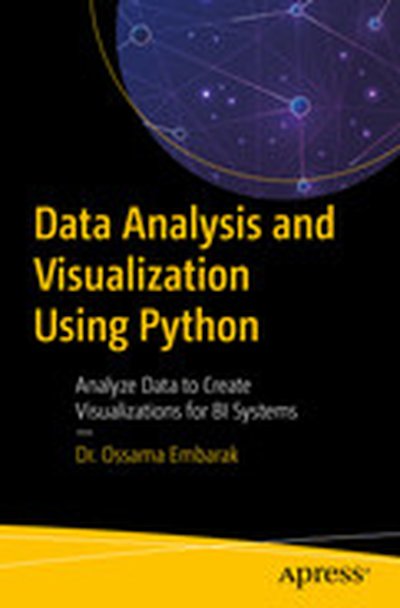
Data Analysis and Visualization Using Python: Analyze Data to Create Visualizations for BI Systems

Look at Python from a data science point of view and learn proven techniques for data visualization as used in making critical business decisions. Starting with an introduction to data science with Python, you will take a closer look at the Python environment and get acquainted with editors such as Jupyter Notebook and Spyder. After going through a primer on Python programming, you will grasp fundamental Python programming techniques used in data science. Moving on to data visualization, you will see how it caters to modern business needs and forms a key factor in decision-making. You will also take a look at some popular data visualization libraries in Python. Shifting focus to data structures, you will learn the various aspects of data structures from a data science perspective. You will then work with file I/O and regular expressions in Python, followed by gathering and cleaning data. Moving on to exploring and analyzing data, you will look at advanced data structures in Python. Then, you will take a deep dive into data visualization techniques, going through a number of plotting systems in Python. In conclusion, you will complete a detailed case study, where you’ll get a chance to revisit the concepts you’ve covered so far. What You Will Learn Use Python programming techniques for data science Master data collections in Python Create engaging visualizations for BI systems Deploy effective strategies for gathering and cleaning data Integrate the Seaborn and Matplotlib plotting systems Who This Book Is For Developers with basic Python programming knowledge looking to adopt key strategies for data analysis and visualizations using Python.

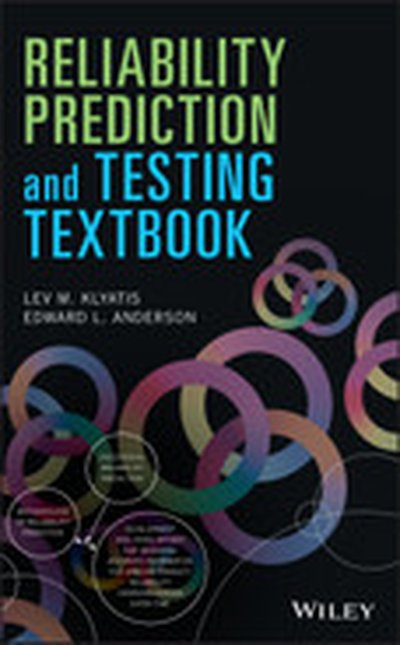
Reliability Prediction and Testing Textbook

This textbook reviews the methodologies of reliability prediction as currently used in industries such as electronics, automotive, aircraft, aerospace, off-highway, farm machinery, and others. It then discusses why these are not successful; and, presents methods developed by the authors for obtaining accurate information for successful prediction. The approach is founded on approaches that accurately duplicate the real world use of the product. Their approach is based on two fundamental components needed for successful reliability prediction; first, the methodology necessary; and, second, use of accelerated reliability and durability testing as a source of the necessary data. Applicable to all areas of engineering, this textbook details the newest techniques and tools to achieve successful reliabilityprediction and testing. It demonstrates practical examples of the implementation of the approaches described. This book is a tool for engineers, managers, researchers, in industry, teachers, and students. The reader will learn the importance of the interactions of the influencing factors and the interconnections of safety and human factors in product prediction and testing.

R Web Scraping Quick Start Guide

Discover the essentials of web scraping with R through this comprehensive guide. In this book, you will learn powerful techniques to extract valuable data from websites using the R programming language and tools like rvest and RSelenium. By understanding how to write efficient scripts, you will gain the ability to automate data collection and analysis for your projects. What this Book will help me do Understand the fundamentals of web scraping and its applications. Master the use of rvest for extracting data from static websites. Learn advanced techniques for dynamic websites using RSelenium. Write effective RegEx and XPath rules to enhance data extraction. Store, manage, and visualize the scraped data efficiently. Author(s) None Aydin is an experienced data analyst and R programmer with a deep passion for data manipulation and analysis. With years of firsthand expertise in utilizing R for various data-related tasks, Aydin brings a practical and methodological approach to teaching complex concepts. His clear instruction style ensures that readers quickly grasp and apply the techniques taught in this book. Who is it for? This book is ideal for R programmers seeking to expand their skills by delving into web scraping techniques. Whether you are a beginner with a basic knowledge of R or a data analyst exploring new ways to extract and utilize data, this guide is tailored for you. It suits readers who aspire to automate data collection and expand their analytical capabilities.

Matplotlib 3.0 Cookbook

Matplotlib 3.0 Cookbook is your go-to guide for mastering the Matplotlib library in Python for creating a wide range of data visualizations. Through 150+ practical recipes, you will learn how to design intuitive and detailed charts, graphs, and dashboards, navigating from simple plots to advanced interactive and 3D visualizations. What this Book will help me do Develop professional-quality data visualizations using Matplotlib. Leverage Matplotlib's API for both quick plotting and advanced customization. Create interactive and animative plots for engaging data representation. Extend Matplotlib functionalities with toolkits like cartopy and axisartist. Integrate Matplotlib figures into GUI applications for broader usage. Author(s) None Poladi and None Borkar are experienced Python developers and enthusiasts who have collaborated in creating a resourceful guide to Matplotlib. They bring extensive experience in data science visualization and Python programming. Their collaborative effort ensures clarity and an approachable learning curve for anyone delving into graphical data representation using Matplotlib. Who is it for? This book is ideal for data scientists, Python developers, and visualization enthusiasts eager to enhance their technical plotting skills. The content covers both fundamentals and advanced topics, suitable for users ranging from beginners curious about Python visualization to experts seeking streamlined workflows and advanced techniques.

Continuous Time Dynamical Systems

This book presents the developments in problems of state estimation and optimal control of continuous-time dynamical systems using orthogonal functions since 1975. It deals with both full and reduced-order state estimation and problems of linear time-invariant systems. It also addresses optimal control problems of varieties of continuous-time systems such as linear and nonlinear systems, time-invariant and time-varying systems, as well as delay-free and time-delay systems. Content focuses on development of recursive algorithms for studying state estimation and optimal control problems.

Douglas Montgomery's Introduction to Statistical Quality Control

Master Statistical Quality Control using JMP ! Using examples from the popular textbook by Douglas Montgomery, Introduction to Statistical Quality Control: A JMP Companion demonstrates the powerful Statistical Quality Control (SQC) tools found in JMP. Geared toward students and practitioners of SQC who are using these techniques to monitor and improve products and processes, this companion provides step-by-step instructions on how to use JMP to generate the output and solutions found in Montgomery’s book. The authors combine their many years of experience as passionate practitioners of SQC and their expertise using JMP to highlight the recent advances in JMP’s Analyze menu, and in particular, Quality and Process. Key JMP platforms include: Control Chart Builder CUSUM Control Chart Control Chart (XBar, IR, P, NP, C, U, UWMA, EWMA, CUSUM) Process Screening Process Capability Measurement System Analysis Time Series Multivariate Control Chart Multivariate and Principal Components Distribution For anyone who wants to learn how to use JMP to more easily explore data using tools associated with Statistical Process Control, Process Capability Analysis, Measurement System Analysis, Advanced Statistical Process Control, and Process Health Assessment, this book is a must!

Applied Data Visualization with R and ggplot2

Applied Data Visualization with R and ggplot2 introduces the crucial concepts of creating compelling data visualizations using R's powerful ggplot2 library in a straightforward and efficient manner. Through engaging explanations and practical exercises, you'll learn to set up your R environment, understand the components of the grammar of graphics, and design visualizations that bring your data to life. What this Book will help me do Master the setup of RStudio and the application of ggplot2's core structure. Harness the grammar of graphics to create meaningful data visualizations. Design visually appealing and informative custom plots with various ggplot2 features. Understand and apply advanced visualization techniques such as density plots and facet plotting. Develop the ability to communicate insights effectively through data visualizations. Author(s) Dr. Tania Moulik is a respected data visualization practitioner and educator, with years of experience using R and ggplot2. She channels her passion for teaching to enable data professionals to enhance their practice through improved visualizations. Dr. Moulik's clear and systematic approach ensures that learners at any level can unlock the potential of their data with ease. Who is it for? This book is ideal for data professionals looking to enhance their visualization skills with R and ggplot2. If you're a student aiming to delve deeper into data analysis using advanced plotting techniques, this book was written for you. It assumes a foundational knowledge of R programming, but is accessible whether you're building your skills or honing your craft. This book aligns perfectly with anyone driven to transform data into actionable insights and compelling visual narratives.

Getting Started with Tableau 2018.x

Dive into the world of data visualization with "Getting Started with Tableau 2018.x." This comprehensive guide introduces you to both the fundamental and advanced functionalities of Tableau 2018.x, making it easier to create impactful data visualizations. Learn to unlock Tableau's full potential through practical examples and clear explanations. What this Book will help me do Understand the new Tableau 2018.x features like density, extensions, and transparency and how to leverage them. Learn how to connect to data sources, perform transformations, and build efficient data models to support your analysis. Master visualization techniques to design effective and insightful dashboards tailored to business needs. Explore advanced concepts such as calculations, cross-database joins, and data blending to handle complex scenarios. Develop the confidence to publish and interact with content on Tableau Server and share your insights effectively. Author(s) None Guillevin and None Pires are data visualization experts with extensive experience using Tableau. They aim to make data analysis accessible through hands-on examples and easy-to-follow explanations. Their writing balances clear instruction with practical application, making advanced concepts understandable for all readers. Who is it for? This book is ideal for beginners or experienced BI professionals who wish to gain expertise in Tableau 2018.x. It caters to aspiring analysts and business professionals looking to answer complex business-specific questions through data visualization. Regardless of prior experience in Tableau or other BI tools, this book provides value through a structured learning approach.

D3.js Quick Start Guide

D3.js Quick Start Guide is your go-to resource for mastering D3.js, a powerful JavaScript library for creating interactive visualizations in the browser. This book walks you through core concepts, from building scatter plots to creating force-directed graphs, helping you go from beginner to creating stunning visual data representations. What this Book will help me do Create interactive scatter plots showcasing data relationships. Implement bar graphs that dynamically update from API data. Design animated pie charts for visually appealing representations. Develop force-directed graphs to represent networked data. Leverage GeoJSON data for building informative interactive maps. Author(s) None Huntington is an experienced web developer with a clear knack for turning complex topics into understandable concepts. With expertise in data visualization and web technologies, Huntington explains technical subject matter in a friendly and approachable manner, ensuring learners grasp both theoretical and practical aspects effectively. Who is it for? This book is ideal for web developers and data enthusiasts eager to learn how to represent data via interactive visualizations using D3.js. If you have a basic understanding of JavaScript and are looking to enhance your web development skillset with dynamic visualization techniques, this guide is perfect for you. Through easy-to-follow examples, you'll get up to speed quickly and start building professional-looking visualizations right away. Whether you're a data scientist, interactive news developer, or just interested in bringing data to life, this book is your key to mastering D3.js.

Web Application Development with R Using Shiny - Third Edition

Transform your R programming into interactive web applications with "Web Application Development with R Using Shiny." This book takes you step-by-step through creating dynamic user interfaces and web solutions with the R Shiny package, empowering you to build impactful tools that showcase your data. What this Book will help me do Create interactive web applications using R Shiny. Apply JavaScript for added functionality and customization in Shiny apps. Effortlessly deploy Shiny apps online for accessibility. Understand Shiny UI functions to design effective user interfaces. Leverage data visualization techniques for insightful analytics in apps. Author(s) Chris Beeley and Shitalkumar R. Sukhdeve bring their profound expertise in R programming and Shiny development to this book. Chris is an experienced data scientist passionate about interactive data solutions, while Shitalkumar, with a strong computing background, shares his hands-on insights. Their collaborative and tutorial approach ensures learners grasp each concept smoothly. Who is it for? This book is ideal for R programmers eager to transition from static data evaluation to engaging, interactive web applications. It caters to professionals and enthusiasts seeking practical, hands-on coding guidance. Readers should have foundational R programming knowledge, ensuring a smooth transition into Shiny concepts.

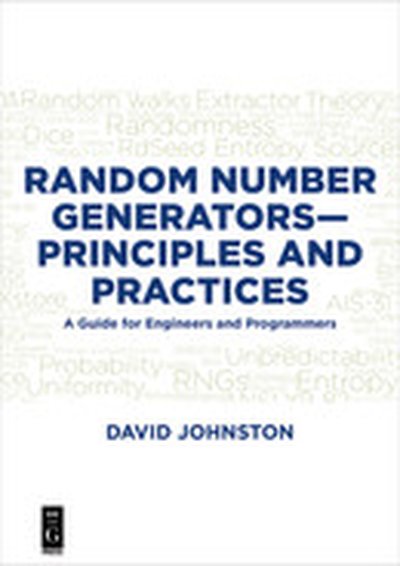
Random Number Generators—Principles and Practices

Random Number Generators, Principles and Practices has been written for programmers, hardware engineers, and sophisticated hobbyists interested in understanding random numbers generators and gaining the tools necessary to work with random number generators with confidence and knowledge. Using an approach that employs clear diagrams and running code examples rather than excessive mathematics, random number related topics such as entropy estimation, entropy extraction, entropy sources, PRNGs, randomness testing, distribution generation, and many others are exposed and demystified. If you have ever Wondered how to test if data is really random Needed to measure the randomness of data in real time as it is generated Wondered how to get randomness into your programs Wondered whether or not a random number generator is trustworthy Wanted to be able to choose between random number generator solutions Needed to turn uniform random data into a different distribution Needed to ensure the random numbers from your computer will work for your cryptographic application Wanted to combine more than one random number generator to increase reliability or security Wanted to get random numbers in a floating point format Needed to verify that a random number generator meets the requirements of a published standard like SP800-90 or AIS 31 Needed to choose between an LCG, PCG or XorShift algorithm Then this might be the book for you.

Displaying Time Series, Spatial, and Space-Time Data with R, 2nd Edition

This book will provide methods to display space-time data using R. The code of each method will be detailed and commented through practical examples with real data. The second edition will discuss new interactive R packages and Add introductory sections with easier examples to show the basics of the most important packages and functions.

Nonlinear Digital Filtering with Python

This book discusses important structural filter classes including the median filter and a number of its extensions (e.g., weighted and recursive median filters), and Volterra filters based on polynomial nonlinearities. Using results from algebra and the theory of functional equations to construct and characterize behaviorally defined nonlinear filter classes, the text first introduces Python programming, and then proposes practical, bottom-up strategies for designing more complex and capable filters from simpler components in a way that preserves the key properties of these components.

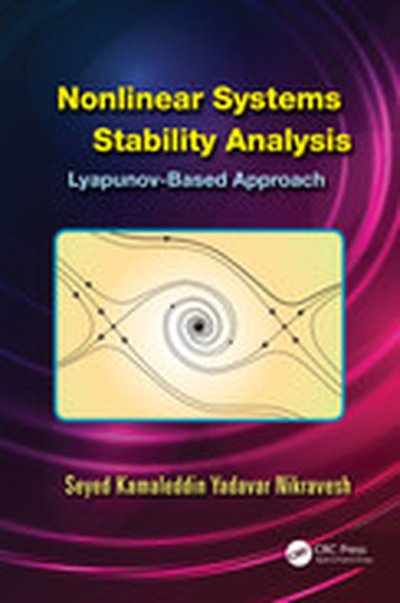
Nonlinear Systems Stability Analysis

Using a Lyapunov-based approach, this book introduces advanced tools for the stability analysis of nonlinear systems. It first discusses standard stability techniques and their shortcomings and then introduces recent developments in stability analysis that can improve the applicability of standard techniques. Finally, the book proposes the stability analysis of special classes of nonlinear systems. Coverage includes the stability of ordinary time-invariant differential equations and time-invariant systems as well as the stability analysis of time-delayed systems and fuzzy linguistic systems models.

Hands-On Dashboard Development with Shiny

"Hands-On Dashboard Development with Shiny" provides a focused and practical guide for developing polished and professional dashboards using R and the Shiny framework. Through applied examples, you'll explore techniques in HTML, CSS, and Bootstrap to elevate your Shiny apps' interface and functionality. The book ensures a comprehensive learning experience by focusing on creating custom interfaces and layouts. What this Book will help me do Create Shiny interfaces using pure HTML to achieve full customization Enhance your R Shiny dashboards with powerful layout functions for professional designs Utilize Bootstrap themes in Shiny for consistent and aesthetically pleasing interfaces Generate interactive dashboards complete with icons and notification elements Develop and distribute R Markdown reports directly from Shiny applications Author(s) Chris Beeley is an experienced data scientist and a frequent R Shiny practitioner. With years of experience building Shiny applications and working on data visualization in professional settings, Chris brings practical and precise teaching to this book. He is passionate about making knowledge accessible and guiding learners through hands-on and engaging content. Who is it for? This book is ideally suited for developers and data analysts who have prior experience with Shiny and wish to delve deeper into customizing their applications' design. If you want to extend your Shiny apps using HTML, CSS, and layouts via Bootstrap, this book is perfect for you. It equips you with the skills to build advanced dashboards efficiently. Whether you're looking to create more visually appealing apps or enhance your UI skills, this resource caters to your needs.