talk-data.com talk-data.com

Topic

data

5765

tagged

Activity Trend

3 peak/qtr
2020-Q1 2026-Q1

Activities

5765 activities · Newest first

The Data Warehouse Lifecycle Toolkit

The world of data warehousing has changed remarkably since the first edition of The Data Warehouse Lifecycle Toolkit was published in 1998. With this new edition, Ralph Kimball and his colleagues have refined the original set of Lifecycle methods and techniques based on their consulting and training experience. They walk you through the detailed steps of designing, developing, and deploying a data warehousing/business intelligence system. With substantial new and updated content, this second edition again sets the standard in data warehousing for the next decade.

Oracle Database 11g DBA Handbook

The Essential Resource for Oracle DBAs--Fully Updated and Expanded Manage a flexible, highly available Oracle database with help from the expert information contained in this exclusive Oracle Press guide. Fully revised to cover every new feature and utility, Oracle Database 11g DBA Handbook shows how to perform a new installation, upgrade from previous versions, configure hardware and software for maximum efficiency, and employ bulletproof security. You will learn to automate the backup and recovery process, provide transparent failover capability, audit and tune performance, and distribute your enterprise databases with Oracle Net. Plan and deploy permanent, temporary, and bigfile tablespaces Optimize disk allocation, CPU usage, I/O throughput, and SQL queries Develop powerful database management applications Guard against human errors using Oracle Flashback and Oracle Automatic Undo Management Diagnose and tune system performance using Oracle Automatic Workload Repository and SQL Tuning Sets Implement robust security using authentication, authorization, fine-grained auditing, and fine-grained access control Maintain high availability using Oracle Real Application Clusters and Oracle Active Data Guard Respond more efficiently to failure scenarios by leveraging the Oracle Automatic Diagnostic Repository and the Oracle Repair Advisor Back up and restore tables, tablespaces, and databases with Oracle Recovery Manager and Oracle Data Pump Export and Import Work with networked databases, data warehouses, and VLDBs Put the latest Oracle Database 11 g tools to work--Oracle Total Recall, Oracle Flashback Data Archive, and more

Tagging: People-powered Metadata for the Social Web

Tagging is fast becoming one of the primary ways people organize and manage digital information. Tagging complements traditional organizational tools like folders and search on users desktops as well as on the web. These developments mean that tagging has broad implications for information management, information architecture and interface design. And its reach extends beyond these technical domains to our culture at large. We can imagine, for example, the scrapbookers of the future curating their digital photos, emails, ticket stubs and other mementos with tags. This book explains the value of tagging, explores why people tag, how tagging works and when it can be used to improve the user experience. It exposes tagging's superficial simplicity to reveal interesting issues related to usability, information architecture, online community and collective intelligence.

Oracle Enterprise Manager 10g Grid Control Implementation Guide

Install and Configure Grid Control to Manage Your Oracle Landscape Build a robust grid computing infrastructure with guidance from an Oracle expert who developed and taught the Grid Control Deep Dive class to Oracle Consulting. Featuring real-world examples and best practices, Oracle Enterprise Manager 10g Grid Control Implementation Guide explains how to reliably and cost-effectively deploy a dynamic Grid Control environment. Learn how to lay the preinstallation groundwork, configure targets for monitoring, create services, implement security, and fine-tune performance. You'll also get full coverage of backup and recovery strategies and high-availability techniques. Prepare infrastructure hosts for Grid Control rollout Install the Oracle management repository, service, and agents Select the Grid Control installation options that fit your needs Discover and manage host, database, and application server targets Set target metrics and policies according to best practices Optimize performance and availability of your Grid Control framework Secure the Grid Control framework to protect data transmitted between components

IBM IMS Version 10 Implementation Guide: A Technical Overview

This IBM Redbooks publication provides an overview of the new functions and enhancements in IBM Information Management System (IMS) Version 10. IBM continues to enhance IMS integration, manageability, and scalability. IMS helps you with On Demand Business enablement, growth, availability, and systems management that current and newer environments and cost measures require. IMS Version 10 helps in addressing your On Demand Business needs through integration/openness, manageability, and scalability, providing: - Integration with other products and platforms across the Internet, supporting open standards that benefit you, and taking best advantage of the latest industry tooling for application development and connectivity - Scalability with virtualization in assuring flexibility for growth and expansion in a heterogeneous environment while utilizing the latest hardware and software facilities to optimize performance, capacity, availability, and recovery

Visualizing Data

Enormous quantities of data go unused or underused today, simply because people can't visualize the quantities and relationships in it. Using a downloadable programming environment developed by the author, Visualizing Data demonstrates methods for representing data accurately on the Web and elsewhere, complete with user interaction, animation, and more. How do the 3.1 billion A, C, G and T letters of the human genome compare to those of a chimp or a mouse? What do the paths that millions of visitors take through a web site look like? With Visualizing Data, you learn how to answer complex questions like these with thoroughly interactive displays. We're not talking about cookie-cutter charts and graphs. This book teaches you how to design entire interfaces around large, complex data sets with the help of a powerful new design and prototyping tool called "Processing". Used by many researchers and companies to convey specific data in a clear and understandable manner, the Processing beta is available free. With this tool and Visualizing Data as a guide, you'll learn basic visualization principles, how to choose the right kind of display for your purposes, and how to provide interactive features that will bring users to your site over and over. This book teaches you: The book does not provide ready-made "visualizations" that can be plugged into any data set. Instead, with chapters divided by types of data rather than types of display, you'll learn how each visualization conveys the unique properties of the data it represents -- why the data was collected, what's interesting about it, and what stories it can tell. The seven stages of visualizing data -- acquire, parse, filter, mine, represent, refine, and interact How all data problems begin with a question and end with a narrative construct that provides a clear answer without extraneous details Several example projects with the code to make them work Positive and negative points of each representation discussed. The focus is on customization so that each one best suits what you want to convey about your data set Visualizing Data teaches you how to answer questions, not simply display information.

Requirements Management Using IBM Rational RequisitePro

Optimize Your Entire Requirements Process–and Use Requirements to Build More Successful Software Using IBM® Rational® RequisitePro®, you can systematically improve the way you create and maintain requirements–and use those requirements to build more effective, higher-quality software. Now, for the first time, there’s a comprehensive, hands-on guide to optimally using RequisitePro in real-world development environments. Utilizing a start-to-finish sample project, requirements expert Peter Zielczynski introduces an organized, best-practice approach to managing requirements and shows how to implement every step with RequisitePro. You’ll walk through planning, eliciting, and clarifying stakeholder requirements; building use cases and other key project documents; managing changing requirements; transforming requirements into designs; and much more. Every stage of the process is illuminated with examples, realistic artifacts, and practical solutions. This book is an invaluable resource for everyone who creates requirements, and everyone who relies on them: business analysts, systems analysts, project managers, architects, designers, developers, and testers alike. Coverage includes Overcoming the three leading causes of project failure: lack of user input, incomplete requirements and specifications, and poorly managed change Understanding each type of software requirement–how they interrelate, and what makes a good requirement Establishing a Requirements Management Plan that describes how requirements are created and handled throughout the project lifecycle Developing a Vision document that can drive your project from beginning to end Creating high-quality use cases Using requirements as the basis for system design Leveraging RequisitePro features for improved project management Integrating requirements management with the IBM Rational Unified Process® Foreword xvii Preface xix Acknowledgments xxiii About the Author xxv Part I: Overview 1 Chapter 1: Requirements Management 3 Chapter 2: Overview of RequisitePro 23 Part II: Requirements Management Activities 33 Chapter 3: Establishing a Requirements Management Plan 35 Chapter 4: Setting up the Project 45 Chapter 5: Requirements Elicitation 63 Chapter 6: Developing a Vision Document 99 Chapter 7: Creating Use Cases 129 Chapter 8: Supplementary Specification 157 Chapter 9: Creating Test Cases from Use Cases 191 Chapter 10: Creating Test Cases from Supplementary Requirements 221 Chapter 11: Object-Oriented Design 243 Chapter 12: Documentation 273 Part III: Other Topics 285 Chapter 13: Managing Projects 287 Chapter 14: Requirements Management in the Rational Unified Process 295 Part IV: Review 311 Chapter 15: Summary 313 Appendix: Sample Requirements Management Plan 319 Index 327

Successful Business Intelligence: Secrets to Making BI a Killer App

Praise for Successful Business Intelligence "If you want to be an analytical competitor, you've got to go well beyond business intelligence technology. Cindi Howson has wrapped up the needed advice on technology, organization, strategy, and even culture in a neat package. It's required reading for quantitatively oriented strategists and the technologists who support them." --Thomas H. Davenport, President's Distinguished Professor, Babson College and co-author, Competing on Analytics "When used strategically, business intelligence can help companies transform their organization to be more agile, more competitive, and more profitable. Successful Business Intelligence offers valuable guidance for companies looking to embark upon their first BI project as well as those hoping to maximize their current deployments." --John Schwarz, CEO, Business Objects "A thoughtful, clearly written, and carefully researched examination of all facets of business intelligence that your organization needs to know to run its business more intelligently and exploit information to its fullest extent." --Wayne Eckerson, Director, TDWI Research "Using real-world examples, Cindi Howson shows you how to use business intelligence to improve the performance, and the quality, of your company." --Bill Baker, Distinguished Engineer & GM, Business Intelligence Applications, Microsoft Corporation "This book outlines the key steps to make BI an integral part of your company's culture and demonstrates how your company can use BI as a competitive differentiator." --Robert VanHees, CFO, Corporate Express "Given the trend to expand the business analytics user base, organizations are faced with a number of challenges that affect the success rate of these projects. This insightful book provides practical advice on improving that success rate." --Dan Vesset, Vice President, Business Analytics Solution Research, IDC

IBM DB2 9 for z/OS: New Tools for Query Optimization

The cost-based optimizer of IBM DB2 for z/OS has continually evolved since its initial inception. Support has included new optimization algorithms, join methods, complex relational data structures, such as star schemas. DB2 for z/OS V8 has provided access path visualization and a Statistics Advisor function through a new Visual Explain. DB2 9 for z/OS starts addressing the challenge of reducing cost of ownership by extending query optimization through expert-based query and workload analysis, server enhancements, and an Index Advisory function. These functions are delivered with two tools: DB2 Optimization Service Center and DB2 Optimization Expert. This book helps you understand the installation, customization, and usage aspects of the tools. You are guided through scenarios of gradually increasing complexity where the functions of the tools are exploited for query optimization.

Tapping into Unstructured Data: Integrating Unstructured Data and Textual Analytics into Business Intelligence

“The authors, the best minds on the topic, are breaking new ground. They show how every organization can realize the benefits of a system that can search and present complex ideas or data from what has been a mostly untapped source of raw data.” --Randy Chalfant, CTO, Sun Microsystems The Definitive Guide to Unstructured Data Management and Analysis--From the World’s Leading Information Management Expert A wealth of invaluable information exists in unstructured textual form, but organizations have found it difficult or impossible to access and utilize it. This is changing rapidly: new approaches finally make it possible to glean useful knowledge from virtually any collection of unstructured data. William H. Inmon--the father of data warehousing--and Anthony Nesavich introduce the next data revolution: unstructured data management. Inmon and Nesavich cover all you need to know to make unstructured data work for your organization. You’ll learn how to bring it into your existing structured data environment, leverage existing analytical infrastructure, and implement textual analytic processing technologies to solve new problems and uncover new opportunities. Inmon and Nesavich introduce breakthrough techniques covered in no other book--including the powerful role of textual integration, new ways to integrate textual data into data warehouses, and new SQL techniques for reading and analyzing text. They also present five chapter-length, real-world case studies--demonstrating unstructured data at work in medical research, insurance, chemical manufacturing, contracting, and beyond. This book will be indispensable to every business and technical professional trying to make sense of a large body of unstructured text: managers, database designers, data modelers, DBAs, researchers, and end users alike. Coverage includes What unstructured data is, and how it differs from structured data First generation technology for handling unstructured data, from search engines to ECM--and its limitations Integrating text so it can be analyzed with a common, colloquial vocabulary: integration engines, ontologies, glossaries, and taxonomies Processing semistructured data: uncovering patterns, words, identifiers, and conflicts Novel processing opportunities that arise when text is freed from context Architecture and unstructured data: Data Warehousing 2.0 Building unstructured relational databases and linking them to structured data Visualizations and Self-Organizing Maps (SOMs), including Compudigm and Raptor solutions Capturing knowledge from spreadsheet data and email Implementing and managing metadata: data models, data quality, and more William H. Inmon is founder, president, and CTO of Inmon Data Systems. He is the father of the data warehouse concept, the corporate information factory, and the government information factory. Inmon has written 47 books on data warehouse, database, and information technology management; as well as more than 750 articles for trade journals such as Data Management Review, Byte, Datamation, and ComputerWorld. His b-eye-network.com newsletter currently reaches 55,000 people. Anthony Nesavich worked at Inmon Data Systems, where he developed multiple reports that successfully query unstructured data. Preface xvii 1 Unstructured Textual Data in the Organization 1 2 The Environments of Structured Data and Unstructured Data 15 3 First Generation Textual Analytics 33 4 Integrating Unstructured Text into the Structured Environment 47 5 Semistructured Data 73 6 Architecture and Textual Analytics 83 7 The Unstructured Database 95 8 Analyzing a Combination of Unstructured Data and Structured Data 113 9 Analyzing Text Through Visualization 127 10 Spreadsheets and Email 135 11 Metadata in Unstructured Data 147 12 A Methodology for Textual Analytics 163 13 Merging Unstructured Databases into the Data Warehouse 175 14 Using SQL to Analyze Text 185 15 Case Study--Textual Analytics in Medical Research 195 16 Case Study--A Database for Harmful Chemicals 203 17 Case Study--Managing Contracts Through an Unstructured Database 209 18 Case Study--Creating a Corporate Taxonomy (Glossary) 215 19 Case Study--Insurance Claims 219 Glossary 227 Index 233

Excel 2007 PivotTables Recipes: A Problem-Solution Approach

Debra Dalgleish, Microsoft Office Excel "Most Valuable Professional" since 2001, and an expert and trainer in Excel, brings together a one-stop resource for anyone curious about representing, analyzing, and using their data with PivotTables and PivotCharts. You'll find this book inimitable when facing any new or difficult problem in PivotTables, covering the entire breadth of situations you could ever encounter, from planning and creating, to formatting and extracting data, to maximizing performance and troubleshooting. The author presents tips and techniques in this collection of recipes that can't be found in Excel's Help section, while carefully explaining the most confusing features of PivotTables to help you realize their powerful potential. The chapters in this book have been organized into a collection of recipes to take you step by step from the problem you are experiencing to the solution you are aiming for. Without fuss, you'll find clear and precise information to help you assess your situation, whether common or unique, and solve your problem. Working examples of complex PivotTables and numerous PivotTable programming examples will help you solve problems quickly, without the need to digest heavy content.

Getting Started with IBM Tivoli Performance Analyzer Version 6.1

Capacity management is the discipline that ensures that IT infrastructure is provided at the right time in the right volume at the right price. IBM® Tivoli® Performance Analyzer is a strategic capacity management solution from IBM that adds value to IBM Tivoli Monitoring, IBM Tivoli Service Management, and OMEGAMON® products. This IBM Redbooks® publication provides a practical guide to implementing, using, and optimizing IBM Tivoli Performance Analyzer Version 6.1, which includes planning and deployment scenarios, troubleshooting, and so forth. We position IBM Tivoli Performance Analyzer against two other IBM capacity management solutions, IBM Tivoli Capacity Process Manager and HyPerformix IPS Capacity Manager. We also provide some best practice guidelines on when to use each solution. To better explain the product functionality, we included several case studies that will help you understand the capabilities of IBM Tivoli Performance Analyzer. This book is a reference for IT professionals who implement and use IBM Tivoli Performance Analyzer in small, medium, and large-scale environments.

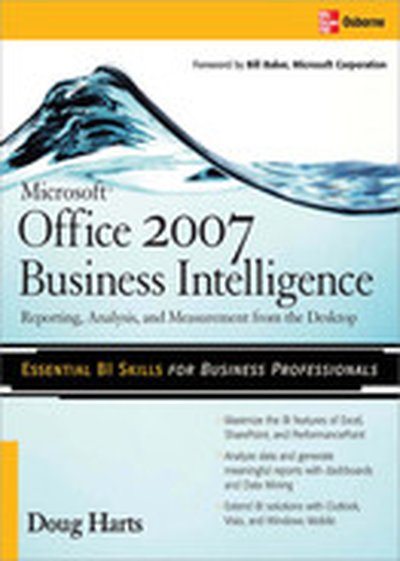
Microsoft ® Office 2007 Business Intelligence

Extract and analyze mission-critical enterprise data using Microsoft Office 2007 This authoritative volume is a practical guide to the powerful new collaborative Business Intelligence tools available in Office 2007. Using real-world examples and clear explanations, Microsoft Office 2007 Business Intelligence: Reporting, Analysis, and Measurement from the Desktop shows you how to use Excel, Excel Services, SharePoint, and PerformancePoint with a wide range of stand-alone and external data in today's networked office. You will learn how to analyze data and generate reports, scorecards, and dashboards with the Office tools you're already using to help you in your everyday work. Create Excel PivotTables and PivotCharts and apply Conditional Formatting Convert Excel spreadsheets into Excel Tables with Conditional Formatting and Charting Connect external data to Excel using Office Data Connections and SharePoint Create SharePoint dashboards that display data from multiple sources Add Key Performance Indicators and Excel Services reports to your dashboards Harness advanced SQL Server 2005 data analysis tools with the Excel Data Mining Add-In and Visio Cluster Diagrams Generate integrated PerformancePoint Scorecards Create Visio PivotDiagrams and Windows Mobile spreadsheets

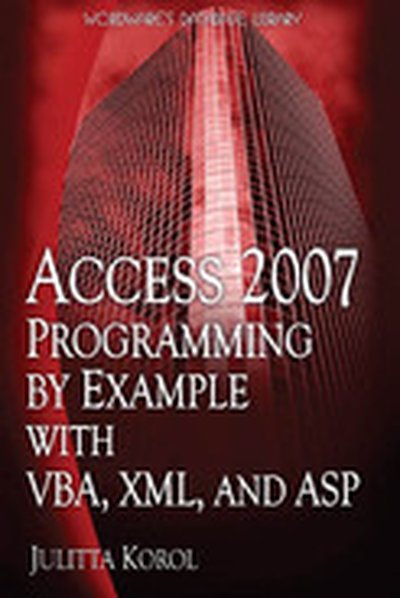
Access 2007 Programming by Example with VBA, XML, and ASP

Access 2007 Programming by Example with VBA, XML, and ASP shows non-programmers how Access databases can be created, managed, and customized with Visual Basic for Applications (VBA) — a powerful programming language built into Access. Hundreds of hands-on examples and projects throughout the book show users how to take charge of their Access databases with programming. Learn how to Write and debug your programming code with the Visual Basic Editor; access and manipulate databases with Data Access Objects (DAO) and ActiveX Data Objects (ADO); use the Data Definition Language (DDL) to enforce data integrity and manage database security; modify the behavior of forms, reports, and controls by writing event procedures; publish dynamic Access data to the web using Active Server Pages (ASP) and Extensible Markup Language (XML); and work with the new features for tables, forms, reports, macros, and templates that are available in the Access 2007 user interface.

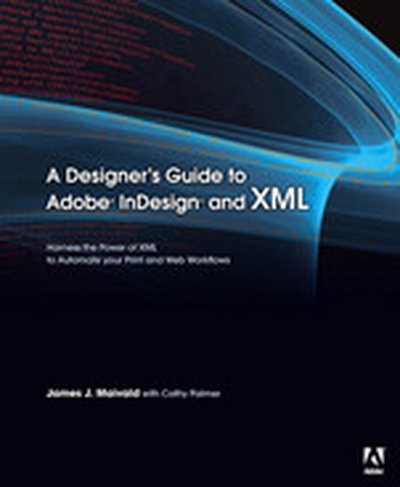
A Designer’s Guide to Adobe InDesign and XML: Harness the Power of XML to Automate your Print and Web Workflows

Is this book for programmers? Written specifically for graphic designers and production artists already comfortable working with Adobe InDesign, this book teaches you how to automate publishing without learning a lot of scary code. XML simplifies the process of moving content in and out of your layouts and can speed up any print or Web assignment. Why should I care about XML? If you’re managing data-intensive layout projects, and you want to keep that data consistent, accurate, and up-to-date, then incorporating XML can help. You can also use XML to automate processes like importing text and large numbers of graphics into a layout, or repurposing content from one application to another. Do I need additional plug-ins or special software? You need only the powerful features built into InDesign CS2, CS3 or CS4 to use this book. This guide includes nine easy-to-follow projects with downloadable support files. With these hands-on tutorials, you will learn XML in context. By the final project, XML will no longer be a mystery, but a powerful tool you can use to support your company or clients. How will I learn XML? These real-world projects will teach you: l Business cards: Create a structured layout in InDesign and then import XML. Format text automatically and flow the text into multiple examples. l Product catalog: Learn how to import XML data into a structured layout using nested styles and cloned text. l Direct mail and variable data printing: Use XML and InDesign to create sophisticated direct mail pieces without costly plug-ins or third-party software. l Magazine and newspaper: Build and export magazine-style publications for online distribution. l Web: Transform XML into XHTML to incorporate directly into your Web pages, or use Cascading Style Sheets to instantly format your exported XML.

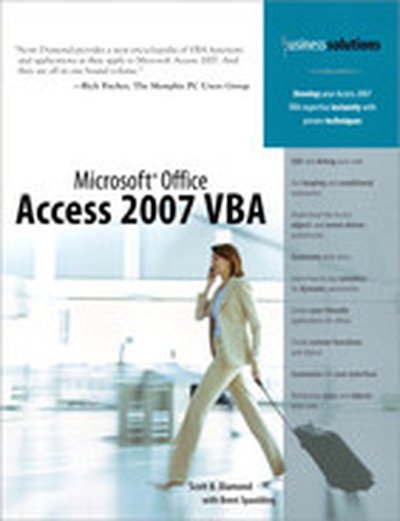
Microsoft® Office Access 2007 VBA

Business Solutions Microsoft® Office Access 2007 VBA Develop your Access 2007 VBA expertise instantly with proven techniques Microsoft Office Access 2007 VBA builds on the skills you’ve already developed in creating database applications and helps you take them to the next level—using Visual Basic for Applications (VBA) to accomplish things you once performed manually. To facilitate this lofty goal, Access includes the VBA programming language. Even if you’ve never programmed, this book will help you learn how to leverage the power of VBA to make your work with Access more efficient than ever before. Microsoft Office Access 2007 VBA is for professionals who use Microsoft Access frequently in their daily work. You have serious work to get done and you can’t spend all day reading a computer book. This book teaches you the essential skills you need to automate your databases as quickly as possible. Although written for Access 2007, the techniques and concepts covered will work in most versions of Microsoft Access. Highlights of This Book Include • Navigating within the Visual Basic Editor • Using variables, constants, and data types • Employing built-in functions • Creating procedures • Understanding object-and event-driven coding • Working with arrays • Understanding scope • Working with forms • Using selection controls • Creating reports • Exploring menus, navigation, and ribbons • Using object models • Working with data • Defining database schema • Using the Windows API • Working with XML files • Exploring Access SQL On the Website Download database files used in the book at www.quepublishing.com. Category Office Applications Covers Visual Basic for Applications User Level Intermediate - Advanced Scott B. Diamond is a seasoned database designer and Microsoft Access 2007 MVP. During the last 20+ years, he has designed databases on a wide range of platforms, including dBASE, FoxPro, SQL/DS, Lotus Approach, Lotus Notes, and, for the past 10 years, Microsoft Access. Scott has worked as a consultant, both in-house and freelance, and as a support professional at firms that are among the leaders in their industries. Scott spends some of his free time answering questions at the premier site for Access support: http://www.utteraccess.com. Brent Spaulding started writing applications about 20 years ago and has utilized Microsoft Access since version 2.0. He looks forward to using Access well into the future. In July 2007, he received the Microsoft MVP award for Access, which recognizes his talent and contributions to the Access community. Front cover bullets: Edit and debug your code Use looping and conditional statements Understand the Access object- and event-driven architecture Automate data entry Learn how to use variables for dynamic automation Create user-friendly applications for others Create custom functions and objects Customize the user interface Manipulate data and objects with code

Oracle Automatic Storage Management: Under-the-Hood & Practical Deployment Guide

Streamline data management and provisioning Build and manage a storage infrastructure with Oracle scalable Automatic Storage Management using Oracle Automatic Storage Management (Oracle ASM) and the detailed information contained in this exclusive Oracle Press resource. Written by a team of database experts, maintain a dynamic, highly available Oracle database Oracle Automatic Storage Management: Under-the-Hood & Practical Deployment Guide explains how to build and storage environment . Inside, you'll learn how to configure storage for Oracle ASM, build disk groups, use data striping and mirroring, and optimize performance. You'll also learn how to ensure consistency across server and storage platforms, maximize data redundancy, and administer Oracle ASM from the command line. Manage Oracle ASM Instances and configure Oracle RDBMS instances to leverage Oracle ASM Define, discover, and manage disk storage under Oracle ASM Create external, normal-redundancy, and high-redundancy disk groups Add and remove Oracle ASM storage without affecting RDMS instance availability Learn how Oracle ASM provides even I/O distribution Work with Oracle ASM directories, files, templates, and aliases Improve storage performance and integrity using the ASMLIB API Simplify system administration with the Oracle ASM command line interface Understand key internal Oracle ASM structures and algorithms

Oracle Database 11g New Features

FOREWORD by Tom Kyte Your Must-Have Guide to Everything New in Oracle Database 11 g Realize the full potential of Oracle Database 11 g with help from the experts. Written by Robert G. Freeman, and with insightful commentary throughout from Arup Nanda, this Oracle Press guide offers full details on the architectural changes, database administration upgrades, availability and recovery revisions, security enhancements, and programming innovations. Every new and updated feature is covered and presented with screenshots, code samples, tables, and charts. Find out how to take full advantage of all the new and improved capabilities of Oracle Database 11 g, including: New Oracle Automatic Storage Management features, such as Fast Disk Resync, Compatibility Attributes, P referred Mirror Read, and Rolling Upgrade components Improved Automated Memory Management capabilities New database design features, such as virtual columns, tablespace encryption, and true table-level data compression New Database Advisors for data recovery and repair, partitioning, and streams performance New tuning features, such as Automatic SQL Tuning and SQL Performance Analyzer Enhancements to Oracle RMAN, including active database duplication and UNDO backup optimization Improved auditing and security capabilities Advanced BI, data warehousing, and partitioning features New SQL and PL/SQL enhancements