talk-data.com talk-data.com

Topic

data

5765

tagged

Activity Trend

3 peak/qtr
2020-Q1 2026-Q1

Activities

5765 activities · Newest first

XForms Essentials

The use of forms on the web is so commonplace that most user interactions involve some type of form. XForms--a combination of XML and forms--offers a powerful alternative to HTML-based forms. By providing excellent XML integration, including XML Schema, XForms allows developers to create flexible, web-based user-input forms for a wide variety of platforms, including desktop computers, handhelds, information appliances, and more. XForms Essentials is an introduction and practical guide to the new XForms specification. Written by Micah Dubinko, a member of the W3C XForms working group and an editor of the specification, the book explains the how and why of XForms, showing readers how to take advantage of them without having to write their own code. You'll learn how to integrate XForms with both HTML and XML vocabularies, and how XForms can simplify the connection between client-based user input and server-based processing. XForms Essentials begins with a general introduction to web forms, including information on history and basic construction of forms. The second part of the book serves as a reference manual to the XForms specification. The third section offers additional hints, guidelines, and techniques for working with XForms. Topics covered in the book include: creating XForms files in a text or XML editor converting existing forms (electronic or paper) to XForms collecting XML data from users in a user-friendly way reducing the amount of JavaScript needed within browser interfaces increasing the security and reliability of your current forms system by combining client-side and server-side checks into a common code base creating interactive websites using the latest standard technology XForms Essentials focuses on the practical application of XForms technology. If you work with forms, HTML, or XML information, XForms Essentials will provide you with a much simpler route to more sophisticated interactions with users.
Unattended Pristine Installation with IBM Tivoli Configuration Manager

Pristine installations of operating systems is a strategic method to ensure that the security of your machines is maintained and that no one has left accounts or Trojan horses on your servers waiting to be executed at a later date. For this reason, reasonable methods to complete this task from a central location is necessary to reduce IT costs. Each vendor has produced software and methods for being able to roll out a new operating system in an unattended fashion. This IBM Redbooks publication ties each of those solutions into a centralized overall solution using IBM Tivoli Configuration Manager Version 4.2. It is important to understand that all the features and enhancements tie together to enable the environment more flexibility, efficiency, and faster deployment, helping to cut costs and time. Pristine installation of software is the first important step of managing your networked computers. IBM Tivoli Configuration Manager Version 4.2 provides an "attended" pristine installation using the Pristine tool. This book explores integrating IBM Tivoli Configuration Manager with tools that provide unattended pristine installations.

Scaling DB2 UDB on Windows Server 2003

As organizations strive to do more with less, DB2 Universal Database v8.1 on Windows Server 2003 brings unprecedented enterprise-class scalability to 32-bit and 64-bit Intel platforms. Supporting both vertical (scale up) and horizontal (scale out) scaling, DB2 UDB v8.1 represents over a decade of industry proven scalability with both non-clustered and clustered database architectures. This IBM Redbooks publication is designed as an informative guide to scaling DB2 UDB V8.1 with Windows Server 2003. It is intended for database and system administrators who need both an introduction and detailed information on scaling DB2 UDB on Windows Server 2003. We begin with an overview to scalability including the goals, measurements, and common approaches. We introduce the scalability features of DB2 UDB, Windows Server 2003, and the IBM xSeries Servers followed by some design considerations for scaling. We dedicate an entire chapter to running DB2 UDB on 64-bit Windows including installation, configuration, and 64-bit migration techniques. We discuss scaling up and how to leverage large memory support in a 32-bit environments. Finally, we include a chapter on scaling out including adding logical and physical database partitions.

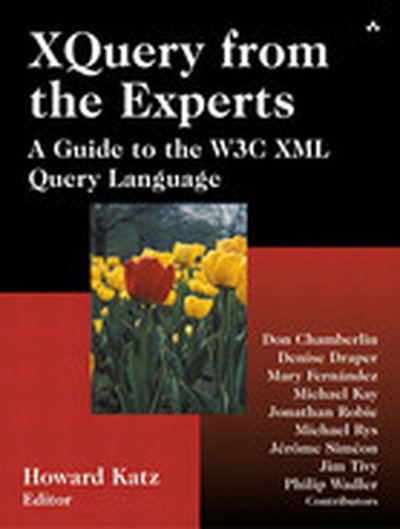
XQuery from the Experts: A Guide to the W3C XML Query Language

"The individual perspectives on the concepts behind the XQuery language offered by XQuery from the Experts will be of great value to those who are seeking to understand the implications, opportunities, and challenges of XQuery as they design future information systems based on XML." —Michael Champion, Advisory Research and Development Specialist, Software AG XQuery answers the growing need for a functional XML search and transformation standard. Backed by the full weight of the World Wide Web Consortium (W3C), XQuery is being extremely well received by the IT community worldwide. The first major XML language that takes advantage of the benefits of strong typing provided by XML Schema, XQuery has the versatility to manipulate both XML and non-XML data and provides a valuable connection between the world of XML and relational databases. In , select members of the W3C's XML Query working group come together to discuss every facet of XQuery. From Jonathan Robie's introductory "XQuery: A Guided Tour" to Mary Mary Fernández, Jérôme Siméon, and Philip Wadler's "Introduction to the Formal Semantics," XQuery is revealed in a way that both novice programmers and industry experts can appreciate. XQuery from the Experts Edited by long-time XML expert and programmer Howard Katz, coverage ranges from strictly technical chapters to comparative essays such as Michael Kay's "XQuery, XPath, and XSLT," which explores the common ancestry of all three languages, and Don Chamberlin's "Influences on the Design of XQuery," which details the process behind XQuery's design. Key coverage includes: Denise Draper on "Mapping Between XML and Relational Data" Michael Rys exploring "Integrating XQuery and Relational Database Systems" Jim Tivy's analysis of "A Native XML DBMS" Mary Mary Fernández, Jérôme Siméon, and Philip Wadler, presenting "Static Typing in XQuery" Information presented in both a tutorial and a reference framework for use by XML professionals of any level For IT managers, professionals, programmers, or anyone involved with XML, is an invaluable resource. XQuery from the Experts 0321180607B07212003

IBM Tivoli Storage Resource Manager: A Practical Introduction

Storage growth continues to accelerate, and the cost of disk can approach 80% of total system hardware costs. Yet, the storage in most businesses is typically only about 50% used. How can you take control of your storage assets to render utilization more efficient, and make the most of your storage dollars? The second edition of this book is updated for IBM Tivoli Storage Resource Manager Version 1.2 Please note that the additional material referenced in the text is not available from IBM.

Sams Teach Yourself DB2® Universal Database™ in 21 Days, Second Edition

Marketshare for DB2 has been growing steadily over the past 5 years and with the recent release of DB2 Universal Database V8, the product has never had more momentum. Not only is the product used in every company on the Fortune 500, but it is becoming very popular in the small to medium sized businesses as well. Sams Teach Yourself DB2 Universal Database in 21 Days, Second Edition, focuses on performing tasks using the graphical interfaces and wizards that are provided with DB2 on the Windows platform. (DB2 also runs on z/OS, OS/400, AIX, Linux, HP-UX, and Sun Solaris.) Readers are guided through performing all the commonly used tasks to run DB2, including installing DB2, setting up DB2, creating databases and tables, populating the database with data, accessing the data, ensuring the database is tuned for performance. This book differs from the competition in that it provides examples and scenarios making it very easy for the reader to learn complicated tasks. It gives them everything they need for the commonly used tasks in a simple to understand manner. Quizzes and exercises strengthen the knowledge gained and ensure concepts are learned rather than memorized.

IBM e-business Technology, Solution, and Design Overview

In a few short years, e-business has gone from a simple concept to an undeniable reality, and for good reason. It works for everyone: Consumers, businesses, and governments. The primary values of e-business, such as cost savings, revenue growth, and customer satisfaction, are proving to be only the tip of the iceberg. Having realized the benefit of Web-enabling individual business processes, many companies now seek further Return On Investment (ROI) by integrating new and existing e-business applications and technologies. The key to their success is to find a way to give customers what they want without the expense of traditional business operations. This IBM Redbook explains the IBM approach to creating e-business solutions. This publication targets IT specialists and architects who want to learn about proven technologies, products, and solutions to build advanced e-business applications. This publication is also written for the technical professional who is planning to take IBM Certification Test 815, IBM e-business Solution Design. This is a revision of Test 811, Designing IBM e-business Solutions. This publication, written by the same people who created Test 815, IBM e-business Solution Design, is a guide to the style and thinking that went into each and every test question. The information in this book is designed to help you prepare for IBM Test 815 and includes helpful tips for taking the test and sample questions.

Implementing CIFS: The Common Internet File System

"The book that Microsoft should have written, but didn't." —Jeremy Allison, Samba Team "Your detailed explanations are clear and backed-up with source code—and the numerous bits of humor make a dry subject very enjoyable to read." —J.D. Lindemann, network engineer, Adaptec, Inc. The first developer's guide to Microsoft®'s Internet/Intranet file sharing standard For years, developers and administrators have struggled to understand CIFS, Microsoft's poorly documented standard for Internet file sharing. Finally, there is an authoritative, cross-platform guide to CIFS capabilities and behavior. Implementing CIFS not only delivers the priceless knowledge of a Samba Team member dedicated to investigating the inner workings of CIFS, it also identifies and describes crucial specifications and supporting documents. Provides essential information for designing and debugging large Windows® and/or Samba networks Offers clear, in-depth introductions to Server Message Block (SMB), NetBIOS over TCP/IP (NBT), browser services, and authentication Drills down into the internals of CIFS, exposing its behavior on the wire and at the desktop—and its strange quirks Presents illustrative code examples throughout Reflects years of work reviewing obscure documentation, packet traces, and sourcecode Includes the SNIA CIFS Technical Reference Implementing CIFS will be indispensable to every developer who wants to provide CIFS compatibility—and every administrator or security specialist who needs an in-depth understanding of how it really works.

Using XML with Legacy Business Applications

"This volume offers relentlessly pragmatic solutions to help your business applications get the most out of XML, with a breezy style that makes the going easy. Mike has lived this stuff; he has a strong command of the solutions and the philosophy that underlies them." --Eve Maler, XML Standards Architect, Sun Microsystems Businesses running legacy applications that do not support XML can face a tough choice: Either keep their legacy applications or switch to newer, XML-enhanced applications. XML presents both challenges and opportunities for organizations as they struggle with their data. Does this dilemma sound familiar? What if you could enable a legacy application to support XML? You can. In e-commerce expert Michael C. Rawlins outlines usable techniques for solving day-to-day XML-related data exchange problems. Using an easy-to-understand cookbook approach, Rawlins shows you how to build XML support into legacy business applications using Java and C++. The techniques are illustrated by building converters for legacy formats. Converting CSV files, flat files, and X12 EDI to and from XML will never be easier! Using XML with Legacy Business Applications, Inside you'll find: A concise tutorial for learning to read W3C XML schemas An introduction to using XSLT to transform between different XML formats Simple, pragmatic advice on transporting XML documents securely over the Internet For developers working with either MSXML with Visual C++ or Java and Xerces: See Chapter 3 for a step-by-step guide to enabling existing business applications to export XML documents See Chapter 2 for a step-by-step guide to enabling existing business applications to import XML documents See Chapter 5 for code examples and tips for validating XML documents against schemas See Chapter 12 for general tips on building commerce support into an application For end users who need a simple and robust conversion utility: See Chapter 7 for converting CSV files to and from XML See Chapter 8 for converting flat files to and from XML See Chapter 9 for converting X12 EDI to and from XML See Chapter 11 for tips on how to use these techniques together for complex format conversions The resource-filled companion Web site (www.rawlinsecconsulting.com/booksupplement) includes executable versions of the utilities described in the book, full source code in C++ and Java, XSLT stylesheets, bug fixes, sample input and output files, and more. 0321154940B07142003

Microsoft® SQL Server™ 2000 High Availability

Ensuring 24/7 database availability is crucial to your company’s success. Discover the best ways to help keep your critical, Microsoft SQL Server 2000–based systems up and running—and secure—with this in-depth guide, straight from the source.

BLAST

Sequence similarity is a powerful tool for discovering biological function. Just as the ancient Greeks used comparative anatomy to understand the human body and linguists used the Rosetta stone to decipher Egyptian hieroglyphs, today we can use comparative sequence analysis to understand genomes. BLAST (Basic Local Alignment Search Tool), is a sophisticated software package for rapid searching of nucleotide and protein databases. It is one of the most important software packages used in sequence analysis and bioinformatics. Most users of BLAST, however, seldom move beyond the program's default parameters, and never take advantage of its full power. BLAST is the only book completely devoted to this popular suite of tools. It offers biologists, computational biology students, and bioinformatics professionals a clear understanding of BLAST as well as the science it supports. This book shows you how to move beyond the default parameters, get specific answers using BLAST, and how to interpret your results. The book also contains tutorial and reference sections covering NCBI-BLAST and WU-BLAST, background material to help you understand the statistics behind BLAST, Perl scripts to help you prepare your data and analyze your results, and a wealth of tips and tricks for configuring BLAST to meet your own research needs. Some of the topics covered include: BLAST basics and the NCBI web interface How to select appropriate search parameters BLAST programs: BLASTN, BLASTP, BLASTX, TBLASTN, TBLASTX, PHI-BLAST, and PSI BLAST Detailed BLAST references, including NCBI-BLAST and WU-BLAST Understanding biological sequences Sequence similarity, homology, scoring matrices, scores, and evolution Sequence Alignment Calculating BLAST statistics Industrial-strength BLAST, including developing applications with Perl and BLAST BLAST is the only comprehensive reference with detailed, accurate information on optimizing BLAST searches for high-throughput sequence analysis. This is a book that any biologist should own.

RTF Pocket Guide

Rich Text Format, or RTF, is the internal markup language used by Microsoft Word and understood by dozens of other word processors. RTF is a universal file format that pervades practically every desktop. Because RTF is text, it's much easier to generate and process than binary .doc files. Any programmer working with word processing documents needs to learn enough RTF to get around, whether it's to format text for Word (or almost any other word processor), to make global changes to an existing document, or to convert Word files to (or from) another format.RTF Pocket Guide is a concise and easy-to-use tutorial and quick-reference for anyone who occasionally ends up mired in RTF files. As the first published book to cover the RTF format in any detail, this small pocket guide explains the syntax of RTF with examples throughout, including special sections on Unicode RTF and MSHelp RTF, and several full programs that demonstrate how to work in RTF effectively.Most word processors produce RTF documents consisting of arcane and redundant markup. This book is the first step to finding order in the disorder of RTF.

Practical RDF

The Resource Description Framework (RDF) is a structure for describing and interchanging metadata on the Web--anything from library catalogs and worldwide directories to bioinformatics, Mozilla internal data structures, and knowledge bases for artificial intelligence projects. RDF provides a consistent framework and syntax for describing and querying data, making it possible to share website descriptions more easily. RDF's capabilities, however, have long been shrouded by its reputation for complexity and a difficult family of specifications. Practical RDF breaks through this reputation with immediate and solvable problems to help you understand, master, and implement RDF solutions. Practical RDF explains RDF from the ground up, providing real-world examples and descriptions of how the technology is being used in applications like Mozilla, FOAF, and Chandler, as well as infrastructure you can use to build your own applications. This book cuts to the heart of the W3C's often obscure specifications, giving you tools to apply RDF successfully in your own projects.The first part of the book focuses on the RDF specifications. After an introduction to RDF, the book covers the RDF specification documents themselves, including RDF Semantics and Concepts and Abstract Model specifications, RDF constructs, and the RDF Schema. The second section focuses on programming language support, and the tools and utilities that allow developers to review, edit, parse, store, and manipulate RDF/XML. Subsequent sections focus on RDF's data roots, programming and framework support, and practical implementation and use of RDF and RDF/XML.If you want to know how to apply RDF to information processing, Practical RDF is for you. Whether your interests lie in large-scale information aggregation and analysis or in smaller-scale projects like weblog syndication, this book will provide you with a solid foundation for working with RDF.

Business Intelligence

Business Intelligence describes the basic architectural components of a business intelligence environment, ranging from traditional topics such as business process modeling, data modeling, and more modern topics such as business rule systems, data profiling, information compliance and data quality, data warehousing, and data mining. This book progresses through a logical sequence, starting with data model infrastructure, then data preparation, followed by data analysis, integration, knowledge discovery, and finally the actual use of discovered knowledge. The book contains a quick reference guide for business intelligence terminology. Business Intelligence is part of Morgan Kaufmann's Savvy Manager's Guide series. * Provides clear explanations without technical jargon, followed by in-depth descriptions. * Articulates the business value of new technology, while providing relevant introductory technical background. * Contains a handy quick-reference to technologies and terminologies. * Guides managers through developing, administering, or simply understanding business intelligence technology. * Bridges the business-technical gap. * Is Web enhanced. Companion sites to the book and series provide value-added information, links, discussions, and more.

DB2® Universal Database™ v8 Application Development Certification Guide, 2nd Edition

You will find every skill and technique you need to build enterprise, Web, and eBusiness applications with DB2 UDB v8. This book is IBM's official guide to becoming an IBM Certified Application Developer for the DB2 Universal Database v8 Family. New to the second edition is the inclusion of the information that you will need to prepare for the Fundamentals exam, a prerequisite to the Application Development exam. This section covers information about the DB2 products, tools, connectivity, data objects, manipulation, control, security, and concurrency. The application development section has been revised and updated to reflect new powerful features of DB2. You can review the DB2 client-server environment, the role of SQL, and the basic structure of a DB2 application; compare the programming interfaces available for DB2 application development, choosing the ones most appropriate to each project; and, of course, prepare for the Application Development Exam. As a bonus, information that is not needed to become an IBM Certified Application Developer for the DB2 Universal Database v8 Family has been provided by the authors to show you how to take advantage of IBM's powerful Extenders for DB2. Using Extenders, you can build searchable indexes to quickly find elements within text, audio, image, or XML objects stored in DB2. Section 1 covers all the fundamentals of DB2 to get you started and to prepare you for the DB2 UDB v8 Family Fundamentals Exam (test 700) Section 2 covers every DB2 v8 programming interface and strategy and will help prepare you for the DB2 UDB v8 Family Application Development Exam (test 703) Section 3 contains bonus materials including information about the many Extenders that are available to create powerful indexes for text, audio, image, and XML documents The accompanying CD-ROM contains a complete trial version of DB2 UDB v8 Personal Edition along with the Application Development Client.

IBM eServer xSeries 450 Planning and Installation Guide

The IBM eServer xSeries 450 is IBM’s new 64-bit Itanium Processor Family (IPF) Architecture server and is the first implementation of the 64-bit IBM XA-64 chipset, as part of the Enterprise X-Architecture strategy. This IBM Redbooks publication is a comprehensive resource on the technical aspects of the server, and is divided into five key subject areas: Chapter 1, Technical description introduces the server and its subsystems and describes the key features and how they work. This includes the new Extensible Firmware Interface, which provides a powerful replacement to the BIOS facility found on the IA-32 platform. Chapter 2, Positioning examines the types of applications that would be used on a server such as the x450. Chapter 3, Planning describes the considerations when planning to purchase and planning to install the x450. It covers such topics as configuration, operating system specifics, scalability, and physical site planning. Chapter 4, Installation covers the process of installing Windows Server 2003, Enterprise Edition and SuSE Linux Enterprise Server on the x450. Chapter 5, Management describes how to use the Remote Supervisor Adapter to send alerts to an IBM Director management environment.

Oracle® DBA SQL Quick Reference

The Oracle SQL every DBA needs—fast and easy! Covers all the core day-to-day tasks DBAs are responsible for Quick access to SQL commands, operators, functions, data dictionary views, and more Includes dozens of easy-to-understand syntax diagrams The fast, practical Oracle SQL reference for every Oracle DBA! If you're a working Oracle DBA, here's the Oracle SQL reference you've been searching for—simple, straightforward, and incredibly easy to use! There's no faster way to discover the exact syntax you need...refresh your memory about that option you haven't used lately...find the name of that view you know exists...start using that new Oracle 9 i feature you haven't tried yet. Keep it by your desk, near your server...wherever you need fast, reliable answers right this minute! Covers Oracle SQL through Oracle9 i Release 2 Clear, well-organized tables of operators, functions, format models, privileges, and reserved words Complete command reference: syntax and options for every Oracle SQL command Standard "railroad" syntax diagrams make it easy to write correct syntax Handy listings of data dictionary views and dynamic performance tables

DCE Replacement Strategies

This IBM Redbooks publication recommends strategies that you can use to replace the Distributed Computing Environment (DCE) dependencies in your environment and move to new technologies. The following topics are covered: This book is a valuable information source if you are an executive, administrator, or developer of an IBM customer environment that uses IBM DCE for a distributed systems and application infrastructure. Although strategies for replacing DCE are described, the book does not cover strategies for replacing dependencies to IBM products that use DCE, such as DFS and TXSeries. Please note that the additional material referenced in the text is not available from IBM.

IMS in the Parallel Sysplex Volume III IMSplex Implementation and Operations

This IBM Redbooks publication is the third volume of a series of redbooks called IMS in the Parallel Sysplex. These redbooks describe how IMS exploits the Parallel Sysplex functions and how to plan for, implement, and operate IMS systems working together in a Parallel Sysplex. This book encompasses two parts. Part 1, Implementation, is a description of the tasks an IMS installation must execute to enable each of the functions. Part 2, Operations, addresses the operational issues associated with running an IMSplex that include startup and shutdown, steady state operations, online change, and recovery from failure. IMS in Parallel Sysplex, Volume I: Reviewing the IMSplex Technology, SG24-6908

DFSMStvs Application Migration Guide

This IBM Redbooks publication will help you to migrate batch VSAM applications to exploit transactional VSAM. DFSMStvs is available in a z/OS environment and offers the ability for VSAM data to be shared for both read and write operations while maintaining integrity and recoverability. DFSNStvs allows logging of changes to recoverable VSAM data sets. Batch programs can use commit and backout functions. This book assumes that you are familiar with the material in the companion book DFSMStvs Overview and Planning, SG24-6971, and refers extensively to material published in that book. We also assume some familiarity with CICS Transaction Server and z/OS. The book is intended for application developers who want to understand how to change applications to make best use of the facilities offered by DFSMStvs and to coexist well with other batch applications and with CICS systems sharing the same VSAM data sets. We assume that you are familiar with the development of batch applications and with the facilities and use of VSAM. The tasks involved in setting up DFSMStvs and the hardware and software prerequisites are not discussed in this book; they are described in DFSMStvs Overview and Planning, SG24-6971.