talk-data.com talk-data.com

Topic

Data Lakehouse

data_architecture data_warehouse data_lake

317

tagged

Activity Trend

118 peak/qtr
2020-Q1 2026-Q1

Activities

317 activities · Newest first

AWS re:Invent 2025 - Best practices for building Apache Iceberg based lakehouse architectures on AWS

Discover advanced strategies for implementing Apache Iceberg on AWS, focusing on Amazon S3 Tables and integration of Iceberg Rest Catalog with the lakehouse in Amazon SageMaker. We'll cover performance optimization techniques for Amazon Athena and Amazon Redshift queries, real-time processing using Apache Spark, and integration with Amazon EMR, AWS Glue, and Trino. Explore practical implementations of zero-ETL, change data capture (CDC) patterns, and medallion architecture. Gain hands-on expertise in implementing enterprise-grade lakehouse solutions with Iceberg on AWS.

Learn more: More AWS events: https://go.aws/3kss9CP

Subscribe: More AWS videos: http://bit.ly/2O3zS75 More AWS events videos: http://bit.ly/316g9t4

ABOUT AWS: Amazon Web Services (AWS) hosts events, both online and in-person, bringing the cloud computing community together to connect, collaborate, and learn from AWS experts. AWS is the world's most comprehensive and broadly adopted cloud platform, offering over 200 fully featured services from data centers globally. Millions of customers—including the fastest-growing startups, largest enterprises, and leading government agencies—are using AWS to lower costs, become more agile, and innovate faster.
AWSreInvent #AWSreInvent2025 #AWS

AWS re:Invent 2025 - Accelerate analytics and AI w/ an open and secure lakehouse architecture-ANT309

Data lakes, data warehouses, or both? Join this session to explore how to build a unified, open, and secure data lakehouse architecture, fully compatible with Apache Iceberg, in Amazon SageMaker. Learn how the lakehouse breaks down data silos and opens your data estate offering flexibility to use your preferred query engines and tools that accelerate time to insights. Learn about recent launches that improve data interoperability and performance, and enable large language models (LLMs) and AI agents to interact with your data. Discover robust security features, including consistent fine-grained access controls, attribute-based access control, and tag-based access control that help democratize data without compromises.

Learn more: More AWS events: https://go.aws/3kss9CP

Subscribe: More AWS videos: http://bit.ly/2O3zS75 More AWS events videos: http://bit.ly/316g9t4

ABOUT AWS: Amazon Web Services (AWS) hosts events, both online and in-person, bringing the cloud computing community together to connect, collaborate, and learn from AWS experts. AWS is the world's most comprehensive and broadly adopted cloud platform, offering over 200 fully featured services from data centers globally. Millions of customers—including the fastest-growing startups, largest enterprises, and leading government agencies—are using AWS to lower costs, become more agile, and innovate faster.
AWSreInvent #AWSreInvent2025 #AWS

AWS re:Invent 2025 - What's new with Amazon SageMaker in the era of unified data and AI (ANT216)

Learn the latest in data and AI development with the next generation of Amazon SageMaker. In this session, we'll cover new innovations that are transforming how enterprises build, deploy, and scale analytics and AI. Dive deep into the features of SageMaker Unified Studio, discover the latest catalog capabilities, and see how our lakehouse architecture is breaking down silos between data, analytics, and AI. From streamlined development experiences to enterprise-grade governance, you'll discover why Amazon SageMaker is the best place to to work with your data at AWS.

Learn more: More AWS events: https://go.aws/3kss9CP

Subscribe: More AWS videos: http://bit.ly/2O3zS75 More AWS events videos: http://bit.ly/316g9t4

ABOUT AWS: Amazon Web Services (AWS) hosts events, both online and in-person, bringing the cloud computing community together to connect, collaborate, and learn from AWS experts. AWS is the world's most comprehensive and broadly adopted cloud platform, offering over 200 fully featured services from data centers globally. Millions of customers—including the fastest-growing startups, largest enterprises, and leading government agencies—are using AWS to lower costs, become more agile, and innovate faster.
AWSreInvent #AWSreInvent2025 #AWS

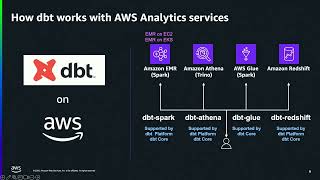
Best practice for leveraging Amazon Analytic Services + dbt

As organizations increasingly adopt modern data stacks, the combination of dbt and AWS Analytics services emerged as a powerful pairing for analytics engineering at scale. This session will explore proven strategies and hard-learned lessons for optimizing this technology stack to use dbt-athena, dbt-redshift, and dbt-glue to deliver reliable, performant data transformations. We will also cover case studies, best practices, and modern lakehouse scenarios with Apache Iceberg and Amazon S3 Tables.

Minus Three Tier: Data Architecture Turned Upside Down

Every data architecture diagram out there makes it abundantly clear who's in charge: At the bottom sits the analyst, above that is an API server, and on the very top sits the mighty data warehouse. This pattern is so ingrained we never ever question its necessity, despite its various issues like slow data response time, multi-level scaling issues, and massive cost.

But there is another way: Disconnect of storage and compute enables localization of query processing closer to people, leading to much snappier responses, natural scaling with client-side query processing, and much reduced cost.

In this talk, it will be discussed how modern data engineering paradigms like decomposition of storage, single-node query processing, and lakehouse formats enable a radical departure from the tired three-tier architecture. By inverting the architecture we can put user's needs first. We can rely on commoditised components like object store to enable fast, scalable, and cost-effective solutions.

Capitalizing Alternatives Data on the Addepar Platform: Private Markets Benchmarking

Addepar possesses an enormous private investment data set with 40% of the $7T assets on the platform allocated to alternatives. Leveraging the Addepar Data Lakehouse (ADL), built on Databricks, we have built a scalable data pipeline that assesses millions of private fund investment cash flows and translates it to a private fund benchmarks data offering. Investors on the Addepar platform can leverage this data seamlessly integrated against their portfolio investments and obtain actionable investment insights. At a high-level, this data offering consists of an extensive data aggregation, filtering, and construction logic that dynamically updates for clients through the Databricks job workflows. This derived dataset has gone through several iterations with investment strategists and academics that leveraged delta shared tables. Irrespective of the data source, the data pipeline coalesces all relevant cash flow activity against a unique identifier before constructing the benchmarks.

Sponsored by: C2S Technologies Inc. | Qbeast: Lakehouse Acceleration as a Service

While modern lakehouse architectures and open-table formats provide flexibility, they are often challenging to manage. Data layouts, clustering, and small files need to be managed for efficiency. Qbeast’s platform-independent patented muti-column indexing optimizes lakehouse data layout, accelerates queries, and sharply reduces compute cost — without disrupting existing architectures. Qbeast also handles high-cardinality clustering and supports incremental updates. Join us to explore how Qbeast enables efficient, scalable, AI-ready data infrastructure — reducing compute costs independent of data platform and compute engine.

Welcome Lakehouse, from a DWH transformation to a M&A data sharing

At DXC, we helped our customer FastWeb with their "Welcome Lakehouse" project - a data warehouse transformation from on-premises to Databricks on AWS. But the implementation became something more. Thanks to features such as Lakehouse Federation and Delta Sharing, from the first day of the Fastweb+Vodafone merger, we have been able to connect two different platforms with ease and make the business focus on the value of data and not on the IT integration. This session will feature our customer Alessandro Gattolin of Fastweb to talk about the experience.

Daft and Unity Catalog: A Multimodal/AI-Native Lakehouse

Modern data organizations have moved beyond big data analytics to also incorporate advanced AI/ML data workloads. These workflows often involve multimodal datasets containing documents, images, long-form text, embeddings, URLs and more. Unity Catalog is an ideal solution for organizing and governing this data at scale. When paired with the Daft open source data engine, you can build a truly multimodal, AI-ready data lakehouse. In this session, we’ll explore how Daft integrates with Unity Catalog’s core features (such as volumes and functions) to enable efficient, AI-driven data lakehouses. You will learn how to ingest and process multimodal data (images, text and videos), run AI/ML transformations and feature extractions at scale, and maintain full control and visibility over your data with Unity Catalog’s fine-grained governance.

Databricks + Apache Iceberg™: Managed and Foreign Tables in Unity Catalog

Unity Catalog support for Apache Iceberg™ brings open, interoperable table formats to the heart of the Databricks Lakehouse. In this session, we’ll introduce new capabilities that allow you to write Iceberg tables from any REST-compatible engine, apply fine-grained governance across all data, and unify access to external Iceberg catalogs like AWS Glue, Hive Metastore, and Snowflake Horizon. Learn how Databricks is eliminating data silos, simplifying performance with Predictive Optimization, and advancing a truly open lakehouse architecture with Delta and Iceberg side by side.

Sponsored by: DataHub | Beyond the Lakehouse: Supercharging Databricks with Contextual Intelligence

While Databricks powers your data lakehouse, DataHub delivers the critical context layer connecting your entire ecosystem. We'll demonstrate how DataHub extends Unity Catalog to provide comprehensive metadata intelligence across platforms. DataHub's real-time platform:Cut AI model time-to-market with our unified REST and GraphQL APIs that ensure models train on reliable and compliant data from across platforms, with complete lineage trackingDecrease data incidents by 60% using our event-driven architecture that instantly propagates changes across systems*Transform data discovery from days to minutes with AI-powered search and natural language interfaces.Leaders use DataHub to transform Databricks data into integrated insights that drive business value. See our demo of syncback technology—detecting sensitive data and enforcing Databricks access controls automatically—plus our AI assistant that enhances' LLMs with cross-platform metadata.

Sponsored by: definity | How You Could Be Saving 50% of Your Spark Costs

Enterprise lakehouse platforms are rapidly scaling – and so are complexity and cost. After monitoring over 1B vCore-hours across Databricks and other Apache Spark™ environments, we consistently saw resource waste, preventable data incidents, and painful troubleshooting. Join this session to discover how definity’s unique full-stack observability provides job-level visibility in-motion, unifying infrastructure performance, pipeline execution, and data behavior, and see how enterprise teams use definity to easily optimize jobs and save millions – while proactively ensuring SLAs, preventing issues, and simplifying RCA.

Sponsored by: Soda Data Inc. | Clean Energy, Clean Data: How Data Quality Powers Decarbonization

Drawing on BDO Canada’s deep expertise in the electricity sector, this session explores how clean energy innovation can be accelerated through a holistic approach to data quality. Discover BDO’s practical framework for implementing data quality and rebuilding trust in data through a structured, scalable approach. BDO will share a real-world example of monitoring data at scale—from high-level executive dashboards to the details of daily ETL and ELT pipelines. Learn how they leveraged Soda’s data observability platform to unlock near-instant insights, and how they moved beyond legacy validation pipelines with built-in checks across their production Lakehouse. Whether you're a business leader defining data strategy or a data engineer building robust data products, this talk connects the strategic value of clean data with actionable techniques to make it a reality.

Building Responsible AI Agents on Databricks

This presentation explores how Databricks' Data Intelligence Platform supports the development and deployment of responsible AI in credit decisioning, ensuring fairness, transparency and regulatory compliance. Key areas include bias and fairness monitoring using Lakehouse Monitoring to track demographic metrics and automated alerts for fairness thresholds. Transparency and explainability are enhanced through the Mosaic AI Agent Framework, SHAP values and LIME for feature importance auditing. Regulatory alignment is achieved via Unity Catalog for data lineage and AIBI dashboards for compliance monitoring. Additionally, LLM reliability and security are ensured through AI guardrails and synthetic datasets to validate model outputs and prevent discriminatory patterns. The platform integrates real-time SME and user feedback via Databricks Apps and AI/BI Genie Space.

Get the Most of Your Delta Lake

Unlock the full potential of Delta Lake, the open-source storage framework for Apache Spark, with this session focused on its latest and most impactful features. Discover how capabilities like Time Travel, Column Mapping, Deletion Vectors, Liquid Clustering, UniForm interoperability, and Change Data Feed (CDF) can transform your data architecture. Learn not just what these features do, but when and how to use them to maximize performance, simplify data management, and enable advanced analytics across your lakehouse environment.

Healthcare Interoperability: End-to-End Streaming FHIR Pipelines With Databricks & Redox

Redox & Databricks direct integration can streamline your interoperability workflows from responding in record time to preauthorization requests to letting attending physicians know about a change in risk for sepsis and readmission in near real time from ADTs. Data engineers will learn how to create fully-streaming ETL pipelines for ingesting, parsing and acting on insights from Redox FHIR bundles delivered directly to Unity Catalog volumes. Once available in the Lakehouse, AI/BI Dashboards and Agentic Frameworks help write FHIR messages back to Redox for direct push down to EMR systems. Parsing FHIR bundle resources has never been easier with SQL combined with the new VARIANT data type in Delta and streaming table creation against Serverless DBSQL Warehouses. We'll also use Databricks accelerators dbignite and redoxwrite for writing and posting FHIR bundles back to Redox integrated EMRs and we'll extend AI/BI with Unity Catalog SQL UDFs and the Redox API for use in Genie.

Leveling Up Gaming Analytics: How Supercell Evolved Player Experiences With Snowplow and Databricks

In the competitive gaming industry, understanding player behavior is key to delivering engaging experiences. Supercell, creators of Clash of Clans and Brawl Stars, faced challenges with fragmented data and limited visibility into user journeys. To address this, they partnered with Snowplow and Databricks to build a scalable, privacy-compliant data platform for real-time insights. By leveraging Snowplow’s behavioral data collection and Databricks’ Lakehouse architecture, Supercell achieved: Cross-platform data unification: A unified view of player actions across web, mobile and in-game Real-time analytics: Streaming event data into Delta Lake for dynamic game balancing and engagement Scalable infrastructure: Supporting terabytes of data during launches and live events AI & ML use cases: Churn prediction and personalized in-game recommendations This session explores Supercell’s data journey and AI-driven player engagement strategies.

ClickHouse and Databricks for Real-Time Analytics

ClickHouse is a C++ based, column-oriented database built for real-time analytics. While it has its own internal storage format, the rise of open lakehouse architectures has created a growing need for seamless interoperability. In response, we have developed integrations with your favorite lakehouse ecosystem to enhance compatibility, performance and governance. From integrating with Unity Catalog to embedding the Delta Kernel into ClickHouse, this session will explore the key design considerations behind these integrations, their benefits to the community, the lessons learned and future opportunities for improved compatibility and seamless integration.