talk-data.com talk-data.com

Topic

Databricks

big_data analytics spark

561

tagged

Activity Trend

515 peak/qtr
2020-Q1 2026-Q1

Activities

Showing filtered results

Filtering by: Databricks DATA + AI Summit 2023 ×
Lineage System Table in Unity Catalog

Unity Catalog provides fully automated data lineage for all workloads in SQL, R, Python, Scala and across all asset types at Databricks. The aggregated view has been available to end users through data explorer and API. In this session, we are excited to share that lineage is available via delta table in their UC metastore. It stores full history of recent lineage records and it is near real time. Additionally, customers can query it through standard SQL interface. With that, customers can get significant operational insights about their workload for impact analysis, troubleshooting, quality assurance, data discovery, and data governance.

Together with the system table platform effort, which provides query history, job run operational data, audit logs and more, lineage table will be a critical piece to link all the data asset and entity asset together, providing better lakehouse observability and unification to customers.

Talk by: Menglei Sun

Connect with us: Website: https://databricks.com Twitter: https://twitter.com/databricks LinkedIn: https://www.linkedin.com/company/databricks Instagram: https://www.instagram.com/databricksinc Facebook: https://www.facebook.com/databricksinc

Processing Prescriptions at Scale at Walgreens

We designed a scalable Spark Streaming job to manage 100s of millions of prescription-related operations per day at an end-to-end SLA of a few minutes and a lookup time of one second using CosmosDB.

In this session, we will share not only the architecture, but the challenges and solutions to using the Spark Cosmos connector at scale. We will discuss usages of the Aggregator API, custom implementations of the CosmosDB connector, and the major roadblocks we encountered with the solutions we engineered. In addition, we collaborated closely with Cosmos development team at Microsoft and will share the new features which resulted. If you ever plan to use Spark with Cosmos, you won't want to miss these gotchas!

Talk by: Daniel Zafar

Here’s more to explore: Big Book of Data Engineering: 2nd Edition: https://dbricks.co/3XpPgNV The Data Team's Guide to the Databricks Lakehouse Platform: https://dbricks.co/46nuDpI

Connect with us: Website: https://databricks.com Twitter: https://twitter.com/databricks LinkedIn: https://www.linkedin.com/company/databricks Instagram: https://www.instagram.com/databricksinc Facebook: https://www.facebook.com/databricksinc

Rapidly Scaling Applied AI/ML with Foundational Models and Applying Them to Modern AI/ML Use Cases

Today many of us are familiar with foundational models such as LLM/ChatGPT. However, there are many more enterprise foundational models that can be rapidly deployed, trained and applied to enterprise use cases. This approach dramatically increases the performance of AI/ML models in production, but also gives AI teams rapid roadmaps for efficiency and delivering value to the business. Databricks provides the ideal toolset to enable this approach.

In this session, we will provide a logically overview of foundational models available today, demonstrate a real-world use case, and provide a business framework for data scientists and business leaders to collaborate to rapidly deploy these use cases.

Talk by: Nick King

Connect with us: Website: https://databricks.com Twitter: https://twitter.com/databricks LinkedIn: https://www.linkedin.com/company/databricks Instagram: https://www.instagram.com/databricksinc Facebook: https://www.facebook.com/databricksin

Real-Time Streaming Solution for Call Center Analytics: Business Challenges and Technical Enablement

A large international client with a business footprint in North America, Europe and Africa reached out to us with an interest in having a real-time streaming solution designed and implemented for its call center handling incoming and outgoing client calls. The client had a previous bad experience with another vendor, who overpromised and underdelivered on the latency of the streaming solution. The previous vendor delivered an over-complex streaming data pipeline resulting in the data taking over five minutes to reach a visualization layer. The client felt that architecture was too complex and involved many services integrated together.

Our immediate challenges involved gaining the client's trust and proving that our design and implementation quality would supersede a previous experience. To resolve an immediate challenge of the overly complicated pipeline design, we deployed a Databricks Lakehouse architecture with Azure Databricks at the center of the solution. Our reference architecture integrated Genesys Cloud : App Services : Event Hub : Databricks : : Data Lake : Power BI.

The streaming solution proved to be low latency (seconds) during the POV stage, which led to subsequent productionalization of the pipeline with deployment of jobs, DLTs pipeline, including multi-notebook workflow and business and performance metrics dashboarding relied on by the call center staff for a day-to-day performance monitoring and improvements.

Talk by: Natalia Demidova

Connect with us: Website: https://databricks.com Twitter: https://twitter.com/databricks LinkedIn: https://www.linkedin.com/company/databricks Instagram: https://www.instagram.com/databricksinc Facebook: https://www.facebook.com/databricksinc

Sponsored: Accenture | Factory of the Future: Building Digital Twins Using Knowledge Graphs & Gen AI

Digital twins are the foundation for the Factory of the Future providing the data foundation to answer questions like what is happening and what can be done about it. It requires combining data across the business — from R&D, manufacturing, supply chain, and operations — and with partners, that then is used with AI to make decisions.

This session presents a case study of a digital twin implemented for warehouse controllers designed to alleviate internal decisions and recommendations for next trips, that replaces tribal knowledge and gut-decision making. We share how we use a domain knowledge graph to drive a data-driven approach that combines warehouse data, with simulations, AI models, and domain knowledge. Warehouse controllers use a dispatch control board that provides a list of orders by dispatch date and time, destination, carrier, assignments to the trailers and to the order and dock number. We show how this new semantic layer works with large language models to make it easier to answer questions on what trip to activate and trailer to choose; based on assets available, products in inventory, and what's coming out of manufacturing.

Talk by: Teresa Tung

Here’s more to explore: A New Approach to Data Sharing: https://dbricks.co/44eUnT1

Connect with us: Website: https://databricks.com Twitter: https://twitter.com/databricks LinkedIn: https://www.linkedin.com/company/databricks Instagram: https://www.instagram.com/databricksinc Facebook: https://www.facebook.com/databricksinc

Sponsored: Anomalo | Data Archaeology: Quickly Understand Unfamiliar Datasets Using Machine Learning

One of the most daunting and time-consuming activities for data scientists and data analysts is understanding new and unfamiliar data sets. When given such a new data set, how do you understand its shape and structure? How can you quickly understand its important trends and characteristics? The typical answer is hours of manual querying and exploration, a process many call data archaeology.

This session will show a better way to explore new data sets by letting machine learning do the work for you. In particular, we will showcase how Anomalo simplifies the process of understanding and obtaining insights from Databricks tables — without manual querying. With a few clicks, you can generate comprehensive profiles and powerful visualizations that give immediate insight into your data's key characteristics and trends, as well as its shape and structure. With this approach, very little manual data archaeology is required, and you can quickly get to work on getting value out of the data (rather than just exploring it).

Talk by: Elliot Shmukler and Vicky Andonova

Here’s more to explore: State of Data + AI Report: https://dbricks.co/44i2HBp The Data Team's Guide to the Databricks Lakehouse Platform: https://dbricks.co/46nuDpI

Connect with us: Website: https://databricks.com Twitter: https://twitter.com/databricks LinkedIn: https://www.linkedin.com/company/databricks Instagram: https://www.instagram.com/databricksinc Facebook: https://www.facebook.com/databricksi

Sponsored: AWS-Real Time Stream Data & Vis Using Databricks DLT, Amazon Kinesis, & Amazon QuickSight

Amazon Kinesis Data Analytics is a managed service that can capture streaming data from IoT devices. Databricks Lakehouse platform provides ease of processing streaming and batch data using Delta Live Tables. Amazon Quicksight with powerful visualization capabilities can provides various advanced visualization capabilities with direct integration with Databricks. Combining these services, customers can capture, process, and visualize data from hundreds and thousands of IoT sensors with ease.

Talk by: Venkat Viswanathan

Here’s more to explore: Big Book of Data Engineering: 2nd Edition: https://dbricks.co/3XpPgNV The Data Team's Guide to the Databricks Lakehouse Platform: https://dbricks.co/46nuDpI

Connect with us: Website: https://databricks.com Twitter: https://twitter.com/databricks LinkedIn: https://www.linkedin.com/company/databricks Instagram: https://www.instagram.com/databricksinc Facebook: https://www.facebook.com/databricksinc

Sponsored: dbt Labs | Modernizing the Data Stack: Lessons Learned From Evolution at Zurich Insurance

In this session, we will explore the path Zurich Insurance took to modernize its data stack and data engineering practices, and the lessons learned along the way. We'll touch on how and why the team chose to:

  • Adopt community standards in code quality, code coverage, code reusability, and CI/CD
  • Rebuild the way data engineering collaborates with business teams
  • Explore data tools accessible to non-engineering users, with considerations for code-first and no-code interfaces
  • Structure our dbt project and orchestration — and the factors that played into our decisions

Talk by: Jose L Sanchez Ros and Gerard Sola

Here’s more to explore: Why the Data Lakehouse Is Your next Data Warehouse: https://dbricks.co/3Pt5unq Lakehouse Fundamentals Training: https://dbricks.co/44ancQs

Connect with us: Website: https://databricks.com Twitter: https://twitter.com/databricks LinkedIn: https://www.linkedin.com/company/databricks Instagram: https://www.instagram.com/databricksinc Facebook: https://www.facebook.com/databricksinc

Sponsored: Matillion - OurFamilyWizard Moves and Transforms Data for Databricks Delta Lake Easy

OurFamilyWizard helps families living separately thrive, empowering parents with needed tools after divorce or separation. Migrating to a modern data stack built on a Databricks Delta Lake seemed like the obvious choice for OurFamilyWizard to start integrating 20 years of on-prem Oracle data with event tracking and SaaS cloud data, but they needed tools to do it. OurFamilyWizard turned to Matillion, a powerful and intuitive solution, to quickly load, combine, and transform source data into reporting tables and data marts, and empower them to turn raw data into information the organization can use to make decisions.

In this session, Beth Mattson, OurFamilyWizard Senior Data Engineer, will detail how Matillion helped OurFamilyWizard migrate their data to Databricks fast and provided end-to-end ETL capabilities. In addition, Jamie Baker, Matillion Director of Product Management, will give a brief demo and discuss the Matillion and Databricks partnership and what is on the horizon.

Talk by: Jamie Baker and Beth Mattson

Connect with us: Website: https://databricks.com Twitter: https://twitter.com/databricks LinkedIn: https://www.linkedin.com/company/databricks Instagram: https://www.instagram.com/databricksinc Facebook: https://www.facebook.com/databricksinc

Streaming Data Analytics with Power BI and Databricks

This session is comprised of a series of end-to-end technical demos illustrating the synergy between Databricks and Power BI for streaming use cases, and considerations around when to choose which scenario:

Scenario 1: DLT + Power BI Direct Query and Auto Refresh

Scenario 2: Structured Streaming + Power BI streaming datasets

Scenario 3: DLT + Power BI composite datasets

Talk by: Liping Huang and Marius Panga

Connect with us: Website: https://databricks.com Twitter: https://twitter.com/databricks LinkedIn: https://www.linkedin.com/company/databricks Instagram: https://www.instagram.com/databricksinc Facebook: https://www.facebook.com/databricksinc

Testing Generative AI Models: What You Need to Know

Generative AI shows incredible promise for enterprise applications. The explosion of generative AI can be attributed to the convergence of several factors. Most significant is that the barrier to entry has dropped for AI application developers through customizable prompts (few-shot learning), enabling laypeople to generate high-quality content. The flexibility of models like ChatGPT and DALLE-2 have sparked curiosity and creativity about new applications that they can support. The number of tools will continue to grow in a manner similar to how AWS fueled app development. But excitement must be tampered by concerns about new risks imposed to business and society. Increased capability and adoption also increase risk exposure. As organizations explore creative boundaries of generative models, measures to reduce risk must be put in place. However, the enormous size of the input space and inherent complexity make this task more challenging than traditional ML models.

In this session, we summarize the new risks introduced by the new class of generative foundation models through several examples, and compare how these risks relate to the risks of mainstream discriminative models. Steps can be taken to reduce the operational risk, bias and fairness issues, and privacy and security of systems that leverage LLM for automation. We’ll explore model hallucinations, output evaluation, output bias, prompt injection, data leakage, stochasticity, and more. We’ll discuss some of the larger issues common to LLMs and show how to test for them. A comprehensive, test-based approach to generative AI development will help instill model integrity by proactively mitigating failure and the associated business risk.

Talk by: Yaron Singer

Here’s more to explore: LLM Compact Guide: https://dbricks.co/43WuQyb Big Book of MLOps: https://dbricks.co/3r0Pqiz

Connect with us: Website: https://databricks.com Twitter: https://twitter.com/databricks LinkedIn: https://www.linkedin.com/company/databricks Instagram: https://www.instagram.com/databricksinc Facebook: https://www.facebook.com/databricksinc

Unleashing the Magic of Large Language Modeling with Dolly 2.0

As the field of artificial intelligence continues to advance at an unprecedented pace, LLMs are becoming increasingly powerful and transformative. LLMs use deep learning techniques to analyze vast amounts of text data, and can generate language that is like human language. These models have been used for a wide range of applications, including language translation, chatbots, text summarization, and more.

Dolly 2.0 is the first open-source, instruction-following LLM that has been fine-tuned on a human-generated instruction dataset – with zero chance of copyright implications. This makes it an ideal tool for research and commercial use, and opens up new possibilities for businesses looking to streamline their operations and enhance their customer service offerings.

In this session, we will provide an overview of Dolly 2.0, discuss its features and capabilities, and showcase its potential through a demo of Dolly in action. Attendees will gain insights into the LLMs, and learn how to maximize the impact of this cutting-edge technology in their organizations. By the end of the session, attendees will have a deep understanding of the capabilities of Dolly 2.0, and will be equipped with the knowledge they need to integrate LLMs into their own operations in order to achieve greater efficiency, productivity, and customer satisfaction.

Talk by: Gavita Regunath

Here’s more to explore: LLM Compact Guide: https://dbricks.co/43WuQyb Big Book of MLOps: https://dbricks.co/3r0Pqiz

Connect with us: Website: https://databricks.com Twitter: https://twitter.com/databricks LinkedIn: https://www.linkedin.com/company/databricks Instagram: https://www.instagram.com/databricksinc Facebook: https://www.facebook.com/databricksinc

Weaving the Data Mesh in the Department of Defense

The Chief Digital and AI Office (CDAO) was created to lead the strategy and policy on data, analytics, and AI adoption across the Department of Defense. To enable that vision, the Department must achieve new ways to scale and standardize delivery under a global strategy while enabling decentralized workflows that capture the wealth of data and domain expertise.

CDAO’s strategy and goals are aligned with data mesh principles. This alignment starts with providing enterprise-level infrastructure and services to advance the adoption of data, analytics, and AI, creating the self-service data infrastructure as a platform. And it continues through implementing policy for federated computational governance centered around decentralizing data ownership to become domain-oriented but enforcing the quality and trustworthiness of data. CDAO seeks to expand and make enterprise data more accessible through providing data as a product and leveraging a federated data catalog to designate authoritative data and common data models. This results in domain-oriented, decentralized data ownership to empower the business domains across the Department to increase mission and business impact that result in significant cost savings, saving lives, and data serving as a “public good.”

Please join us in our session as we discuss how the CDAO leverages modern, innovative implementations that accelerate the delivery of data and AI throughout one of the largest distributed organizations in the world; the Department of Defense. We will walk through how this enables delivery in various Department of Defense use cases.

Talk by: Brad Corwin and Cody Ferguson

Here’s more to explore: State of Data + AI Report: https://dbricks.co/44i2HBp The Data Team's Guide to the Databricks Lakehouse Platform: https://dbricks.co/46nuDpI

Connect with us: Website: https://databricks.com Twitter: https://twitter.com/databricks LinkedIn: https://www.linkedin.com/company/databricks Instagram: https://www.instagram.com/databricksinc Facebook: https://www.facebook.com/databricksinc

Delta Sharing: The Key Data Mesh Enabler

Data Mesh is an emerging architecture pattern that challenges the centralized data platform approach by empowering different engineering teams to own the data products in a specific business domain. One of the keys to the success of any Data Mesh initiative is selecting the right protocol for Data Sharing between different business data domains that could potentially be implemented through different technologies and cloud providers.

In this session you will learn about how the Delta Sharing protocol and the Delta table format have enabled the historically stuck-in-the-past energy and construction industry to be catapulted to the 21st century by way of a modern Data Mesh implementation based on Azure Databricks.

Talk by: Francesco Pizzolon

Here’s more to explore: A New Approach to Data Sharing: https://dbricks.co/44eUnT1

Connect with us: Website: https://databricks.com Twitter: https://twitter.com/databricks LinkedIn: https://www.linkedin.com/company/databricks Instagram: https://www.instagram.com/databricksinc Facebook: https://www.facebook.com/databricksinc

How Mars Achieved a People Analytics Transformation with a Modern Data Stack

People Analytics at Mars was formed two years ago as part of an ambitious journey to transform our HR analytics capabilities. To transform, we needed to build foundational services to provide our associates with helpful insights through fast results and resolving complex problems. Critical in that foundation are data governance and data enablement which is the responsibility of the Mars People Data Office team whose focus is to deliver high quality and reliable data that is reusable for current and future People Analytics use cases. Come learn how this team used Databricks in helping Mars achieve its People Analytics Transformation.

Talk by: Rachel Belino and Sreeharsha Alagani

Here’s more to explore: State of Data + AI Report: https://dbricks.co/44i2HBp The Data Team's Guide to the Databricks Lakehouse Platform: https://dbricks.co/46nuDpI

Connect with us: Website: https://databricks.com Twitter: https://twitter.com/databricks LinkedIn: https://www.linkedin.com/company/databricks Instagram: https://www.instagram.com/databricksinc Facebook: https://www.facebook.com/databricksinc

Simplifying Migrations to Lakehouse

This session will cover:

  • Challenges with legacy platforms
  • Perenti Databricks migration journey
  • Reimagining migrations the Databricks way
  • The Databricks migration methodology and approach

Talk by: Dan Smith

Connect with us: Website: https://databricks.com Twitter: https://twitter.com/databricks LinkedIn: https://www.linkedin.com/company/databricks Instagram: https://www.instagram.com/databricksinc Facebook: https://www.facebook.com/databricksinc

Unlocking the Value of Data Sharing in Financial Services with Lakehouse

The emergence of secure data sharing is already having a tremendous economic impact, in large part due to the increasing ease and safety of sharing financial data. McKinsey predicts that the impact of open financial data will be 1-4.5% of GDP globally by 2030. This indicates there is a narrowing window on a massive opportunity for financial institutions and it is critical that they prioritize data sharing. This session will first address the ways in which Delta Sharing and Unity Catalog on a Databricks Lakehouse architecture provides a simple and open framework for building a Secure Data Sharing platform in the financial services industry. Next we will use a Databricks environment to walk through different use cases for open banking data and secure data sharing, demonstrating how they will be implemented using Delta Sharing, Unity Catalog, and other parts of the Lakehouse platform. The use cases will include examples of new product features such as Databricks to Databricks sharing, change data feed and streaming on Delta Sharing, table/column lineage, and the Delta Sharing Excel plugin to demonstrate state of the art sharing capabilities.

In this session, we will discuss secure data sharing on Databricks Lakehouse and will demonstrate architecture and code for common sharing use cases in the finance industry.

Talk by: Spencer Cook

Connect with us: Website: https://databricks.com Twitter: https://twitter.com/databricks LinkedIn: https://www.linkedin.com/company/databricks Instagram: https://www.instagram.com/databricksinc Facebook: https://www.facebook.com/databricksinc

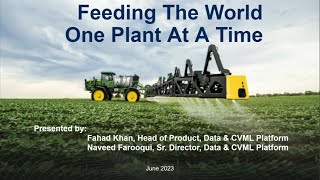
Feeding the World One Plant at a Time

Join this session to learn how the CVML and Data Platform team at BlueRiver Technology utilized Databricks to maximize savings on herbicide usage and revolutionize Precision Agriculture.

Blue River Technology is an agricultural technology company that uses computer vision and machine learning (CVML) to revolutionize the way crops are grown and harvested. BRT’s See & Spray technology, which uses CVML to identify and precisely determine whether the plant is a weed or a crop so it can deliver a small, targeted dose of herbicide directly to the plant, while leaving the crop unharmed. By using this approach, Blue River significantly reduces the amount of herbicides used in agriculture by over 70% and has a positive impact on the environment and human health.

The technical challenges we seek to overcome are:  - Processing massive petabytes of proprietary data at scale and in real time. Equipment in the field can generate up to 40TBs of data per hour per machine. - Aggregating, curating and visualizing at scale data can often be convoluted, error-prone and complex.  - Streamlining pipelines runs from weeks to hours to ensure continuous delivery of data.  - Abstracting and automating  the infra, deployment and data management from each program. - Building downstream data products based on descriptive analysis, predictive analysis or prescriptive analysis to drive the machine behavior.

The business questions we seek to answer for any machine are:  - Are we getting the spray savings we anticipated? - Are we reducing the use of herbicide at the scale we expected? - Are spraying nozzles performing at the expected rate? - Finding the relevant data to troubleshoot new edge conditions.  - Providing a simple interface for data exploration to both technical and non-technical personas to help improve our model. - Identifying repetitive and new faults in our machines. - Filtering out data based on certain incidents. - Identifying anomalies for e.g. sudden drop in spray saving, like frequency of broad spray suddenly is too high.

How we are addressing and plan to address these challenges: - Designating Databricks as our purposeful DB for all data - using the bronze, silver and gold layer standards. - Processing new machine logs using a Delta Live table as a source both in batch and incremental manner. - Democratize access for data scientists, product managers, data engineers who are not proficient with the robotic software stack via notebooks for quick development as well as real time dashboards.

Talk by: Fahad Khan and Naveed Farooqui

Here’s more to explore: LLM Compact Guide: https://dbricks.co/43WuQyb Big Book of MLOps: https://dbricks.co/3r0Pqiz

Connect with us: Website: https://databricks.com Twitter: https://twitter.com/databricks LinkedIn: https://www.linkedin.com/company/databricks Instagram: https://www.instagram.com/databricksinc Facebook: https://www.facebook.com/databricksin
Sponsored: Kyvos | Analytics 100x Faster Lowest Cost w/ Kyvos & Databricks, Even on Trillions Rows

Databricks and Kyvos together are helping organizations build their next-generation cloud analytics platform. A platform that can process and analyze massive amounts of data, even trillions of rows, and provide multidimensional insights instantly. Combining the power of Databricks with the speed, scale and cost optimization capabilities of Kyvos Analytics Acceleration Platform, customers can go beyond the limit of their analytics boundaries. Join our session to know how and also learn about a real-world use case.

Talk by: Leo Duncan

Here’s more to explore: Why the Data Lakehouse Is Your next Data Warehouse: https://dbricks.co/3Pt5unq Lakehouse Fundamentals Training: https://dbricks.co/44ancQs

Connect with us: Website: https://databricks.com Twitter: https://twitter.com/databricks LinkedIn: https://www.linkedin.com/company/databricks Instagram: https://www.instagram.com/databricksinc Facebook: https://www.facebook.com/databricksin
Activate Your Lakehouse with Unity Catalog

Building a lakehouse is straightforward today thanks to many open source technologies and Databricks. However, it can be taxing to extract value from lakehouses as they grow without robust data operations. Join us to learn how YipitData uses the Unity Catalog to streamline data operations and discover best practices to scale your own Lakehouse. At YipitData, our 15+ petabyte Lakehouse is a self-service data platform built with Databricks and AWS, supporting analytics for a data team of over 250. We will share how leveraging Unity Catalog accelerates our mission to help financial institutions and corporations leverage alternative data by:

  • Enabling clients to universally access our data through a spectrum of channels, including Sigma, Delta Sharing, and multiple clouds
  • Fostering collaboration across internal teams using a data mesh paradigm that yields rich insights
  • Strengthening the integrity and security of data assets through ACLs, data lineage, audit logs, and further isolation of AWS resources
  • Reducing the cost of large tables without downtime through automated data expiration and ETL optimizations on managed delta tables

Through our migration to Unity Catalog, we have gained tactics and philosophies to seamlessly flow our data assets internally and externally. Data platforms need to be value-generating, secure, and cost-effective in today's world. We are excited to share how Unity Catalog delivers on this and helps you get the most out of your lakehouse.

Talk by: Anup Segu

Connect with us: Website: https://databricks.com Twitter: https://twitter.com/databricks LinkedIn: https://www.linkedin.com/company/databricks Instagram: https://www.instagram.com/databricksinc Facebook: https://www.facebook.com/databricksinc