Send us a text GenAI in Marketing. Making Data Simple welcomes Michael Cohen, Chief Data Analytics Officer and ML and AI product and marketing expert in consumer data technologies. Marketing Operations, Automated Decision Activation, Measurement and Analytics, Info Security and Privacy. 01:15 Meeting Michael Cohen03:33 The Plus Company08:06 Traditional Approaches to Marketing12:03 The Future of Marketing17:31 Data Augmentin's Role24:46 Data Inputs26:18 The AIOS Product31:39 Algorithms34:03 2 Min Plus Pitch41:13 Aggressive Innovation Roadmaps44:44 Next Marketing Disruption46:33 For FunLinkedIn: www.linkedin.com/in/macohen1/ Website: www.macohen.net, https://pluscompany.com Want to be featured as a guest on Making Data Simple? Reach out to us at [email protected] and tell us why you should be next. The Making Data Simple Podcast is hosted by Al Martin, WW VP Technical Sales, IBM, where we explore trending technologies, business innovation, and leadership ... while keeping it simple & fun. Want to be featured as a guest on Making Data Simple? Reach out to us at [email protected] and tell us why you should be next. The Making Data Simple Podcast is hosted by Al Martin, WW VP Technical Sales, IBM, where we explore trending technologies, business innovation, and leadership ... while keeping it simple & fun.
 talk-data.com
Topic
GenAI
Generative AI
1517
tagged
Activity Trend
Top Events
This blog examines the upcoming trend of domain-specific LLMs and evaluates three different methods of implementation. Published at: https://www.eckerson.com/articles/the-next-wave-of-generative-ai-domain-specific-llms
We’ve never been more aware of the word ‘hallucinate’ in a professional setting. Generative AI has taught us that we need to work in tandem with personal AI tools when we want accurate and reliable information. We’ve also seen the impacts of bias in AI systems, and why trusting outputs at face value can be a dangerous game, even for the largest tech organizations in the world. It seems we could be both very close and very far away from being able to fully trust AI in a work setting. To really find out what trustworthy AI is, and what causes us to lose trust in an AI system, we need to hear from someone who’s been at the forefront of the policy and tech around the issue. Alexandra Ebert is an expert in data privacy and responsible AI. She works on public policy issues in the emerging field of synthetic data and ethical AI. Alexandra is on Forbes ‘30 Under 30’ list and has an upcoming course on DataCamp! In addition to her role as Chief Trust Officer at MOSTLY AI, Alexandra is the chair of the IEEE Synthetic Data IC expert group and the host of the Data Democratization podcast. In the episode, Richie and Alexandra explore the importance of trust in AI, what causes us to lose trust in AI systems and the impacts of a lack of trust, AI regulation and adoption, AI decision accuracy and fairness, privacy concerns in AI, handling sensitive data in AI systems, the benefits of synthetic data, explainability and transparency in AI, skills for using AI in a trustworthy fashion and much more. Links Mentioned in the Show: MOSTLY.AIMicrosoft Research on AI FairnessUsing Synthetic Data for Machine Learning & AI in Python[Course] AI Ethics
Jennifer Stiso, #DataScientist at Myriad Genetics, joins us on this latest #podcast #episode of Data Unchained, to talk about #DataBias. We discuss the #challenges and #solutions to obtaining #unbiased #datasets, future #trends of #generativeAI, and how the #AI and data sets are helping advance #healthcare.
data #datastorage #decentralizeddata #datascience
Cyberpunk by jiglr | https://soundcloud.com/jiglrmusic Music promoted by https://www.free-stock-music.com Creative Commons Attribution 3.0 Unported License https://creativecommons.org/licenses/by/3.0/deed.en_US
Hosted on Acast. See acast.com/privacy for more information.
Steve Nouri has a massive following on LinkedIn, travels the world speaking at conferences and advising companies, and most recently created a community - Generative AI, on LinkedIn. We chat about being an influencer, building and growing a community, and much more.
In this episode, I’m chatting with former Gartner analyst Sanjeev Mohan who is the Co-Author of Data Products for Dummies. Throughout our conversation, Sanjeev shares his expertise on the evolution of data products, and what he’s seen as a result of implementing practices that prioritize solving for use cases and business value. Sanjeev also shares a new approach of structuring organizations to best implement ownership and accountability of data product outcomes. Sanjeev and I also explore the common challenges of product adoption and who is responsible for user experience. I purposefully had Sanjeev on the show because I think we have pretty different perspectives from which we see the data product space.
Highlights/ Skip to:
I introduce Sanjeev Mohan, co-author of Data Products for Dummies (00:39) Sanjeev expands more on the concept of writing a “for Dummies” book (00:53) Sanjeev shares his definition of a data product, including both a technical and a business definition (01:59) Why Sanjeev believes organizational changes and accountability are the keys to preventing the acceleration of shipping data products with little to no tangible value (05:45) How Sanjeev recommends getting buy-in for data product ownership from other departments in an organization (11:05) Sanjeev and I explore adoption challenges and the topic of user experience (13:23) Sanjeev explains what role is responsible for user experience and design (19:03) Who should be responsible for defining the metrics that determine business value (28:58) Sanjeev shares some case studies of companies who have adopted this approach to data products and their outcomes (30:29) Where companies are finding data product managers currently (34:19) Sanjeev expands on his perspective regarding the importance of prioritizing business value and use cases (40:52) Where listeners can get Data Products for Dummies, and learn more about Sanjeev’s work (44:33)
Quotes from Today’s Episode “You may slap a label of data product on existing artifact; it does not make it a data product because there’s no sense of accountability. In a data product, because they are following product management best practices, there must be a data product owner or a data product manager. There’s a single person [responsible for the result]. — Sanjeev Mohan (09:31)
“I haven’t even mentioned the word data mesh because data mesh and data products, they don’t always have to go hand-in-hand. I can build data products, but I don’t need to go into the—do all of data mesh principles.” – Sanjeev Mohan (26:45)
“We need to have the right organization, we need to have a set of processes, and then we need a simplified technology which is standardized across different teams. So, this way, we have the benefit of reusing the same technology. Maybe it is Snowflake for storage, DBT for modeling, and so on. And the idea is that different teams should have the ability to bring their own analytical engine.” – Sanjeev Mohan (27:58)
“Generative AI, right now as we are recording, is still in a prototyping phase. Maybe in 2024, it’ll go heavy-duty production. We are not in prototyping phase for data products for a lot of companies. They’ve already been experimenting for a year or two, and now they’re actually using them in production. So, we’ve crossed that tipping point for data products.” – Sanjeev Mohan (33:15)
“Low adoption is a problem that’s not just limited to data products. How long have we had data catalogs, but they have low adoption. So, it’s a common problem.” – Sanjeev Mohan (39:10)
“That emphasis on technology first is a wrong approach. I tell people that I’m sorry to burst your bubble, but there are no technology projects, there are only business projects. Technology is an enabler. You don’t do technology for the sake of technology; you have to serve a business cause, so let’s start with that and keep that front and center.” – Sanjeev Mohan (43:03)
Links Data Products for Dummies: https://www.dataops.live/dataproductsfordummies “What Exactly is A Data Product” article: https://medium.com/data-mesh-learning/what-exactly-is-a-data-product-7f6935a17912 It Depends: https://www.youtube.com/@SanjeevMohan Chief Data Analytics and Product Officer of Equifax: https://www.youtube.com/watch?v=kFY7WGc-jFM SanjMo Consulting: https://www.sanjmo.com/ dataops.live: https://dataops.live dataops.live/dataproductsfordummies: https://dataops.live/dataproductsfordummies LinkedIn: https://www.linkedin.com/in/sanjmo/ Medium articles: https://sanjmo.medium.com
We learned so much about generative AI and its impact for people and organizations in 2023, we must anticipate many more innovations in the data and AI space 2024. One of the best places to look for this information is through the wisdom of those that spend their time with the Fortune 1000 leaders that are helping shape data and AI practices. Wavestone’s annual Data and AI Executive Leadership Survey is a great way to gain insight into thoughts in current practices, as well as understand what to expect from business leaders and organizations in the near future. In this episode, we speak to the author of the survey. Randy Bean is a start-up business founder, CEO, industry thought leader, author, and speaker in the field of data-driven business leadership. He serves as Innovation Fellow, Data Strategy for Paris-based consultancy Wavestone. Randy is the creator of the Data and AI Leadership Executive Survey discussed in today's episode. He is the author of the bestselling "Fail Fast, Learn Faster: Lessons in Data-Driven Leadership in an Age of Disruption, Big Data, and AI", and a current contributor to Forbes, Harvard Business Review, and MIT Sloan Management Review. In the episode, Richie and Randy explore the 2024 Data and AI Leadership Executive Survey, the impact of generative AI in 2023 and what to expect from it in 2024, the state of generative AI implementation in organizations, healthcare and AI, including examples of generative AI outperforming human doctors, the evolving responsibilities of CDOs, the increasing importance of data-driven decision-making in organizations, the barriers to becoming data-driven, insights on data skills and the generational shift towards more data-savvy business leaders, as well as much more. Links Mentioned in the Show: Data and AI Leadership Executive SurveyRandy’s Articles in ForbesAlly FinancialResponsible AI InstituteCourse: Implementing AI Solutions in Business
For those who celebrate or acknowledge it, Christmas is now in the rearview mirror. Father Time has a beard that reaches down to his toes, and he's ready to hand over the clock to an absolutely adorable little Baby Time when 2024 rolls in. That means it's time for our annual set of reflections on the analytics and data science industry. Somehow, the authoring of this description of the show was completely unaided by an LLM, although the show did include quite a bit of discussion around generative AI. It also included the announcement of a local LLM based on all of our podcast episodes to date (updated with each new episode going forward!), which you can try out here! The discussion was wide-ranging beyond AI: Google Analytics 4, Marketing Mix Modelling (MMM), the technical/engineering side of analytics versus the softer skills of creative analytical thought and engaging with stakeholders, and more, as well as a look ahead to 2024! For complete show notes, including links to items mentioned in this episode and a transcript of the show, visit the show page.
There are a few caveats to using generative AI tools, those caveats have led to a few tips that have quickly become second nature to those that use LLMs like ChatGPT. The main one being: have the domain knowledge to validate the output in order to avoid hallucinations. Hallucinations are one of the weak spots for LLMs due to the nature of the way they are built, as they are trained to correlate data in order to predict what might come next in an incomplete sequence. Does this mean that we’ll always have to be wary of the output of AI products, with the expectation that there is no intelligent decision-making going on under the hood? Far from it. Causal AI is bound by reason—rather than looking at correlation, these exciting systems are able to focus on the underlying causal mechanisms and relationships. As the AI field rapidly evolves, Causal AI is an area of research that is likely to have a huge impact on a huge number of industries and problems. Paul Hünermund is an Assistant Professor of Strategy and Innovation at Copenhagen Business School. In his research, Dr. Hünermund studies how firms can leverage new technologies in the space of machine learning and artificial intelligence such as Causal AI for value creation and competitive advantage. His work explores the potential for biases in organizational decision-making and ways for managers to counter them. It thereby sheds light on the origins of effective business strategies in markets characterized by a high degree of technological competition and the resulting implications for economic growth and environmental sustainability. His work has been published in The Journal of Management Studies, the Econometrics Journal, Research Policy, Journal of Product Innovation Management, International Journal of Industrial Organization, MIT Sloan Management Review, and Harvard Business Review, among others. In the full episode, Richie and Paul explore Causal AI, its differences when compared to other forms of AI, use cases of Causal AI in fields like drug development, marketing, manufacturing, and defense. They also discuss how Causal AI contributes to better decision-making, the role of domain experts in getting accurate results, what happens in the early stages of Causal AI adoption, exciting new developments within the Causal AI space and much more. Links Mentioned in the Show: Causal Data Science in BusinessCausal AI by causaLensIntro to Causal AI Using the DoWhy Library in PythonLesson: Inference (causal) models
Data leaders must prepare their teams to deliver the timely, accurate, and trustworthy data that GenAI initiatives need to ensure they deliver results. They can do so by modernizing their environments, extending data governance programs, and fostering collaboration with data science teams. Published at: https://www.eckerson.com/articles/the-data-leader-s-guide-to-generative-ai-part-i-models-applications-and-pipelines
In this conversation with Klara Lindner, Service Designer at diconium data, we explore how behavioral science and UX can be used to increase adoption of data products. Klara describes how she went from having a highly technical career as an electrical engineer and being the founder of a solar startup to her current role in service design for data products. Klara shares powerful insights into the value of user research and human-centered design, including one which stopped me in my tracks during this episode: how the people making data products and evangelizing data-driven decision making aren’t actually following their own advice when it comes to designing their data products. Klara and I also explore some easy user research techniques that data professionals can use, and discuss who should ultimately be responsible for user adoption of data products. Lastly, Klara gives us a peek at her upcoming December 19th, 2023 webinar with the The Data Product Leadership Community (DPLC) where she will be going deeper on two frameworks from psychology and behavioral science that teams can use to increase adoption of data products. Klara is also a founding member of the DPLC and was one of—if not the very first—design/UX professionals to join.
Highlights/ Skip to:
I introduce Klara, and she explains the role of Service Design to our audience (00:49) Klara explains how she realized she’s been doing design work longer than she thought by reflecting on the company she founded, Mobisol (02:09) How Klara balances the desire to design great dashboards with the mission of helping end users (06:15) Klara describes the psychology behind user research and her upcoming talk on December 19th at The Data Product Leadership Community (08:32) What data product teams can do as a starting point to begin implementing user research principles (10:52) Klara gives a powerful example of the type of insight and value even basic user research can provide (12:49) Klara and I discuss a key revelation when it comes to designing data products for users, which is the irony that even developers use intuition as well as quantitative data when building (16:43) What adjustments Klara had to make in her thinking when moving from a highly technical background to doing human-centered design (21:08) Klara describes the two frameworks for driving adoption that she’ll be sharing in her talk at the DPLC on December 19th (24:23) An example of how understanding and addressing adoption blockers is important for product and design teams (30:44) How Klara has seen her teams adopt a new way of thinking about product & service design (32:55) Klara gives her take on the Jobs to be Done framework, which she will also be sharing in her talk at the DPLC on December 19th (35:26) Klara’s advice to teams that are looking to build products around generative AI (39:28) Where listeners can connect with Klara to learn more (41:37)
Links diconium data: http://www.diconium.com/ LinkedIn: https://www.linkedin.com/in/klaralindner/ Personal Website: https://magic-investigations.com/ Hear Klara speak on Dec 19, 2023 at 10am ET here: https://designingforanalytics.com/community/
Over the past year, we’ve seen a full hype cycle of hysteria and discourse surrounding generative AI. It almost seems difficult to think back to a time when no one had used ChatGPT. We are in the midst of the fourth industrial revolution, and technology is moving rapidly. Better performing and more capable models are being released at a stunning rate, and with the growing presence of multimodal AI, can we expect another whirlwind year that vastly changes the state of play within AI again? Who might be able to provide insight into what is to come in 2024? Craig S. Smith is an American journalist, former executive of The New York Times, and host of the podcast Eye on AI. Until January 2000, he wrote for The Wall Street Journal, most notably covering the rise of the religious movement Falun Gong in China. He has reported for the Times from more than 40 countries and has covered several conflicts, including the 2001 invasion of Afghanistan, the 2003 war in Iraq, and the 2006 Israeli-Lebanese war. He retired from the Times in 2018 and now writes about artificial intelligence for the Times and other publications. He was a special Government employee for the National Security Commission on Artificial Intelligence until the commission's end in October 2021. In the episode, Richie and Craig explore the 2023 advancements in generative AI, such as GPT-4, and the evolving roles of companies like Anthropic and Meta, practical AI applications for research and image generation, challenges in large language models, the promising future of world models and AI agents, the societal impacts of AI, the issue of misinformation, computational constraints, and the importance of AI literacy in the job market, the transformative potential of AI in various sectors and much more. Links Mentioned in the Show: Eye on AIWayveAnthropicCohereMidjourneyYann Lecun
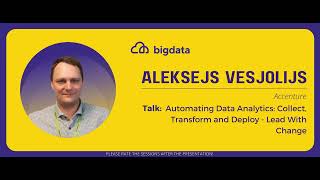
Join Aleksejs Vesjolijs in a compelling session on 'Automating Data Analytics: Collect, Transform, and Deploy - Lead With Change.' 📊🤖 Explore the path to building resilient and cost-effective Big Data solutions, leveraging generative AI and automation to meet evolving business needs and maximize data efficiency. 💡🚀 #DataAnalytics #Automation #innovation
✨ H I G H L I G H T S ✨
🙌 A huge shoutout to all the incredible participants who made Big Data Conference Europe 2023 in Vilnius, Lithuania, from November 21-24, an absolute triumph! 🎉 Your attendance and active participation were instrumental in making this event so special. 🌍
Don't forget to check out the session recordings from the conference to relive the valuable insights and knowledge shared! 📽️
Once again, THANK YOU for playing a pivotal role in the success of Big Data Conference Europe 2023. 🚀 See you next year for another unforgettable conference! 📅 #BigDataConference #SeeYouNextYear
On today’s episode, we’re joined by Sid Banerjee, Chief XM Strategy Officer, Qualtrics, the leader and creator of the experience management category. We talk about: Using automation to generate faster insightsFocusing on delivering value, and demonstrating that to prospective clientsHow Gen AI is finding problems & recommending solutionsUsing AI for right & left brain capabilities to build 150 different analysis modelsUsing analytics to determine where digital customer journeys break
Send us a text Back to talking Data with Ed Anuff, CPO, DataStax. With experience at Google, Apigee, Six Apart, Vignette, Epicentric, and Wired, Ed talks the future of databases with AI and GenAI.
05:04 The Crazy life of Ed Anuff08:12 DataStax defined10:06 Vector Database11:58 GenAI and RAG Pattern18:03 DataStax Differentiation21:39 NoSQL vs SQL24:27 Common AI Use Cases25:47 The Secret to ChatGPT31:10 DataStax 2min Pitch31:42 The Future35:47 Bring AI to the DataLinkedIn: linkedin.com/in/edanuff Website: https://www.datastax.com/ Want to be featured as a guest on Making Data Simple? Reach out to us at [email protected] and tell us why you should be next. The Making Data Simple Podcast is hosted by Al Martin, WW VP Technical Sales, IBM, where we explore trending technologies, business innovation, and leadership ... while keeping it simple & fun. Want to be featured as a guest on Making Data Simple? Reach out to us at [email protected] and tell us why you should be next. The Making Data Simple Podcast is hosted by Al Martin, WW VP Technical Sales, IBM, where we explore trending technologies, business innovation, and leadership ... while keeping it simple & fun.

Prompt engineering and LLMOps are pivotal in maximizing the capabilities of Language Models (LLMs) for specific business needs. This session offers a comprehensive guide to Azure AI's latest features that simplify the AI application development cycle. We'll walk you through the entire process—from prototyping and experimenting to evaluating and deploying your AI-powered apps. Learn how to streamline your AI workflows and harness the full potential of Generative AI with Azure AI Studio.
To learn more, please check out these resources: * https://aka.ms/Ignite23CollectionsBRK203H * https://info.microsoft.com/ww-landing-contact-me-for-events-m365-in-person-events.html?LCID=en-us&ls=407628-contactme-formfill * https://aka.ms/azure-ignite2023-dataaiblog
𝗦𝗽𝗲𝗮𝗸𝗲𝗿𝘀: * Cassie Breviu * Daniel Schneider * Bozhong Lin * Jessica Cioffi * Ed Donahue * Meng Tang * Takuto Higuchi * Greg Buehrer * Jithendra Veeramachaneni
𝗦𝗲𝘀𝘀𝗶𝗼𝗻 𝗜𝗻𝗳𝗼𝗿𝗺𝗮𝘁𝗶𝗼𝗻: This video is one of many sessions delivered for the Microsoft Ignite 2023 event. View sessions on-demand and learn more about Microsoft Ignite at https://ignite.microsoft.com
BRK203 | English (US) | AI & Apps
MSIgnite
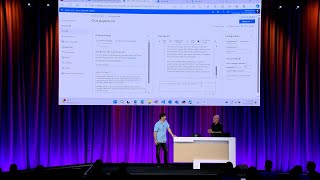
From Chat GPT to the NBA to Mercedes-Benz, Azure Cosmos DB is enabling intelligent apps that change the way we live and work. Join us to learn from KPMG about how they built a generative AI-based assistant, and Bond Brand Loyalty on how they scale data to meet global customer demand, with Azure Cosmos DB. We'll explore capabilities like vector search and how to implement RAG pattern, along with improved elasticity, and greater scale.
To learn more, please check out these resources: * https://aka.ms/Ignite23CollectionsBRK226H * https://info.microsoft.com/ww-landing-contact-me-for-events-m365-in-person-events.html?LCID=en-us&ls=407628-contactme-formfill * https://aka.ms/azure-ignite2023-dataaiblog
𝗦𝗽𝗲𝗮𝗸𝗲𝗿𝘀: * James Codella * Kirill Gavrylyuk * Maria Pallante * Mark Brown * Robert Finlayson * Anitha Adusumilli * Estefani Arroyo * Andrew Liu * Marko Hotti * Rodrigo Souza * Jason Fogaty
𝗦𝗲𝘀𝘀𝗶𝗼𝗻 𝗜𝗻𝗳𝗼𝗿𝗺𝗮𝘁𝗶𝗼𝗻: This video is one of many sessions delivered for the Microsoft Ignite 2023 event. View sessions on-demand and learn more about Microsoft Ignite at https://ignite.microsoft.com
BRK226HG | English (US) | Data
MSIgnite
The future of app development is at the intersection of AI and cloud-native technologies like Kubernetes. Whether you’re a Dev team using generative AI or an Ops teams balancing innovation with security, compliance, and cost, Azure has the tools to help you succeed. Discover how: 1. Cutting-edge features in Azure Kubernetes Service, Azure Functions, & Azure Container Apps help seamlessly bring your intelligent apps to production. 2. AI assistance built into Azure empowers Dev and Ops to scale.
To learn more, please check out these resources: * https://aka.ms/Ignite23CollectionsBRK208H * https://info.microsoft.com/ww-landing-contact-me-for-events-m365-in-person-events.html?LCID=en-us&ls=407628-contactme-formfill * https://aka.ms/azure-ignite2023-dataaiblog
𝗦𝗽𝗲𝗮𝗸𝗲𝗿𝘀: * Devanshi Joshi * Jorge Palma * Kamala Dasika * Daria Grigoriu * Tara E Walker * Ed Donahue * Nate Ceres * Simon Jakesch * Thiago Almeida
𝗦𝗲𝘀𝘀𝗶𝗼𝗻 𝗜𝗻𝗳𝗼𝗿𝗺𝗮𝘁𝗶𝗼𝗻: This video is one of many sessions delivered for the Microsoft Ignite 2023 event. View sessions on-demand and learn more about Microsoft Ignite at https://ignite.microsoft.com
BRK208H | English (US) | AI & Apps
MSIgnite
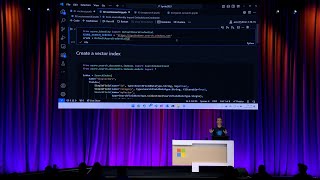
Generative AI apps are powered by a combination of reasoning and knowledge. In this in-depth session we’ll dive into knowledge retrieval, the role of vector search, how hybrid search and reranking models improve relevance, and how recent improvements make it easier to prepare and ingest data into knowledge bases. We’ll ground concepts with live code and data from our extensive evaluations on retrieval quality.
To learn more, please check out these resources: * https://aka.ms/Ignite23CollectionsBRK206H * https://info.microsoft.com/ww-landing-contact-me-for-events-m365-in-person-events.html?LCID=en-us&ls=407628-contactme-formfill * https://aka.ms/azure-ignite2023-dataaiblog
𝗦𝗽𝗲𝗮𝗸𝗲𝗿𝘀: * Pablo Castro * Farzad Sunavala * Liam Cavanagh * Ed Donahue * Gia Mondragon * Allison Sparrow
𝗦𝗲𝘀𝘀𝗶𝗼𝗻 𝗜𝗻𝗳𝗼𝗿𝗺𝗮𝘁𝗶𝗼𝗻: This video is one of many sessions delivered for the Microsoft Ignite 2023 event. View sessions on-demand and learn more about Microsoft Ignite at https://ignite.microsoft.com
BRK206H | English (US) | AI & Apps
MSIgnite

Generative AI and LLMs are no longer just buzzwords. In this session, you will see it all in action -- the latest in Azure OpenAI Service, Azure Machine Learning, and Azure AI Search. We will also share the latest innovations in Azure AI Studio including; Text-to-Speech avatar, GPT-4 Visual, and Azure AI Content Safety multi-modal models.
To learn more, please check out these resources: * https://aka.ms/Ignite23CollectionsBRK202H * https://info.microsoft.com/ww-landing-contact-me-for-events-m365-in-person-events.html?LCID=en-us&ls=407628-contactme-formfill * https://aka.ms/azure-ignite2023-dataaiblog
𝗦𝗽𝗲𝗮𝗸𝗲𝗿𝘀: * Aarthy Longino * Gerald Ertl * Marco Casalaina * Katelyn Rothney * Ronak Chokshi * Ed Donahue * Andy Beatman
𝗦𝗲𝘀𝘀𝗶𝗼𝗻 𝗜𝗻𝗳𝗼𝗿𝗺𝗮𝘁𝗶𝗼𝗻: This video is one of many sessions delivered for the Microsoft Ignite 2023 event. View sessions on-demand and learn more about Microsoft Ignite at https://ignite.microsoft.com
BRK202H | English (US) | AI & Apps