talk-data.com talk-data.com

Topic

JavaScript

programming_language web_development front_end

48

tagged

Activity Trend

12 peak/qtr
2020-Q1 2026-Q1

Activities

Showing filtered results

Filtering by: O'Reilly Data Science Books ×
Agile Data Science

Mining big data requires a deep investment in people and time. How can you be sure you’re building the right models? With this hands-on book, you’ll learn a flexible toolset and methodology for building effective analytics applications with Hadoop. Using lightweight tools such as Python, Apache Pig, and the D3.js library, your team will create an agile environment for exploring data, starting with an example application to mine your own email inboxes. You’ll learn an iterative approach that enables you to quickly change the kind of analysis you’re doing, depending on what the data is telling you. All example code in this book is available as working Heroku apps. Create analytics applications by using the agile big data development methodology Build value from your data in a series of agile sprints, using the data-value stack Gain insight by using several data structures to extract multiple features from a single dataset Visualize data with charts, and expose different aspects through interactive reports Use historical data to predict the future, and translate predictions into action Get feedback from users after each sprint to keep your project on track
IBM Cognos 10 Report Studio Cookbook - Second Edition

This cookbook is a comprehensive guide to mastering IBM Cognos 10 Report Studio, enabling users to become proficient in developing professional-grade reports. Through practical recipes, you will learn how to harness the full potential of Report Studio, mastering both fundamental and advanced features for real-world application. What this Book will help me do Efficiently organize and process data using advanced sorting and filtering techniques. Create visually engaging and functional reports, including dynamic drill-through links and enhanced formatting options. Master the use of conditional formatting, cascaded prompts, and master-detailed queries in your reports. Enhance reports with Active Reports, direct XML editing, and by integrating JavaScript and HTML elements. Adopt industry best practices for report development, including version control and regression testing. Author(s) The author of this cookbook is an experienced IBM Cognos consultant with years of experience in developing business intelligence solutions and creating comprehensive reports. They focus on combining technical expertise with practical examples, presenting information in an approachable and user-friendly manner. Who is it for? This book is ideal for Business Intelligence Developers with a working knowledge of IBM Cognos 10 who seek to enhance their report-building skills. It also serves Business Analysts or Power Users familiar with basic report authoring who aim to explore advanced features. Prior knowledge of IBM Cognos 10 architecture and basic Report Studio functionalities is assumed.

Getting Started with D3

Learn how to create beautiful, interactive, browser-based data visualizations with the D3 JavaScript library. This hands-on book shows you how to use a combination of JavaScript and SVG to build everything from simple bar charts to complex infographics. You’ll learn how to use basic D3 tools by building visualizations based on real data from the New York Metropolitan Transit Authority. Using historical tables, geographical information, and other data, you’ll graph bus breakdowns and accidents and the percentage of subway trains running on time, among other examples. By the end of the book, you’ll be prepared to build your own web-based data visualizations with D3. Join a dataset with elements of a webpage, and modify the elements based on the data Map data values onto pixels and colors with D3’s scale objects Apply axis and line generators to simplify aspects of building visualizations Create a simple UI that allows users to investigate and compare data Use D3 transitions in your UI to animate important aspects of the data Get an introduction to D3 layout tools for building more sophisticated visualizations If you can code and manipulate data, and know how to work with JavaScript and SVG, this book is for you.

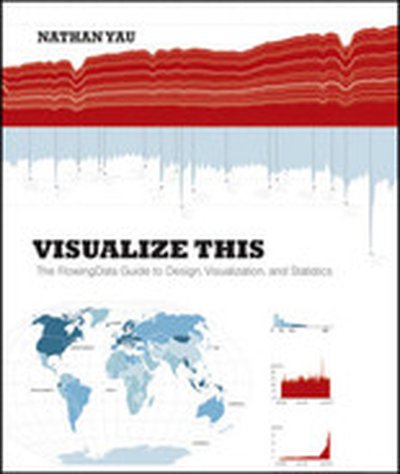
Visualize This: The FlowingData Guide to Design, Visualization, and Statistics

Practical data design tips from a data visualization expert of the modern age Data doesn't decrease; it is ever-increasing and can be overwhelming to organize in a way that makes sense to its intended audience. Wouldn't it be wonderful if we could actually visualize data in such a way that we could maximize its potential and tell a story in a clear, concise manner? Thanks to the creative genius of Nathan Yau, we can. With this full-color book, data visualization guru and author Nathan Yau uses step-by-step tutorials to show you how to visualize and tell stories with data. He explains how to gather, parse, and format data and then design high quality graphics that help you explore and present patterns, outliers, and relationships. Presents a unique approach to visualizing and telling stories with data, from a data visualization expert and the creator of flowingdata.com, Nathan Yau Offers step-by-step tutorials and practical design tips for creating statistical graphics, geographical maps, and information design to find meaning in the numbers Details tools that can be used to visualize data-native graphics for the Web, such as ActionScript, Flash libraries, PHP, and JavaScript and tools to design graphics for print, such as R and Illustrator Contains numerous examples and descriptions of patterns and outliers and explains how to show them Visualize This demonstrates how to explain data visually so that you can present your information in a way that is easy to understand and appealing.

Mining the Social Web

Popular social networks such as Facebook and Twitter generate a tremendous amount of valuable data on topics and use patterns. Who's talking to whom? What are they talking about? How often are they talking? This concise and practical book shows you how to answer these questions and more by harvesting and analyzing data using social web APIs, Python, and pragmatic storage technologies such as Redis, CouchDB, and NetworkX. With Mining the Social Web, intermediate to advanced programmers will learn how to harvest and analyze social data in way that lends itself to hacking as well as more industrial-strength analysis. Algorithms are designed with robustness and efficiency in mind so that the approaches scale well on an ordinary piece of commodity hardware. The book is highly readable from cover to cover as content progressively grows in complexity, but also lends itself to being read in an ad-hoc fashion. Use easily adaptable scripts to access popular social network APIs including Twitter, OpenSocial, and Facebook Learn approaches for slicing and dicing social data that's been harvested from social web APIs as well as other common formats such as email and markup formats Harvest data from other sources such as Freebase and other sites to enrich your analytic capabilities with additional context Visualize and analyze data in interactive ways with tools built upon rich UI JavaScript toolkits Get a concise and straightforward synopsis of some practical technologies from the semantic web landscape that you can incorporate into your analysis This book is still in progress, but you can get going on this technology through our Rough Cuts edition, which lets you read the manuscript as it's being written, either online or via PDF.

Applied SAP BI 7.0 Web Reports: Using BEx Web Analyzer and Web Application Designer

Deliver SAP BI 7.0 Web Reports Distribute integrated, accurate, and timely data across your enterprise using the Web-based reporting components in SAP BI. Written by an SAP insider, Applied SAP BI 7.0 Web Reports: Using BEx Web Analyzer and Web Application Designer shows you how to construct effective queries, create HTML-based reports, and combine key analytics into a dashboard-style interface. Learn how to import data from multiple providers, configure custom templates, track Key Performance Indicators (KPIs), and incorporate JavaScript and XHTML. Security, troubleshooting, and third-party tools are also discussed in this comprehensive guide. Essential BI skills for business professionals: Define queries and export them as links with BEx Web Analyzer Create BI-specific HTML pages using Web Application Designer and Report Designer Construct reusable templates, shortcuts, and Web items Design high-impact BI dashboards, cockpits, and billboards Integrate toolbars,drilldown capabilities, and drag-and-drop features Publish reporting objects with the Broadcaster and Broadcast Wizard Migrate existing systems and reports to the SAP BI 7.0 platform Add BusinessObjects, Crystal Reports, and JavaScript components Peter Jones, MBA, is a principal/platinum business applications consultant with SAP Professional Services Consulting. He has more than 11 years of consulting and educational experience in a variety of strategic and leadership roles. Jones is the author of SAP Business Information Warehouse Reporting.

Pentaho 3.2 Data Integration Beginner's Guide

Explore, transform, validate, and integrate your data with ease Get started with Pentaho Data Integration from scratch. Enrich your data transformation operations by embedding Java and JavaScript code in PDI transformations. Create a simple but complete Datamart Project that will cover all key features of PDI. Part of Packt's Beginner's Guide series: Each task gradually develops from the previous task with an organized sequence of instructions accompanied with relevant explanation and a set of challenging tasks that the reader will be able to accomplish. In Detail Pentaho Data Integration (a.k.a. Kettle) is a full-featured open source ETL (Extract, Transform, and Load) solution. Although PDI is a feature-rich tool, effectively capturing, manipulating, cleansing, transferring, and loading data can get complicated. This book is full of practical examples that will help you to take advantage of Pentaho Data Integration's graphical, drag-and-drop design environment. You will quickly get started with Pentaho Data Integration by following the step-by-step guidance in this book. The useful tips in this book will encourage you to exploit powerful features of Pentaho Data Integration and perform ETL operations with ease. Starting with the installation of the PDI software, this book will teach you all the key PDI concepts. Each chapter introduces new features, allowing you to gradually get involved with the tool. First, you will learn to work with plain files, and to do all kinds of data manipulation. Then, the book gives you a primer on databases and teaches you how to work with databases inside PDI. Not only that, you'll be given an introduction to data warehouse concepts and you will learn to load data in a data warehouse. After that, you will learn to implement simple and complex processes. Once you've learned all the basics, you will build a simple datamart that will serve to reinforce all the concepts learned through the book. A practical, easy-to-read guide that gives you full understanding of the Pentaho Data Integration tool and shows you how to use it to your advantage to manipulate data

Integrating and Extending BIRT

A new edition of this title is available, ISBN-10: 0321580303 ISBN-13: 9780321580306 The second of a two-book series about business intelligence and reporting technology, introduces programmers to BIRT architecture and the reporting framework. Built on the Eclipse platform, this exciting technology makes it possible for programmers to build and deploy customized reports using scripting and BIRT APIs. In addition, programmers can extend the BIRT framework by building new plug-ins using the Eclipse Plug-in Development Environment. Integrating and Extending BIRT This book describes the key components of BIRT architecture, applications, and engines, including installing, deploying, and troubleshooting the Reporting and Charting engines in an Enterprise Java application-server environment.For developers who wish to incorporate custom business logic in their reports or access data from Java objects, the book describes BIRT's extensive scripting capabilities in JavaScript and Java. For developers who want to extend the BIRT framework, the book describes the key extension points to use in creating customized report items, rendering extensions for generating output other than HTML or PDF, and Open Data Access (ODA) drivers for new data sources. The book provides extensive examples of how to build plug-ins to extend the features of the BIRT framework. Topics discussed include Installing and deploying BIRT Deploying a BIRT report to an application server Understanding BIRT architecture Scripting in a BIRT report design Integrating BIRT functionality in applications Working with the BIRT extension framework