talk-data.com talk-data.com

Topic

LLM

Large Language Models (LLM)

nlp ai machine_learning

1405

tagged

Activity Trend

158 peak/qtr
2020-Q1 2026-Q1

Activities

1405 activities · Newest first

AI Regulation is Coming: The EU AI Act and How Databricks Can Help with Compliance

With the heightened attention on LLMs and what they can do, and the widening impact of AI on day-to-day life, the push by regulators across the globe to regulate AI is intensifying. As with GDPR in the privacy realm, the EU is leading the way with the EU Artificial Intelligence Act (AIA). Regulators everywhere will be looking to the AIA as precedent, and understanding the requirements imposed by the AIA is important for all players in the AI channel. Although not finalized, the basic framework regarding how the AIA will work is becoming clearer. The impact on developers and deployers of AI (‘providers’ and ‘users’ under the AIA) will be substantial. Although the AIA will probably not go into effect until early 2025, AI applications developed today will likely be affected, and design and development decisions made now should take the future regulations into account. In this session, we Matteo Quattrocchi, Brussels-based Director, Policy – EMEA, for BSA (the Software Alliance – the leading advocacy organization representing the enterprise software sector), will present an overview of the current proposed requirements under the AIA and give an update on the ongoing deliberations and likely timing for enactment. We will also highlight some of the ways the Lakehouse platform, including Managed MLflow, can help providers and users of ML-based applications meet the requirements of the AIA and other upcoming AI regulations.

Talk by: Matteo Quattrocchi and Scott Starbird

Connect with us: Website: https://databricks.com Twitter: https://twitter.com/databricks LinkedIn: https://www.linkedin.com/company/databricks Instagram: https://www.instagram.com/databricksinc Facebook: https://www.facebook.com/databricksinc
Sponsored by: Labelbox | Unlocking Enterprise AI with Your Proprietary Data and Foundation Models

We are starting to see a paradigm shift in how AI systems are built across enterprises. In 2023 and beyond, this shift is being propelled by the era of foundation models. Foundation models can be seen as the next evolution in using "pre-trained" models and transfer learning. In order to fully leverage these breakthrough models, we’ve seen a common formula for success: leading AI teams within enterprises need to be able successfully harness their own store of unstructured data and pair this with the right model in order to ship intelligent applications that deliver next-generation experiences to their customers.

In this session you will learn how to incorporate foundation models into your data and machine learning workflows so that anyone can build AI faster and, in many cases, get the business outcome without needing to build AI models altogether. Which foundation AI models can be used to pre-label / enrich data and what specific data pipeline (data engine) will enable this? Real-world use cases of when to incorporate large language models and fine-tuning to improve machine learning models in real-time. Discover the power of leveraging both Labelbox and Databricks to streamline this data management and model deployment process.

Talk by: Manu Sharma

Here’s more to explore: LLM Compact Guide: https://dbricks.co/43WuQyb Big Book of MLOps: https://dbricks.co/3r0Pqiz

Connect with us: Website: https://databricks.com Twitter: https://twitter.com/databricks LinkedIn: https://www.linkedin.com/company/databricks Instagram: https://www.instagram.com/databricksinc Facebook: https://www.facebook.com/databricksinc
Sponsored: Gathr | Achieve 50x Faster Outcomes From Data at Scale - Using ML-Powered, No-Code Apps

Data Engineers love data and business users need outcomes. How do we cross the chasm? While there is no dearth of data in today’s world, managing and analyzing large datasets can be daunting. Additionally, data may lose its value over time. It needs to be analyzed and acted upon quickly, to accelerate decision-making, and help realize business outcomes faster. 

Take a deep dive into the future of the data economy and learn how to drive 50 times faster time to value. Hear from United Airlines how they leveraged Gathr to process massive volumes of complex digital interactions and operational data, to create breakthroughs in operations and customer experience, in real time.

The session will feature a live-demo, showcasing how enterprises from across domains leverage Gathr’s machine learning powered zero-code applications for ingestion, ETL, ML, XOps, Cloud Cost Control, Business Process Automation, and more – to accelerate their journey from data to outcomes, like never before.

Talk by: Sameer Bhide and Sarang Bapat

Here’s more to explore: LLM Compact Guide: https://dbricks.co/43WuQyb Big Book of MLOps: https://dbricks.co/3r0Pqiz

Connect with us: Website: https://databricks.com Twitter: https://twitter.com/databricks LinkedIn: https://www.linkedin.com/company/databricks Instagram: https://www.instagram.com/databricksinc Facebook: https://www.facebook.com/databricksin

Large Language Models in Healthcare: Benchmarks, Applications, and Compliance

Large language models provide a leap in capabilities on understanding medical language and context - from passing the US medical licensing exam to summarizing clinical notes. They also suffer from a wide range of issues - hallucinations, robustness, privacy, bias – blocking many use cases. This session shares currently deployed software, lessons learned, and best practices that John Snow Labs has learned while enabling academic medical centers, pharmaceuticals, and health IT companies to build LLM-based solutions.

First, we cover benchmarks for new healthcare-specific large language models, showing how tuning LLM’s specifically on medical data and tasks results in higher accuracy on use cases such as question answering, information extraction, and summarization, compared to general-purpose LLM’s like GPT-4. Second, we share an architecture for medical chatbots that tackles issues of hallucinations, outdated content, privacy, and building a longitudinal view of patients. Third, we present a comprehensive solution for testing LLM’s beyond accuracy – for bias, fairness, representation, robustness, and toxicity – using the open-source nlptest library.

Talk by: David Talby

Here’s more to explore: LLM Compact Guide: https://dbricks.co/43WuQyb Big Book of MLOps: https://dbricks.co/3r0Pqiz

Connect with us: Website: https://databricks.com Twitter: https://twitter.com/databricks LinkedIn: https://www.linkedin.com/company/databricks Instagram: https://www.instagram.com/databricksinc Facebook: https://www.facebook.com/databricksinc
Your LLM, Your Data, Your Infrastructure

Lamini, the most powerful LLM engine, is the platform for any and every software engineer to ship an LLM into production as rapidly and as easily as possible. In this session, learn how to train your LLM on your own data and infrastructure with a few lines of code using the Lamini library. Get early access to a playground to train any open-source LLM. With Lamini, your own LLM comes with better performance, better data privacy, lower cost, lower latency, and more.

Talk by: Sharon Zhou

Here’s more to explore: LLM Compact Guide: https://dbricks.co/43WuQyb Big Book of MLOps: https://dbricks.co/3r0Pqiz

Connect with us: Website: https://databricks.com Twitter: https://twitter.com/databricks LinkedIn: https://www.linkedin.com/company/databricks Instagram: https://www.instagram.com/databricksinc Facebook: https://www.facebook.com/databricksinc
D-Lite: Integrating a Lightweight ChatGPT-Like Model Based on Dolly into Organizational Workflows

DLite is a new instruction-following model developed by AI Squared by fine-tuning the smallest GPT-2 model on the Alpaca dataset. Despite having only 124 million parameters, DLite exhibits impressive ChatGPT-like interactivity and can be fine-tuned on a single T4 GPU for less than $15.00. Due to its small relative size, DLite can be run locally on a wide variety of compute environments, including laptop CPUs, and can be used without sending data to any third-party API. This lightweight property of DLite makes it highly accessible for personal use, empowering users to integrate machine learning models and advanced analytics into their workflows quickly, securely, and cost-effectively.

Leveraging DLite within AI Squared's platform can empower organizations to orchestrate the integration of Dolly/DLite into business workflows, creating personalized versions of Dolly/DLite, chaining models or analytics to contextualize Dolly/Dlite responses/prompts, and curating new datasets leveraging real-time feedback.

Talk by: Jacob Renn and Ian Sotnek

Here’s more to explore: LLM Compact Guide: https://dbricks.co/43WuQyb Big Book of MLOps: https://dbricks.co/3r0Pqiz

Connect with us: Website: https://databricks.com Twitter: https://twitter.com/databricks LinkedIn: https://www.linkedin.com/company/databricks Instagram: https://www.instagram.com/databricksinc Facebook: https://www.facebook.com/databricksinc
IFC's MALENA Provides Analytics for ESG Reviews in Emerging Markets Using NLP and LLMs

International Finance Corporation (IFC) is using data and AI to build machine learning solutions that create analytical capacity to support the review of ESG issues at scale. This includes natural language processing and requires entity recognition and other applications to support the work of IFC’s experts and other investors working in emerging markets. These algorithms are available via IFC’s Machine Learning ESG Analyst (MALENA) platform to enable rapid analysis, increase productivity, and build investor confidence. In this manner, IFC, a development finance institution with the mandate to address poverty in emerging markets, is making use of its historical datasets and open source AI solutions to build custom-AI applications that democratize access to ESG capacity to read and classify text.

In this session, you will learn the unique flexibility of the Apache Spark™ ecosystem from Databricks and how that has allowed IFC’s MALENA project to connect to scalable data lake storage, use different natural language processing models and seamlessly adopt MLOps.

Talk by: Atiyah Curmally and Blaise Sandwidi

Connect with us: Website: https://databricks.com Twitter: https://twitter.com/databricks LinkedIn: https://www.linkedin.com/company/databricks Instagram: https://www.instagram.com/databricksinc Facebook: https://www.facebook.com/databricksinc
Evaluating LLM-based Applications

Evaluating LLM-based applications can feel like more of an art than a science. In this workshop, we'll give a hands-on introduction to evaluating language models. You'll come away with knowledge and tools you can use to evaluate your own applications, and answers to questions like:

  • Where do I get evaluation data from, anyway?
  • Is it possible to evaluate generative models in an automated way?
  • What metrics can I use?
  • What's the role of human evaluation?

Talk by: Josh Tobin

Here’s more to explore: LLM Compact Guide: https://dbricks.co/43WuQyb Big Book of MLOps: https://dbricks.co/3r0Pqiz

Connect with us: Website: https://databricks.com Twitter: https://twitter.com/databricks LinkedIn: https://www.linkedin.com/company/databricks Instagram: https://www.instagram.com/databricksinc Facebook: https://www.facebook.com/databricksinc
Generative AI at Scale Using GAN and Stable Diffusion

Generative AI is under the spotlight and it has diverse applications but there are also many considerations when deploying a generative model at scale. This presentation will make a deep dive into multiple architectures and talk about optimization hacks for the sophisticated data pipelines that generative AI requires. The session will cover: - How to create and prepare a dataset for training at scale in single GPU and multi GPU environments. - How to optimize your data pipeline for training and inference in production considering the complex deep learning models that need to be run. - Tradeoff between higher quality outputs versus training time and resources and processing times.

Agenda: - Basic concepts in Generative AI: GAN networks and Stable Diffusion - Training and inference data pipelines - Industry applications and use cases

Talk by: Paula Martinez and Rodrigo Beceiro

Here’s more to explore: LLM Compact Guide: https://dbricks.co/43WuQyb Big Book of MLOps: https://dbricks.co/3r0Pqiz

Connect with us: Website: https://databricks.com Twitter: https://twitter.com/databricks LinkedIn: https://www.linkedin.com/company/databricks Instagram: https://www.instagram.com/databricksinc Facebook: https://www.facebook.com/databricksinc
Rapidly Scaling Applied AI/ML with Foundational Models and Applying Them to Modern AI/ML Use Cases

Today many of us are familiar with foundational models such as LLM/ChatGPT. However, there are many more enterprise foundational models that can be rapidly deployed, trained and applied to enterprise use cases. This approach dramatically increases the performance of AI/ML models in production, but also gives AI teams rapid roadmaps for efficiency and delivering value to the business. Databricks provides the ideal toolset to enable this approach.

In this session, we will provide a logically overview of foundational models available today, demonstrate a real-world use case, and provide a business framework for data scientists and business leaders to collaborate to rapidly deploy these use cases.

Talk by: Nick King

Connect with us: Website: https://databricks.com Twitter: https://twitter.com/databricks LinkedIn: https://www.linkedin.com/company/databricks Instagram: https://www.instagram.com/databricksinc Facebook: https://www.facebook.com/databricksin

Testing Generative AI Models: What You Need to Know

Generative AI shows incredible promise for enterprise applications. The explosion of generative AI can be attributed to the convergence of several factors. Most significant is that the barrier to entry has dropped for AI application developers through customizable prompts (few-shot learning), enabling laypeople to generate high-quality content. The flexibility of models like ChatGPT and DALLE-2 have sparked curiosity and creativity about new applications that they can support. The number of tools will continue to grow in a manner similar to how AWS fueled app development. But excitement must be tampered by concerns about new risks imposed to business and society. Increased capability and adoption also increase risk exposure. As organizations explore creative boundaries of generative models, measures to reduce risk must be put in place. However, the enormous size of the input space and inherent complexity make this task more challenging than traditional ML models.

In this session, we summarize the new risks introduced by the new class of generative foundation models through several examples, and compare how these risks relate to the risks of mainstream discriminative models. Steps can be taken to reduce the operational risk, bias and fairness issues, and privacy and security of systems that leverage LLM for automation. We’ll explore model hallucinations, output evaluation, output bias, prompt injection, data leakage, stochasticity, and more. We’ll discuss some of the larger issues common to LLMs and show how to test for them. A comprehensive, test-based approach to generative AI development will help instill model integrity by proactively mitigating failure and the associated business risk.

Talk by: Yaron Singer

Here’s more to explore: LLM Compact Guide: https://dbricks.co/43WuQyb Big Book of MLOps: https://dbricks.co/3r0Pqiz

Connect with us: Website: https://databricks.com Twitter: https://twitter.com/databricks LinkedIn: https://www.linkedin.com/company/databricks Instagram: https://www.instagram.com/databricksinc Facebook: https://www.facebook.com/databricksinc
Unleashing the Magic of Large Language Modeling with Dolly 2.0

As the field of artificial intelligence continues to advance at an unprecedented pace, LLMs are becoming increasingly powerful and transformative. LLMs use deep learning techniques to analyze vast amounts of text data, and can generate language that is like human language. These models have been used for a wide range of applications, including language translation, chatbots, text summarization, and more.

Dolly 2.0 is the first open-source, instruction-following LLM that has been fine-tuned on a human-generated instruction dataset – with zero chance of copyright implications. This makes it an ideal tool for research and commercial use, and opens up new possibilities for businesses looking to streamline their operations and enhance their customer service offerings.

In this session, we will provide an overview of Dolly 2.0, discuss its features and capabilities, and showcase its potential through a demo of Dolly in action. Attendees will gain insights into the LLMs, and learn how to maximize the impact of this cutting-edge technology in their organizations. By the end of the session, attendees will have a deep understanding of the capabilities of Dolly 2.0, and will be equipped with the knowledge they need to integrate LLMs into their own operations in order to achieve greater efficiency, productivity, and customer satisfaction.

Talk by: Gavita Regunath

Here’s more to explore: LLM Compact Guide: https://dbricks.co/43WuQyb Big Book of MLOps: https://dbricks.co/3r0Pqiz

Connect with us: Website: https://databricks.com Twitter: https://twitter.com/databricks LinkedIn: https://www.linkedin.com/company/databricks Instagram: https://www.instagram.com/databricksinc Facebook: https://www.facebook.com/databricksinc
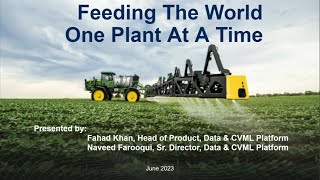
Feeding the World One Plant at a Time

Join this session to learn how the CVML and Data Platform team at BlueRiver Technology utilized Databricks to maximize savings on herbicide usage and revolutionize Precision Agriculture.

Blue River Technology is an agricultural technology company that uses computer vision and machine learning (CVML) to revolutionize the way crops are grown and harvested. BRT’s See & Spray technology, which uses CVML to identify and precisely determine whether the plant is a weed or a crop so it can deliver a small, targeted dose of herbicide directly to the plant, while leaving the crop unharmed. By using this approach, Blue River significantly reduces the amount of herbicides used in agriculture by over 70% and has a positive impact on the environment and human health.

The technical challenges we seek to overcome are:  - Processing massive petabytes of proprietary data at scale and in real time. Equipment in the field can generate up to 40TBs of data per hour per machine. - Aggregating, curating and visualizing at scale data can often be convoluted, error-prone and complex.  - Streamlining pipelines runs from weeks to hours to ensure continuous delivery of data.  - Abstracting and automating  the infra, deployment and data management from each program. - Building downstream data products based on descriptive analysis, predictive analysis or prescriptive analysis to drive the machine behavior.

The business questions we seek to answer for any machine are:  - Are we getting the spray savings we anticipated? - Are we reducing the use of herbicide at the scale we expected? - Are spraying nozzles performing at the expected rate? - Finding the relevant data to troubleshoot new edge conditions.  - Providing a simple interface for data exploration to both technical and non-technical personas to help improve our model. - Identifying repetitive and new faults in our machines. - Filtering out data based on certain incidents. - Identifying anomalies for e.g. sudden drop in spray saving, like frequency of broad spray suddenly is too high.

How we are addressing and plan to address these challenges: - Designating Databricks as our purposeful DB for all data - using the bronze, silver and gold layer standards. - Processing new machine logs using a Delta Live table as a source both in batch and incremental manner. - Democratize access for data scientists, product managers, data engineers who are not proficient with the robotic software stack via notebooks for quick development as well as real time dashboards.

Talk by: Fahad Khan and Naveed Farooqui

Here’s more to explore: LLM Compact Guide: https://dbricks.co/43WuQyb Big Book of MLOps: https://dbricks.co/3r0Pqiz

Connect with us: Website: https://databricks.com Twitter: https://twitter.com/databricks LinkedIn: https://www.linkedin.com/company/databricks Instagram: https://www.instagram.com/databricksinc Facebook: https://www.facebook.com/databricksin

An API for Deep Learning Inferencing on Apache Spark™

Apache Spark is a popular distributed framework for big data processing. It is commonly used for ETL (extract, transform and load) across large datasets. Today, the transform stage can often include the application of deep learning models on the data. For example, common models can be used for classification of images, sentiment analysis of text, language translation, anomaly detection, and many other use cases. Applying these models within Spark can be done today with the combination of PySpark, Pandas_UDF, and a lot of glue code. Often, that glue code can be difficult to get right, because it requires expertise across multiple domains - deep learning frameworks, PySpark APIs, pandas_UDF internal behavior, and performance optimization.

In this session, we introduce a new, simplified API for deep learning inferencing on Spark, introduced in SPARK-40264 as a collaboration between NVIDIA and Databricks, which seeks to standardize and open source this glue code to make deep learning inference integrations easier for everyone. We discuss its design and demonstrate its usage across multiple deep learning frameworks and models.

Talk by: Lee Yang

Here’s more to explore: LLM Compact Guide: https://dbricks.co/43WuQyb Big Book of MLOps: https://dbricks.co/3r0Pqiz

Connect with us: Website: https://databricks.com Twitter: https://twitter.com/databricks LinkedIn: https://www.linkedin.com/company/databricks Instagram: https://www.instagram.com/databricksinc Facebook: https://www.facebook.com/databricksinc
Building AI-Powered Products with Foundation Models

Foundation models make for fantastic demos, but in practice, they can be challenging to put into production. These models work well over datasets that match common training distributions (e.g., generating WEBTEXT or internet images), but may fail on domain-specific tasks or long-tail edge case; the settings that matter most to organizations building differentiated products. We propose a data-centric development approach that organizations can use to adapt foundation models to their own private/proprietary datasets.

We'll describe several techniques, including supervision "warmstarts" and interactive prompting (spoiler alert: no code needed). To make these techniques come to life, we'll walk through real case studies describing how we've seen data-centric development drive AI-powered products, from "AI assist" use cases (e.g., copywriting assistants) to "fully automated" solutions (e.g., loan processing engines).

Talk by: Vincent Chen

Here’s more to explore: LLM Compact Guide: https://dbricks.co/43WuQyb Big Book of MLOps: https://dbricks.co/3r0Pqiz

Connect with us: Website: https://databricks.com Twitter: https://twitter.com/databricks LinkedIn: https://www.linkedin.com/company/databricks Instagram: https://www.instagram.com/databricksinc Facebook: https://www.facebook.com/databricksinc
De-Risking Language Models for Faster Adoption

Language models are incredible engineering breakthroughs but require auditing and risk management before productization. These systems raise concerns about toxicity, transparency and reproducibility, intellectual property licensing and ownership, disinformation and misinformation, supply chains, and more. How can your organization leverage these new tools without taking on undue or unknown risks? While language models and associated risk management are in their infancy, a small number of best practices in governance and risk are starting to emerge. If you have a language model use case in mind, want to understand your risks, and do something about them, this presentation is for you! We'll be covering the following: 

  • Studying past incidents in the AI Incident Database and using this information to guide debugging.
  • Adhering to authoritative standards, like the NIST AI Risk Management Framework. 
  • Finding and fixing common data quality issues.
  • Applying general public tools and benchmarks as appropriate (e.g., BBQ, Winogender, TruthfulQA).
  • Binarizing specific tasks and debugging them using traditional model assessment and bias testing.
  • Engineering adversarial prompts with strategies like counterfactual reasoning, role-playing, and content exhaustion. 
  • Conducting random attacks: random sequences of attacks, prompts, or other tests that may evoke unexpected responses. 
  • Countering prompt injection attacks, auditing for backdoors and data poisoning, ensuring endpoints are protected with authentication and throttling, and analyzing third-party dependencies. 
  • Engaging stakeholders to help find problems system designers and developers cannot see. 
  • Everyone knows that generative AI is going to be huge. Don't let inadequate risk management ruin the party at your organization!

Talk by: Patrick Hall

Here’s more to explore: LLM Compact Guide: https://dbricks.co/43WuQyb Big Book of MLOps: https://dbricks.co/3r0Pqiz

Connect with us: Website: https://databricks.com Twitter: https://twitter.com/databricks LinkedIn: https://www.linkedin.com/company/databricks Instagram: https://www.instagram.com/databricksinc Facebook: https://www.facebook.com/databricksinc
Explainable Data Drift for NLP

Detecting data drift, although far from solved-for tabular data, has become a common approach to monitor ML models in production. For Natural Language Processing (NLP) on the other hand the question remains mostly open. In this session, we will present and compare two approaches. In the first approach, we will demonstrate how by extracting a wide range of explainable properties per document such as topics, language, sentiment, named entities, keywords and more we are able to explore potential sources of drift. We will show how these properties can be consistently tracked over time, how they can be used to detect meaningful data drift as soon as it occurs and how they can be used to explain and fix the root cause.

The second approach we will present is to detect drift by using the embeddings of common foundation models (such as GPT3 in the Open AI model family) and use them to identify areas in the embedding space in which significant drift has occurred. These areas in embedding space should then be characterized in a human-readable way to enable root cause analysis of the detected drift. We will compare the performance and explainability of these two methods and explore the pros and cons of each approach.

Talk by: Noam Bressler

Here’s more to explore: LLM Compact Guide: https://dbricks.co/43WuQyb Big Book of MLOps: https://dbricks.co/3r0Pqiz

Connect with us: Website: https://databricks.com Twitter: https://twitter.com/databricks LinkedIn: https://www.linkedin.com/company/databricks Instagram: https://www.instagram.com/databricksinc Facebook: https://www.facebook.com/databricksinc
Monetizing Data Assets: Sharing Data, Models and Features

Data is an asset. Selling/sharing data has largely been solved, and hosted models exist (example: ChatGPT), but moving sensitive data across the public internet or across clouds is problematic. Sharing features (the result of feature engineering) can be monetized for new potential revenue streams. Sharing models can also be monetized while avoiding the transfer of sensitive data.

This session will walk through a few examples of how to share models and features to generate new revenue streams using Delta Sharing, MLflow, and Databricks

Talk by: Keith Anderson and Avinash Sooriyarachchi

Connect with us: Website: https://databricks.com Twitter: https://twitter.com/databricks LinkedIn: https://www.linkedin.com/company/databricks Instagram: https://www.instagram.com/databricksinc Facebook: https://www.facebook.com/databricksinc
Sponsored: AWS|Build Generative AI Solution on Open Source Databricks Dolly 2.0 on Amazon SageMaker

Create a custom chat-based solution to query and summarize your data within your VPC using Dolly 2.0 and Amazon SageMaker. In this talk, you will learn about Dolly 2.0, Databricks, state-of-the-art, open source, LLM, available for commercial and Amazon SageMaker, AWS’s premiere toolkit for ML builders. You will learn how to deploy and customize models to reference your data using retrieval augmented generation (RAG) and additional fine tuning techniques…all using open-source components available today.

Talk by: Venkat Viswanathan and Karl Albertsen

Here’s more to explore: LLM Compact Guide: https://dbricks.co/43WuQyb Big Book of MLOps: https://dbricks.co/3r0Pqiz

Connect with us: Website: https://databricks.com Twitter: https://twitter.com/databricks LinkedIn: https://www.linkedin.com/company/databricks Instagram: https://www.instagram.com/databricksinc Facebook: https://www.facebook.com/databricksinc
Colossal AI: Scaling AI Models in Big Model Era

The proliferation of large models based on Transformer has outpaced advances in hardware, resulting in an urgent need for the ability to distribute enormous models across multiple GPUs. Despite this growing demand, best practices for choosing an optimal strategy are still lacking due to the breadth of knowledge required across HPC, DL, and distributed systems. These difficulties have stimulated both AI and HPC developers to explore the key questions: How can training and inference efficiency of large models be improved to reduce costs? How can larger AI models be accommodated even with limited resources?

What can be done to enable more community members to easily access large models and large-scale applications? In this session, we investigate efforts to solve the questions mentioned above. Firstly, diverse parallelization is an important tool to improve the efficiency of large model training and inference. Heterogeneous memory management can help enhance the model accommodation capacity of processors like GPUs.

Furthermore, user-friendly DL systems for large models significantly reduce the specialized background knowledge users need, allowing more community members to get started with larger models more efficiently. We will provide participants with a system-level open-source solution, Colossal-AI. More information can be found at https://github.com/hpcaitech/ColossalAI.

Talk by: James Demmel and Yang You

Here’s more to explore: LLM Compact Guide: https://dbricks.co/43WuQyb Big Book of MLOps: https://dbricks.co/3r0Pqiz

Connect with us: Website: https://databricks.com Twitter: https://twitter.com/databricks LinkedIn: https://www.linkedin.com/company/databricks Instagram: https://www.instagram.com/databricksinc Facebook: https://www.facebook.com/databricksinc