talk-data.com talk-data.com

Topic

LLM

Large Language Models (LLM)

nlp ai machine_learning

1405

tagged

Activity Trend

158 peak/qtr
2020-Q1 2026-Q1

Activities

1405 activities · Newest first

Is AI the new AE? - Coalesce 2023

ChatGPT is the talk of the town, with everyone asking - are the robots finally coming for our jobs? Join this panel of data leaders to hear about why they believe that ChatGPT and other AI tools are actually an analytical engineer's new best friend.

Speakers: Kate Schiffelbein, Head of Business Intelligence, Northbeam; Lindsay Murphy, Head of Data, Secoda; Patrick Ross, Solutions Architect, Data Clymer

Register for Coalcese at https://coalesce.getdbt.com/

In today's AI landscape, organizations are actively exploring how to seamlessly embed AI into their products, systems, processes, and workflows. The success of ChatGPT stands as a testament to this. Its success is not solely due to the performance of the underlying model; a significant part of its appeal lies in its human-centered user experience, particularly its chat interface. Beyond the foundational skills, infrastructure, and tools, it's clear that great design is a crucial ingredient in building memorable AI experiences. How do you build human-centered AI experiences? What is the role of design in driving successful AI implementations? How can data leaders and practitioners adopt a design lens when building with AI? Here to answer these questions is Haris Butt, Head of Product Design at ClickUp. ClickUp is a project management tool that's been making a big bet on AI, and Haris plays a key role in shaping how AI is embedded within the platform. Throughout the episode, Adel & Haris spoke about the role of design in driving human-centered AI experiences, the iterative process of designing with large language models, how to design AI experiences that promote trust, how designing for AI differs from traditional software, whether good design will ultimately end up killing prompt engineering, and a lot more.

Está no ar o Data Hackers News, os assuntos mais quentes da semana onde iremos comentar as principais notícias da área de Dados, IA e Tecnologia, que você encontra na nossa Newsletter semanal, agora no Podcast do Data Hackers !

Você acompanha essas noticias semanais, agora no podcast do Data Hackers!

Conheça nossos comentaristas do Data Hackers News:

⁠Monique Femme⁠ ⁠Paulo Vasconcellos⁠

Onde se inscrever na Newsletter semanal:

⁠⁠https://www.datahackers.com.br/newsletter⁠⁠

Leia as noticias citadas, completas:

OpenAI está buscando nova rodada de investimento a um valuation de US$ 90 bi

Meta anuncia IA para Whatsapp, Messenger e Instagram

Amazon anuncia Bedrock para todos os usuários

Demais canais do Data Hackers:

⁠⁠Site⁠⁠ ⁠Linkedin⁠ ⁠Instagram⁠ ⁠Tik Tok⁠ ⁠Youtube⁠

Já aproveita para nos seguir no Spotify, Apple Podcasts, ou no seu player de podcasts favoritos !

On today’s episode, we’re joined by Devvret Rishi, CEO & Co-Founder at Predibase, the low-code AI platform for developers. We talk about:

Progress towards democratization of LLM & AITackling the main challenges of machine learningWill LLM apps replace or enhance SaaS apps?Insights from Predibase’s survey of 150 executives, data scientists, & developersWhy people will stop trying to use a cannon when they need a scalpel

It's been almost a year since ChatGPT was released, mainstreaming AI into the collective consciousness in the process. Since that moment, we've seen a really spirited debate emerge within the data & AI communities, and really public discourse at large. The focal point of this debate is whether AI is or will lead to existential risk for the human species at large. We've seen thinkers such as Elizier Yudkowski, Yuval Noah Harari, and others sound the alarm bell on how AI is as dangerous, if not more dangerous than nuclear weapons. We've also seen AI researchers and business leaders sign petitions and lobby government for strict regulation on AI.  On the flip side, we've also seen luminaries within the field such as Andrew Ng and Yan Lecun, calling for, and not against, the proliferation of open-source AI. So how do we maneuver this debate, and where does the risk spectrum actually lie with AI? More importantly, how can we contextualize the risk of AI with other systemic risks humankind faces? Such as climate change, risk of nuclear war, and so on and so forth? How can we regulate AI without falling into the trap of regulatory capture—where a select and mighty few benefit from regulation, drowning out the competition in the meantime? Trond Arne Undheim is a Research scholar in Global Systemic Risk, Innovation, and Policy at Stanford University, Venture Partner at Antler, and CEO and co-founder of Yegii, an insight network with experts and knowledge assets on disruption. He is a nonresident Fellow at the Atlantic Council with a portfolio in artificial intelligence, future of work, data ethics, emerging technologies, and entrepreneurship. He is a former director of MIT Startup Exchange and has helped launch over 50 startups. In a previous life, he was an MIT Sloan School of Management Senior Lecturer, WPP Oracle Executive, and EU National Expert. In this episode, Trond and Adel explore the multifaceted risks associated with AI, the cascading risks lens and the debate over the likelihood of runaway AI. Trond shares the role of governments and organizations in shaping AI's future, the need for both global and regional regulatory frameworks, as well as the importance of educating decision-makers on AI's complexities. Trond also shares his opinion on the contrasting philosophies behind open and closed-source AI technologies, the risk of regulatory capture, and more.  Links mentioned in the show: Augmented Lean: A Human-Centric Framework for Managing Frontline Operations by Trond Arne Undheim & Natan LinderFuture Tech: How to Capture Value from Disruptive Industry Trends Trond Arne UndheimFuturized PodcastStanford Cascading Risk StudyCourse: AI Ethics

Send us a text Microsoft announces Python for ExcelAnnouncing Python in Excel: Combining the power of Python and the flexibility of Excel.https://techcommunity.microsoft.com/t5/excel-blog/announcing-python-in-excel-combining-the-power-of-python-and-the/ba-p/3893439AI-powered Coca ColaCoca‑Cola® Creations Imagines Year 3000 With New Futuristic Flavor and AI-Powered Experiencehttps://www.coca-colacompany.com/media-center/coca-cola-creations-imagines-year-3000-futuristic-flavor-ai-powered-experience40% productivity boost from AI, according to HarvardEnterprise workers gain 40 percent performance boost from GPT-4, Harvard study findshttps://venturebeat.com/ai/enterprise-workers-gain-40-percent-performance-boost-from[…]ewsletter&utm_campaign=ibm-pledges-to-train-two-million-in-aiMicrosoft’s Copilot announcementAnnouncing Microsoft Copilot, your everyday AI companionhttps://blogs.microsoft.com/blog/2023/09/21/announcing-microsoft-copilot-your-everyday-ai-companion/v0 - AI-powered react componentsWhat is v0?https://v0.dev/faq#what-is-v0Microsoft looking for a nuclear energy expertMicrosoft is hiring a nuclear energy expert to help power its AI and cloud data centershttps://www.cnbc.com/2023/09/25/microsoft-is-hiring-a-nuclear-energy-expert-to-help-power-data-centers.htmlIntro music courtesy of fesliyanstudios.com

Já exploramos com o Grupo Boticário, assuntos desde como é trabalhar com dados, até mesmo, como fazem uso de Modern Data Stack. Agora, queremos saber como a IA está mudando a forma do trabalho de uma das empresas mais admiradas da America Latina, da Pesquisa State of Data Brazil.

Neste episódio do Data Hackers — a maior comunidade de AI e Data Science do Brasil-, conheçam esse time de especialistas : a Isabella Becker — DPO (Data Protection Officer); e o Bruno Gobbet — Senior Data Manager; ambos atuantes na área de dados do Grupo Boticário.

Lembrando que você pode encontrar todos os podcasts da comunidade Data Hackers no Spotify, iTunes, Google Podcast, Castbox e muitas outras plataformas. Caso queira, você também pode ouvir o episódio aqui no post mesmo!

Link no Medium: https://medium.com/data-hackers/como-ia-est%C3%A1-mudando-a-forma-do-grupo-botic%C3%A1rio-trabalhar-data-hackers-podcast-74-c45006b64d67

Falamos no episódio

Conheça nosso convidado:

Isabella Becker — DPO ( Data Protection Officer) Bruno Gobbet — Senior Data Manager

Bancada Data Hackers:

Paulo Vasconcellos Monique Femme

Links de referências:

GH TECH (Medium): https://medium.com/gbtech Data Hackers News ( noticias semanais sobre a área de dados, AI e tecnologia) — https://podcasters.spotify.com/pod/show/datahackers/episodes/Data-Hackers-News-1---Amazon-investe-US-4-bi-na-Anthropic--Microsoft-anuncia-Copilot-para-Windows-11--OpenAI-anuncia-DALL-E-3-e29r06f Série Netflix Coded Bias: https://www.netflix.com/br/title/81328723 Livro ( Weapons of Math Destruction: How Big Data Increases Inequality and Threatens Democracy): https://www.amazon.com/Weapons-Math-Destruction-Increases-Inequality/dp/0553418815

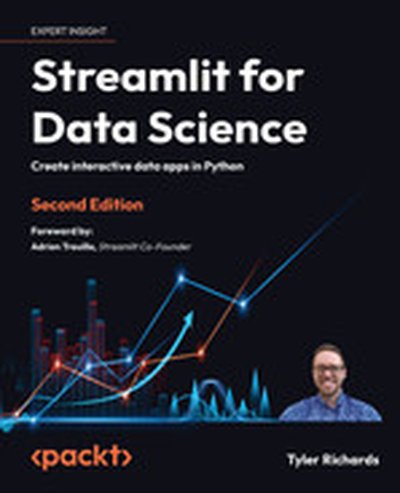
Streamlit for Data Science - Second Edition

Streamlit for Data Science is your complete guide to mastering the creation of powerful, interactive data-driven applications using Python and Streamlit. With this comprehensive resource, you'll learn everything from foundational Streamlit skills to advanced techniques like integrating machine learning models and deploying apps to cloud platforms, enabling you to significantly enhance your data science toolkit. What this Book will help me do Master building interactive applications using Streamlit, including techniques for user interfaces and integrations. Develop visually appealing and functional data visualizations using Python libraries in Streamlit. Learn to integrate Streamlit applications with machine learning frameworks and tools like Hugging Face and OpenAI. Understand and apply best practices to deploy Streamlit apps to cloud platforms such as Streamlit Community Cloud and Heroku. Improve practical Python skills through implementing end-to-end data applications and prototyping data workflows. Author(s) Tyler Richards, the author of Streamlit for Data Science, is a senior data scientist with in-depth practical experience in building data-driven applications. With a passion for Python and data visualization, Tyler leverages his knowledge to help data professionals craft effective and compelling tools. His teaching approach combines clarity, hands-on exercises, and practical relevance. Who is it for? This book is written for data scientists, engineers, and enthusiasts who use Python and want to create dynamic data-driven applications. With a focus on those who have some familiarity with Python and libraries like Pandas or NumPy, it assists readers in building on their knowledge by offering tailored guidance. Perfect for those looking to prototype data projects or enhance their programming toolkit.

Está no ar o Data Hackers News, os assuntos mais quentes da semana onde iremos comentar as principais notícias da área de Dados, IA e Tecnologia, que você encontra na nossa Newsletter semanal, agora no Podcast do Data Hackers !

A partir de hoje, você terá noticias semanais no podcast do Data Hackers!

Conheça nossos comentaristas do Data Hackers News:

Monique Femme Paulo Vasconcellos

Onde se inscrever na Newsletter semanal:

⁠https://www.datahackers.com.br/newsletter⁠

Leia as noticias citadas, completas:

Amazon vai investir até US$ 4 bilhões na Anthropic, criadora do Claude (principal concorrente da OpenAI)

Microsoft anuncia Copilot para o Windows 11 com IA até no Paint

OpenAI anuncia DALLE-3, com versão melhorada para gerar textos e integrada com ChatGPT

⁠ChatGPT agora pode ler, ouvir e falar⁠

Demais canais do Data Hackers:

⁠Site⁠ Linkedin Instagram Tik Tok Youtube

Já aproveita para nos seguir no Spotify, Apple Podcasts, ou no seu player de podcasts favoritos !

From the dawn of humanity, decisions, both big and small, have shaped our trajectory. Decisions have built civilizations, forged alliances, and even charted the course of our very evolution. And now, as data & AI become more widespread, the potential upside for better decision making is massive. Yet, like any technology, the true value of data & AI is realized by how we wield it.  We're often drawn to the allure of the latest tools and techniques, but it's crucial to remember that these tools are only as effective as the decisions we make with them. ChatGPT is only as good as the prompt you decide to feed it and what you decide to do with the output. A dashboard is only as good as the decisions that it influences. Even a data science team is only as effective as the value they deliver to the organization.  So in this vast landscape of data and AI, how can we master the art of better decision making? How can we bridge data & AI with better decision intelligence? ​​Cassie Kozyrkov founded the field of Decision Intelligence at Google where, until recently, she served as Chief Decision Scientist, advising leadership on decision process, AI strategy, and building data-driven organizations. Upon leaving Google, Cassie started her own company of which she is the CEO, Data Scientific. In almost 10 years at the company, Cassie personally trained over 20,000 Googlers in data-driven decision-making and AI and has helped over 500 projects implement decision intelligence best practices. Cassie also previously served in Google's Office of the CTO as Chief Data Scientist, and the rest of her 20 years of experience was split between consulting, data science, lecturing, and academia.  Cassie is a top keynote speaker and a beloved personality in the data leadership community, followed by over half a million tech professionals. If you've ever went on a reading spree about AI, statistics, or decision-making, chances are you've encountered her writing, which has reached millions of readers.  In the episode Cassie and Richie explore misconceptions around data science, stereotypes associated with being a data scientist, what the reality of working in data science is, advice for those starting their career in data science, and the challenges of being a data ‘jack-of-all-trades’.  Cassie also shares what decision-science and decision intelligence are, what questions to ask future employers in any data science interview, the importance of collaboration between decision-makers and domain experts, the differences between data science models and their real-world implementations, the pros and cons of generative AI in data science, and much more.  Links mentioned in the Show: Data scientist: The sexiest job of the 22nd centuryThe Netflix PrizeAI Products: Kitchen AnalogyType one, Two & Three Errors in StatisticsCourse: Data-Driven Decision Making for BusinessRadar: Data & AI Literacy...

Summary

The rapid growth of machine learning, especially large language models, have led to a commensurate growth in the need to store and compare vectors. In this episode Louis Brandy discusses the applications for vector search capabilities both in and outside of AI, as well as the challenges of maintaining real-time indexes of vector data.

Announcements

Hello and welcome to the Data Engineering Podcast, the show about modern data management Introducing RudderStack Profiles. RudderStack Profiles takes the SaaS guesswork and SQL grunt work out of building complete customer profiles so you can quickly ship actionable, enriched data to every downstream team. You specify the customer traits, then Profiles runs the joins and computations for you to create complete customer profiles. Get all of the details and try the new product today at dataengineeringpodcast.com/rudderstack This episode is brought to you by Datafold – a testing automation platform for data engineers that finds data quality issues before the code and data are deployed to production. Datafold leverages data-diffing to compare production and development environments and column-level lineage to show you the exact impact of every code change on data, metrics, and BI tools, keeping your team productive and stakeholders happy. Datafold integrates with dbt, the modern data stack, and seamlessly plugs in your data CI for team-wide and automated testing. If you are migrating to a modern data stack, Datafold can also help you automate data and code validation to speed up the migration. Learn more about Datafold by visiting dataengineeringpodcast.com/datafold You shouldn't have to throw away the database to build with fast-changing data. You should be able to keep the familiarity of SQL and the proven architecture of cloud warehouses, but swap the decades-old batch computation model for an efficient incremental engine to get complex queries that are always up-to-date. With Materialize, you can! It’s the only true SQL streaming database built from the ground up to meet the needs of modern data products. Whether it’s real-time dashboarding and analytics, personalization and segmentation or automation and alerting, Materialize gives you the ability to work with fresh, correct, and scalable results — all in a familiar SQL interface. Go to dataengineeringpodcast.com/materialize today to get 2 weeks free! If you’re a data person, you probably have to jump between different tools to run queries, build visualizations, write Python, and send around a lot of spreadsheets and CSV files. Hex brings everything together. Its powerful notebook UI lets you analyze data in SQL, Python, or no-code, in any combination, and work together with live multiplayer and version control. And now, Hex’s magical AI tools can generate queries and code, create visualizations, and even kickstart a whole analysis for you – all from natural language prompts. It’s like having an analytics co-pilot built right into where you’re already doing your work. Then, when you’re ready to share, you can use Hex’s drag-and-drop app builder to configure beautiful reports or dashboards that anyone can use. Join the hundreds of data teams like Notion, AllTrails, Loom, Mixpanel and Algolia using Hex every day to make their work more impactful. Sign up today at dataengineeringpodcast.com/hex to get a 30-day free trial of the Hex Team plan! Your host is Tobias Macey and today I'm interviewing Louis Brandy about building vector indexes in real-time for analytics and AI applications

Interview

Introduction How did you get involved in the area of data management? Can you describe what vector search is and how it differs from other search technologies?

What are the technical challenges related to providing vector search? What are the applications for vector search that merit the added complexity?

Vector databases have been gaining a lot of attention recently with the proliferation of LLM applicati

In this episode of the Data Career Podcast, I sit down with Luke Barousse, a data analyst and data star on YouTube, to discuss the impact of AI on the role of data analysts.

We delve into the question of whether AI will replace data analysts or enhance their work, sharing insights and perspectives on the topic.

Connect with Luke Barousse:

🤝 Connect on Linkedin

▶️ Subscribe on Youtube

📊 Datanerd.tech

📩 Get my weekly email with helpful data career tips

📊 Come to my next free “How to Land Your First Data Job” training

🏫 Check out my 10-week data analytics bootcamp

Timestamps:

(05:22) - ChatGPT Code Interpreter

(09:09) - Will AI Steal Your Job?

Connect with Avery:

📺 Subscribe on YouTube

🎙Listen to My Podcast

👔 Connect with me on LinkedIn

📸 Instagram

🎵 TikTok

Mentioned in this episode: Join the last cohort of 2025! The LAST cohort of The Data Analytics Accelerator for 2025 kicks off on Monday, December 8th and enrollment is officially open!

To celebrate the end of the year, we’re running a special End-of-Year Sale, where you’ll get: ✅ A discount on your enrollment 🎁 6 bonus gifts, including job listings, interview prep, AI tools + more

If your goal is to land a data job in 2026, this is your chance to get ahead of the competition and start strong.

👉 Join the December Cohort & Claim Your Bonuses: https://DataCareerJumpstart.com/daa https://www.datacareerjumpstart.com/daa

Michel Tricot (CEO of Airbyte) joins me to chat about the impact of AI on the modern data stack, ETL for AI, the challenges of moving from open source to a paid product, and much more.

Airbyte & Pinecone - https://airbyte.com/tutorials/chat-with-your-data-using-openai-pinecone-airbyte-and-langchain

Note from Joe - I had audio issues cuz he got a new computer and didn't use the correct mic :(

podcast_episode
by Val Kroll , Julie Hoyer , Tim Wilson (Analytics Power Hour - Columbus (OH) , Dr. Brandeis Marshall , Moe Kiss (Canva) , Michael Helbling (Search Discovery)

It's a lot of work to produce each episode of this show, so we were pretty sure that, by this time, we would have just turned the whole kit and kaboodle over to AI. Alas! It seems like the critical thinking and curiosity and mixing of different personalities in a discussion are safely human tasks… for now. Dr. Brandeis Marshall joined Michael, Julie, and Moe for a discussion about AI that, not surprisingly, got a little bleak at times, but it also had a fair amount of hope and handy perspectives through which to think about this space. We recommend listening to it rather than running the transcript through an LLM for a summary! For complete show notes, including links to items mentioned in this episode and a transcript of the show, visit the show page.

Kevin Petrie, the Vice President of Research at Eckerson Group, and Dan O’Brien, research analyst, discussed large language models (LLMs), which are neural networks that analyze text to predict the next word or phrase. These models use training data, often from the internet, to understand word relationships and provide accurate answers to natural language questions.

Juan Sequeda and I chat about knowledge graphs (he's an OG in this area), the potential of LLMs on structured datasets, and much more. This is an honest, no-BS chat about the transition from a data-first world to a knowledge-first world. Enjoy!

LinkedIn: https://www.linkedin.com/in/juansequeda/

data.world: https://data.world/product/

website: https://www.juansequeda.com/

It's been a year since ChatGPT burst onto the scene. It has given many of us a sense of the power and potential that LLMs hold in revolutionizing the global economy. But the power that generative AI brings also comes with inherent risks that need to be mitigated.  For those working in AI, the task at hand is monumental: to chart a safe and ethical course for the deployment and use of artificial intelligence. This isn't just a challenge; it's potentially one of the most important collective efforts of this decade. The stakes are high, involving not just technical and business considerations, but ethical and societal ones as well. How do we ensure that AI systems are designed responsibly? How do we mitigate risks such as bias, privacy violations, and the potential for misuse? How do we assemble the right multidisciplinary mindset and expertise for addressing AI safety?  Reid Blackman, Ph.D., is the author of “Ethical Machines” (Harvard Business Review Press), creator and host of the podcast “Ethical Machines,” and Founder and CEO of Virtue, a digital ethical risk consultancy. He is also an advisor to the Canadian government on their federal AI regulations, was a founding member of EY’s AI Advisory Board, and a Senior Advisor to the Deloitte AI Institute. His work, which includes advising and speaking to organizations including AWS, US Bank, the FBI, NASA, and the World Economic Forum, has been profiled by The Wall Street Journal, the BBC, and Forbes. His written work appears in The Harvard Business Review and The New York Times. Prior to founding Virtue, Reid was a professor of philosophy at Colgate University and UNC-Chapel Hill. In the episode, Reid and Richie discuss the dominant concerns in AI ethics, from biased AI and privacy violations to the challenges introduced by generative AI, such as manipulative agents and IP issues. They delve into the existential threats posed by AI, including shifts in the job market and disinformation. Reid also shares examples where unethical AI has led to AI projects being scrapped, the difficulty in mitigating bias, preemptive measures for ethical AI and much more.  Links mentioned in the show: Ethical Machines by Reid BlackmanVirtue Ethics ConsultancyAmazon’s Scrapped AI Recruiting ToolNIST AI Risk Management FrameworkCourse: AI EthicsDataCamp Radar: Data & AI Literacy

We talked about:

Maria's background Marvelous MLOps Maria's definition of MLOps Alternate team setups without a central MLOps team Pragmatic vs non-pragmatic MLOps Must-have ML tools (categories) Maturity assessment What to start with in MLOps Standardized MLOps Convincing DevOps to implement Understanding what the tools are used for instead of knowing all the tools Maria's next project plans Is LLM Ops a thing? What Ahold Delhaize does Resource recommendations to learn more about MLOps The importance of data engineering knowledge for ML engineers

Links:

LinkedIn: https://www.linkedin.com/company/marvelous-mlops/

Website: https://marvelousmlops.substack.com/

Free MLOps course: https://github.com/DataTalksClub/mlops-zoomcamp Join DataTalks.Club: https://datatalks.club/slack.html Our events: https://datatalks.club/events.html