talk-data.com talk-data.com

Topic

LLM

Large Language Models (LLM)

nlp ai machine_learning

1405

tagged

Activity Trend

158 peak/qtr
2020-Q1 2026-Q1

Activities

1405 activities · Newest first

Live from the Lakehouse: LLMs, AutoML, modern data stacks: Ben Lorica, Conor Jensen, & Franco Patano

Hear from two guests. First, Ben Lorica (Principal, Gradient Flow) on AI and LLMs. Second guest, Conor Jensen (Field CDO, Dataiku), discusses democratizing AI through AutoML, LLMs, and the role of Field CDOs. Third guest, Franco Patano (Lead Product Specialist, Databricks), on modern data stacks and technology community. Hosted by Holly Smith (Sr Resident Solutions Architect, Databricks) and Jimmy Obeyeni (Strategic Account Executive, Databricks)

Connect with us: Website: https://databricks.com Twitter: https://twitter.com/databricks LinkedIn: https://www.linkedin.com/company/databricks Instagram: https://www.instagram.com/databricksinc Facebook: https://www.facebook.com/databricksinc

Live from the Lakehouse: LLMs, LangChain, and analytics engineering workflow with dbt Labs

Hear from three guests. Harrison Chase (CEO, LangChain) and Nicolas Palaez (Sr. Technical Marketing Manager, Databricks) on LLMs and generative AI. Third guest, Drew Banin (co-founder, dbt Labs), discusses analytics engineering workflow with his company dbt Labs, how he started the company, and how they provide value with the Databricks partnership. Hosted by Ari Kaplan (Head of Evangelism, Databricks) and Pearl Ubaru (Sr Technical Marketing Engineer, Databricks)

Connect with us: Website: https://databricks.com Twitter: https://twitter.com/databricks LinkedIn: https://www.linkedin.com/company/databricks Instagram: https://www.instagram.com/databricksinc Facebook: https://www.facebook.com/databricksinc

Live from the Lakehouse: Machine Learning, LLM, Delta Lake, and data engineering

Hear from two guests. First, Caryl Yuhas (Global Practice Lead, Solutions Architect, Databricks) on Machine Learning & LLMs. Second guest, Jason Pohl (Sr. Director, Field Engineering), discusses Delta Lake and data engineering. Hosted by Holly Smith (Sr Resident Solutions Architect, Databricks) and Jimmy Obeyeni (Strategic Account Executive, Databricks)

Connect with us: Website: https://databricks.com Twitter: https://twitter.com/databricks LinkedIn: https://www.linkedin.com/company/databricks Instagram: https://www.instagram.com/databricksinc Facebook: https://www.facebook.com/databricksinc

Live from the Lakehouse: Machine Learning, LLM & market changes over the past decade & data strategy

Hear from two guests. First, Richard Garris (Global Product Specialists Leader, Databricks) on Machine Learning, LLMs, and his decade journey at Databricks. Second guest, Robin Sutara (Field CTO, Databricks) on data strategy, and the learnings from her role as Field CTO. Hosted by Ari Kaplan (Head of Evangelism, Databricks) and Pearl Ubaru (Sr Technical Marketing Engineer, Databricks)

Connect with us: Website: https://databricks.com Twitter: https://twitter.com/databricks LinkedIn: https://www.linkedin.com/company/databricks Instagram: https://www.instagram.com/databricksinc Facebook: https://www.facebook.com/databricksinc

Bob Muglia likely needs no introduction. The former CEO of Snowflake led the company during its early, transformational years after a long career at Microsoft and Juniper.  Bob recently released the book The Datapreneurs about the arc of innovation in the data industry, starting with the first relational databases all the way to the present craze of LLMs and beyond. In this conversation with Tristan and Julia, Bob shares insights into the future of data engineering and its potential business impact while offering a glimpse into his professional journey.  For full show notes and to read 6+ years of back issues of the podcast's companion newsletter, head to https://roundup.getdbt.com.  The Analytics Engineering Podcast is sponsored by dbt Labs.

Data and AI are advancing at an unprecedented rate—and while the jury is still out on achieving superintelligent AI systems, the idea of artificial intelligence that can understand and learn anything—an “artificial general intelligence”—is becoming more likely. What does the rise of AI mean for the future of software and work as we know it? How will AI help reinvent most of the ways we interact with the digital and physical world? Bob Muglia is a data technology investor and business executive, former CEO of Snowflake, and past president of Microsoft's Server and Tools Division. As a leader in data & AI, Bob focuses on how innovation and ethical values can merge to shape the data economy's future in the era of AI. He serves as a board director for emerging companies that seek to maximize the power of data to help solve some of the world's most challenging problems. In the episode, Richie and Bob explore the current era of AI and what it means for the future of software. Throughout the episode, they discuss how to approach driving value with large language models, the main challenges organizations face when deploying AI systems, the risks, and rewards of fine-tuning LLMs for specific use cases, what the next 12 to 18 months hold for the burgeoning AI ecosystem, the likelihood of superintelligence within our lifetimes, and more. Links from the show: The Datapreneurs by Bob Muglia and Steve HammThe Singularity is Near by Ray KurzweilIsaac AsimovSnowflakePineconeDocugamiOpenAI/GPT-4The Modern Data Stack

The first is recording patient-doctor consultations: transcription using audio-to-text models, and then summarising and reformatting into professional clinical documentation using LLMs. The second is using NLP and vector databases to do efficient search of clinical guideline documents, and ability to interact with the guidelines using NLP.

We are developing a LLM that uses medical question-answer pairs from PubMedQA: Jin et al., 2019, MedQA: Jin et al., 2020, and MMLU: Hendrycks et al., 2020. This model is mainly aimed as an instructional tool for non-EU doctors who want to become licensed doctors in Germany.

It should be no surprise to the Airflow community that the hype around generative large language models (LLMs) and their wildly-inventive chat front ends have brought significant attention to growing these models and feeding them on a steady diet of data. For many communities in the infrastructure, orchestration, and data landscape this is an opportunity to think big, help our users scale, and make the right foundational investments to sustain that growth over the long term. In this keynote I’ll talk about my own community, Kubernetes, and how we’re using the surge in AI/ML excitement to address long standing gaps and unlock new capabilities. Not just for the workloads using GPUs and the platform teams supporting them, but thinking about how we can accelerate Airflow users and other key automators of workflow. We’re all in this together, and the future of orchestration is moving mountains of data at the speed of light!

Behind the growing interest in Generate AI and LLM-based enterprise applications lies an expanded set of requirements for data integrations and ML orchestration. Enterprises want to use proprietary data to power LLM-based applications that create new business value, but they face challenges in moving beyond experimentation. The pipelines that power these models need to run reliably at scale, bringing together data from many sources and reacting continuously to changing conditions. This talk focuses on the design patterns for using Apache Airflow to support LLM applications created using private enterprise data. We’ll go through a real-world example of what this looks like, as well as a proposal to improve Airflow and to add additional Airflow Providers to make it easier to interact with LLMs such as the ones from OpenAI (such as GPT4) and the ones on HuggingFace, while working with both structured and unstructured data. In short, this shows how these Airflow patterns enable reliable, traceable, and scalable LLM applications within the enterprise.

Promessas tecnológicas teoricamente foram feitas no campo da educação, que não foram cumpridas. E os avanços da Inteligência Artificial, gerou impactos significativos no meio do aprendizado. 

Para abordar este assunto nós do Data Hackers — a maior comunidade de AI e Data Science do Brasil -, selecionamos os maiores especialistas sobre o assunto, para falar neste episódio sobre os impactos AI na Educação - onde o grande desafio da Inteligência Artificial, nesta área, é proporcionar momentos mais humanos. 

E para este papo, chamamos o Guilherme Silveira, Chief Innovation Officer e Co-fundador da Alura; e o Jones Madruga, Senior Engineering Manager no Nubank e AI Teacher Fellowship na Sirius Education; que contam sobre suas visões dos avanços da Inteligência Artificial, no campo da educação. 

Lembrando que você pode encontrar todos os podcasts da família Data Hackers no Spotify, iTunes, Google Podcast, Castbox e muitas outras plataformas. Caso queira, você também pode ouvir o episódio aqui no post mesmo!

Falamos no episódio

Conheça nossos convidados:

Guilherme Silveira — Chief Innovation Officer e Co-fundador da Alura : https://www.linkedin.com/in/guilhermeazevedosilveira/ Jones Madruga — Senior Engineering Manager at Nubank and AI Teacher Fellowship at Sirius Education - https://www.linkedin.com/in/jonesmadruga/

Links de referência no Medium: https://medium.com/data-hackers/chatgpt-na-educa%C3%A7%C3%A3o-data-hackers-podcast-69-7d08a473d769

Paul Blankley and Ryan Janssen are the co-founders of Zenlytic. They started a BI company with an LLM-first approach (back before LLM's were insanely cool). We talk about the future of BI, and how LLM's will change the face of data and analytics.

Zenlytic: https://www.zenlytic.com/

Paul's LinkedIn: https://www.linkedin.com/in/paulblankley/

Ryan's LinkedIn: https://www.linkedin.com/in/janssenryan/


If you like this show, give it a 5-star rating on your favorite podcast platform.

Purchase Fundamentals of Data Engineering at your favorite bookseller.

Subscribe to my Substack: https://joereis.substack.com/

About 10 years ago, Thomas Davenport & DJ Patil published the article "Data Scientist: The Sexiest Job of the 21st Century" in the Harvard Business Review. In this piece, they described the bourgeoning role of the data scientist and what it will mean for organizations and individuals in the coming decade. As time has passed, data science has become increasingly institutionalized. Once seen as a luxury, it is now deemed a necessity in every modern boardroom. Moreover as technologies like AI and systems like ChatGPT keep astonishing us with their capabilities in handling data science tasks, it raises a pertinent question: Is Data Science Still the Sexiest Job of the 21st Century? In this episode, we invited Thomas Davenport on the show to share his perspective on where data science & AI are at today, and where they are headed. Thomas Davenport is the President’s Distinguished Professor of Information Technology and Management at Babson College, the co-founder of the International Institute for Analytics, a Fellow of the MIT Initiative for the Digital Economy, and a Senior Advisor to Deloitte Analytics. He has written or edited twenty books and over 250 print or digital articles for Harvard Business Review (HBR), Sloan Management Review, the Financial Times, and many other publications. One of HBR’s most frequently published authors, Thomas has been at the forefront of the Process Innovation, Knowledge Management, and Analytics and Big Data movements. He pioneered the concept of “competing on analytics” with his 2006 Harvard Business Review article and his 2007 book by the same name. Since then, he has continued to provide cutting-edge insights on how companies can use analytics and big data to their advantage, and then on artificial intelligence. Throughout the episode, we discuss how data science has changed since he first published his article, how it has become more institutionalized, how data leaders can drive value with data science, the importance of data culture, his views on AI and where he thinks its going, and a lot more. Links from the Show: Working with AI by Thomas Davenport The AI Advantage: How to Put the Artificial Intelligence Revolution to Work by Thomas Davenport Harvard Business Review New Vantage Partners CCC Intelligent Solutions Radar AI

LLMs are hugely popular with data engineers because they boost productivity. But companies must adapt their data governance programs to control risks related to data quality, privacy, intellectual property, fai-Datarness, and explainability. Published at: https://www.eckerson.com/articles/should-ai-bots-build-your-data-pipelines-part-ii-risks-and-governance-approaches-for-data-engineers-to-use-large-language-models

Send us a text Listeners, I'm excited to share this episode with you.  I had the pleasure to interview my buddy's 97 year old grandmother.  It was fascinating to hear from her first hand, and it gives me perspective on how technology changes.  What will I be saying about technology when I'm 97? Will I say "hey kids, I remember the before times... before ChatGPT"

I needed levity for a simpler time. Meet Maxine Ryals, Grandmother, Life Coach, Continuous Learner, at 97.  ….Talk to the people that matter before they're gone.  There is wisdom in age.  00:50 Meet Maxine Ryals05:00 Remembering the rebel years06:46 Romance10:46 The secret to longevity13:24 First job15:59 How the world has changed18:47 WW220:32 Changes for women21:57 Most amazing thing in the last 100 years24:50 #1 Invention26:22 Biggest influencer 27:02 Life's activities30:38 What does it take to be happy? 32:57 How long is a good life?33:47 The 100th birthday partyWant to be featured as a guest on Making Data Simple?  Reach out to us at [email protected] and tell us why you should be next.  The Making Data Simple Podcast is hosted by Al Martin, WW VP Technical Sales, IBM, where we explore trending technologies, business innovation, and leadership ... while keeping it simple & fun.  Want to be featured as a guest on Making Data Simple? Reach out to us at [email protected] and tell us why you should be next. The Making Data Simple Podcast is hosted by Al Martin, WW VP Technical Sales, IBM, where we explore trending technologies, business innovation, and leadership ... while keeping it simple & fun.

Send us a text ChatGPT and great businesses leveraging the capability...  Meet Sam Tucker the CEO of VegCatalyst. Vegan businesses and animal rights, Sam is living his values. 03:12 Meet Sam Tucker08:35 Investor Pitch11:33 GTM & Use Case14:21 The Technology16:11 Secret Sauce 16:48 ChatGPT24:30 Competitors?25:36 VegCatalyst Current Status 27:05 Is ChatGPT all that?LinkedIn: linkedin.com/in/sam-tucker-vegan Website: vegancreativecompass.com/, https://vegcatalyst.com/ Want to be featured as a guest on Making Data Simple?  Reach out to us at [email protected] and tell us why you should be next.  The Making Data Simple Podcast is hosted by Al Martin, WW VP Technical Sales, IBM, where we explore trending technologies, business innovation, and leadership ... while keeping it simple & fun.  Want to be featured as a guest on Making Data Simple? Reach out to us at [email protected] and tell us why you should be next. The Making Data Simple Podcast is hosted by Al Martin, WW VP Technical Sales, IBM, where we explore trending technologies, business innovation, and leadership ... while keeping it simple & fun.

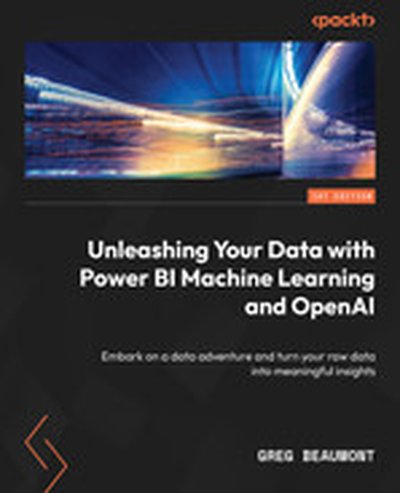
Power BI Machine Learning and OpenAI

Microsoft Power BI Machine Learning and OpenAI offers a comprehensive exploration into advanced data analytics and artificial intelligence using Microsoft Power BI. Through hands-on, workshop-style examples, readers will discover the integration of machine learning models and OpenAI features to enhance business intelligence. This book provides practical examples, real-world scenarios, and step-by-step guidance. What this Book will help me do Learn to apply machine learning capabilities within Power BI to create predictive analytics Understand how to integrate OpenAI services to build enhanced analytics workflows Gain hands-on experience in using R and Python for advanced data visualization in Power BI Master the skills needed to build and deploy SaaS auto ML models within Power BI Leverage Power BI's AI visuals and features to elevate data storytelling Author(s) Greg Beaumont, an expert in data science and business intelligence, brings years of experience in Power BI and analytics to this book. With a focus on practical applications, Greg empowers readers to harness the power of AI and machine learning to elevate their data solutions. As a consultant and trainer, he shares his deep knowledge to help readers unlock the full potential of their tools. Who is it for? This book is ideal for data analysts, BI professionals, and data scientists who aim to integrate machine learning and OpenAI into their workflows. If you're familiar with Power BI's fundamentals and are eager to explore its advanced capabilities, this guide is tailored for you. Perfect for professionals looking to elevate their analytics to a new level, combining data science concepts with Power BI's features.

We talked about:

Boyan's background What is data strategy? Due diligence and establishing a common goal Designing a data strategy Impact assessment, portfolio management, and DataOps Data products DataOps, Lean, and Agile Data Strategist vs Data Science Strategist The skills one needs to be a data strategist How does one become a data strategist? Data strategist as a translator Transitioning from a Data Strategist role to a CTO Using ChatGPT as a writing co-pilot Using ChatGPT as a starting point How ChatGPT can help in data strategy Pitching a data strategy to a stakeholder Setting baselines in a data strategy Boyan's book recommendations

Links:

LinkedIn: https://www.linkedin.com/in/angelovboyan/ Twitter: https://twitter.com/thinking_code Github: https://github.com/boyanangelov Website: https://boyanangelov.com/

Free MLOps course: https://github.com/DataTalksClub/mlops-zoomcamp Join DataTalks.Club: https://datatalks.club/slack.html Our events: https://datatalks.club/events.html