talk-data.com talk-data.com

Topic

Microsoft

technology software cloud

1606

tagged

Activity Trend

556 peak/qtr
2020-Q1 2026-Q1

Activities

1606 activities · Newest first

Practical PostgreSQL

Arguably the most capable of all the open source databases, PostgreSQL is an object-relational database management system first developed in 1977 by the University of California at Berkeley. In spite of its long history, this robust database suffers from a lack of easy-to-use documentation. Practical PostgreSQL fills that void with a fast-paced guide to installation, configuration, and usage. This comprehensive new volume shows you how to compile PostgreSQL from source, create a database, and configure PostgreSQL to accept client-server connections. It also covers the many advanced features, such as transactions, versioning, replication, and referential integrity that enable developers and DBAs to use PostgreSQL for serious business applications. The thorough introduction to PostgreSQL's PL/pgSQL programming language explains how you can use this very useful but under-documented feature to develop stored procedures and triggers. The book includes a complete command reference, and database administrators will appreciate the chapters on user management, database maintenance, and backup & recovery. With Practical PostgreSQL, you will discover quickly why this open source database is such a great open source alternative to proprietary products from Oracle, IBM, and Microsoft.
Sams Teach Yourself Microsoft Access 2002 in 21 Days

This book is a hands-on tutorial for Access users who want to learn Access by working through solid examples. It will show the reader how to use Access and how to develop solid databases from start to finish. The focus of the book will be Access databases on the desktop but will have two chapters on implementing Access in a networked or client/server environment. Key topics include understanding relational databases and the Access 2002 architecture; designing, building, and maintaining full-feature, robust database applications; implementing Data Access Pages; working with Visual Basic for Applications and the Visual Basic Editor; and publishing Access content to the WWW or a company's intranet.

XML and SQL: Developing Web Applications

"Dan's book provides something that the formal standards and development manuals sorely lack: a context that helps developers understand how to use XML in their own projects." --Tim Kientzle, Independent Software Consultant is a guide for Web developers and database programmers interested in building robust XML applications backed by SQL databases. It makes it easier than ever for Web developers to create and manage scalable database applications optimized for the Internet. XML and SQL: Developing Web Applications The author offers an understanding of the many advantages of both XML and SQL and provides practical information and techniques for utilizing the best of both systems. The book explores the stages of application development step by step, featuring a real-world perspective and many examples of when and how each technology is most effective. Specific topics covered include: Project definition for a data-oriented application Creating a bullet-proof data model DTDs (document type definitions) and the design of XML documents When to use XML, and what parts of your data should remain purely relational Related standards, such as XSLT and XML Schema How to use the XML support incorporated into Microsoft's SQL Server™ 2000 The XML-specific features of J2EE™ (Java™ 2 Enterprise Edition) Throughout this book, numerous concrete examples illustrate how to use each of these powerful technologies to circumvent the other's limitations. If you want to use the best part of XML and SQL to create robust, data-centric systems then there is no better resource than this book. 0201657961B10152001

Web Security, Privacy & Commerce, 2nd Edition

Since the first edition of this classic reference was published, World Wide Web use has exploded and e-commerce has become a daily part of business and personal life. As Web use has grown, so have the threats to our security and privacy--from credit card fraud to routine invasions of privacy by marketers to web site defacements to attacks that shut down popular web sites. Web Security, Privacy & Commerce goes behind the headlines, examines the major security risks facing us today, and explains how we can minimize them. It describes risks for Windows and Unix, Microsoft Internet Explorer and Netscape Navigator, and a wide range of current programs and products. In vast detail, the book covers: Web technology--The technological underpinnings of the modern Internet and the cryptographic foundations of e-commerce are discussed, along with SSL (the Secure Sockets Layer), the significance of the PKI (Public Key Infrastructure), and digital identification, including passwords, digital signatures, and biometrics. Web privacy and security for users--Learn the real risks to user privacy, including cookies, log files, identity theft, spam, web logs, and web bugs, and the most common risk, users' own willingness to provide e-commerce sites with personal information. Hostile mobile code in plug-ins, ActiveX controls, Java applets, and JavaScript, Flash, and Shockwave programs are also covered. Web server security--Administrators and service providers discover how to secure their systems and web services. Topics include CGI, PHP, SSL certificates, law enforcement issues, and more. Web content security--Zero in on web publishing issues for content providers, including intellectual property, copyright and trademark issues, P3P and privacy policies, digital payments, client-side digital signatures, code signing, pornography filtering and PICS, and other controls on web content. Nearly double the size of the first edition, this completely updated volume is destined to be the definitive reference on Web security risks and the techniques and technologies you can use to protect your privacy, your organization, your system, and your network.

Backing Up Oracle Using Tivoli Storage Management

This IBM Redbooks publication is designed to assist Oracle Database administrators and system/storage administrators with Oracle backup solutions using Tivoli Storage Manager V4.1. The primary tool we used for backup and recovery is Tivoli Data Protection (TDP) for Oracle V1.1, and the book covers setup and configuration of TDP as well as day-to-day management examples. Operating environments covered by the project are AIX, Sun Solaris, and Microsoft Windows 2000. We provide an overview of relational database management systems and how to plan for protecting them. This book will help you install, tailor, and configure Tivoli Storage Manager and Tivoli Data Protection for Oracle on UNIX and Microsoft Windows 2000 platforms in order to accomplish backup and restore of Oracle8i databases. RMAN commands and setup are covered in detail, and emphasis is placed on practical recovery scenarios. Also featured are new solutions utilizing Tivoli's hardware integration features for IBM's ESS intelligent storage subsystem, as well as an update on using TDP for Oracle V2.2 new features. Note: This book replaces relevant sections of the earlier book, Using ADSM to Back Up Databases, SG24-4335-03, by updating and re-branding the content of that book.

Ten Minute Guide to Microsoft® Visio® 2002

Because most people don't have the luxury of sitting down uninterrupted for hours at a time to learn Visio, this 10-Minute Guide focuses on the most often used features, covering them in lessons designed to take 10 minutes or less to complete. In addition, this guide teaches the user how to use Visio without relying on technical jargon, by providing straightforward, easy-to-follow explanations and lists of numbered steps that tell the user which keys to press and which options to select.

F. Scott Barker’s Microsoft Access 2002 Power Programming

F. Scott Barker's Access 2002 Power Programming gives many practical techniques for the corporate and independent developer. The main topics covered are: The Root of Power Programming; Manipulating and Presenting Data; Extending Access with Interoperability; Adding the Professional Look and Distributing Applications; Managing Databases; Adding Finishing Touches. New features of Access 2002 will be covered thoroughly, including: A whole new chapter devoted to Data Pages, which is Microsoft's way of bringing the Web interface into everyday office solutions. A new chapter clarifying the confusion over ADP/MDB and DAO/ADO. Including when and where to use each. There are a number of new additions to VBA which developers will need good exposure to in order to take advantage of them. A number of changes have been implemented in the form design with control features added.

Sams Teach Yourself Microsoft® Access 2002 Programming in 24 Hours

Sams Teach Yourself Access 2002 Programming in 24 Hours will considerably improve the quality of the database applications that the reader can create with Microsoft Access. Concise tutorials that quickly bring the reader up to speed will be the goal of each chapter. Having completed this book, the readers will be able to understand any sample VBA code that they see, and will possess the skills to attack all of the most common Access programming tasks. Topics covered in the book will include: ¨ Creating data aware web pages ¨ Creating views to organize data ¨ Building reusable code modules ¨ Programming reports ¨ Communicating results with graphing ¨ Automating contact and task management with Outlook ¨ Access programming for Internet Explorer

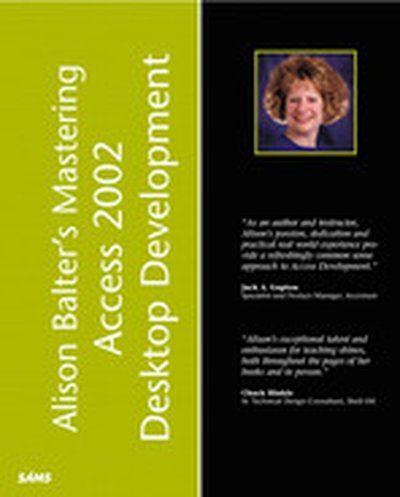
Alison Balter’s Mastering Microsoft Access 2002 Desktop Development

What Ms Balter's book offers over most or all of the other books on the market is that Ms Balter is able to take a highly technical topic and present it in a manner that is easy to comprehend. It is a book that the reader will often want to read from cover to cover, but it can also act as an excellent reference. Readers of Alison Balter's Mastering Microsoft Access 2002 Desktop Development will learn ( A thorough knowledge of Access application development. ( Real-world solutions to specific development and programming problems. ( Professional programming techniques backed by concise, no-nonsense explanations of the underlying theories. ( Debugging and troubleshooting methods to solve problems quickly and get stalled development projects back on track.

MySQL Building User Interfaces

MySQL: Designing User Interfaces starts by introducing the functionality of GTK+ and how to migrate from Microsoft's Visual Basic. It then introduces MySQL as a simple, fast, reliable database for corporate applications. The book then flows into the how-to of combining GTK+ and MySQL through the coverage of the C API for MySQL because it is the "backend" to a GTK+ application. It then expands its coverage and teaches about heterogeneous network and deployment issues, as well as migration from existing systems to MySQL.

Practical SQL Handbook, The: Using SQL Variants, Fourth Edition

This latest edition of the best-selling implementation guide to the Structured Query Language teaches SQL fundamentals while providing practical solutions for critical business applications. now includes expanded platform SQL coverage and extensive real-world examples based on feedback from actual SQL users. The Practical SQL Handbook, Fourth Edition begins with a step-by-step introduction to SQL basics and examines the issues involved in designing SQL-based database applications. It fully explores SQL’s most popular implementations from industry leaders, Oracle, Microsoft, Sybase, and Informix. The Practical SQL Handbook Highlights include: Detailed coverage of SQL commands for creating databases, tables, and indexes, and for adding, changing, and deleting data Using the SELECT command to retrieve specific data Handling NULL values (missing information) in a relational database Joining tables, including self joins and outer joins (ANSI and WHERE-clause syntax) Working with nested queries (subqueries) to get data from multiple tables Creating views (virtual tables) to provide customized access to data Using SQL functions A bonus CD-ROM contains a time-limited, full-feature version of the Sybase® Adaptive Server Anywhere™ software as well as the sample database, scripts, and examples included in the book. is the most complete reference available for day-to-day SQL implementations. The Practical SQL Handbook 0201703092B05222001

Microsoft® SQL Server™ 2000 Programming by Example

SQL Server 2000 Programming by Example provides clear and concise examples of basic programming techniques used in SQL Server 2000 primarily using Transact-SQL. Even if you're a complete novice to SQL Server 2000 programming, you will benefit by reading through the book's logical process. SQL Server 2000 is introduced and explored, database structure is designed and built, and finally a variety of programming techniques are studied and reviewed. If you are already familiar with SQL Server 2000 programming, you may use the book as a quick reference guide that provides plenty of pertinent examples.

Designing SQL Server 2000 Databases

The Microsoft .NET initiative is the future of e-commerce - making it possible for organisations to build a secure, reliable e-commerce infrastructure. This is the first book to outline the capabilities of SQL Server 2000, one of the key components of .NET. SQL Server 2000 introduces powerful new data mining functionality designed specifically to capture and process customer profiles and to predict future buying patterns on e-commerce sites. Designing SQL Server 2000 Databases addresses the needs of IT professionals migrating from the popular SQL 7 databases to the new SQL 2000, as well as those who are starting from scratch. Covers all key features of SQL Server 2000 including; XML support, enhanced data-mining capabilities and integration with Windows 2000 While there are many books available on SQL 7 - this is the first to be announced for SQL 2000 Free ongoing customer support and information upgrades

Learning XML

The arrival of support for XML--the Extensible Markup Language--in browsers and authoring tools has followed a long period of intense hype. Major databases, authoring tools (including Microsoft's Office 2000), and browsers are committed to XML support. Many content creators and programmers for the Web and other media are left wondering, "What can XML and its associated standards really do for me?" Getting the most from XML requires being able to tag and transform XML documents so they can be processed by web browsers, databases, mobile phones, printers, XML processors, voice response systems, and LDAP directories, just to name a few targets. In Learning XML, the author explains XML and its capabilities succinctly and professionally, with references to real-life projects and other cogent examples. Learning XML shows the purpose of XML markup itself, the CSS and XSL styling languages, and the XLink and XPointer specifications for creating rich link structures. The basic advantages of XML over HTML are that XML lets a web designer define tags that are meaningful for the particular documents or database output to be used, and that it enforces an unambiguous structure that supports error-checking. XML supports enhanced styling and linking standards (allowing, for instance, simultaneous linking to the same document in multiple languages) and a range of new applications. For writers producing XML documents, this book demystifies files and the process of creating them with the appropriate structure and format. Designers will learn what parts of XML are most helpful to their team and will get started on creating Document Type Definitions. For programmers, the book makes syntax and structures clear It also discusses the stylesheets needed for viewing documents in the next generation of browsers, databases, and other devices.

SQL in a Nutshell

SQL (Structured Query Language) is a standardized query language for requesting information from a database. Historically, SQL has been the choice for database management systems running on minicomputers and mainframes. Increasingly, however, SQL is being adapted to PC database systems because it supports distributed databases--databases that are spread out over several computer systems, so that several users on a local-area network can access the same database simultaneously. Although there are different dialects of SQL, it is the closest thing to a standard query language that currently exists. SQL in a Nutshell is a practical and useful command reference to the latest release of the Structured Query Language (SQL99), helping readers learn how their favorite database product supports any standard SQL command. This book presents each of the SQL commands and describes its use in both commercial (Microsoft SQL Server 2000 and Oracle 8 i) and open source (MySQL, PostgreSQL 7.0) implementations. Each command reference includes the command syntax (by vendor, if the syntax differs across implementations), a description, and informative examples that illustrate important concepts and uses. SQL in a Nutshell is more than a convenient reference guide for experienced SQL programmers, analysts, and database administrators. It's also a great learning resource for novice and auxiliary SQL users such as system administrators, users of packaged client/server products, and consultants who need to be familiar with the various SQL dialects across many platforms.

Inside XML

The XML explosion hardly needs any introduction-it's everywhere and there just seems to be no end to what can be done with XML. While writing to the W3C standards, and keeping up with the pace for corporate implementation, you, the programmer or web developer, will need a comprehensive guide to get you started and show you what XML and its related technologies can do. A thorough guide is imperative to success because you will need to know and understand the full scope of XML from day one in order to work with it successfully. With your time constraints and impossible project schedules, you need a comprehensive guide that fulfills your needs in one complete book. Inside XML is an anchor book that covers both the Microsoft and non-Microsoft approach to XML programming. It covers in detail the hot aspects of XML; such as, DTD's vs. XML Schemas, CSS, XSL, XSLT, Xlinks, Xpointers, XHTML, RDF, CDF, parsing XML in Perl and Java, and much more.

Essential Guide to Computing: The Story of Information Technology, The

The complete, easy-to-understand guide to IT—now and in the future! Computers, networks, and pervasive computing Hardware, operating systems, and software How networks work: LANs, WANs, and the Internet E-business, the Web, and security The guide for ANYONE who needs to understand the key technologies driving today's economy and high tech industries! You can't afford not to understand the information revolution that's sweeping the world-but who's got time for all the acronyms and hype most technology books give you? The Essential Guide to Computing demystifies the digital society we live in with an intelligent, thorough, and up-to-date explanation of computer, networking, and Internet technologies. It's perfect for smart professionals who want to get up to speed, but don't have computer science or engineering degrees! You'll find up-to-the-minute coverage on all of today's hottest technologies including: The evolution of computing: from the room-sized "monoliths" of the 1950s to today's global Internet Preview of the next revolution: "pervasive computing" Computer hardware: microprocessors, memory, storage, I/O, displays, and architecture Windows, Macintosh, UNIX/Linux, DOS, NetWare, Palm: what operating systems do, and how they compare Programming languages: from machine language to advanced object-oriented technologies Key software applications: databases, spreadsheets, word processing, voice recognition, and beyond Microsoft and the software industry: where they stand, where they're headed How networks work: LANs, WANs, packet switching, hardware, media, and more The Internet, e-commerce, and security Enterprise applications: data warehousing, Web-centered development, and groupware Whether you're a consumer, investor, marketer, or executive, this is your start-to-finish briefing on the information technologies that have changed the world-and the coming technologies that will transform it yet again!

Writing Stored Procedures for Microsoft SQL Server

Writing Stored Procedures for Microsoft SQL Server focuses on teaching you not only how to build effective stored procedures, but also how to optimize and streamline them for long term use. Get an understanding of how SQL Server interprets stored procedures verses direct access via SQL queries. This is followed by detailed instructions on creating and maintaining a repository of stored procedures. Once you know how stored procedures are created and built, you are taught how to determine which logic within an application makes sense to be put into this scheme. Additionally, you're provided with guidance on making stored procedures that are portable across applications.

The Guru's Guide to Transact-SQL

Since its introduction over a decade ago, the Microsoft SQL Server query language, Transact-SQL, has become increasingly popular and more powerful. The current version sports such advanced features as OLE Automation support, cross-platform querying facilities, and full-text search management. This book is the consummate guide to Microsoft Transact-SQL. From data type nuances to complex statistical computations to the bevy of undocumented features in the language, imparts the knowledge you need to become a virtuoso of the language as quickly as possible. The Guru's Guide to Transact-SQL In this book, you will find the information, explanations, and advice you need to master Transact-SQL and develop the best possible Transact-SQL code. Some 600 code examples not only illustrate important concepts and best practices, but also provide working Transact-SQL code that can be incorporated into your own real-world DBMS applications. Your journey begins with an introduction explaining language fundamentals such as database and table creation, inserting and updating data, queries, joins, data presentation, and managing transactions. Moving on to more advanced topics, the journey continues with in-depth coverage of: Transact-SQL performance tuning using tools such as Query Analyzer and Performance Monitor Nuances of the various T-SQL data types Complex statistical calculations such as medians, modes, and sliding aggregates Run, sequence, and series identification and interrogation Advanced Data Definition Language (DDL) and Data Management Language (DML) techniques Stored procedure and trigger best practices and coding methods Transaction management Optimal cursor use and caveats to look out for Full-text search Hierarchies and arrays Administrative Transact-SQL OLE Automation More than 100 undocumented commands and language features, including numerous unpublished DBCC command verbs, trace flags, stored procedures, and functions Comprehensive, written in understandable terms, and full of practical information and examples, is an indispensable reference for anyone working with this database development language. The accompanying CD-ROM includes the complete set of code examples found in the book as well as a SQL programming environment that will speed the development of your own top-notch Transact-SQL code. The Guru's Guide to Transact-SQL