talk-data.com talk-data.com

Topic

MySQL

relational_database open_source sql

268

tagged

Activity Trend

27 peak/qtr
2020-Q1 2026-Q1

Activities

268 activities · Newest first

MySQL® Administrator's Bible

With special focus on the next major release of MySQL, this resource provides a solid framework for anyone new to MySQL or transitioning from another database platform, as well as experience MySQL administrators. The high-profile author duo provides essential coverage of the fundamentals of MySQL database management—including MySQL’s unique approach to basic database features and functions—as well as coverage of SQL queries, data and index types, stores procedure and functions, triggers and views, and transactions. They also present comprehensive coverage of such topics as MySQL server tuning, managing storage engines, caching, backup and recovery, managing users, index tuning, database and performance monitoring, security, and more.

Learning SQL, 2nd Edition

Updated for the latest database management systems -- including MySQL 6.0, Oracle 11g, and Microsoft's SQL Server 2008 -- this introductory guide will get you up and running with SQL quickly. Whether you need to write database applications, perform administrative tasks, or generate reports, Learning SQL, Second Edition, will help you easily master all the SQL fundamentals. Each chapter presents a self-contained lesson on a key SQL concept or technique, with numerous illustrations and annotated examples. Exercises at the end of each chapter let you practice the skills you learn. With this book, you will: Move quickly through SQL basics and learn several advanced features Use SQL data statements to generate, manipulate, and retrieve data Create database objects, such as tables, indexes, and constraints, using SQL schema statements Learn how data sets interact with queries, and understand the importance of subqueries Convert and manipulate data with SQL's built-in functions, and use conditional logic in data statements Knowledge of SQL is a must for interacting with data. With Learning SQL, you'll quickly learn how to put the power and flexibility of this language to work.

PHP6 and MySQL® 6 Bible

MySQL is the leading open source database on the market and PHP continues to dominate the server side of the scripting market—together, they are the most popular and common team for creating dynamic, database-driven web sites. This comprehensive book covers the newest version of PHP and MySQL and is packed with extensive code examples, full working applications, and valuable troubleshooting advice. You’ll explore installing, developing, and debugging the latest versions of PHP and MySQL and get insight on advanced topics such as error handling, debugging, PEAR, security, HTTP, cookies, and OOP.

SQL in a Nutshell, 3rd Edition

For programmers, analysts, and database administrators, SQL in a Nutshell is the essential reference for the SQL language used in today's most popular database products. This new edition clearly documents every SQL command according to the latest ANSI standard, and details how those commands are implemented in Microsoft SQL Server 2008, Oracle 11g, and the MySQL 5.1 and PostgreSQL 8.3 open source database products. You'll also get a concise overview of the Relational Database Management System (RDBMS) model, and a clear-cut explanation of foundational RDBMS concepts -- all packed into a succinct, comprehensive, and easy-to-use format. This book provides: Background on the Relational Database Model, including current and previous SQL standards Fundamental concepts necessary for understanding relational databases and SQL commands An alphabetical command reference to SQL statements, according to the SQL2003 ANSI standard The implementation of each command by MySQL, Oracle, PostgreSQL, and SQL Server An alphabetical reference of the ANSI SQL2003 functions, as well as the vendor implementations Platform-specific functions unique to each implementation Beginning where vendor documentation ends, SQL in a Nutshell distills the experiences of professional database administrators and developers who have used SQL variants to support complex enterprise applications. Whether SQL is new to you, or you've been using SQL since its earliest days, you'll get lots of new tips and techniques in this book.

Beginning Database Design Solutions

This book is intended for IT professionals and students who want to learn how to design, analyze, and understand databases. The material will benefit those who want a better high-level understanding of databases such as proposal managers, architects, project managers, and even customers. The material will also benefit those who will actually design, build, and work with databases such as database designers, database administrators, and programmers. In many projects, these roles overlap so the same person may be responsible for working on the proposal, managing part of the project, and designing and creating the database. This book is aimed at IT professionals and students of all experience levels. It does not assume that you have any previous experience with databases or programs that use them. It doesn't even assume that you have experience with computers. All you really need is a willingness and desire to learn. This book explains database design. It tells how to plan a database's structure so the database will be robust, resistant to errors, and flexible enough to accommodate a reasonable amount of future change. It explains how to discover database requirements, build data models to study data needs, and refine those models to improve the database's effectiveness. The book solidifies these concepts by working through a detailed example that designs a realistic database. Later chapters explain how to actually build databases using two common database products: Access 2007 and MySQL. The book finishes by describing some of the topics you need to understand to keep a database running effectively such as database maintenance and security. This book explains database design. It tells how to determine what should go in a database and how the database should be structured to give the best results. This book does not focus on actually creating the database. The details of database construction are different for different database tools so, to remain as generally as useful as possible, this book doesn't concentrate on any particular database system. You can apply the techniques described here equally to whatever database tool you use whether it's Access, SQL Server, Oracle, MySQL, or some other database product. Most database products include free editions that you can use for smaller projects. For example, SQL Server Express Edition, Oracle Express Edition, and MySQL Community Server are all free. To remain database neutral, the book does not assume you are using a particular database so you don't need any particular software or hardware. To work through the Exercises, all you really need is a pencil and some paper. You are welcome to type solutions into your computer if you like but you may actually find working with pencil and paper easier than using a graphical design tool to draw pictures, at least until you are comfortable with database design and are ready to pick a computerized design tool. "Goals of Effective Database Design," explains the reasons why people and organizations use databases. It explains a database's purpose and conditions that it must satisfy to be useful. This also describes the basic ACID (Atomicity, Consistency, Isolation, Durability) and CRUD (Create, Read, Update, Delete) features that any good database should have. It explains in high-level general terms what makes a good database and what makes a bad database. "Database Types," explains some of the different types of databases that you might decide to use. These include flat files, spreadsheets, hierarchical databases (XML), object databases, and relational databases. The relational database is one of the most powerful and most commonly used forms of database so it is the focus of this book, but it is important to realize that there are alternatives that may be more appropriate under certain circumstances. This gives some tips on deciding which kind of database might be best for a particular project. "Relational Database Fundamentals," explains basic relational database concepts such as tables, rows, and columns. It explains the common usage of relational database terms in addition to the more technical terms that are sometimes used by database theorists. It describes different kinds of constraints that databases use to guarantee that the data is stored safely and consistently. "Understanding User Needs," explains how to learn about the users' needs and gather user requirements. It tells how to study the users' current operations, existing databases (if any), and desired improvements. It describes common questions that you can ask to learn about users' operations, desires, and needs, and how to build the results into requirements documents and specifications. This explains what use cases are and tells how to use them and the requirements to guide database design and to measure success. "Translating User Needs into Data Models," introduces data modeling. It explains how to translate the user's conceptual model and the requirements into other more precise models that define the database design rigorously. This describes several database modeling techniques including user-interface models, semantic object models, entity-relationship diagrams, and relational models. "Extracting Business Rules," explains how a database can handle business rules. It explains what business rules are, how they differ from database structure requirements, and how you can identify business rules. This explains the benefits of separating business rules from the database structure and tells how achieve that separation. "Normalizing Data," explains one of the biggest tools in database design: normalization. Normalization techniques allow you to restructure a database to increase its flexibility and make it more robust. This explains the various forms of normalization, emphasizing the stages that are most common and important: first, second, and third normal forms (1NF, 2NF, and 3NF). It explains how each of these kinds of normalization helps prevent errors and tells why it is sometimes better to leave a database slightly less normalized to improve performance. "Designing Databases to Support Software Applications," explains how databases fit into the larger context of application design and lifecycle. This explains how later development depends on the underlying database design. It discusses multi-tier architectures that can help decouple the application and database design so there can be at least some changes to either without requiring changes to the other. "Common Design Patterns," explains some common patterns that are useful in many applications. Some of these techniques include implementing various kinds of relationships among objects, storing hierarchical and network data, recording temporal data, and logging and locking. "Common Design Pitfalls," explains some common design mistakes that occur in database development. It describes problems that can arise from insufficient planning, incorrect normalization, and obsession with ID fields and performance. "User Needs and Requirements," walks through the steps required to analyze the users' problem, define requirements, and create use cases. It describes interviews with fictitious customers that are used to identify the application's needs and translate them into database requirements. "Building a Data Model," translates the requirements gathered in the previous into a series of data models that precisely define the database's structure. This builds user-interface models, entity-relationship diagrams, semantic object models, and relational models to refine the database's initial design. The final relational models match the structure of a relational database fairly closely so they are easy to implement. "Extracting Business Rules," identifies the business rules embedded in the relational model. It shows how to extract those rules in order to separate them logically from the database's structure. This makes the database more robust in the face of future changes to the business rules. "Normalization and Refinement," refines the relational model by normalizing it. It walks through several versions of the database that are in different normal forms. It then selects the degree of normalization that provides a reasonable tradeoff between robust design and acceptable performance. "Microsoft Access," explains how to build a database with Microsoft Access 2007. This explains enough to get started and to use Access to build non-trivial databases. You can use other versions of Access to work through this, although the locations of menus, buttons, and other Access features are different in different versions. "MySQL," explains how to build a database with MySQL. This tells where to download a free version of MySQL. It explains how to use the MySQL Command Line Client as well as some useful graphical tools including MySQL Query Browser and MySQL Workbench. "Introduction to SQL," provides an introduction to SQL (Structured Query Language). It explains how to use SQL commands to add, insert, update, and delete data. By using SQL, you can help insulate a program from the idiosyncrasies of the particular database product that it uses to store data. "Building Databases with SQL Scripts," explains how to use SQL scripts to build a database. It explains the advantages of this technique, such as the ability to create scripts to initialize a database before performing tests. It also explains some of the restrictions on this method, such as the fact that the user must create and delete tables in specific orders to satisfy table relationships. "Database Maintenance," describes some of the database maintenance issues that are part of any database application. Though performing and restoring backups, compressing tables, rebuilding indexes, and populating data warehouses are strictly not database design tasks, they are essential to any working application. "Database Security," explains database security issues. It explains the kinds of security that some database products provide. It also explains some additional techniques that can enhance database security such as using database views to appropriately restrict the users' access to data.

SQL: A Beginner's Guide, Third Edition, 3rd Edition

Essential Skills--Made Easy! Written to the SQL:2006 ANSI/ISO standard, this easy-to-follow guide will get you started programming in SQL right away. You will learn how to retrieve, insert, update, and delete database data, and perform management and administrative functions. SQL: A Beginner's Guide, Third Edition covers new features, including SQL/XML, and is loaded with updated SQL examples along with notes on using them with the latest RDBMS software versions such as MySQL 5.0, SQL Server 2008, and Oracle Database 11g. Designed for Easy Learning: Key Skills & Concepts--Lists of specific skills covered in the chapter Ask the Experts--Q&A sections filled with bonus information and helpful tips Try This--Hands-on exercises that show how to apply your skills Notes--Extra information related to the topic being covered Self-Tests--Chapter-ending quizzes to test your knowledge Annotated Syntax--Example code with commentary that describes the programming techniques being illustrated

MySQL®

The Definitive Guide to Using, Programming, and Administering MySQL 5.0 and 5.1 MySQL is an open source relational database management system that has experienced a phenomenal growth in popularity and use. Known for its speed and ease of use, MySQL has proven itself to be particularly well-suited for developing database-backed websites and applications. In MySQL, Paul DuBois provides a comprehensive guide to using and administering MySQL effectively and productively. He describes everything from the basics of getting information into a database and formulating queries, to using MySQL with PHP or Perl to generate dynamic web pages, to writing your own programs that access MySQL databases, to administering MySQL servers. The fourth edition of this bestselling book has been meticulously revised and updated to thoroughly cover the latest features and capabilities of MySQL 5.0, as well as to add new coverage of features introduced with MySQL 5.1. “One of the best technical books I have read on any subject.” –Gregory Haley, C Vu, The Association of C & C++ Users “A top-notch user’s guide and reference manual, and in my opinion, the only book you’ll need for the daily operation and maintenance of MySQL databases.” –Eugene Kim, Web Techniques Introduction 1 Part I: General MySQL Use Chapter 1: Getting Started with MySQL 13 Chapter 2: Using SQL to Manage Data 101 Chapter 3: Data Types 201 Chapter 4: Stored Programs 289 Chapter 5: Query Optimization 303 Part II: Using MySQL Programming Interfaces Chapter 6: Introduction to MySQL Programming 341 Chapter 7: Writing MySQL Programs Using C 359 Chapter 8: Writing MySQL Programs Using Perl DBI 435 Chapter 9: Writing MySQL Programs Using PHP 527 Part III: MySQL Administration Chapter 10: Introduction to MySQL Administration 579 Chapter 11: The MySQL Data Directory 585 Chapter 12: General MySQL Administration 609 Chapter 13: Access Control and Security 699 Chapter 14: Database Maintenance, Backups, and Replication 737 Part IV: Appendixes Appendix A: Obtaining and Installing Software 777 Appendix B: Data Type Reference 797 Appendix C: Operator and Function Reference 813 Appendix D: System, Status, and User Variable Reference 889 Appendix E: SQL Syntax Reference 937 Appendix F: MySQL Program Reference 1037 Note: Appendixes G, H, and I are located online and are accessible either by registering this book at informit.com/register or by visiting www.kitebird.com/mysql-book. Appendix G: C API Reference 1121 Appendix H: Perl DBI API Reference 1177 Appendix I: PHP API Reference 1207 Index 1225

High Performance MySQL, 2nd Edition

High Performance MySQL is the definitive guide to building fast, reliable systems with MySQL. Written by noted experts with years of real-world experience building very large systems, this book covers every aspect of MySQL performance in detail, and focuses on robustness, security, and data integrity. High Performance MySQL teaches you advanced techniques in depth so you can bring out MySQL's full power. Learn how to design schemas, indexes, queries and advanced MySQL features for maximum performance, and get detailed guidance for tuning your MySQL server, operating system, and hardware to their fullest potential. You'll also learn practical, safe, high-performance ways to scale your applications with replication, load balancing, high availability, and failover. This second edition is completely revised and greatly expanded, with deeper coverage in all areas. Major additions include: Emphasis throughout on both performance and reliability Thorough coverage of storage engines, including in-depth tuning and optimizations for the InnoDB storage engine Effects of new features in MySQL 5.0 and 5.1, including stored procedures, partitioned databases, triggers, and views A detailed discussion on how to build very large, highly scalable systems with MySQL New options for backups and replication Optimization of advanced querying features, such as full-text searches Four new appendices The book also includes chapters on benchmarking, profiling, backups, security, and tools and techniques to help you measure, monitor, and manage your MySQL installations.

Sams Teach Yourself PHP, MySQL and Apache All in One, Fourth Edition

Sams Teach Yourself PHP, MySQL® and Apache All in One Fourth Edition Julie C. Meloni Starter Kit CD-ROM includes a complete starter kit for Windows®, Linux®, and Mac® OS X In just a short time, you can learn how to use PHP, MySQL, and Apache together to create dynamic, interactive websites and applications using the three leading open-source web development technologies. Using a straightforward, step-by-step approach, each lesson in this book builds on the previous ones, enabling you to learn the essentials of PHP scripting, MySQL databases, and the Apache web server from the ground up. Regardless of whether you run Linux, Windows, or Mac OS X, the enclosed CD includes a complete starter kit that lets you install all the software you need to set up a stable environment for learning, testing, and production. Learn how to… Install, configure, and set up the PHP scripting language, the MySQL database system, and the Apache Web server Get these technologies to work together to create a dynamic, database-backed website Interact with MySQL using PHP Work with forms and files Create a web-based discussion forum or mailing list Add a storefront and shopping cart to your site Optimize your MySQL databases Fine-tune the Apache server’s performance Restrict access to your applications Set up a secure web server Julie C. Meloni is the technical director for i2i Interactive, a multimedia company located in Los Altos, California. She has been developing web-based applications since the early days of the web, and is the author of several books and articles on web-based programming languages and database topics, including Sams Teach Yourself MySQL in 24 Hours. CD-ROM Includes A complete PHP, MySQL, and Apache starter kit for Windows®, Linux®, or Mac® OS X. Category: Web Development Covers: PHP 5.2, MySQL 5, Apache 2.2 User Level: Beginning

Essential SQLAlchemy

Essential SQLAlchemy introduces a high-level open-source code library that makes it easier for Python programmers to access relational databases such as Oracle, DB2, MySQL, PostgreSQL, and SQLite. SQLAlchemy has become increasingly popular since its release, but it still lacks good offline documentation. This practical book fills the gap, and because a developer wrote it, you get an objective look at SQLAlchemy's tools rather than an advocate's description of all the "cool" features. SQLAlchemy includes both a database server-independent SQL expression language and an object-relational mapper (ORM) that lets you map "plain old Python objects" (POPOs) to database tables without substantially changing your existing Python code. Essential SQLAlchemy demonstrates how to use the library to create a simple database application, walks you through simple queries, and explains how to use SQLAlchemy to connect to multiple databases simultaneously with the same Metadata. You also learn how to: Create custom types to be used in your schema, and when it's useful to use custom rather than built-in types Run queries, updates, and deletes with SQLAlchemy's SQL expression language Build an object mapper with SQLAlchemy, and understand the differences between this and active record patterns used in other ORMs Create objects, save them to a session, and flush them to the database Use SQLAlchemy to model object oriented inheritance Provide a declarative, active record pattern for use with SQLAlchemy using the Elixir extension Use the SQLSoup extension to provide an automatic metadata and object model based on database reflection In addition, you'll learn how and when to use other extensions to SQLAlchemy, including AssociationProxy, OrderingList, and more. Essential SQLAlchemy is the much-needed guide for every Python developer using this code library. Instead of a feature-by-feature documentation, this book takes an "essentials" approach that gives you exactly what you need to become productive with SQLAlchemy right away.

Sams Teach Yourself SQL in 24 Hours, Fourth Edition

In just 24 lessons of one hour or less, you will learn professional techniques to design and build efficient databases and query them to extract useful information. Using a straightforward, step-by-step approach, each lesson builds on the previous one, allowing you to learn the essentials of ANSI SQL from the ground up. Example code demonstrates the authors’ professional techniques, while exercises written for MySQL offer the reader hands-on learning with an open-source database. Included are advanced techniques for using views, managing transactions, database administration, and extending SQL. Step-by-step instructions carefully walk you through the most common SQL tasks. Q&As, Quizzes, and Exercises at the end of each chapter help you test your knowledge. Notes and Tips point out shortcuts and solutions. New terms are clearly defined and explained. Learn how to… Use SQL-2003, the latest standard for the Structured Query Language Design and deploy efficient, secure databases Build advanced queries for information retrieval Sort, group, and summarize information for best presentation Tune databases and queries for maximum performance Understand database administration and security techniques For more than ten years the authors have studied, applied, and documented the SQL standard and its application to critical database systems. Ryan Stephens and Ron Plew are entrepreneurs, speakers, and cofounders of Perpetual Technologies, Inc. (PTI), a fast-growing IT management and consulting firm which specializes in database technologies. They taught database courses for Indiana University–Purdue University in Indianapolis for five years and have authored more than a dozen books on Oracle, SQL, database design, and the high availability of critical systems. Arie D. Jones is Senior SQL Server database administrator and analyst for PTI. He is a regular speaker at technical events and has authored several books and articles. Category: Database Covers: ANSI SQL User Level: Beginning–Intermediate Register your book at informit.com/title/9780672330186 for convenient access to updates and corrections as they become available.

MySQL in a Nutshell, 2nd Edition

When you need to find the right SQL keyword or MySQL client command-line option right away, turn to this convenient reference, known for the same speed and flexibility as the system it covers so thoroughly. MySQL is packed with so many capabilities that the odds of remembering a particular function or statement at the right moment are pretty slim. With MySQL in a Nutshell, you get the details you need, day in and day out, in one concise and extremely well organized book. The new edition contains all the commands and programming information for version 5.1, including new features and language interfaces. It's ideal for anyone using MySQL, from novices who need to get up to speed to advanced users who want a handy reference. Like all O'Reilly Nutshell references, it's easy to use and highly authoritative, written by the editor of the MySQL Knowledge Base at MySQL AB, the creator and owner of MySQL. Inside, you'll find: A thorough reference to MySQL statements, functions, and administrative utilities Several tutorial chapters to help newcomers get started Programming language APIs for PHP, Perl, and C Brief tutorials at the beginning of each API chapter to help anyone, regardless of experience level, understand and master unfamiliar territory New chapters on replication, triggers, and stored procedures Plenty of new examples of how MySQL is used in practice Useful tips to help you get through the most difficult subjectsWhether you employ MySQL in a mission-critical, heavy-use environment or for applications that are more modest, this book puts a wealth of easy-to-find information at your fingertips, saving you hundreds of hours of trial and error and tedious online searching. If you're ready to take advantage of everything MySQL has to offer, MySQL in a Nutshell has precisely what it takes.

PHP & MySQL® Web Development All-in-One Desk Reference for Dummies®

If you want to build dynamic Web sites that encourage users to interact with them, PHP and MySQL are among the best tools you’ll find. PHP is a scripting language designed specifically for use on the Web, while MySQL is a database management system that works with it perfectly. Best of all, they’re free. It’s hard to beat that combination! PHP & MySQL Web Development All-in-One Desk Reference For Dummies is kind of one-stop shopping for the information you need to get up and running with these tools and put them to good use. It’s divided into six handy minibooks that cover setting up your environment, PHP programming, using MySQL, security, PHP extensions, and PHP Web applications. They make it easy to create a Web site where visitors can sign on, use shopping carts, complete forms, and do business with your business. It’s easy to find what you need in this handy guide. You’ll discover how to: Find and acquire all the tools you need and set up your development environment Build PHP scripts to make your Web site work Create a MySQL database that visitors can access Summarize and sort data results Design and implement user access control Build a shopping cart application Create extensions that make your site more useful With PHP & MySQL Web Development All-in-One Desk Reference For Dummies by your side, you’ll be a Web site guru before you know it!

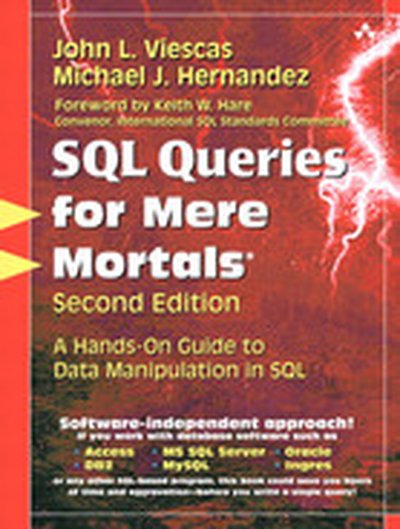
SQL Queries for Mere Mortals: A Hands-On Guide to Data Manipulation in SQL, Second Edition

Unless you are working at a very advanced level, this is the only SQL book you will ever need. The authors have taken the mystery out of complex queries and explained principles and techniques with such clarity that a "Mere Mortal" will indeed be empowered to perform the superhuman. Do not walk past this book! --Graham Mandeno, Database Consultant provides a step-by-step, easy-to-read introduction to writing SQL queries. It includes hundreds of examples with detailed explanations. This book provides the tools you need to understand, modify, and create SQL queries SQL Queries for Mere Mortals --Keith W. Hare, Convenor, ISO/IEC JTC1 SC32 WG3--the International SQL Standards Committee I learned SQL primarily from the first edition of this book, and I am pleased to see a second edition of this book so that others can continue to benefit from its organized presentation of the language. Starting from how to design your tables so that SQL can be effective (a common problem for database beginners), and then continuing through the various aspects of SQL construction and capabilities, the reader can become a moderate expert upon completing the book and its samples. Learning how to convert a question in English into a meaningful SQL statement will greatly facilitate your mastery of the language. Numerous examples from real life will help you visualize how to use SQL to answer the questions about the data in your database. Just one of the "watch out for this trap" items will save you more than the cost of the book when you avoid that problem when writing your queries. I highly recommend this book if you want to tap the full potential of your database. --Kenneth D. Snell, Ph.D., Database Designer/Programmer I don't think they do this in public schools any more, and it is a shame, but do you remember in the seventh and eighth grades when you learned to diagram a sentence? Those of you who do may no longer remember how you did it, but all of you do write better sentences because of it. John Viescas and Mike Hernandez must have remembered because they take everyday English queries and literally translate them into SQL. This is an important book for all database designers. It takes the complexity of mathematical Set Theory and of First Order Predicate Logic, as outlined in E. F. Codd's original treatise on relational database design, and makes it easy for anyone to understand. If you want an elementary- through intermediate-level course on SQL, this is the one book that is a requirement, no matter how many others you buy. --Arvin Meyer, MCP, MVP Even in this day of wizards and code generators, successful database developers still require a sound knowledge of Structured Query Language (SQL, the standard language for communicating with most database systems). In this book, John and Mike do a marvelous job of making what's usually a dry and difficult subject come alive, presenting the material with humor in a logical manner, with plenty of relevant examples. I would say that this book should feature prominently in the collection on the bookshelf of all serious developers, except that I'm sure it'll get so much use that it won't spend much time on the shelf! -- Doug Steele, Microsoft Access Developer and author Over the last several decades, SQL has evolved from a language known only to computer specialists to a widely used international standard of the computer industry. The number of new applications deployed each year using SQL now totals in the millions. If you are accessing corporate information from the Internet or from an internal network, you are probably using SQL. This new edition of helps new users learn the foundations of SQL queries, and is an essential reference guide for intermediate and advanced users. SQL Queries for Mere Mortals The accompanying CD contains five sample databases used for the example queries throughout the book in four different formats: Microsoft SQL Server 2000 and later, Microsoft Access 2000 and later, MySQL version 5.0 and later, and SQL scripts that can be used with most other implementations of the language.

Learning PHP & MySQL, 2nd Edition

PHP and MySQL are quickly becoming the de facto standard for rapid development of dynamic, database-driven web sites. This book is perfect for newcomers to programming as well as hobbyists who are intimidated by harder-to-follow books. With concepts explained in plain English, the new edition starts with the basics of the PHP language, and explains how to work with MySQL, the popular open source database. You then learn how to put the two together to generate dynamic content. If you come from a web design or graphics design background and know your way around HTML, Learning PHP & MySQL is the book you've been looking for. The content includes: PHP basics such as strings and arrays, and pattern matching A detailed discussion of the variances in different PHP versions MySQL data fundamentals like tables and statements Information on SQL data access for language A new chapter on XHTML Error handling, security, HTTP authentication, and more Learning PHP & MySQL explains everything from fundamental concepts to the nuts and bolts of performing specific tasks. As part of O'Reilly's bestselling Learning series, the book is an easy-to-use resource designed specifically for beginners. It's a launching pad for future learning, providing you with a solid foundation for more advanced development.

MySQL Pocket Reference, 2nd Edition

To help you be more efficient in your work, this handy pocket reference gives you instant reminders on how to use important MySQL functions, especially in conjunction with key parts of the LAMP open source infrastructure. This powerful database system is so rich in features that no administrator or programmer can stay familiar with all of them. MySQL Pocket Reference is an ideal on-the-job companion, well organized to help you find and adapt the statements you need -- quickly. Updated for the latest versions of this popular database, this edition covers many complex features that have been added to MySQL 5.0 and 5.1, including a section dedicated to stored procedures and triggers. After a brief introduction on installation and initial setup, the book explains: You don't have time to stop and thumb through an exhaustive reference when you're hard at work. This portable and affordable guide is small enough to fit into your pocket, and gives you a convenient reference that you can consult anywhere. When you reach a sticking point and need to get to a solution quickly, the How to configure MySQL, such as setting the root password MySQL data types, including numerics, strings, dates, and complex types SQL syntax, commands, data types, operators, and functions Arithmetic, comparison and logical operators Aggregate and general functions Stored procedures and triggers, including procedure definition, procedure calls, procedure management, cursors, and triggers MySQL Pocket Reference is the book you want to have.

SQL for MySQL Developers: A Comprehensive Tutorial and Reference

The Most Complete and Practical Guide to MySQL Version 5’s Powerful SQL Dialect MySQL version 5 offers a SQL dialect with immense power. In SQL for MySQL Developers, Rick F. van der Lans helps you master this version ofSQL and take advantage of its full potential. Using case study examplesand hands-on exercises, van der Lans illuminates every key concept,technique, and statement–including advanced features that make iteasier to create even the most complex statements and programs. Drawing on decades of experience as an SQL standards team member and enterprise consultant, he reveals exactly why MySQL’s dialect works as it does–and how to get the most out of it. You’ll gain powerful insight into everything from basic queries to stored procedures, transactions to data security. Whether you’re a programmer, Web developer, analyst, DBA, or database user, this book can take you from “apprentice” to true SQL expert. If you’ve used SQL in older versions of MySQL, you’ll become dramatically more effective–and if you’re migrating from other database platforms, you’ll gain practical mastery fast. Coverage includes Writing queries, including joins, functions, and subqueries Updating data Creating tables, views, and other database objects Specifying keys and other integrity constraints Improving efficiency with indexes Enforcing security via passwords and privileges Embedding SQL statements within PHP programs Building stored procedures and triggers Using transactions, locking, rollback, and isolation levels Utilizing MySQL’s catalog All of the book’s sample programs are available for download from www.r20.nl. About the Author Rick F. van der Lans is author of the classic Introduction to SQL, the definitive SQL guide that database developers have relied on for more than 20 years. He is a consultant, author, and lecturer specializing in database technology, development tools, data warehousing, and XML. As managing director of the Netherlands-based R20/Consultancy, he has advised many large companies on defining their IT architectures. He chairs the European Meta Data Conference, and writes columns for several magazines. Contents About the Author Preface PART I Introduction CHAPTER 1 Introduction to MySQL CHAPTER 2 The Tennis Club Sample Database CHAPTER 3 Installing the Software CHAPTER 4 SQL in a Nutshell PART II Querying and Updating Data CHAPTER 5 SELECT Statement: Common Elements CHAPTER 6 SELECT Statements, Table Expressions, and Subqueries CHAPTER 7 SELECT Statement:The FROM Clause CHAPTER 8 SELECT Statement: The WHERE Clause CHAPTER 9 SELECT Statement: SELECT Clause and Aggregation Functions CHAPTER 10 SELECT Statement: The GROUP BY Clause CHAPTER 11 SELECT Statement: The HAVING Clause CHAPTER 12 SELECT Statement: The ORDER BY Clause CHAPTER 13 SELECT Statement: The LIMIT Clause CHAPTER 14 Combining Table Expressions CHAPTER 15 The User Variable and the SET Statement CHAPTER 16 The HANDLER Statement CHAPTER 17 Updating Tables CHAPTER 18 Loading and Unloading Data CHAPTER 19 Working with XML Documents PART III Creating Database Objects CHAPTER 20 Creating Tables CHAPTER 21 Specifying Integrity Constraints CHAPTER 22 Character Sets and Collations CHAPTER 23 The ENUM and SET Types CHAPTER 24 Changing and Dropping Tables CHAPTER 25 Using Indexes CHAPTER 26 Views CHAPTER 27 Creating Databases CHAPTER 28 Users and Data Security CHAPTER 29 Statements for Table Maintenance CHAPTER 30 The SHOW, DESCRIBE, and HELP Statements PART IV Procedural Database Objects CHAPTER 31 Stored Procedures CHAPTER 32 Stored Functions CHAPTER 33 Triggers CHAPTER 34 Events PART V Programming with SQL CHAPTER 35 MySQL and PHP CHAPTER 36 Dynamic SQL with Prepared Statement CHAPTER 37 Transactions and Multiuser Usage APPENDIX A Syntax of SQL APPENDIX B Scalar Functions APPENDIX C System Variables APPENDIX D Bibliography Index

Understanding MySQL Internals

Although MySQL's source code is open in the sense of being publicly available, it's essentially closed to you if you don't understand it. In this book, Sasha Pachev -- a former member of the MySQL Development Team -- provides a comprehensive tour of MySQL 5 that shows you how to figure out the inner workings of this powerful database. You'll go right to heart of the database to learn how data structures and convenience functions operate, how to add new storage engines and configuration options, and much more. The core of Understanding MySQL Internals begins with an Architecture Overview that provides a brief introduction of how the different components of MySQL work together. You then learn the steps for setting up a working compilable copy of the code that you can change and test at your pleasure. Other sections of the book cover: Core server classes, structures, and API The communication protocol between the client and the server Configuration variables, the controls of the server; includes a tutorial on how to add your own Thread-based request handling -- understanding threads and how they are used in MySQL An overview of MySQL storage engines The storage engine interface for integrating third-party storage engines The table lock manager The parser and optimizer for improving MySQL's performance Integrating a transactional storage engine into MySQL The internals of replication Understanding MySQL Internals provides unprecedented opportunities for developers, DBAs, database application programmers, IT departments, software vendors, and computer science students to learn about the inner workings of this enterprise-proven database. With this book, you will soon reach a new level of comprehension regarding database development that will enable you to accomplish your goals. It's your guide to discovering and improving a great database.

Expert MySQL

Since the enormous number of features made available with MySQL release 5.0, MySQL has been gaining steam as a viable alternative to database behemoths like Oracle and IBM DB2. MySQL users now have the ability to extend MySQL with new SQL commands, optimize query execution, and embed MySQL within low-resource environments like embedded devices and kiosks. Expert MySQL, by Dr. Charles A. Bell, is the first book to examine these opportunities in detail, showing you how to wield maximum control over this powerful open source database. You'll learn how to create your own custom storage handlers, ensuring maximum flexibility and speed within your specialized applications. You'll also gain valuable insight into MySQLs architecture and learn how to tweak its behavior through custom changes to the source code.

MySQL Cookbook, 2nd Edition

Along with MySQL's popularity has come a flood of questions about solving specific problems, and that's where this Cookbook is essential. Designed as a handy resource when you need quick solutions or techniques, the book offers dozens of short, focused pieces of code and hundreds of worked-out examples for programmers of all levels who don't have the time (or expertise) to solve MySQL problems from scratch. The new edition covers MySQL 5.0 and its powerful new features, as well as the older but still widespread MySQL 4.1. One major emphasis of this book is how to use SQL to formulate queries for particular kinds of questions, using the mysql client program included in MySQL distributions. The other major emphasis is how to write programs that interact with the MySQL server through an API. You'll find plenty of examples using several language APIs in multiple scenarios and situations, including the use of Ruby to retrieve and format data. There are also many new examples for using Perl, PHP, Python, and Java as well. Other recipes in the book teach you to: Access data from multiple tables at the same time Use SQL to select, sort, and summarize rows Find matches or mismatches between rows in two tables Determine intervals between dates or times, including age calculations Store images into MySQL and retrieve them for display in web pages Get LOAD DATA to read your data files properly or find which values in the file are invalid Use strict mode to prevent entry of bad data into your database Copy a table or a database to another server Generate sequence numbers to use as unique row identifiers Create database events that execute according to a schedule And a lot more MySQL Cookbook doesn't attempt to develop full-fledged, complex applications. Instead, it's intended to assist you in developing applications yourself by helping you get past problems that have you stumped.