talk-data.com talk-data.com

Topic

NLP

Natural Language Processing (NLP)

ai machine_learning text_analysis

12

tagged

Activity Trend

24 peak/qtr
2020-Q1 2026-Q1

Activities

Showing filtered results

Filtering by: O'Reilly AI & ML Books ×
Advances in Artificial Intelligence Applications in Industrial and Systems Engineering

Comprehensive guide offering actionable strategies for enhancing human-centered AI, efficiency, and productivity in industrial and systems engineering through the power of AI. Advances in Artificial Intelligence Applications in Industrial and Systems Engineering is the first book in the Advances in Industrial and Systems Engineering series, offering insights into AI techniques, challenges, and applications across various industrial and systems engineering (ISE) domains. Not only does the book chart current AI trends and tools for effective integration, but it also raises pivotal ethical concerns and explores the latest methodologies, tools, and real-world examples relevant to today’s dynamic ISE landscape. Readers will gain a practical toolkit for effective integration and utilization of AI in system design and operation. The book also presents the current state of AI across big data analytics, machine learning, artificial intelligence tools, cloud-based AI applications, neural-based technologies, modeling and simulation in the metaverse, intelligent systems engineering, and more, and discusses future trends. Written by renowned international contributors for an international audience, Advances in Artificial Intelligence Applications in Industrial and Systems Engineering includes information on: Reinforcement learning, computer vision and perception, and safety considerations for autonomous systems (AS) (NLP) topics including language understanding and generation, sentiment analysis and text classification, and machine translation AI in healthcare, covering medical imaging and diagnostics, drug discovery and personalized medicine, and patient monitoring and predictive analysis Cybersecurity, covering threat detection and intrusion prevention, fraud detection and risk management, and network security Social good applications including poverty alleviation and education, environmental sustainability, and disaster response and humanitarian aid. Advances in Artificial Intelligence Applications in Industrial and Systems Engineering is a timely, essential reference for engineering, computer science, and business professionals worldwide.
Machine Learning and AI for Absolute Beginners

Explore AI and Machine Learning fundamentals, tools, and applications in this beginner-friendly guide. Learn to build models in Python and understand AI ethics. Key Features Covers AI fundamentals, Machine Learning, and Python model-building Provides a clear, step-by-step guide to learning AI techniques Explains ethical considerations and the future role of AI in society Book Description This book is an ideal starting point for anyone interested in Artificial Intelligence and Machine Learning. It begins with the foundational principles of AI, offering a deep dive into its history, building blocks, and the stages of development. Readers will explore key AI concepts and gradually transition to practical applications, starting with machine learning algorithms such as linear regression and k-nearest neighbors. Through step-by-step Python tutorials, the book helps readers build and implement models with hands-on experience. As the book progresses, readers will dive into advanced AI topics like deep learning, natural language processing (NLP), and generative AI. Topics such as recommender systems and computer vision demonstrate the real-world applications of AI technologies. Ethical considerations and privacy concerns are also addressed, providing insight into the societal impact of these technologies. By the end of the book, readers will have a solid understanding of both the theory and practice of AI and Machine Learning. The final chapters provide resources for continued learning, ensuring that readers can continue to grow their AI expertise beyond the book. What you will learn Understand key AI and ML concepts and how they work together Build and apply machine learning models from scratch Use Python to implement AI techniques and improve model performance Explore essential AI tools and frameworks used in the industry Learn the importance of data and data preparation in AI development Grasp the ethical considerations and the future of AI in work Who this book is for This book is ideal for beginners with no prior knowledge of AI or Machine Learning. It is tailored to those who wish to dive into these topics but are not yet familiar with the terminology or techniques. There are no prerequisites, though basic programming knowledge can be helpful. The book caters to a wide audience, from students and hobbyists to professionals seeking to transition into AI roles. Readers should be enthusiastic about learning and exploring AI applications for the future.

Handbook of Intelligent Automation Systems Using Computer Vision and Artificial Intelligence

The book is essential for anyone seeking to understand and leverage the transformative power of intelligent automation technologies, providing crucial insights into current trends, challenges, and effective solutions that can significantly enhance operational efficiency and decision-making within organizations. Intelligent automation systems, also called cognitive automation, use automation technologies such as artificial intelligence, business process management, and robotic process automation, to streamline and scale decision-making across organizations. Intelligent automation simplifies processes, frees up resources, improves operational efficiencies, and has a variety of applications. Intelligent automation systems aim to reduce costs by augmenting the workforce and improving productivity and accuracy through consistent processes and approaches, which enhance quality, improve customer experience, and address compliance and regulations with confidence. Handbook of Intelligent Automation Systems Using Computer Vision and Artificial Intelligence explores the significant role, current trends, challenges, and potential solutions to existing challenges in the field of intelligent automation systems, making it an invaluable guide for researchers, industry professionals, and students looking to apply these innovative technologies. Readers will find the volume: Offers comprehensive coverage on intelligent automation systems using computer vision and AI, covering everything from foundational concepts to real-world applications and ethical considerations; Provides actionable knowledge with case studies and best practices for intelligent automation systems, computer vision, and AI; Explores the integration of various techniques, including facial recognition, natural language processing, neuroscience and neuromarketing. Audience The book is designed for AI and data scientists, software developers and engineers in industry and academia, as well as business leaders and entrepreneurs who are interested in the applications of intelligent automation systems.

AI and ML for Coders in PyTorch

Eager to learn AI and machine learning but unsure where to start? Laurence Moroney's hands-on, code-first guide demystifies complex AI concepts without relying on advanced mathematics. Designed for programmers, it focuses on practical applications using PyTorch, helping you build real-world models without feeling overwhelmed. From computer vision and natural language processing (NLP) to generative AI with Hugging Face Transformers, this book equips you with the skills most in demand for AI development today. You'll also learn how to deploy your models across the web and cloud confidently. Gain the confidence to apply AI without needing advanced math or theory expertise Discover how to build AI models for computer vision, NLP, and sequence modeling with PyTorch Learn generative AI techniques with Hugging Face Diffusers and Transformers

Machine Learning Algorithms in Depth

Learn how machine learning algorithms work from the ground up so you can effectively troubleshoot your models and improve their performance. Fully understanding how machine learning algorithms function is essential for any serious ML engineer. In Machine Learning Algorithms in Depth you’ll explore practical implementations of dozens of ML algorithms including: Monte Carlo Stock Price Simulation Image Denoising using Mean-Field Variational Inference EM algorithm for Hidden Markov Models Imbalanced Learning, Active Learning and Ensemble Learning Bayesian Optimization for Hyperparameter Tuning Dirichlet Process K-Means for Clustering Applications Stock Clusters based on Inverse Covariance Estimation Energy Minimization using Simulated Annealing Image Search based on ResNet Convolutional Neural Network Anomaly Detection in Time-Series using Variational Autoencoders Machine Learning Algorithms in Depth dives into the design and underlying principles of some of the most exciting machine learning (ML) algorithms in the world today. With a particular emphasis on probabilistic algorithms, you’ll learn the fundamentals of Bayesian inference and deep learning. You’ll also explore the core data structures and algorithmic paradigms for machine learning. Each algorithm is fully explored with both math and practical implementations so you can see how they work and how they’re put into action. About the Technology Learn how machine learning algorithms work from the ground up so you can effectively troubleshoot your models and improve their performance. This book guides you from the core mathematical foundations of the most important ML algorithms to their Python implementations, with a particular focus on probability-based methods. About the Book Machine Learning Algorithms in Depth dissects and explains dozens of algorithms across a variety of applications, including finance, computer vision, and NLP. Each algorithm is mathematically derived, followed by its hands-on Python implementation along with insightful code annotations and informative graphics. You’ll especially appreciate author Vadim Smolyakov’s clear interpretations of Bayesian algorithms for Monte Carlo and Markov models. What's Inside Monte Carlo stock price simulation EM algorithm for hidden Markov models Imbalanced learning, active learning, and ensemble learning Bayesian optimization for hyperparameter tuning Anomaly detection in time-series About the Reader For machine learning practitioners familiar with linear algebra, probability, and basic calculus. About the Author Vadim Smolyakov is a data scientist in the Enterprise & Security DI R&D team at Microsoft. Quotes I love this book! It shows you how to implement common ML algorithms in plain Python with only the essential libraries, so you can see how the computation and math works in practice. - Junpeng Lao, Senior Data Scientist at Google I highly recommend this book. In the era of ChatGPT real knowledge of algorithms is invaluable. - Vatsal Desai, InfoDesk Explains algorithms so well that even a novice can digest it. - Harsh Raval, Zymr

Deep Learning and AI Superhero

"Deep Learning and AI Superhero" is an extensive resource for mastering the core concepts and advanced techniques in AI and deep learning using TensorFlow, Keras, and PyTorch. This comprehensive guide walks you through topics from foundational neural network concepts to implementing real-world machine learning solutions. You will gain hands-on experience and theoretical knowledge to elevate your AI development skills. What this Book will help me do Develop a solid foundation in neural networks, their structure, and their training methodologies. Understand and implement deep learning models using TensorFlow and Keras effectively. Gain experience using PyTorch for creating, training, and optimizing advanced machine learning models. Learn advanced applications such as CNNs for computer vision, RNNs for sequential data, and Transformers for natural language processing. Deploy AI models on cloud and edge platforms through practical examples and optimized workflows. Author(s) Cuantum Technologies LLC has established itself as a pioneer in creating educational resources for advanced AI technologies. Their team consists of experts and practitioners in the field, combining years of industry and academic experience. Their books are crafted to ensure readers can practically apply cutting-edge AI techniques with clarity and confidence. Who is it for? This book is ideally suited for software developers, AI enthusiasts, and data scientists who have a basic understanding of programming and machine learning concepts. It's perfect for those seeking to enhance their skills and tackle real-world AI challenges. Whether your goals are professional development, research, or personal learning, you'll find practical and detailed guidance throughout this book.

Artificial Intelligence: Beyond Classical AI

Pearson’s Artificial Intelligence encompasses a comprehensive text on the fundamental principles and concepts of Artificial Intelligence—a new-age technology that fuels the much-coveted ‘Industry 4.0’. Presented in lucid English, this book covers all the basic concepts, enriched with latest examples. It also discusses all the major components of AI, such as Neural Networks, Natural Language Processing, Reinforcement Learning, Machine Learning, Deep Learning and Computer Vision. The book is a deliberation of classical as well modern AI techniques and related technologies that provides readers with an overall knowledge and understanding of AI in present-day context.

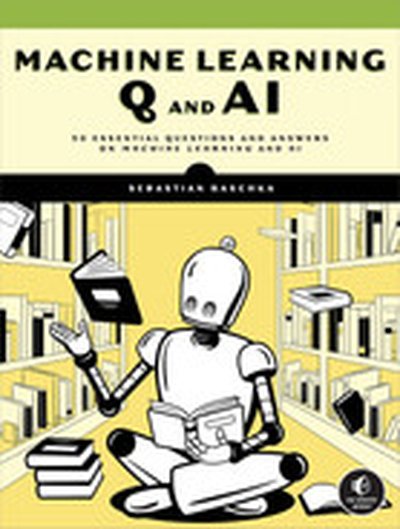
Machine Learning Q and AI

If you're ready to venture beyond introductory concepts and dig deeper into machine learning, deep learning, and AI, the question-and-answer format of Machine Learning Q and AI will make things fast and easy for you, without a lot of mucking about. Born out of questions often fielded by author Sebastian Raschka, the direct, no-nonsense approach of this book makes advanced topics more accessible and genuinely engaging. Each brief, self-contained chapter journeys through a fundamental question in AI, unraveling it with clear explanations, diagrams, and hands-on exercises. WHAT'S INSIDE: FOCUSED CHAPTERS: Key questions in AI are answered concisely, and complex ideas are broken down into easily digestible parts. WIDE RANGE OF TOPICS: Raschka covers topics ranging from neural network architectures and model evaluation to computer vision and natural language processing. PRACTICAL APPLICATIONS: Learn techniques for enhancing model performance, fine-tuning large models, and more. You'll also explore how to: Manage the various sources of randomness in neural network training Differentiate between encoder and decoder architectures in large language models Reduce overfitting through data and model modifications Construct confidence intervals for classifiers and optimize models with limited labeled data Choose between different multi-GPU training paradigms and different types of generative AI models Understand performance metrics for natural language processing Make sense of the inductive biases in vision transformers If you've been on the hunt for the perfect resource to elevate your understanding of machine learning, Machine Learning Q and AI will make it easy for you to painlessly advance your knowledge beyond the basics.

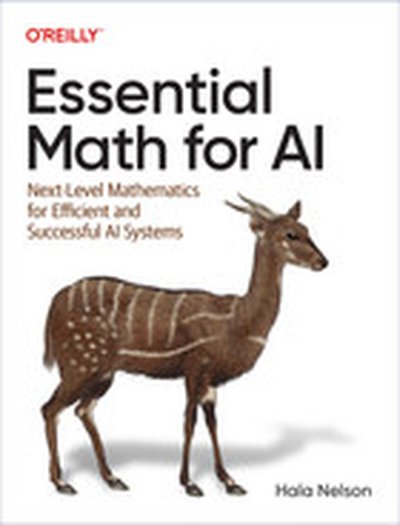
Essential Math for AI

Companies are scrambling to integrate AI into their systems and operations. But to build truly successful solutions, you need a firm grasp of the underlying mathematics. This accessible guide walks you through the math necessary to thrive in the AI field such as focusing on real-world applications rather than dense academic theory. Engineers, data scientists, and students alike will examine mathematical topics critical for AI--including regression, neural networks, optimization, backpropagation, convolution, Markov chains, and more--through popular applications such as computer vision, natural language processing, and automated systems. And supplementary Jupyter notebooks shed light on examples with Python code and visualizations. Whether you're just beginning your career or have years of experience, this book gives you the foundation necessary to dive deeper in the field. Understand the underlying mathematics powering AI systems, including generative adversarial networks, random graphs, large random matrices, mathematical logic, optimal control, and more Learn how to adapt mathematical methods to different applications from completely different fields Gain the mathematical fluency to interpret and explain how AI systems arrive at their decisions

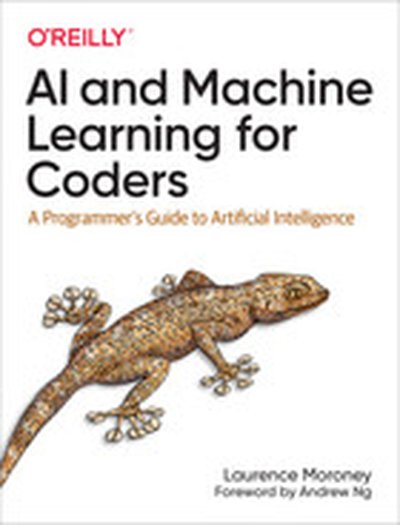
AI and Machine Learning for Coders

If you're looking to make a career move from programmer to AI specialist, this is the ideal place to start. Based on Laurence Moroney's extremely successful AI courses, this introductory book provides a hands-on, code-first approach to help you build confidence while you learn key topics. You'll understand how to implement the most common scenarios in machine learning, such as computer vision, natural language processing (NLP), and sequence modeling for web, mobile, cloud, and embedded runtimes. Most books on machine learning begin with a daunting amount of advanced math. This guide is built on practical lessons that let you work directly with the code. You'll learn: How to build models with TensorFlow using skills that employers desire The basics of machine learning by working with code samples How to implement computer vision, including feature detection in images How to use NLP to tokenize and sequence words and sentences Methods for embedding models in Android and iOS How to serve models over the web and in the cloud with TensorFlow Serving

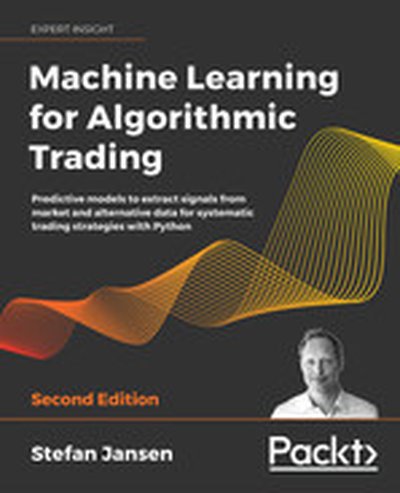
Machine Learning for Algorithmic Trading - Second Edition

Explore the intersection of machine learning and algorithmic trading with "Machine Learning for Algorithmic Trading" by Stefan Jansen. This comprehensive guide walks you through applying predictive modeling and data analysis to uncover financial signals and build systematic trading strategies. By the end, you'll be equipped to design and implement machine learning-driven trading systems. What this Book will help me do Develop data-driven trading strategies using supervised, unsupervised, and reinforcement learning methods. Master techniques for extracting predictive features from market and alternative datasets. Gain expertise in backtesting and validating ML-based trading strategies in Python. Apply text analysis techniques like NLP to news articles and transcripts for financial insights. Optimize portfolio risk and returns using advanced Python libraries. Author(s) Stefan Jansen is a quantitative researcher and data scientist with extensive experience in developing algorithmic trading solutions. He specializes in leveraging machine learning to extract financial insights and optimize investment strategies. His practical approach to applying ML in trading is reflected in this comprehensive guide, helping readers navigate complex trading challenges. Who is it for? This book is crafted for Python developers, data scientists, and finance professionals looking to integrate machine learning into algorithmic trading. Ideal for those with a basic understanding of Python and ML principles, it guides readers in crafting data-driven trading strategies. It's especially useful for analysts aiming to harness diverse data types for financial applications.

Artificial Intelligence for Marketing

A straightforward, non-technical guide to the next major marketing tool Artificial Intelligence for Marketing presents a tightly-focused introduction to machine learning, written specifically for marketing professionals. This book will not teach you to be a data scientist—but it does explain how Artificial Intelligence and Machine Learning will revolutionize your company's marketing strategy, and teach you how to use it most effectively. Data and analytics have become table stakes in modern marketing, but the field is ever-evolving with data scientists continually developing new algorithms—where does that leave you? How can marketers use the latest data science developments to their advantage? This book walks you through the "need-to-know" aspects of Artificial Intelligence, including natural language processing, speech recognition, and the power of Machine Learning to show you how to make the most of this technology in a practical, tactical way. Simple illustrations clarify complex concepts, and case studies show how real-world companies are taking the next leap forward. Straightforward, pragmatic, and with no math required, this book will help you: Speak intelligently about Artificial Intelligence and its advantages in marketing Understand how marketers without a Data Science degree can make use of machine learning technology Collaborate with data scientists as a subject matter expert to help develop focused-use applications Help your company gain a competitive advantage by leveraging leading-edge technology in marketing Marketing and data science are two fast-moving, turbulent spheres that often intersect; that intersection is where marketing professionals pick up the tools and methods to move their company forward. Artificial Intelligence and Machine Learning provide a data-driven basis for more robust and intensely-targeted marketing strategies—and companies that effectively utilize these latest tools will reap the benefit in the marketplace. Artificial Intelligence for Marketing provides a nontechnical crash course to help you stay ahead of the curve.