talk-data.com talk-data.com

Topic

statistics

512

tagged

Activity Trend

1 peak/qtr
2020-Q1 2026-Q1

Activities

512 activities · Newest first

Bayesian Analysis with Excel and R

Leverage the full power of Bayesian analysis for competitive advantage Bayesian methods can solve problems you can't reliably handle any other way. Building on your existing Excel analytics skills and experience, Microsoft Excel MVP Conrad Carlberg helps you make the most of Excel's Bayesian capabilities and move toward R to do even more. Step by step, with real-world examples, Carlberg shows you how to use Bayesian analytics to solve a wide array of real problems. Carlberg clarifies terminology that often bewilders analysts, provides downloadable Excel workbooks you can easily adapt to your own needs, and offers sample R code to take advantage of the rethinking package in R and its gateway to Stan. As you incorporate these Bayesian approaches into your analytical toolbox, you'll build a powerful competitive advantage for your organization---and yourself. Explore key ideas and strategies that underlie Bayesian analysis Distinguish prior, likelihood, and posterior distributions, and compare algorithms for driving sampling inputs Use grid approximation to solve simple univariate problems, and understand its limits as parameters increase Perform complex simulations and regressions with quadratic approximation and Richard McElreath's quap function Manage text values as if they were numeric Learn today's gold-standard Bayesian sampling technique: Markov Chain Monte Carlo (MCMC) Use MCMC to optimize execution speed in high-complexity problems Discover when frequentist methods fail and Bayesian methods are essential---and when to use both in tandem ...
Statistics All-in-One For Dummies

The odds-on best way to master stats. Statistics All-in-One For Dummies is packed with lessons, examples, and practice problems to help you slay your stats course. Develop confidence and understanding in statistics with easy-to-understand (even fun) explanations of key concepts. Plus, you’ll get access to online chapter quizzes and other resources that will turn you into a stats master. This book teaches you how to interpret graphs, determine probability, critique data, and so much more. Written by an expert author and serious statistics nerd, Statistics AIO For Dummies explains everything in terms anyone can understand. Get a grasp of basic statistics concepts required in every statistics course Clear up the process of interpreting graphs, understanding polls, and analyzing data Master correlation, regression, and other data analysis tools Score higher on stats tests and get a better grade in your high school or college class Statistics All-in-One For Dummies follows the curriculum of intro college statistics courses (including AP Stats!) so you can learn everything you need to know to get the grade you need—the Dummies way.

Nonparametric Statistics with Applications to Science and Engineering with R, 2nd Edition

NONPARAMETRIC STATISTICS WITH APPLICATIONS TO SCIENCE AND ENGINEERING WITH R Introduction to the methods and techniques of traditional and modern nonparametric statistics, incorporating R code Nonparametric Statistics with Applications to Science and Engineering with R presents modern nonparametric statistics from a practical point of view, with the newly revised edition including custom R functions implementing nonparametric methods to explain how to compute them and make them more comprehensible. Relevant built-in functions and packages on CRAN are also provided with a sample code. R codes in the new edition not only enable readers to perform nonparametric analysis easily, but also to visualize and explore data using R’s powerful graphic systems, such as ggplot2 package and R base graphic system. The new edition includes useful tables at the end of each chapter that help the reader find data sets, files, functions, and packages that are used and relevant to the respective chapter. New examples and exercises that enable readers to gain a deeper insight into nonparametric statistics and increase their comprehension are also included. Some of the sample topics discussed in Nonparametric Statistics with Applications to Science and Engineering with R include: Basics of probability, statistics, Bayesian statistics, order statistics, Kolmogorov–Smirnov test statistics, rank tests, and designed experiments Categorical data, estimating distribution functions, density estimation, least squares regression, curve fitting techniques, wavelets, and bootstrap sampling EM algorithms, statistical learning, nonparametric Bayes, WinBUGS, properties of ranks, and Spearman coefficient of rank correlation Chi-square and goodness-of-fit, contingency tables, Fisher exact test, MC Nemar test, Cochran’s test, Mantel–Haenszel test, and Empirical Likelihood Nonparametric Statistics with Applications to Science and Engineering with R is a highly valuable resource for graduate students in engineering and the physical and mathematical sciences, as well as researchers who need a more comprehensive, but succinct understanding of modern nonparametric statistical methods.

Codeless Time Series Analysis with KNIME

This book, "Codeless Time Series Analysis with KNIME," serves as your practical guide to mastering time series analysis using the KNIME Analytics Platform. By diving into this book, you'll explore a variety of statistical and machine learning techniques applied explicitly to real-world time series scenarios, helping you build predictive and analysis models effectively. What this Book will help me do Leverage KNIME's powerful tools to preprocess and prepare time series data for analysis. Visualize and dissect time series data into its components like trends and seasonality. Apply statistical models like ARIMA to analyze and forecast continuous data. Train and utilize neural networks including LSTM models for predictive analytics. Integrate external tools like Spark and H2O to enhance your forecasting workflows. Author(s) The authors, including experts from KNIME AG, Corey Weisinger, Maarit Widmann, and Daniele Tonini, collectively bring extensive experience in data analytics and time series modeling. Their expertise with KNIME's tools and real-world time series analysis applications ensures readers gain insights into practical, hands-on techniques. Who is it for? This book is ideally suited for data analysts and scientists eager to explore time series analysis through codeless methodologies. Beginners will benefit from the introductory explanations, while seasoned professionals will find value in the advanced topics and real-world examples. A basic understanding of the KNIME platform is recommended to get the most from this book.

Optimal and Robust State Estimation

A unified and systematic theoretical framework for solving problems related to finite impulse response (FIR) estimate Optimal and Robust State Estimation: Finite Impulse Response (FIR) and Kalman Approaches is a comprehensive investigation into batch state estimators and recursive forms. The work begins by introducing the reader to the state estimation approach and provides a brief historical overview. Next, the work discusses the specific properties of finite impulse response (FIR) state estimators. Further chapters give the basics of probability and stochastic processes, discuss the available linear and nonlinear state estimators, deal with optimal FIR filtering, and consider a limited memory batch and recursive algorithms. Other topics covered include solving the q-lag FIR smoothing problem, introducing the receding horizon (RH) FIR state estimation approach, and developing the theory of FIR state estimation under disturbances. The book closes by discussing the theory of FIR state estimation for uncertain systems and providing several applications where the FIR state estimators are used effectively. Key concepts covered in the work include: A holistic overview of the state estimation approach, which arose from the need to know the internal state of a real system, given that the input and output are both known Optimal, optimal unbiased, maximum likelihood, and unbiased and robust finite impulse response (FIR) structures FIR state estimation approach along with the infinite impulse response (IIR) and Kalman approaches Cost functions and the most critical properties of FIR and IIR state estimates Optimal and Robust State Estimation: Finite Impulse Response (FIR) and Kalman Approaches was written for professionals in the fields of microwave engineering, system engineering, and robotics who wish to move towards solving finite impulse response (FIR) estimate issues in both theoretical and practical applications. Graduate and senior undergraduate students with coursework dealing with state estimation will also be able to use the book to gain a valuable foundation of knowledge and become more adept in their chosen fields of study.

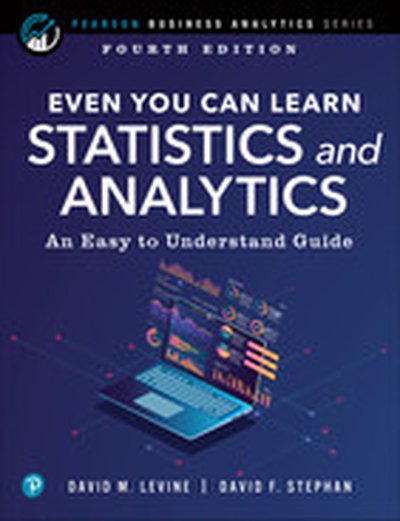
Even You Can Learn Statistics and Analytics: An Easy to Understand Guide

THE GUIDE FOR ANYONE AFRAID TO LEARN STATISTICS & ANALYTICS UPDATED WITH NEW EXAMPLES & EXERCISES This book discusses statistics and analytics using plain language and avoiding mathematical jargon. If you thought you couldn't learn these data analysis subjects because they were too technical or too mathematical, this book is for you! This edition delivers more everyday examples and end-of-chapter exercises and contains updated instructions for using Microsoft Excel. You'll use downloadable data sets and spreadsheet solutions, template-based solutions you can put right to work. Using this book, you will understand the important concepts of statistics and analytics, including learning the basic vocabulary of these subjects. Create tabular and visual summaries and learn to avoid common charting errors Gain experience working with common descriptive statistics measures including the mean, median, and mode; and standard deviation and variance, among others Understand the probability concepts that underlie inferential statistics Learn how to apply hypothesis tests, using Z, t, chi-square, ANOVA, and other techniques Develop skills using regression analysis, the most commonly-used Inferential statistical method Explore results produced by predictive analytics software Choose the right statistical or analytic techniques for any data analysis task Optionally, read the Equation Blackboards, designed for readers who want to learn about the mathematical foundations of selected methods ...

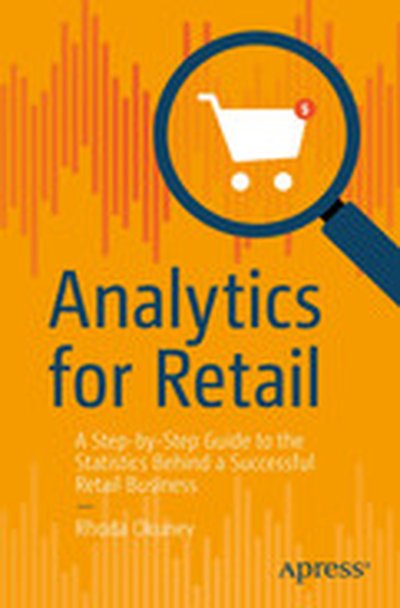
Analytics for Retail: A Step-by-Step Guide to the Statistics Behind a Successful Retail Business

Examine select retail business scenarios to learn basic mathematics, as well as probability and statistics required to analyze big data. This book focuses on useful and imperative applied analytics needed to build a retail business and explains mathematical concepts essential for decision making and communication in retail business environments. Everyone is a buyer or seller of products these days whether through a physical department store, Amazon, or their own business website. This book is a step-by-step guide to understanding and managing the mechanics of markups, markdowns, and basic statistics, math and computers that will help in your retail business. You'll tackle what to do with data once it is has accumulated and see how to arrange the data using descriptive statistics, primarily means, median, and mode, and then how to read the corresponding charts and graphs. Analytics for Retail is your path to creating visualrepresentations that powerfully communicate information and drive decisions. What You'll Learn Review standard statistical concepts to enhance your understanding of retail data Understand the concepts of markups, markdowns and profit margins, and probability Conduct an A/B testing email campaign with all the relevant analytics calculated and explained Who This Book Is For This is a primer book for anyone in the field of retail that needs to learn or refresh their skills or for a reader who wants to move in their company to a more analytical position.

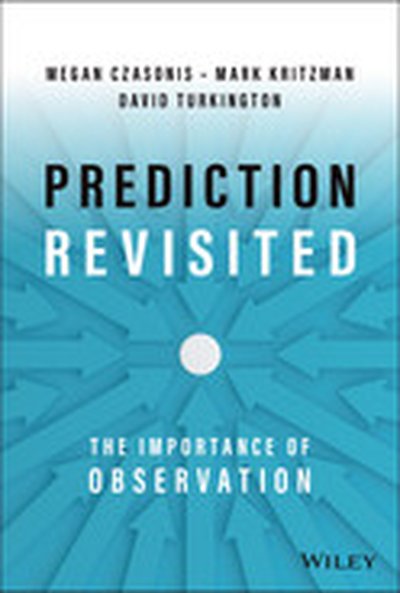
Prediction Revisited

A thought-provoking and startlingly insightful reworking of the science of prediction In Prediction Revisited: The Importance of Observation, a team of renowned experts in the field of data-driven investing delivers a ground-breaking reassessment of the delicate science of prediction for anyone who relies on data to contemplate the future. The book reveals why standard approaches to prediction based on classical statistics fail to address the complexities of social dynamics, and it provides an alternative method based on the intuitive notion of relevance. The authors describe, both conceptually and with mathematical precision, how relevance plays a central role in forming predictions from observed experience. Moreover, they propose a new and more nuanced measure of a prediction’s reliability. Prediction Revisited also offers: Clarifications of commonly accepted but less commonly understood notions of statistics Insight into the efficacy of traditional prediction models in a variety of fields Colorful biographical sketches of some of the key prediction scientists throughout history Mutually supporting conceptual and mathematical descriptions of the key insights and methods discussed within With its strikingly fresh perspective grounded in scientific rigor, Prediction Revisited is sure to earn its place as an indispensable resource for data scientists, researchers, investors, and anyone else who aspires to predict the future from the data-driven lessons of the past.

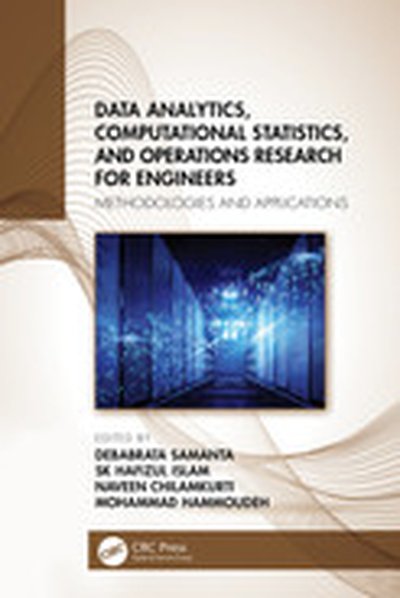
Data Analytics, Computational Statistics, and Operations Research for Engineers

This book investigates the role of data mining in computational statistics for machine learning. It offers applications that can be used in various domains and examines the role of transformation functions in optimizing problem statements.

Time Series Analysis on AWS

Time Series Analysis on AWS is your guide to building and deploying powerful forecasting models and identifying anomalies in your time series data. With this book, you will explore effective strategies for modern time series analysis using Amazon Web Services' powerful AI/ML tools. What this Book will help me do Master the fundamental concepts of time series and its applications using industry-relevant examples. Understand time series forecasting with Amazon Forecast and how to deliver actionable business insights. Build and deploy anomaly detection systems using Amazon Lookout for Equipment for predictive maintenance. Learn to utilize Amazon Lookout for Metrics to identify business operational anomalies effectively. Gain practical experience applying AWS ML tools to real-world time series data challenges. Author(s) None Hoarau is a data scientist with extensive experience in utilizing machine learning to solve real-world problems. Combining strong programming skills with domain expertise, they focus on developing applications leveraging AWS AI services. This book reflects their passion for making technical topics accessible and actionable for professionals. Who is it for? This book is ideal for data analysts, business analysts, and data scientists eager to enhance their skills in time series analysis. It suits readers familiar with statistical concepts but new to machine learning. If you're aiming to solve business problems using data and AWS tools, this resource is tailored for you.

What Is Causal Inference?

Causal inference lies at the heart of our ability to understand why things happen by helping us predict the results of our actions. This process is vital for businesses that aspire to turn data and information into valuable knowledge. With this report, data scientists and analysts will learn a principled way of thinking about causality, using a suite of causal inference techniques now available. Authors Hugo Bowne-Anderson, a data science consultant, and Mike Loukides, vice president of content strategy at O'Reilly Media, introduce causality and discuss randomized control trials (RCTs), key aspects of causal graph theory, and much-needed techniques from econometrics. You'll explore: Techniques from econometrics, including randomized control trials, the causality gold standard used in A/B-testing The constant-effects model for dealing with all things not being equal across the groups you're comparing Regression for dealing with confounding variables and selection bias Instrumental variables to estimate causal relationships in situations where regression won't work Techniques from causal graph theory including forks and colliders, the graphical tools for representing common causal patterns Backdoor and front-door adjustments for making causal inferences in the presence of confounders

Statistical Analysis with Excel For Dummies, 5th Edition

Become a stats superstar by using Excel to reveal the powerful secrets of statistics Microsoft Excel offers numerous possibilities for statistical analysis—and you don’t have to be a math wizard to unlock them. In Statistical Analysis with Excel For Dummies, fully updated for the 2021 version of Excel, you’ll hit the ground running with straightforward techniques and practical guidance to unlock the power of statistics in Excel. Bypass unnecessary jargon and skip right to mastering formulas, functions, charts, probabilities, distributions, and correlations. Written for professionals and students without a background in statistics or math, you’ll learn to create, interpret, and translate statistics—and have fun doing it! In this book you’ll find out how to: Understand, describe, and summarize any kind of data, from sports stats to sales figures Confidently draw conclusions from your analyses, make accurate predictions, and calculate correlations Model the probabilities of future outcomes based on past data Perform statistical analysis on any platform: Windows, Mac, or iPad Access additional resources and practice templates through Dummies.com For anyone who’s ever wanted to unleash the full potential of statistical analysis in Excel—and impress your colleagues or classmates along the way—Statistical Analysis with Excel For Dummies walks you through the foundational concepts of analyzing statistics and the step-by-step methods you use to apply them.

Change Detection and Image Time-Series Analysis 1

Change Detection and Image Time Series Analysis 1 presents a wide range of unsupervised methods for temporal evolution analysis through the use of image time series associated with optical and/or synthetic aperture radar acquisition modalities. Chapter 1 introduces two unsupervised approaches to multiple-change detection in bi-temporal multivariate images, with Chapters 2 and 3 addressing change detection in image time series in the context of the statistical analysis of covariance matrices. Chapter 4 focuses on wavelets and convolutional-neural filters for feature extraction and entropy-based anomaly detection, and Chapter 5 deals with a number of metrics such as cross correlation ratios and the Hausdorff distance for variational analysis of the state of snow. Chapter 6 presents a fractional dynamic stochastic field model for spatio temporal forecasting and for monitoring fast-moving meteorological events such as cyclones. Chapter 7 proposes an analysis based on characteristic points for texture modeling, in the context of graph theory, and Chapter 8 focuses on detecting new land cover types by classification-based change detection or feature/pixel based change detection. Chapter 9 focuses on the modeling of classes in the difference image and derives a multiclass model for this difference image in the context of change vector analysis.

Introduction to Probability

INTRODUCTION TO PROBABILITY Discover practical models and real-world applications of multivariate models useful in engineering, business, and related disciplines In Introduction to Probability: Multivariate Models and Applications, a team of distinguished researchers delivers a comprehensive exploration of the concepts, methods, and results in multivariate distributions and models. Intended for use in a second course in probability, the material is largely self-contained, with some knowledge of basic probability theory and univariate distributions as the only prerequisite. This textbook is intended as the sequel to Introduction to Probability: Models and Applications. Each chapter begins with a brief historical account of some of the pioneers in probability who made significant contributions to the field. It goes on to describe and explain a critical concept or method in multivariate models and closes with two collections of exercises designed to test basic and advanced understanding of the theory. A wide range of topics are covered, including joint distributions for two or more random variables, independence of two or more variables, transformations of variables, covariance and correlation, a presentation of the most important multivariate distributions, generating functions and limit theorems. This important text: Includes classroom-tested problems and solutions to probability exercises Highlights real-world exercises designed to make clear the concepts presented Uses Mathematica software to illustrate the text’s computer exercises Features applications representing worldwide situations and processes Offers two types of self-assessment exercises at the end of each chapter, so that students may review the material in that chapter and monitor their progress Perfect for students majoring in statistics, engineering, business, psychology, operations research and mathematics taking a second course in probability, Introduction to Probability: Multivariate Models and Applications is also an indispensable resource for anyone who is required to use multivariate distributions to model the uncertainty associated with random phenomena.

Brownian Motion, 3rd Edition

Stochastic processes occur everywhere in the sciences, economics and engineering, and they need to be understood by (applied) mathematicians, engineers and scientists alike. This book gives a gentle introduction to Brownian motion and stochastic processes, in general. Brownian motion plays a special role, since it shaped the whole subject, displays most random phenomena while being still easy to treat, and is used in many real-life models. Im this new edition, much material is added, and there are new chapters on ''Wiener Chaos and Iterated Itô Integrals'' and ''Brownian Local Times''.