talk-data.com talk-data.com

Topic

statistics

512

tagged

Activity Trend

1 peak/qtr
2020-Q1 2026-Q1

Activities

512 activities · Newest first

Stochastic Dynamics of Economic Cycles

This book includes discussions related to solutions of such tasks as: probabilistic description of the investment function; recovering the income function from GDP estimates; development of models for the economic cycles; selecting the time interval of pseudo-stationarity of cycles; estimating characteristics/parameters of cycle models; analysis of accuracy of model factors. All of the above constitute the general principles of a theory explaining the phenomenon of economic cycles and provide mathematical tools for their quantitative description. The introduced theory is applicable to macroeconomic analyses as well as econometric estimations of economic cycles.

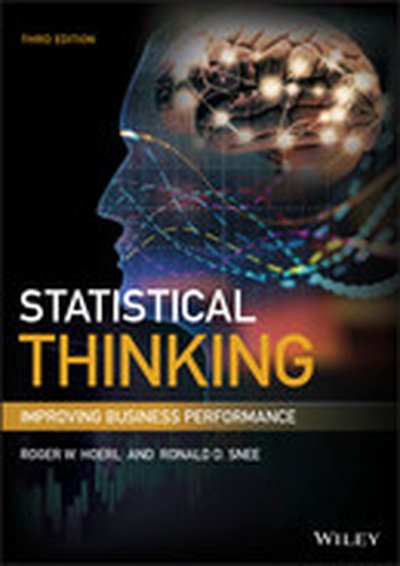
Statistical Thinking, 3rd Edition

Apply statistics in business to achieve performance improvement Statistical Thinking: Improving Business Performance, 3rd Edition helps managers understand the role of statistics in implementing business improvements. It guides professionals who are learning statistics in order to improve performance in business and industry. It also helps graduate and undergraduate students understand the strategic value of data and statistics in arriving at real business solutions. Instruction in the book is based on principles of effective learning, established by educational and behavioral research. The authors cover both practical examples and underlying theory, both the big picture and necessary details. Readers gain a conceptual understanding and the ability to perform actionable analyses. They are introduced to data skills to improve business processes, including collecting the appropriate data, identifying existing data limitations, and analyzing data graphically. The authors also provide an in-depth look at JMP software, including its purpose, capabilities, and techniques for use. Updates to this edition include: A new chapter on data, assessing data pedigree (quality), and acquisition tools Discussion of the relationship between statistical thinking and data science Explanation of the proper role and interpretation of p-values (understanding of the dangers of “p-hacking”) Differentiation between practical and statistical significance Introduction of the emerging discipline of statistical engineering Explanation of the proper role of subject matter theory in order to identify causal relationships A holistic framework for variation that includes outliers, in addition to systematic and random variation Revised chapters based on significant teaching experience Content enhancements based on student input This book helps readers understand the role of statistics in business before they embark on learning statistical techniques.

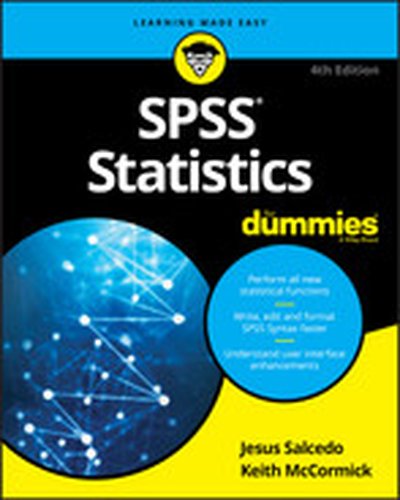
SPSS Statistics For Dummies, 4th Edition

The fun and friendly guide to mastering IBM’s Statistical Package for the Social Sciences Written by an author team with a combined 55 years of experience using SPSS, this updated guide takes the guesswork out of the subject and helps you get the most out of using the leader in predictive analysis. Covering the latest release and updates to SPSS 27.0, and including more than 150 pages of basic statistical theory, it helps you understand the mechanics behind the calculations, perform predictive analysis, produce informative graphs, and more. You’ll even dabble in programming as you expand SPSS functionality to suit your specific needs. Master the fundamental mechanics of SPSS Learn how to get data into and out of the program Graph and analyze your data more accurately and efficiently Program SPSS with Command Syntax Get ready to start handling data like a pro—with step-by-step instruction and expert advice!

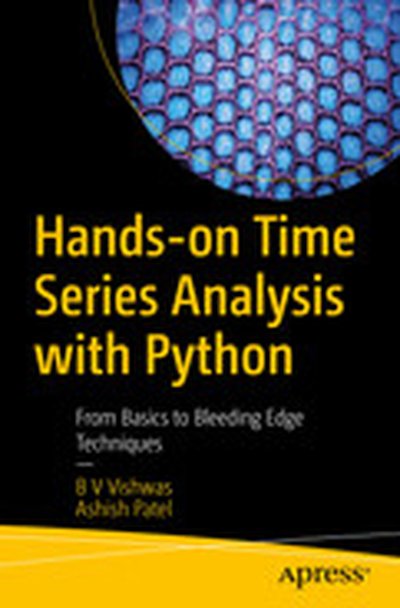
Hands-on Time Series Analysis with Python: From Basics to Bleeding Edge Techniques

Learn the concepts of time series from traditional to bleeding-edge techniques. This book uses comprehensive examples to clearly illustrate statistical approaches and methods of analyzing time series data and its utilization in the real world. All the code is available in Jupyter notebooks. You'll begin by reviewing time series fundamentals, the structure of time series data, pre-processing, and how to craft the features through data wrangling. Next, you'll look at traditional time series techniques like ARMA, SARIMAX, VAR, and VARMA using trending framework like StatsModels and pmdarima. The book also explains building classification models using sktime, and covers advanced deep learning-based techniques like ANN, CNN, RNN, LSTM, GRU and Autoencoder to solve time series problem using Tensorflow. It concludes by explaining the popular framework fbprophet for modeling time series analysis. After reading Hands-On Time Series Analysis with Python, you'll be able to apply these new techniques in industries, such as oil and gas, robotics, manufacturing, government, banking, retail, healthcare, and more. What You'll Learn: · Explains basics to advanced concepts of time series · How to design, develop, train, and validate time-series methodologies · What are smoothing, ARMA, ARIMA, SARIMA,SRIMAX, VAR, VARMA techniques in time series and how to optimally tune parameters to yield best results · Learn how to leverage bleeding-edge techniques such as ANN, CNN, RNN, LSTM, GRU, Autoencoder to solve both Univariate and multivariate problems by using two types of data preparation methods for time series. · Univariate and multivariate problem solving using fbprophet. Who This Book Is For Data scientists, data analysts, financial analysts, and stock market researchers

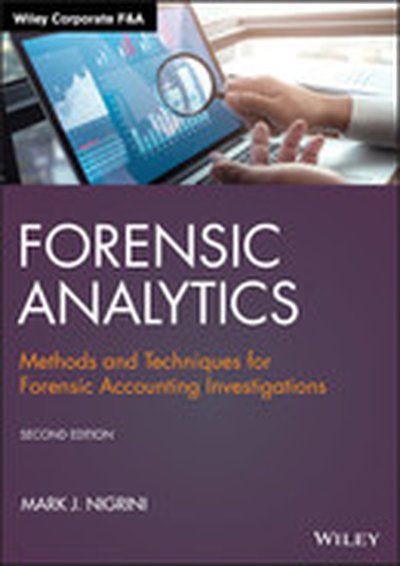
Forensic Analytics, 2nd Edition

Become the forensic analytics expert in your organization using effective and efficient data analysis tests to find anomalies, biases, and potential fraud—the updated new edition Forensic Analytics reviews the methods and techniques that forensic accountants can use to detect intentional and unintentional errors, fraud, and biases. This updated second edition shows accountants and auditors how analyzing their corporate or public sector data can highlight transactions, balances, or subsets of transactions or balances in need of attention. These tests are made up of a set of initial high-level overview tests followed by a series of more focused tests. These focused tests use a variety of quantitative methods including Benford’s Law, outlier detection, the detection of duplicates, a comparison to benchmarks, time-series methods, risk-scoring, and sometimes simply statistical logic. The tests in the new edition include the newly developed vector variation score that quantifies the change in an array of data from one period to the next. The goals of the tests are to either produce a small sample of suspicious transactions, a small set of transaction groups, or a risk score related to individual transactions or a group of items. The new edition includes over two hundred figures. Each chapter, where applicable, includes one or more cases showing how the tests under discussion could have detected the fraud or anomalies. The new edition also includes two chapters each describing multi-million-dollar fraud schemes and the insights that can be learned from those examples. These interesting real-world examples help to make the text accessible and understandable for accounting professionals and accounting students without rigorous backgrounds in mathematics and statistics. Emphasizing practical applications, the new edition shows how to use either Excel or Access to run these analytics tests. The book also has some coverage on using Minitab, IDEA, R, and Tableau to run forensic-focused tests. The use of SAS and Power BI rounds out the software coverage. The software screenshots use the latest versions of the software available at the time of writing. This authoritative book: Describes the use of statistically-based techniques including Benford’s Law, descriptive statistics, and the vector variation score to detect errors and anomalies Shows how to run most of the tests in Access and Excel, and other data analysis software packages for a small sample of the tests Applies the tests under review in each chapter to the same purchasing card data from a government entity Includes interesting cases studies throughout that are linked to the tests being reviewed. Includes two comprehensive case studies where data analytics could have detected the frauds before they reached multi-million-dollar levels Includes a continually-updated companion website with the data sets used in the chapters, the queries used in the chapters, extra coverage of some topics or cases, end of chapter questions, and end of chapter cases. Written by a prominent educator and researcher in forensic accounting and auditing, the new edition of Forensic Analytics: Methods and Techniques for Forensic Accounting Investigations is an essential resource for forensic accountants, auditors, comptrollers, fraud investigators, and graduate students.

Practical Statistics for Data Scientists, 2nd Edition

Statistical methods are a key part of data science, yet few data scientists have formal statistical training. Courses and books on basic statistics rarely cover the topic from a data science perspective. The second edition of this popular guide adds comprehensive examples in Python, provides practical guidance on applying statistical methods to data science, tells you how to avoid their misuse, and gives you advice on what’s important and what’s not. Many data science resources incorporate statistical methods but lack a deeper statistical perspective. If you’re familiar with the R or Python programming languages and have some exposure to statistics, this quick reference bridges the gap in an accessible, readable format. With this book, you’ll learn: Why exploratory data analysis is a key preliminary step in data science How random sampling can reduce bias and yield a higher-quality dataset, even with big data How the principles of experimental design yield definitive answers to questions How to use regression to estimate outcomes and detect anomalies Key classification techniques for predicting which categories a record belongs to Statistical machine learning methods that "learn" from data Unsupervised learning methods for extracting meaning from unlabeled data

Principles of Managerial Statistics and Data Science

Introduces readers to the principles of managerial statistics and data science, with an emphasis on statistical literacy of business students Through a statistical perspective, this book introduces readers to the topic of data science, including Big Data, data analytics, and data wrangling. Chapters include multiple examples showing the application of the theoretical aspects presented. It features practice problems designed to ensure that readers understand the concepts and can apply them using real data. Over 100 open data sets used for examples and problems come from regions throughout the world, allowing the instructor to adapt the application to local data with which students can identify. Applications with these data sets include: Assessing if searches during a police stop in San Diego are dependent on driver’s race Visualizing the association between fat percentage and moisture percentage in Canadian cheese Modeling taxi fares in Chicago using data from millions of rides Analyzing mean sales per unit of legal marijuana products in Washington state Topics covered in Principles of Managerial Statistics and Data Science include:data visualization; descriptive measures; probability; probability distributions; mathematical expectation; confidence intervals; and hypothesis testing. Analysis of variance; simple linear regression; and multiple linear regression are also included. In addition, the book offers contingency tables, Chi-square tests, non-parametric methods, and time series methods. The textbook: Includes academic material usually covered in introductory Statistics courses, but with a data science twist, and less emphasis in the theory Relies on Minitab to present how to perform tasks with a computer Presents and motivates use of data that comes from open portals Focuses on developing an intuition on how the procedures work Exposes readers to the potential in Big Data and current failures of its use Supplementary material includes: a companion website that houses PowerPoint slides; an Instructor's Manual with tips, a syllabus model, and project ideas; R code to reproduce examples and case studies; and information about the open portal data Features an appendix with solutions to some practice problems Principles of Managerial Statistics and Data Science is a textbook for undergraduate and graduate students taking managerial Statistics courses, and a reference book for working business professionals.

Statistics and Probability with Applications for Engineers and Scientists Using MINITAB, R and JMP, 2nd Edition

Introduces basic concepts in probability and statistics to data science students, as well as engineers and scientists Aimed at undergraduate/graduate-level engineering and natural science students, this timely, fully updated edition of a popular book on statistics and probability shows how real-world problems can be solved using statistical concepts. It removes Excel exhibits and replaces them with R software throughout, and updates both MINITAB and JMP software instructions and content. A new chapter discussing data mining—including big data, classification, machine learning, and visualization—is featured. Another new chapter covers cluster analysis methodologies in hierarchical, nonhierarchical, and model based clustering. The book also offers a chapter on Response Surfaces that previously appeared on the book’s companion website. Statistics and Probability with Applications for Engineers and Scientists using MINITAB, R and JMP, Second Edition is broken into two parts. Part I covers topics such as: describing data graphically and numerically, elements of probability, discrete and continuous random variables and their probability distributions, distribution functions of random variables, sampling distributions, estimation of population parameters and hypothesis testing. Part II covers: elements of reliability theory, data mining, cluster analysis, analysis of categorical data, nonparametric tests, simple and multiple linear regression analysis, analysis of variance, factorial designs, response surfaces, and statistical quality control (SQC) including phase I and phase II control charts. The appendices contain statistical tables and charts and answers to selected problems. Features two new chapters—one on Data Mining and another on Cluster Analysis Now contains R exhibits including code, graphical display, and some results MINITAB and JMP have been updated to their latest versions Emphasizes the p-value approach and includes related practical interpretations Offers a more applied statistical focus, and features modified examples to better exhibit statistical concepts Supplemented with an Instructor's-only solutions manual on a book’s companion website Statistics and Probability with Applications for Engineers and Scientists using MINITAB, R and JMP is an excellent text for graduate level data science students, and engineers and scientists. It is also an ideal introduction to applied statistics and probability for undergraduate students in engineering and the natural sciences.

Neural Networks Modeling and Control

Neural Networks Modelling and Control: Applications for Unknown Nonlinear Delayed Systems in Discrete Time focuses on modeling and control of discrete-time unknown nonlinear delayed systems under uncertainties based on Artificial Neural Networks. First, a Recurrent High Order Neural Network (RHONN) is used to identify discrete-time unknown nonlinear delayed systems under uncertainties, then a RHONN is used to design neural observers for the same class of systems. Therefore, both neural models are used to synthesize controllers for trajectory tracking based on two methodologies: sliding mode control and Inverse Optimal Neural Control. As well as considering the different neural control models and complications that are associated with them, this book also analyzes potential applications, prototypes and future trends. Provide in-depth analysis of neural control models and methodologies Presents a comprehensive review of common problems in real-life neural network systems Includes an analysis of potential applications, prototypes and future trends

Introduction to Stochastic Processes and Simulation

Mastering chance has, for a long time, been a preoccupation of mathematical research. Today, we possess a predictive approach to the evolution of systems based on the theory of probabilities. Even so, uncovering this subject is sometimes complex, because it necessitates a good knowledge of the underlying mathematics. This book offers an introduction to the processes linked to the fluctuations in chance and the use of numerical methods to approach solutions that are difficult to obtain through an analytical approach. It takes classic examples of inventory and queueing management, and addresses more diverse subjects such as equipment reliability, genetics, population dynamics, physics and even market finance. It is addressed to those at Master's level, at university, engineering school or management school, but also to an audience of those in continuing education, in order that they may discover the vast field of decision support.

Advanced Statistics with Applications in R

Advanced Statistics with Applications in R fills the gap between several excellent theoretical statistics textbooks and many applied statistics books where teaching reduces to using existing packages. This book looks at what is under the hood. Many statistics issues including the recent crisis with p-value are caused by misunderstanding of statistical concepts due to poor theoretical background of practitioners and applied statisticians. This book is the product of a forty-year experience in teaching of probability and statistics and their applications for solving real-life problems. There are more than 442 examples in the book: basically every probability or statistics concept is illustrated with an example accompanied with an R code. Many examples, such as Who said π? What team is better? The fall of the Roman empire, James Bond chase problem, Black Friday shopping, Free fall equation: Aristotle or Galilei, and many others are intriguing. These examples cover biostatistics, finance, physics and engineering, text and image analysis, epidemiology, spatial statistics, sociology, etc. Advanced Statistics with Applications in R teaches students to use theory for solving real-life problems through computations: there are about 500 R codes and 100 datasets. These data can be freely downloaded from the author's website dartmouth.edu/~eugened. This book is suitable as a text for senior undergraduate students with major in statistics or data science or graduate students. Many researchers who apply statistics on the regular basis find explanation of many fundamental concepts from the theoretical perspective illustrated by concrete real-world applications.

Business Statistics with Solutions in R

Business Statistics with Solutions in R covers a wide range of applications of statistics in solving business related problems. It will introduce readers to quantitative tools that are necessary for daily business needs and help them to make evidence-based decisions. The book provides an insight on how to summarize data, analyze it, and draw meaningful inferences that can be used to improve decisions. It will enable readers to develop computational skills and problem-solving competence using the open source language, R. Mustapha Abiodun Akinkunmi uses real life business data for illustrative examples while discussing the basic statistical measures, probability, regression analysis, significance testing, correlation, the Poisson distribution, process control for manufacturing, time series analysis, forecasting techniques, exponential smoothing, univariate and multivariate analysis including ANOVA and MANOVA and more in this valuable reference for policy makers, professionals, academics and individuals interested in the areas of business statistics, applied statistics, statistical computing, finance, management and econometrics.

Practical Time Series Analysis

Time series data analysis is increasingly important due to the massive production of such data through the internet of things, the digitalization of healthcare, and the rise of smart cities. As continuous monitoring and data collection become more common, the need for competent time series analysis with both statistical and machine learning techniques will increase. Covering innovations in time series data analysis and use cases from the real world, this practical guide will help you solve the most common data engineering and analysis challengesin time series, using both traditional statistical and modern machine learning techniques. Author Aileen Nielsen offers an accessible, well-rounded introduction to time series in both R and Python that will have data scientists, software engineers, and researchers up and running quickly. You’ll get the guidance you need to confidently: Find and wrangle time series data Undertake exploratory time series data analysis Store temporal data Simulate time series data Generate and select features for a time series Measure error Forecast and classify time series with machine or deep learning Evaluate accuracy and performance

Applied Statistics

Instructs readers on how to use methods of statistics and experimental design with R software Applied statistics covers both the theory and the application of modern statistical and mathematical modelling techniques to applied problems in industry, public services, commerce, and research. It proceeds from a strong theoretical background, but it is practically oriented to develop one's ability to tackle new and non-standard problems confidently. Taking a practical approach to applied statistics, this user-friendly guide teaches readers how to use methods of statistics and experimental design without going deep into the theory. Applied Statistics: Theory and Problem Solutions with R includes chapters that cover R package sampling procedures, analysis of variance, point estimation, and more. It follows on the heels of Rasch and Schott's Mathematical Statistics via that book's theoretical background—taking the lessons learned from there to another level with this book’s addition of instructions on how to employ the methods using R. But there are two important chapters not mentioned in the theoretical back ground as Generalised Linear Models and Spatial Statistics. Offers a practical over theoretical approach to the subject of applied statistics Provides a pre-experimental as well as post-experimental approach to applied statistics Features classroom tested material Applicable to a wide range of people working in experimental design and all empirical sciences Includes 300 different procedures with R and examples with R-programs for the analysis and for determining minimal experimental sizes Applied Statistics: Theory and Problem Solutions with R will appeal to experimenters, statisticians, mathematicians, and all scientists using statistical procedures in the natural sciences, medicine, and psychology amongst others.

A Gentle Introduction to Statistics Using SASⓇ Studio

Point and click your way to performing statistics! Many people are intimidated by learning statistics, but A Gentle Introduction to Statistics Using SAS Studio is here to help. Whether you need to perform statistical analysis for a project or, perhaps, for a course in education, psychology, sociology, economics, or any other field that requires basic statistical skills, this book teaches the fundamentals of statistics, from designing your experiment through calculating logistic regressions. Serving as an introduction to many common statistical tests and principles, it explains concepts in a non-technical way with little math and very few formulas. Once the basic statistical concepts are covered, the book then demonstrates how to use them with SAS Studio and SAS University Edition’s easy point-and-click interface. Topics included in this book are: How to install and use SAS University Edition Descriptive statistics One-sample tests T tests (for independent or paired samples) One-way analysis of variance (ANOVA) N-way ANOVA Correlation analysis Simple and multiple linear regression Binary logistic regression Categorical data, including two-way tables and chi-square Power and sample size calculations Questions are provided to test your knowledge and practice your skills.

Probably Not, 2nd Edition

A revised edition that explores random numbers, probability, and statistical inference at an introductory mathematical level Written in an engaging and entertaining manner, the revised and updated second edition of Probably Not continues to offer an informative guide to probability and prediction. The expanded second edition contains problem and solution sets. In addition, the book’s illustrative examples reveal how we are living in a statistical world, what we can expect, what we really know based upon the information at hand and explains when we only think we know something. The author introduces the principles of probability and explains probability distribution functions. The book covers combined and conditional probabilities and contains a new section on Bayes Theorem and Bayesian Statistics, which features some simple examples including the Presecutor’s Paradox, and Bayesian vs. Frequentist thinking about statistics. New to this edition is a chapter on Benford’s Law that explores measuring the compliance and financial fraud detection using Benford’s Law. This book: Contains relevant mathematics and examples that demonstrate how to use the concepts presented Features a new chapter on Benford’s Law that explains why we find Benford’s law upheld in so many, but not all, natural situations Presents updated Life insurance tables Contains updates on the Gantt Chart example that further develops the discussion of random events Offers a companion site featuring solutions to the problem sets within the book Written for mathematics and statistics students and professionals, the updated edition of Probably Not: Future Prediction Using Probability and Statistical Inference, Second Edition combines the mathematics of probability with real-world examples. LAWRENCE N. DWORSKY, PhD, is a retired Vice President of the Technical Staff and Director of Motorola’s Components Research Laboratory in Schaumburg, Illinois, USA. He is the author of Introduction to Numerical Electrostatics Using MATLAB from Wiley.

Bayesian Statistics the Fun Way

Probability and statistics are increasingly important in a huge range of professions. But many people use data in ways they don’t even understand, meaning they aren’t getting the most from it. Bayesian Statistics the Fun Way will change that. This book will give you a complete understanding of Bayesian statistics through simple explanations and un-boring examples. Find out the probability of UFOs landing in your garden, how likely Han Solo is to survive a flight through an asteroid belt, how to win an argument about conspiracy theories, and whether a burglary really was a burglary, to name a few examples. By using these off-the-beaten-track examples, the author actually makes learning statistics fun. And you’ll learn real skills, like how to: •How to measure your own level of uncertainty in a conclusion or belief •Calculate Bayes theorem and understand what it’s useful for •Find the posterior, likelihood, and prior to check the accuracy of your conclusions •Calculate distributions to see the range of your data •Compare hypotheses and draw reliable conclusions from them Next time you find yourself with a sheaf of survey results and no idea what to do with them, turn to Bayesian Statistics the Fun Way to get the most value from your data.

Associations and Correlations

"Associations and Correlations: Unearth the powerful insights buried in your data" is a comprehensive guide for understanding and utilizing associations and correlations in data analysis. This book walks you through methods of classifying data, selecting appropriate statistical tests, and interpreting results effectively. By the end, you'll have mastered how to reveal data insights clearly and reliably. What this Book will help me do Identify and prepare datasets suitable for analysis with confidence. Understand and apply the principles of associations and correlations in data analytics. Use statistical tests to uncover univariate and multivariate relationships. Classify and interpret data into qualitative and quantitative segments effectively. Develop visual representations of data relationships to communicate insights clearly. Author(s) Lee Baker is an experienced statistician and data scientist with a passion for education. With years of teaching and mentoring professionals in data analysis, Lee excels in breaking down complex statistical concepts into understandable insights. Lee's approachable style aims to empower learners to harness their data's full potential. Who is it for? This book is designed for budding data analysts and data scientists, targeting those starting their journey into data analytics. It serves well as an introduction to the fundamentals of associations and correlations, making it suitable for beginners. If you seek a foundational understanding or a recap of key concepts, this book is for you.

Probability and Statistics for Computer Scientists, 3rd Edition

Probability and statistical methods, simulation techniques, and modeling tools. This third edition textbook adds R, including codes for data analysis examples, helps students solve problems, make optimal decisions in select stochastic models, probabilities and forecasts, and evaluate performance of computer systems and networks.