talk-data.com talk-data.com

Event

O'Reilly Data Science Books

2013-08-09 – 2026-02-25 Oreilly Visit website ↗

Activities tracked

2091

Collection of O'Reilly books on Data Science.

Filtering by: data-science ×

Sessions & talks

Showing 1126–1150 of 2091 · Newest first

Search within this event →
SAS 9.4 Intelligence Platform: Overview, Second Edition, 2nd Edition

Provides a point of entry for understanding the basics of the SAS Intelligence Platform. It discusses the benefits of the SAS Intelligence Platform to businesses, describes the architecture, and provides an overview of each software component. This document can be used alone or as an introduction to the deployment and administration guides.

Data Wrangling with Python

How do you take your data analysis skills beyond Excel to the next level? By learning just enough Python to get stuff done. This hands-on guide shows non-programmers like you how to process information that’s initially too messy or difficult to access. You don't need to know a thing about the Python programming language to get started. Through various step-by-step exercises, you’ll learn how to acquire, clean, analyze, and present data efficiently. You’ll also discover how to automate your data process, schedule file- editing and clean-up tasks, process larger datasets, and create compelling stories with data you obtain. Quickly learn basic Python syntax, data types, and language concepts Work with both machine-readable and human-consumable data Scrape websites and APIs to find a bounty of useful information Clean and format data to eliminate duplicates and errors in your datasets Learn when to standardize data and when to test and script data cleanup Explore and analyze your datasets with new Python libraries and techniques Use Python solutions to automate your entire data-wrangling process

Web Application Development with R Using Shiny Second Edition - Second Edition

This book dives into the practical application of R's power combined with Shiny's simplicity to build web-based analytics and interactive data summary tools. By following this step-by-step guide, you'll go from the basics of building with R and Shiny to creating sophisticated custom dashboards and interactive web apps. What this Book will help me do Create interactive web apps and dashboards using Shiny with impressive user interfaces. Integrate Shiny applications into custom HTML and CSS-based web pages for enhanced flexibility. Produce user-friendly Shiny applications extended with JavaScript and jQuery for added functionality. Develop web solutions that include interactive graphics, maps, and data analysis summaries. Deliver and deploy web apps securely using cloud solutions or self-hosted servers. Author(s) Chris Beeley, an experienced R developer and teacher, has a robust background in statistical programming and data analysis. Chris is passionate about sharing knowledge through practical examples and hands-on exercises. As the author of this book, Chris ensures that readers receive a clear and approachable entry into web application development using Shiny. Who is it for? This book is ideal for data enthusiasts, analysts, and developers looking to transition their analytic skills to the web. It caters to readers with basic programming knowledge but does not require prior experience with R or Shiny. It is perfect for professionals and learners wanting to create interactive analytics tools, dashboards, or data-driven web applications.

Excel Dashboards and Reports for Dummies, 3rd Edition

Make the most of your data using the power of Excel When you think of data, do you think of endless rows and columns in spreadsheets? Excel Dashboards and Reports For Dummies, 3 shows you how to make the most of your data—and puts an end to mind-numbing spreadsheets by exploring new ways to conceptualize and present key information. There's often a gap between handling data and synthesizing it into meaningful reports, and this approachable text bridges this gap with quick and accessible information that answers key questions, like how to meaningfully capture data trends, how to show relationships in data, and when it's better to show variances than actual data values. rd Edition As a leading spreadsheet application, Microsoft Excel is the go-to data software. This tool allows you to use dashboard reports that leverage gauges, maps, charts, sliders, and other visual elements to present complex data in a manner that's easy to understand. Using Excel dashboards effectively can improve your professional capabilities by leaps and bounds. Analyze and report on large amounts of data in a meaningful way Look at data from different perspectives, and better visualize the information you're presenting by quickly slicing data on the fly Automate redundant reporting and analysis functions, making your data analysis and reporting routine more efficient Create visualizations, dashboards, and what-if analyses that are as visually appealing as they are substantial Excel Dashboards and Reports For Dummies, 3 is a fantastic resource if you're looking to spice up your reporting! rd Edition

Tableau Your Data!, 2nd Edition

Transform your organization's data into actionable insights with Tableau Tableau is designed specifically to provide fast and easy visual analytics. The intuitive drag-and-drop interface helps you create interactive reports, dashboards, and visualizations, all without any special or advanced training. This all new edition of Tableau Your Data! is your Tableau companion, helping you get the most out of this invaluable business toolset. Tableau Your Data! shows you how to build dynamic, best of breed visualizations using the Tableau Software toolset. This comprehensive guide covers the core feature set for data analytics, and provides clear step-by-step guidance toward best practices and advanced techniques that go way beyond the user manual. You'll learn how Tableau is different from traditional business information analysis tools, and how to navigate your way around the Tableau 9.0 desktop before delving into functions and calculations, as well as sharing with the Tableau Server. Analyze data more effectively with Tableau Desktop Customize Tableau's settings for your organization's needs with detailed real-world examples on data security, scaling, syntax, and more Deploy visualizations to consumers throughout the enterprise - from sales to marketing, operations to finance, and beyond Understand Tableau functions and calculations and leverage Tableau across every link in the value chain Learn from actual working models of the book's visualizations and other web-based resources via a companion website Tableau helps you unlock the stories within the numbers, and Tableau Your Data! puts the software's full functionality right at your fingertips.

QlikView Essentials

"QlikView Essentials" is your guide to mastering QlikView, a versatile and powerful business intelligence tool. This practical book walks you through the complete QlikView workflow, from loading data and creating effective data models to designing interactive dashboards and deploying BI applications. Gain confidence in handling data and deriving actionable insights using QlikView. What this Book will help me do Understand the full QlikView workflow, encompassing data loading, visualization, and analysis. Utilize QlikView's capabilities to load data from various sources effectively, including JSON and QVD files. Implement robust solutions for addressing common data modeling challenges in BI projects. Design engaging and accessible dashboards that visualize crucial insights and support decision-making. Successfully deploy QlikView applications securely for optimal usage and adoption within your organization. Author(s) None Sinha is an experienced data analyst and QlikView expert with a passion for making data accessible and actionable for businesses. With years of experience working with business intelligence platforms, Sinha has provided invaluable insights and strategies to organizations in leveraging their data effectively. This book reflects their dedication to simplifying complex concepts and empowering readers with hands-on skills. Who is it for? This book is ideal for professionals who work with data and want to leverage QlikView for business intelligence tasks. If you are a data analyst, manager, or IT professional familiar with BI concepts but looking to enhance your QlikView expertise, this guide is for you. Even if you're new to QlikView but have a basic understanding of data manipulation, you will find this book an excellent resource. It's tailored to anyone who wishes to turn data into meaningful insights easily and effectively.

Perfect Simulation

This book illustrates the application of perfect simulation ideas and algorithms to a wide range of problems. The author describes numerous protocol methodologies for designing algorithms for specific problems. He first examines the commonly used acceptance/rejection (AR) protocol for creating perfect simulation algorithms. He then covers other major protocols, including coupling from the past (CFTP); the Fill, Machida, Murdoch, and Rosenthal (FMMR) method; the randomness recycler; retrospective sampling; and partially recursive AR, along with multiple variants of these protocols.

Effective CRM using Predictive Analytics

A step-by-step guide to data mining applications in CRM. Following a handbook approach, this book bridges the gap between analytics and their use in everyday marketing, providing guidance on solving real business problems using data mining techniques. The book is organized into three parts. Part one provides a methodological roadmap, covering both the business and the technical aspects. The data mining process is presented in detail along with specific guidelines for the development of optimized acquisition, cross/ deep/ up selling and retention campaigns, as well as effective customer segmentation schemes. In part two, some of the most useful data mining algorithms are explained in a simple and comprehensive way for business users with no technical expertise. Part three is packed with real world case studies which employ the use of three leading data mining tools: IBM SPSS Modeler, RapidMiner and Data Mining for Excel. Case studies from industries including banking, retail and telecommunications are presented in detail so as to serve as templates for developing similar applications. Key Features: Includes numerous real-world case studies which are presented step by step, demystifying the usage of data mining models and clarifying all the methodological issues. Topics are presented with the use of three leading data mining tools: IBM SPSS Modeler, RapidMiner and Data Mining for Excel. Accompanied by a website featuring material from each case study, including datasets and relevant code. Combining data mining and business knowledge, this practical book provides all the necessary information for designing, setting up, executing and deploying data mining techniques in CRM. Effective CRM using Predictive Analytics will benefit data mining practitioners and consultants, data analysts, statisticians, and CRM officers. The book will also be useful to academics and students interested in applied data mining.

Fundamentals of Big Data Network Analysis for Research and Industry

Fundamentals of Big Data Network Analysis for Research and Industry Hyunjoung Lee, Institute of Green Technology, Yonsei University, Republic of Korea Il Sohn, Material Science and Engineering, Yonsei University, Republic of Korea Presents the methodology of big data analysis using examples from research and industry There are large amounts of data everywhere, and the ability to pick out crucial information is increasingly important. Contrary to popular belief, not all information is useful; big data network analysis assumes that data is not only large, but also meaningful, and this book focuses on the fundamental techniques required to extract essential information from vast datasets. Featuring case studies drawn largely from the iron and steel industries, this book offers practical guidance which will enable readers to easily understand big data network analysis. Particular attention is paid to the methodology of network analysis, offering information on the method of data collection, on research design and analysis, and on the interpretation of results. A variety of programs including UCINET, NetMiner, R, NodeXL, and Gephi for network analysis are covered in detail. Fundamentals of Big Data Network Analysis for Research and Industry looks at big data from a fresh perspective, and provides a new approach to data analysis. This book: Explains the basic concepts in understanding big data and filtering meaningful data Presents big data analysis within the networking perspective Features methodology applicable to research and industry Describes in detail the social relationship between big data and its implications Provides insight into identifying patterns and relationships between seemingly unrelated big data Fundamentals of Big Data Network Analysis for Research and Industry will prove a valuable resource for analysts, research engineers, industrial engineers, marketing professionals, and any individuals dealing with accumulated large data whose interest is to analyze and identify potential relationships among data sets.

Multimedia Quality of Experience (QoE)

This book discusses the current status of QoE research; reporting latest advances from various standardisation bodies (ITU, ETSI, IEEE, IETF) Multimedia Quality of Experience (QoE): Current Status and Future Requirements discusses the current status of QoE (Quality of Experience) research, providing guidelines on QoE assessment and management practice. Moreover, the book covers many different aspects of QoE research, including definition, standardization (ITU, ETSI, IEEE, IETF, etc.), measurement, management, and architectures. In addition, the authors bring together contributions from recognized experts (worldwide) in the area of subjective and objective QoE video assessment. Topics/chapters include: (1) QoE Definition and its relation/mapping to QoS; QoE Standardization activities; QoE Metrics for various media applications; QoE Subjective and Objective Evaluation Methodologies; QoE Control, Monitoring and Management strategies; End-to-End QoE Architectures in heterogeneous environments. Discusses the current status of QoE research; reporting latest advances from various standardisation bodies (e.g. ITU, ETSI, IEEE, IETF) Provides guidelines on QoE assessment and management practice Explores methods, means and architectures of QoE Addresses multiple technologies and requires input from multiple disciplines such as engineering, sociology and psychology Brings together contributions from recognized experts (worldwide) in the area of subjective and objective QoE video assessment Considers future requirements of QoE

Quality of Life and Living Standards Analysis

This book is about the concept of “Quality of Life”. What is necessary for quality of life, and how can it be measured? The approach is a multicriterial scheme reduction which prevents as much information loss as possible when shifting from the set of partial criteria to their convolution. This book is written for researchers, analysts and graduate and postgraduate students of mathematics and economics.

Statistics in Toxicology Using R

The apparent contradiction between statistical significance and biological relevance has diminished the value of statistical methods as a whole in toxicology. Moreover, recommendations for statistical analysis are imprecise in most toxicological guidelines. Addressing these dilemmas, Statistics in Toxicology Using R explains the statistical analysis of selected experimental data in toxicology and presents assay-specific suggestions, such as for the in vitro micronucleus assay. Mostly focusing on hypothesis testing, the book covers standardized bioassays for chemicals, drugs, and environmental pollutants. It is organized according to selected toxicological assays, including:Short-term repeated toxicity studiesLong-term carcinogenicity assaysStudies on reproductive toxicityMutagenicity assaysToxicokinetic studiesThe book also discusses proof of safety (particularly in ecotoxicological assays), toxicogenomics, the analysis of interlaboratory studies and the modeling of dose-response relationships for risk assessment. For each toxicological problem, the author describes the statistics involved, matching data example, R code, and outcomes and their interpretation. This approach allows you to select a certain bioassay, identify the specific data structure, run the R code with the data example, understand the test outcome and interpretation, and replace the data set with your own data and run again.Supporting material for this title can be downloaded here.

Multiple Time Series Modeling Using the SAS VARMAX Procedure

Aimed at econometricians who have completed at least one course in time series modeling, Multiple Time Series Modeling Using the SAS VARMAX Procedure will teach you the time series analytical possibilities that SAS offers today. Estimations of model parameters are now performed in a split second. For this reason, working through the identifications phase to find the correct model is unnecessary. Instead, several competing models can be estimated, and their fit can be compared instantaneously.

Consequently, for time series analysis, most of the Box and Jenkins analysis process for univariate series is now obsolete. The former days of looking at cross-correlations and pre-whitening are over, because distributed lag models are easily fitted by an automatic lag identification method. The same goes for bivariate and even multivariate models, for which PROC VARMAX models are automatically fitted. For these models, other interesting variations arise: Subjects like Granger causality testing, feedback, equilibrium, cointegration, and error correction are easily addressed by PROC VARMAX.

One problem with multivariate modeling is that it includes many parameters, making parameterizations unstable. This instability can be compensated for by application of Bayesian methods, which are also incorporated in PROC VARMAX. Volatility modeling has now become a standard part of time series modeling, because of the popularity of GARCH models. Both univariate and multivariate GARCH models are supported by PROC VARMAX. This feature is especially interesting for financial analytics in which risk is a focus.

This book teaches with examples. Readers who are analyzing a time series for the first time will find PROC VARMAX easy to use; readers who know more advanced theoretical time series models will discover that PROC VARMAX is a useful tool for advanced model building.

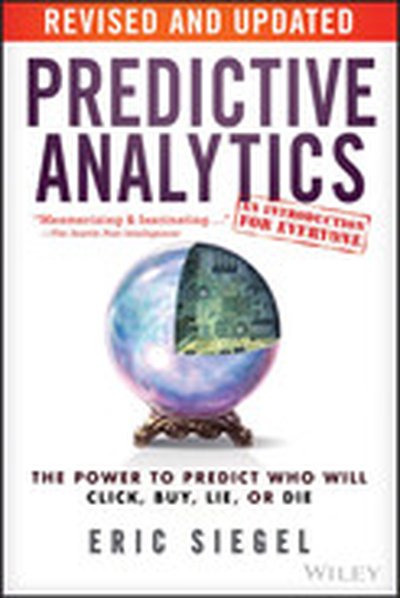
Predictive Analytics, Revised and Updated

"Mesmerizing & fascinating..." — The Seattle Post-Intelligencer "The Freakonomics of big data." —Stein Kretsinger, founding executive of Advertising.com Award-winning | Used by over 30 universities | Translated into 9 languages An introduction for everyone. In this rich, fascinating — surprisingly accessible — introduction, leading expert Eric Siegel reveals how predictive analytics works, and how it affects everyone every day. Rather than a “how to” for hands-on techies, the book serves lay readers and experts alike by covering new case studies and the latest state-of-the-art techniques. Prediction is booming. It reinvents industries and runs the world. Companies, governments, law enforcement, hospitals, and universities are seizing upon the power. These institutions predict whether you're going to click, buy, lie, or die. Why? For good reason: predicting human behavior combats risk, boosts sales, fortifies healthcare, streamlines manufacturing, conquers spam, optimizes social networks, toughens crime fighting, and wins elections. How? Prediction is powered by the world's most potent, flourishing unnatural resource: data. Accumulated in large part as the by-product of routine tasks, data is the unsalted, flavorless residue deposited en masse as organizations churn away. Surprise! This heap of refuse is a gold mine. Big data embodies an extraordinary wealth of experience from which to learn. unleashes the power of data. With this technology Predictive Analytics , the computer literally learns from data how to predict the future behavior of individuals. Perfect prediction is not possible, but putting odds on the future drives millions of decisions more effectively, determining whom to call, mail, investigate, incarcerate, set up on a date, or medicate. In this lucid, captivating introduction — now in its Revised and Updated edition — former Columbia University professor and Predictive Analytics World founder Eric Siegel reveals the power and perils of prediction: What type of mortgage risk Chase Bank predicted before the recession. Predicting which people will drop out of school, cancel a subscription, or get divorced before they even know it themselves. Why early retirement predicts a shorter life expectancy and vegetarians miss fewer flights. Five reasons why organizations predict death — including one health insurance company. How U.S. Bank and Obama for America calculated — and Hillary for America 2016 plans to calculate — the way to most strongly persuade each individual. Why the NSA wants all your data: machine learning supercomputers to fight terrorism. How IBM's Watson computer used predictive modeling to answer questions and beat the human champs on TV's Jeopardy! How companies ascertain untold, private truths — how Target figures out you're pregnant and Hewlett-Packard deduces you're about to quit your job. How judges and parole boards rely on crime-predicting computers to decide how long convicts remain in prison. 182 examples from Airbnb, the BBC, Citibank, ConEd, Facebook, Ford, Google, the IRS, LinkedIn, Match.com, MTV, Netflix, PayPal, Pfizer, Spotify, Uber, UPS, Wikipedia, and more. How does predictive analytics work? This jam-packed book satisfies by demystifying the intriguing science under the hood. For future hands-on practitioners pursuing a career in the field, it sets a strong foundation, delivers the prerequisite knowledge, and whets your appetite for more. A truly omnipresent science, predictive analytics constantly affects our daily lives. Whether

A First Course in Statistics, 12th Edition

For courses in introductory statistics. A Contemporary Classic Classic, yet contemporary; theoretical, yet applied—McClave & Sincich’s A First Course in Statistics gives you the best of both worlds. This text offers a trusted, comprehensive introduction to statistics that emphasizes inference and integrates real data throughout. The authors stress the development of statistical thinking, the assessment of credibility, and value of the inferences made from data. This new edition is extensively revised with an eye on clearer, more concise language throughout the text and in the exercises. Ideal for one- or two-semester courses in introductory statistics, this text assumes a mathematical background of basic algebra. Flexibility is built in for instructors who teach a more advanced course, with optional footnotes about calculus and the underlying theory. Also available with MyStatLab MyStatLab™ is an online homework, tutorial, and assessment program designed to work with this text to engage students and improve results. Within its structured environment, students practice what they learn, test their understanding, and pursue a personalized study plan that helps them absorb course material and understand difficult concepts. For this edition, MyStatLab offers 30% new and updated exercises. Note: You are purchasing a standalone product; MyLab™ & Mastering™ does not come packaged with this content. Students, if interested in purchasing this title with MyLab & Mastering, ask your instructor for the correct package ISBN and Course ID. Instructors, contact your Pearson representative for more information. If you would like to purchase both the physical text and MyLab & Mastering, search for: 0134090438 / 9780134090436 * Statistics Plus New MyStatLab with Pearson eText -- Access Card Package Package consists of: 0134080211 / 9780134080215 * Statistics 0321847997 / 9780321847997 * My StatLab Glue-in Access Card 032184839X / 9780321848390 * MyStatLab Inside Sticker for Glue-In Packages

Handbook of Discrete-Valued Time Series

This handbook presents state-of-the-art methods for modeling time series of counts and incorporates frequentist and Bayesian approaches for discrete-valued spatio-temporal data and multivariate data. The book examines the advantages and limitations of the various modeling techniques and keeps probabilistic, technical details to a minimum. While the book focuses on time series of counts, some of the methods discussed can be applied to other types of discrete-valued time series, such as binary-valued or categorical time series.

Probability Methods for Cost Uncertainty Analysis, 2nd Edition

This book presents analytical methods for modeling and measuring uncertainty in the cost of engineering systems. This includes the treatment of correlation between the cost of system elements, how to present the analysis to decision-makers, and the use of bivariate probability distributions to capture joint interactions between a system's cost and schedule. Analytical techniques from probability theory are stressed, along with the Monte Carlo simulation method. Numerous examples and case discussions illustrate the practical application of theoretical concepts.

R for Programmers

Unlike other books about R, written from the perspective of statistics, this book is written from the perspective of programmers, providing a channel for programmers with expertise in other programming languages to quickly understand R. The contents are divided into four parts: the basics of R, the server of R, databases and big data, and the appendices, which introduce the installation of Java, various databases, and Hadoop. Because this is a reference book, there is no special sequence for reading all the chapters. Anyone new to the subject who wishes to master R comprehensively can simply follow the chapters in sequence.

Big Data For Small Business For Dummies

Capitalise on big data to add value to your small business Written by bestselling author and big data expert Bernard Marr, Big Data For Small Business For Dummies helps you understand what big data actually is—and how you can analyse and use it to improve your business. Free of confusing jargon and complemented with lots of step-by-step guidance and helpful advice, it quickly and painlessly helps you get the most from using big data in a small business. Business data has been around for a long time. Unfortunately, it was trapped away in overcrowded filing cabinets and on archaic floppy disks. Now, thanks to technology and new tools that display complex databases in a much simpler manner, small businesses can benefit from the big data that's been hiding right under their noses. With the help of this friendly guide, you'll discover how to get your hands on big data to develop new offerings, products and services; understand technological change; create an infrastructure; develop strategies; and make smarter business decisions. Shows you how to use big data to make sense of user activity on social networks and customer transactions Demonstrates how to capture, store, search, share, analyse and visualise analytics Helps you turn your data into actionable insights Explains how to use big data to your advantage in order to transform your small business If you're a small business owner or employee, Big Data For Small Business For Dummies helps you harness the hottest commodity on the market today in order to take your company to new heights.

Business Forecasting

A comprehensive collection of the field's most provocative, influential new work Business Forecasting compiles some of the field's important and influential literature into a single, comprehensive reference for forecast modeling and process improvement. It is packed with provocative ideas from forecasting researchers and practitioners, on topics including accuracy metrics, benchmarking, modeling of problem data, and overcoming dysfunctional behaviors. Its coverage includes often-overlooked issues at the forefront of research, such as uncertainty, randomness, and forecastability, as well as emerging areas like data mining for forecasting. The articles present critical analysis of current practices and consideration of new ideas. With a mix of formal, rigorous pieces and brief introductory chapters, the book provides practitioners with a comprehensive examination of the current state of the business forecasting field. Forecasting performance is ultimately limited by the 'forecastability' of the data. Yet failing to recognize this, many organizations continue to squander resources pursuing unachievable levels of accuracy. This book provides a wealth of ideas for improving all aspects of the process, including the avoidance of wasted efforts that fail to improve (or even harm) forecast accuracy. Analyzes the most prominent issues in business forecasting Investigates emerging approaches and new methods of analysis Combines forecasts to improve accuracy Utilizes Forecast Value Added to identify process inefficiency The business environment is evolving, and forecasting methods must evolve alongside it. This compilation delivers an array of new tools and research that can enable more efficient processes and more accurate results. Business Forecasting provides an expert's-eye view of the field's latest developments to help you achieve your desired business outcomes.

Multi-Carrier Communication Systems with Examples in MATLAB

This book covers multi-carrier communication and discusses its advantages and limitations with solutions for these limitations. It addresses the two primary drawbacks of OFDM communication systems: the high sensitivity to carrier frequency offsets and phase noise, and the high peak-to-average power ratio (PAPR) of the transmitted signals. Presenting a new interleaving scheme for multicarrier communication, it discusses the application of continuous phase modulation to multi-carrier communication systems such as OFDM and SC-FDMA systems. It also discusses image transmission with Discrete Cosine Transform (DCT)-based SC-FDMA systems using continuous phase modulation.

Statistics for Economics, Second Edition

Statistics is the branch of mathematics that deals with real life problems. As such, it is an essential tool for economists. Unfortunately, the way the concept is introduced to students is not compatible with the way economists think and learn. The problem is worsened by the use of mathematical jargon and complex derivations. However, as this book demonstrates, neither is necessary. The book is written in simple English with minimal use of symbols, mostly for the sake of brevity and to make reading literature more meaningful. The second edition also incorporates Stata software for use by more technically oriented readers who have access to sophisticated software. The objective of this book is to address the fundamentals of statistical analysis in a simple and easy-to-comprehend way. Instead of covering numerous topics, the book covers interrelated subjects that are necessary for the comprehension of the presented topics. The second edition has augmented the explanations in the first to clarify the subjects even more. The examples are based on economic theory utilizing actual data. The hope is that the use of theory will prove useful in relating the subject to actual empirical applications and help with research.

Microsoft Visio 2016 Step By Step

The quick way to learn Microsoft Visio 2016!This is learning made easy. Get more done quickly with Visio 2016. Jump in wherever you need answers--brisk lessons and colorful screenshots show you exactly what to do, step by step. Get results faster with starter diagrams Diagram processes, organizations, networks, and datacenters Add styles, colors, and themes Enhance diagrams with data-driven visualizations Link to external data sources, websites, and documents Add structure to diagrams with containers, lists, and callouts Validate flowchart, swimlane, and BPMN diagrams Collaborate and publish with Visio Services and Microsoft SharePoint 2016 Look up just the tasks and lessons you need