talk-data.com talk-data.com

Event

O'Reilly Data Science Books

2013-08-09 – 2026-02-25 Oreilly Visit website ↗

Activities tracked

170

Collection of O'Reilly books on Data Science.

Filtering by: DataViz ×

Sessions & talks

Showing 151–170 of 170 · Newest first

Search within this event →
Expert Cube Development with SSAS Multidimensional Models

"Expert Cube Development with SSAS Multidimensional Models" is a comprehensive guide designed for professionals looking to elevate their competence in creating and optimizing SSAS cube solutions. Focused on the multidimensional model, this book provides a detailed, pragmatic approach to delivering high-performance Business Intelligence solutions. What this Book will help me do Master the core features of multidimensional modeling with SSAS. Develop efficient and scalable OLAP cubes for business analysis. Implement advanced calculations and measures using MDX. Optimize and troubleshoot SSAS performance for real-world scenarios. Integrate SSAS models for insightful data visualization. Author(s) The authors of this book are seasoned SSAS consultants and developers, each with years of hands-on experience working with Microsoft Analysis Services in enterprise environments. Their deep understanding of multidimensional modeling shines through in this detailed and well-structured book, providing readers with not only practical guidance but also invaluable tips drawn from real-world projects. Who is it for? This book is tailored for BI developers and data professionals who already have some familiarity with Microsoft Analysis Services and want to deepen their expertise in SSAS multidimensional models. It is ideal for those looking to enhance their ability to design, implement, and optimize robust cube solutions for complex business scenarios. With step-by-step tutorials, it caters to intermediate to advanced learners seeking to take their SSAS skills to the next level.
Minitab Cookbook

Minitab Cookbook is your hands-on guide to mastering Minitab, a powerful tool for statistical analysis. With over 110 practical recipes, this book will guide you through data organization, analysis, and graphing techniques, equipping you with skills to tackle diverse real-world data problems. What this Book will help me do Master data importation into Minitab and preprocessing workflows. Generate and customize impactful visualizations for your datasets. Apply statistical techniques such as hypothesis testing in Minitab. Perform regression analysis and understand model outcomes. Utilize Minitab's advanced tools for process capability and quality improvement. Author(s) Isaac A Newton, an experienced statistician, has years of professional expertise in statistical analysis and its applications across various domains. Passionate about data visualization and statistical modeling, he aims to make intricate statistical topics approachable and practical with Minitab. His engaging writing style brings clarity to complex techniques. Who is it for? This book is perfect for statisticians and professionals with basic statistical knowledge looking to harness the capabilities of Minitab for their projects. Ideal for both newcomers to Minitab and those seeking advanced recipes to improve their efficiency. Whether you're analyzing simple datasets or complex statistical phenomena, this book will be a valuable resource. Educational professionals and students can also benefit greatly from its clear, practical approach to learning Minitab.

QlikView Server and Publisher

This book, "QlikView Server and Publisher," serves as a comprehensive guide for implementing and managing QlikView Server and Publisher in enterprise environments. It walks you through the entire process, highlighting vital configuration techniques, and best practices necessary to maximize the potential of QlikView for your data solutions. What this Book will help me do Understand the best practices for configuring QlikView Server and Publisher in your organization's IT environment. Master the process of installing and maintaining QlikView Server to ensure optimal performance. Learning how to deploy enterprise-grade QlikView Server setups effectively. Gain expertise in setting up and leveraging QlikView Publisher for task scheduling and automation. Acquire the skills to integrate QlikView with advanced security solutions and monitor system efficiency. Author(s) Stephen Redmond is a renowned author and expert on data visualization platforms, particularly QlikView. With years of experience in implementing enterprise data solutions, Stephen brings practical insights to complex technical concepts. He focuses on guiding readers with systematic and approachable methods to master Qlik technologies. Who is it for? This book is designed for IT professionals and system administrators who are tasked with deploying or maintaining QlikView systems. Whether you're new to QlikView or have some experience, you'll find the material clear and beneficial to mastering enterprise implementations. The content suits individuals aiming to improve data-driven decision-making systems in their organization.

Programming in MATLAB ®

MATLAB ® provides an interactive programming interface for numerical computation and data visualization making it the default framework used for analysis, design and research in many domains of science and industry. Programming in MATLAB ®: A problem-solving approach is intended as an aid to engineers and scientists with no prior programming expertise. The book focuses on the systematic development of practical programming skills through MATLAB language constructs, backed by several well-designed examples and exercises. Designed to be as much a MATLAB reference tool for researchers in varied fields as it is a guide for undergraduate readers, the book builds on the concepts sequentially as it progresses through the chapters. Each chapter is complete, independent of the book's remaining contents. Thus, for teaching purposes, one can suitably the relevant portions.

Doing Data Science

Now that people are aware that data can make the difference in an election or a business model, data science as an occupation is gaining ground. But how can you get started working in a wide-ranging, interdisciplinary field that’s so clouded in hype? This insightful book, based on Columbia University’s Introduction to Data Science class, tells you what you need to know. In many of these chapter-long lectures, data scientists from companies such as Google, Microsoft, and eBay share new algorithms, methods, and models by presenting case studies and the code they use. If you’re familiar with linear algebra, probability, and statistics, and have programming experience, this book is an ideal introduction to data science. Topics include: Statistical inference, exploratory data analysis, and the data science process Algorithms Spam filters, Naive Bayes, and data wrangling Logistic regression Financial modeling Recommendation engines and causality Data visualization Social networks and data journalism Data engineering, MapReduce, Pregel, and Hadoop Doing Data Science is collaboration between course instructor Rachel Schutt, Senior VP of Data Science at News Corp, and data science consultant Cathy O’Neil, a senior data scientist at Johnson Research Labs, who attended and blogged about the course.

Modeling Techniques in Predictive Analytics: Business Problems and Solutions with R

Today, successful firms compete and win based on analytics. Modeling Techniques in brings together all the concepts, techniques, and R code you need to excel in any role involving analytics. Thomas W. Miller’s unique balanced approach combines business context Predictive Analytics and quantitative tools, appealing to managers, analysts, programmers, and students alike. Miller addresses multiple business challenges and business cases, including segmentation, brand positioning, product choice modeling, pricing research, finance, sports, text analytics, sentiment analysis, and social network analysis. He illuminates the use of cross-sectional data, time series, spatial, and even spatio-temporal data. For each problem, Miller explains why the problem matters, what data is relevant, how to explore your data once you’ve identified it, and then how to successfully model that data. You’ll learn how to model data conceptually, with words and figures; and then how to model it with realistic R programs that deliver actionable insights and knowledge. Miller walks you through model construction, explanatory variable subset selection, and validation, demonstrating best practices for improving out-of-sample predictive performance. He employs data visualization and statistical graphics in exploring data, presenting models, and evaluating performance. All example code is presented in R, today’s #1 system for applied statistics, statistical research, and predictive modeling; code is set apart from other text so it’s easy to find for those who want it (and easy to skip for those who don’t).

Data Insights

Data Insights: New Ways to Visualize and Make Sense of Data offers thought-provoking insights into how visualization can foster a clearer and more comprehensive understanding of data. The book offers perspectives from people with different backgrounds, including data scientists, statisticians, painters, and writers. It argues that all data is useless, or misleading, if we do not know what it means.Organized into seven chapters, the book explores some of the ways that data visualization and other emerging approaches can make data meaningful and therefore useful. It also discusses some fundamental ideas and basic questions in the data lifecycle; the process of interactions between people, data, and displays that lead to better questions and more useful answers; and the fundamentals, origins, and purposes of the basic building blocks that are used in data visualization. The reader is introduced to tried and true approaches to understanding users in the context of user interface design, how communications can get distorted, and how data visualization is related to thinking machines. Finally, the book looks at the future of data visualization by assessing its strengths and weaknesses. Case studies from business analytics, healthcare, network monitoring, security, and games, among others, as well as illustrations, thought-provoking quotes, and real-world examples are included.This book will prove useful to computer professionals, technical marketing professionals, content strategists, Web and product designers, and researchers. Demonstrates, with a variety of case studies, how visualizations can foster a clearer and more comprehensive understanding of data Answers the question, "How can data visualization help me?" with discussions of how it fits into a wide array of purposes and situations Makes the case that data visualization is not just about technology; it also involves a deeply human process

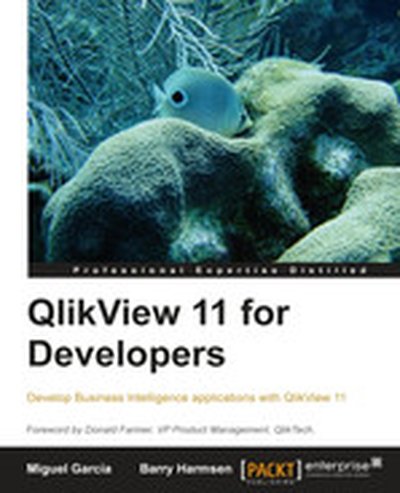
QlikView 11 for Developers

In 'QlikView 11 for Developers', you will learn how to leverage QlikView to create robust, insightful business intelligence applications. By following the case study of HighCloud Airlines, this book offers a practical, step-by-step guide to developing and mastering QlikView to address real-world data analysis needs. What this Book will help me do Build comprehensive QlikView dashboards with advanced techniques. Understand how to create associative data models by integrating different data sources. Design interactive user interfaces to enable insightful analysis. Apply best practices in QlikView scripting to transform and prepare data. Master QlikView's built-in functions for calculations and analyses. Author(s) The authors of 'QlikView 11 for Developers' bring extensive experience in business intelligence and QlikView application development. With backgrounds in software engineering and data visualization, they combine technical rigor with practical insights. Their teaching approach ensures concepts are accessible and actionable for a wide range of learners. Who is it for? This book is ideal for software developers and data analysts who want to harness QlikView to build business intelligence applications. It is tailored for those with a basic understanding of business intelligence looking to deepen their expertise in QlikView. The content is also valuable for power users seeking efficiency through advanced features. Readers will gain practical, hands-on knowledge by following this guide.

R in a Nutshell, 2nd Edition

If you’re considering R for statistical computing and data visualization, this book provides a quick and practical guide to just about everything you can do with the open source R language and software environment. You’ll learn how to write R functions and use R packages to help you prepare, visualize, and analyze data. Author Joseph Adler illustrates each process with a wealth of examples from medicine, business, and sports. Updated for R 2.14 and 2.15, this second edition includes new and expanded chapters on R performance, the ggplot2 data visualization package, and parallel R computing with Hadoop. Get started quickly with an R tutorial and hundreds of examples Explore R syntax, objects, and other language details Find thousands of user-contributed R packages online, including Bioconductor Learn how to use R to prepare data for analysis Visualize your data with R’s graphics, lattice, and ggplot2 packages Use R to calculate statistical fests, fit models, and compute probability distributions Speed up intensive computations by writing parallel R programs for Hadoop Get a complete desktop reference to R

Infographics: The Power of Visual Storytelling

Transform your marketing efforts through the power of visual content In today's fast-paced environment, you must communicate your message in a concise and engaging way that sets it apart from the noise. Visual content—such as infographics and data visualization—can accomplish this. With DIY functionality, Infographics: The Power of Visual Storytelling will teach you how to find stories in your data, and how to visually communicate and share them with your audience for maximum impact. Infographics will show you the vast potential to using the communication medium as a marketing tool by creating informative and shareable infographic content. Learn how to explain an object, idea, or process using strong illustration that captures interest and provides instant clarity Discover how to unlock interesting stories (in previously buried or boring data) and turn them into visual communications that will help build brands and increase sales Use the power of visual content to communicate with and engage your audience, capture attention, and expand your market.

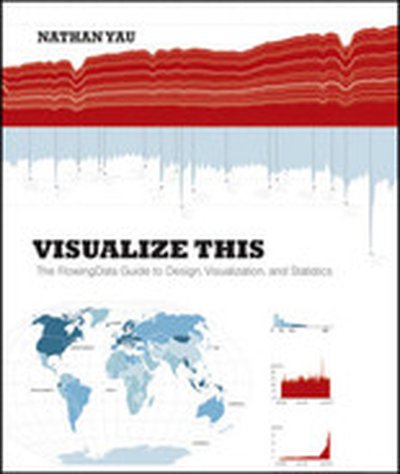
Visualize This: The FlowingData Guide to Design, Visualization, and Statistics

Practical data design tips from a data visualization expert of the modern age Data doesn't decrease; it is ever-increasing and can be overwhelming to organize in a way that makes sense to its intended audience. Wouldn't it be wonderful if we could actually visualize data in such a way that we could maximize its potential and tell a story in a clear, concise manner? Thanks to the creative genius of Nathan Yau, we can. With this full-color book, data visualization guru and author Nathan Yau uses step-by-step tutorials to show you how to visualize and tell stories with data. He explains how to gather, parse, and format data and then design high quality graphics that help you explore and present patterns, outliers, and relationships. Presents a unique approach to visualizing and telling stories with data, from a data visualization expert and the creator of flowingdata.com, Nathan Yau Offers step-by-step tutorials and practical design tips for creating statistical graphics, geographical maps, and information design to find meaning in the numbers Details tools that can be used to visualize data-native graphics for the Web, such as ActionScript, Flash libraries, PHP, and JavaScript and tools to design graphics for print, such as R and Illustrator Contains numerous examples and descriptions of patterns and outliers and explains how to show them Visualize This demonstrates how to explain data visually so that you can present your information in a way that is easy to understand and appealing.

SAP BusinessObjects Dashboards 4.0 Cookbook

Discover how to create compelling, interactive dashboards efficiently using SAP BusinessObjects Dashboards 4.0 (formerly Xcelsius). In this comprehensive cookbook, learn step-by-step recipes that guide you through practical tasks leveraging the tool's advanced features like dynamic visibility and live data connections. What this Book will help me do Master the use of Dashboard Design's spreadsheet and data-driven components to efficiently create professional dashboards. Learn various data visualization techniques to present data clearly and effectively within your dashboards. Implement dynamic interactivity and control logic using features like Dynamic Visibility to enhance dashboard usability. Understand how to connect dashboards to live data sources for up-to-date and real-time business insights. Explore and utilize additional Dashboard Design features and add-ons to customize and extend the capabilities of your dashboards. Author(s) The author(s) of this book are seasoned professionals in SAP BusinessObjects Dashboards and enterprise dashboard design. With years of experience in teaching and applying these tools in practical settings, they aim to demystify complex dashboarding concepts and empower professionals to build impactful visualizations. Who is it for? This book is targeted at developers and business professionals who wish to sharpen their skills in dashboard creation using SAP BusinessObjects Dashboards 4.0. Readers should have a basic understanding of dashboards and some experience with Excel to benefit from this content. It's ideal for those new to SAP Dashboard Design seeking a comprehensive and practical guide.

Data Mashups in R

How do you use R to import, manage, visualize, and analyze real-world data? With this short, hands-on tutorial, you learn how to collect online data, massage it into a reasonable form, and work with it using R facilities to interact with web servers, parse HTML and XML, and more. Rather than use canned sample data, you'll plot and analyze current home foreclosure auctions in Philadelphia. This practical mashup exercise shows you how to access spatial data in several formats locally and over the Web to produce a map of home foreclosures. It's an excellent way to explore how the R environment works with R packages and performs statistical analysis. Parse messy data from public foreclosure auction postings Plot the data using R's PBSmapping package Import US Census data to add context to foreclosure data Use R's lattice and latticeExtra packages for data visualization Create multidimensional correlation graphs with the pairs() scatterplot matrix package

Microsoft Visio 2010 Business Process Diagramming and Validation

In the book 'Microsoft Visio 2010 Business Process Diagramming and Validation', you'll master the specialized features of Microsoft Visio 2010 Premium. This guide focuses on creating structured diagrams and validation rules, helping you enhance the accuracy and clarity of your business data visualization. What this Book will help me do Gain expertise in leveraging Visio's structured diagram tools for business process mapping. Learn how to build, customize, and apply Validation Rules for ensuring diagram accuracy. Develop skills in using the Visio Object Model and ShapeSheet to create advanced diagramming solutions. Understand and implement enhanced diagramming templates and rules, including BPMN and custom workflows. Acquire techniques for creating add-ins and publishing templates to establish company-wide diagramming standards. Author(s) David Parker, the author of this insightful book, is a seasoned professional with extensive experience in Microsoft Visio. His expertise includes creating complex diagramming solutions and training professionals in maximizing Visio's features. David's hands-on approach and understanding of business process needs make this a practical and enriching guide. Who is it for? This book is for users and developers of Microsoft Visio 2010 Premium Edition who want to master diagram validation and structured diagrams. Beginners with basic Visio knowledge and experienced users aiming to develop advanced applications will both benefit from this resource. It is especially useful for professionals seeking to enforce accuracy and compliance in their diagrams.

Mathematica Cookbook

Visit the catalog page for Mathematica CookbookVisit the errata page for Mathematica Cookbook Mathematica Cookbook helps you master the application's core principles by walking you through real-world problems. Ideal for browsing, this book includes recipes for working with numerics, data structures, algebraic equations, calculus, and statistics. You'll also venture into exotic territory with recipes for data visualization using 2D and 3D graphic tools, image processing, and music. Although Mathematica 7 is a highly advanced computational platform, the recipes in this book make it accessible to everyone -- whether you're working on high school algebra, simple graphs, PhD-level computation, financial analysis, or advanced engineering models. Learn how to use Mathematica at a higher level with functional programming and pattern matching Delve into the rich library of functions for string and structured text manipulation Learn how to apply the tools to physics and engineering problems Draw on Mathematica's access to physics, chemistry, and biology data Get techniques for solving equations in computational finance Learn how to use Mathematica for sophisticated image processing Process music and audio as musical notes, analog waveforms, or digital sound samples

R in a Nutshell

Why learn R? Because it's rapidly becoming the standard for developing statistical software. R in a Nutshell provides a quick and practical way to learn this increasingly popular open source language and environment. You'll not only learn how to program in R, but also how to find the right user-contributed R packages for statistical modeling, visualization, and bioinformatics. The author introduces you to the R environment, including the R graphical user interface and console, and takes you through the fundamentals of the object-oriented R language. Then, through a variety of practical examples from medicine, business, and sports, you'll learn how you can use this remarkable tool to solve your own data analysis problems. Understand the basics of the language, including the nature of R objects Learn how to write R functions and build your own packages Work with data through visualization, statistical analysis, and other methods Explore the wealth of packages contributed by the R community Become familiar with the lattice graphics package for high-level data visualization Learn about bioinformatics packages provided by Bioconductor "I am excited about this book. R in a Nutshell is a great introduction to R, as well as a comprehensive reference for using R in data analytics and visualization. Adler provides 'real world' examples, practical advice, and scripts, making it accessible to anyone working with data, not just professional statisticians."

Making Sense of Data: A Practical Guide to Exploratory Data Analysis and Data Mining

A practical, step-by-step approach to making sense out of data Making Sense of Data educates readers on the steps and issues that need to be considered in order to successfully complete a data analysis or data mining project. The author provides clear explanations that guide the reader to make timely and accurate decisions from data in almost every field of study. A step-by-step approach aids professionals in carefully analyzing data and implementing results, leading to the development of smarter business decisions. With a comprehensive collection of methods from both data analysis and data mining disciplines, this book successfully describes the issues that need to be considered, the steps that need to be taken, and appropriately treats technical topics to accomplish effective decision making from data. Readers are given a solid foundation in the procedures associated with complex data analysis or data mining projects and are provided with concrete discussions of the most universal tasks and technical solutions related to the analysis of data, including: Problem definitions Data preparation Data visualization Data mining Statistics Grouping methods Predictive modeling Deployment issues and applications Throughout the book, the author examines why these multiple approaches are needed and how these methods will solve different problems. Processes, along with methods, are carefully and meticulously outlined for use in any data analysis or data mining project. From summarizing and interpreting data, to identifying non-trivial facts, patterns, and relationships in the data, to making predictions from the data, Making Sense of Data addresses the many issues that need to be considered as well as the steps that need to be taken to master data analysis and mining.

Visualization Handbook

The Visualization Handbook provides an overview of the field of visualization by presenting the basic concepts, providing a snapshot of current visualization software systems, and examining research topics that are advancing the field. This text is intended for a broad audience, including not only the visualization expert seeking advanced methods to solve a particular problem, but also the novice looking for general background information on visualization topics. The largest collection of state-of-the-art visualization research yet gathered in a single volume, this book includes articles by a “who’s who? of international scientific visualization researchers covering every aspect of the discipline, including: · Virtual environments for visualization · Basic visualization algorithms · Large-scale data visualization · Scalar data isosurface methods · Visualization software and frameworks · Scalar data volume rendering · Perceptual issues in visualization · Various application topics, including information visualization. * Edited by two of the best known people in the world on the subject; chapter authors are authoritative experts in their own fields; * Covers a wide range of topics, in 47 chapters, representing the state-of-the-art of scientific visualization.

Developing Bioinformatics Computer Skills

Bioinformatics--the application of computational and analytical methods to biological problems--is a rapidly evolving scientific discipline. Genome sequencing projects are producing vast amounts of biological data for many different organisms, and, increasingly, storing these data in public databases. Such biological databases are growing exponentially, along with the biological literature. It's impossible for even the most zealous researcher to stay on top of necessary information in the field without the aid of computer-based tools. Bioinformatics is all about building these tools. Developing Bioinformatics Computer Skills is for scientists and students who are learning computational approaches to biology for the first time, as well as for experienced biology researchers who are just starting to use computers to handle their data. The book covers the Unix file system, building tools and databases for bioinformatics, computational approaches to biological problems, an introduction to Perl for bioinformatics, data mining, and data visualization. Written in a clear, engaging style, Developing Bioinformatics Computer Skills will help biologists develop a structured approach to biological data as well as the tools they'll need to analyze the data.