talk-data.com talk-data.com

Topic

AI/ML

Artificial Intelligence/Machine Learning

data_science algorithms predictive_analytics

9014

tagged

Activity Trend

1532 peak/qtr
2020-Q1 2026-Q1

Activities

9014 activities · Newest first

🛰️➡️🧑‍💻: Streamlining Satellite Data for Analysis-Ready Outputs

I will share how our team built an end-to-end system to transform raw satellite imagery into analysis-ready datasets for use cases like vegetation monitoring, deforestation detection, and identifying third-party activity. We streamlined the entire pipeline from automated acquisition and cloud storage to preprocessing that ensures spatial, spectral, and temporal consistency. By leveraging Prefect for orchestration, Anyscale Ray for scalable processing, and the open source STAC standard for metadata indexing, we reduced processing times from days to near real-time. We addressed challenges like inconsistent metadata and diverse sensor types, building a flexible system capable of supporting large-scale geospatial analytics and AI workloads.
Despite a softening US labor market and a downshift in global industry and trade, the global economy looks resilient with the US tracking above-trend growth this quarter. With tariff and immigration drags still building, do we just delay the expected pothole or fill it over? The Fed is set to cut, but strong growth, high-and-rising inflation, and threats to independence complicate the path beyond.

Speakers:

Bruce Kasman

Joseph Lupton

This podcast was recorded on 29 August 2025.

This communication is provided for information purposes only. Institutional clients please visit www.jpmm.com/research/disclosures for important disclosures. © 2025 JPMorgan Chase & Co. All rights reserved. This material or any portion hereof may not be reprinted, sold or redistributed without the written consent of J.P. Morgan. It is strictly prohibited to use or share without prior written consent from J.P. Morgan any research material received from J.P. Morgan or an authorized third-party (“J.P. Morgan Data”) in any third-party artificial intelligence (“AI”) systems or models when such J.P. Morgan Data is accessible by a third-party. It is permissible to use J.P. Morgan Data for internal business purposes only in an AI system or model that protects the confidentiality of J.P. Morgan Data so as to prevent any and all access to or use of such J.P. Morgan Data by any third-party.

In this episode of Data Unchained,we sit down with David Flynn, Founder and CEO of Hammerspace, to explore how next-generation infrastructure is transforming the future of AI factories, hyperscaler data centers, and enterprise-scale AI deployments. From exabyte-in-a-rack architectures to parallel file systems native in Linux, this conversation reveals how organizations can drastically lower CapEx, OpEx, and power consumption while unlocking unprecedented performance density. Cyberpunk by jiglr | https://soundcloud.com/jiglrmusic Music promoted by https://www.free-stock-music.com Creative Commons Attribution 3.0 Unported License https://creativecommons.org/licenses/by/3.0/deed.en_US

AIInfrastructure #Hyperscalers #DataEngineering #EnterpriseAI #SoftwareArchitecture #ExabyteStorage #ParallelFileSystems #LinuxNative #DataCenters #AIatScale #OpenPlatformInitiative #globaldata

Hosted on Acast. See acast.com/privacy for more information.

In this episode, Conor and Bryce chat about some open source projects, podcast recommendations, our upcoming trip to Europe and much more! Link to Episode 249 on WebsiteDiscuss this episode, leave a comment, or ask a question (on GitHub)Socials ADSP: The Podcast: TwitterConor Hoekstra: Twitter | BlueSky | MastodonBryce Adelstein Lelbach: TwitterShow Notes Date Recorded: 2025-08-21 Date Released: 2025-08-29 Astro Bot VideoADSP Episode 176: 🇺🇸 prior, deltas & Dinner with PhineasThrust Github Search Vibing ProjectPaddlePaddle/Paddle RepoUber AresDB RepoLatent Space PodcastBig Technology PodcastCheeky Pint PodcastDwarkesh PodcastTraining Data PodcastADSP Episode 39: How Steve Jobs Saved Sean ParentRoku Engineering SymposiumCopenhagen C++ MeetupCasey Muratori – The Big OOPs: Anatomy of a Thirty-five-year Mistake – BSC 2025NDC Tech Town CUDA Python WorkshopNDC Tech Town CUDA C++ WorkshopIntro Song Info Miss You by Sarah Jansen https://soundcloud.com/sarahjansenmusic Creative Commons — Attribution 3.0 Unported — CC BY 3.0 Free Download / Stream: http://bit.ly/l-miss-you Music promoted by Audio Library https://youtu.be/iYYxnasvfx8

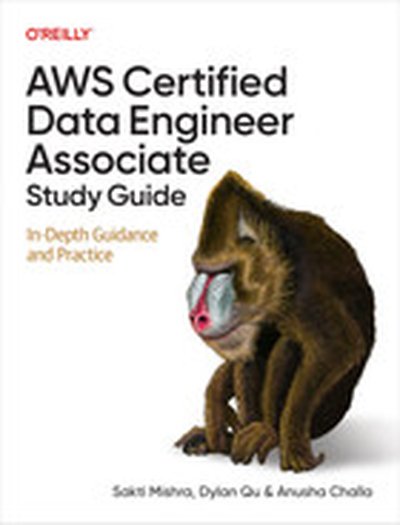
AWS Certified Data Engineer Associate Study Guide

There's no better time to become a data engineer. And acing the AWS Certified Data Engineer Associate (DEA-C01) exam will help you tackle the demands of modern data engineering and secure your place in the technology-driven future. Authors Sakti Mishra, Dylan Qu, and Anusha Challa equip you with the knowledge and sought-after skills necessary to effectively manage data and excel in your career. Whether you're a data engineer, data analyst, or machine learning engineer, you'll discover in-depth guidance, practical exercises, sample questions, and expert advice you need to leverage AWS services effectively and achieve certification. By reading, you'll learn how to: Ingest, transform, and orchestrate data pipelines effectively Select the ideal data store, design efficient data models, and manage data lifecycles Analyze data rigorously and maintain high data quality standards Implement robust authentication, authorization, and data governance protocols Prepare thoroughly for the DEA-C01 exam with targeted strategies and practices

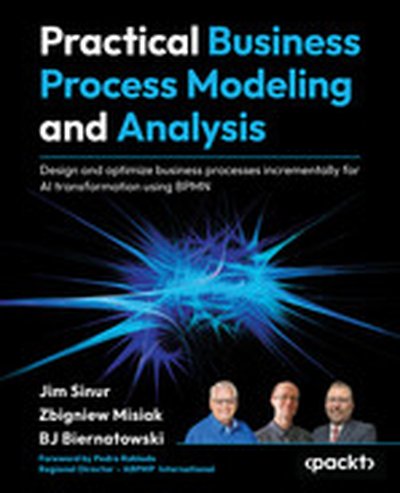
Practical Business Process Modeling and Analysis

Embark on a journey to master business process modeling and analysis with this comprehensive guide. Through practical examples and structured frameworks, this book helps you learn to define, map, and optimize your business processes for digital transformation. By the end, you'll be equipped to drive seamless integration of automation and align processes with strategic goals. What this Book will help me do Become proficient in using BPMN for modeling complex business processes effectively. Develop skills to identify inefficiencies and optimize business processes for measurable improvements. Understand how to integrate automation into processes to enhance operational efficiency. Learn to evaluate business process performance and align changes with business goals. Apply frameworks and best practices for successful digital transformation. Author(s) The authors, Jim Sinur, Zbigniew Misiak, and BJ Biernatowski, bring decades of experience in business process modeling, automation, and consulting. They've guided organizations through challenging transformations and are experts in leveraging BPMN and related technologies. Their insights in this book stem from real-world challenges and successes, providing readers with practical and actionable guidance. Who is it for? This book is tailored for business analysts, process improvement practitioners, project managers, consultants, operations managers, and IT leaders. Whether you are starting with no prior experience in BPMN or looking to enhance your existing skillset, this book offers valuable insights for streamlining workflows and driving AI-powered innovation.

Welcome to DataFramed Industry Roundups! In this series of episodes, we sit down to discuss the latest and greatest in data & AI.  In this episode, with special guest, DataCamp Editor Alex, we touch upon the launch of GPT-5, scaling limits in AI, Meta’s leaked chatbot guidelines, trust in AI tools from the Stack Overflow survey, why OpenAI and Anthropic are giving models away to the US government, AI safety concerns around reasoning, and much more. Links Mentioned in the Show: GPT-5 Is an Evolution, Not a RevolutionMeta’s AI rules have let bots hold ‘sensual’ chats with kids, offer false medical infoAI | 2025 Stack Overflow Developer SurveyOpenAI, Anthropic, both giving AI to federal workers for $1/agency New to DataCamp? Learn on the go using the DataCamp mobile appEmpower your business with world-class data and AI skills with DataCamp for business

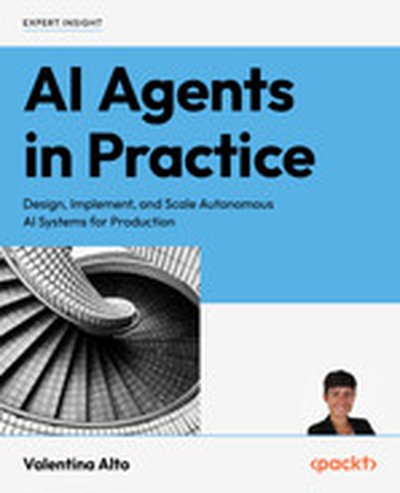
AI Agents in Practice

Discover how to build autonomous AI agents tailored for real-world tasks with 'AI Agents in Practice.' This book guides you through creating and deploying AI systems that go beyond chatbots to solve complex problems, using leading frameworks and practical design patterns. What this Book will help me do Understand and implement core components of AI agents, such as memory, tool integration, and context management. Develop production-ready AI agents for diverse applications using frameworks like LangChain. Design and implement multi-agent systems to enable advanced collaboration and problem-solving. Apply ethical and responsible AI techniques, including monitoring and human oversight, in agent development. Optimize performance and scalability of AI agents for production use cases. Author(s) Valentina Alto is an accomplished AI engineer with years of experience in AI systems design and implementation. Valentina specializes in developing practical solutions utilizing large language models and contemporary frameworks for real-world applications. Through her writing, she conveys complex ideas in an accessible manner, and her goal is to empower AI developers and enthusiasts with the skills to create meaningful solutions. Who is it for? This book is perfect for AI engineers, data scientists, and software developers ready to go beyond foundational knowledge of large language models to implement advanced AI agents. It caters to professionals looking to build scalable solutions and those interested in ethical considerations of AI usage. Readers with a background in machine learning and Python will benefit most from the technical insights provided.

We’ll explore the subtle yet significant ways in which reliance on AI tools—particularly large language models (LLMs) can change the way developers think. Drawing from personal experiences and broader industry trends, the talk examines the dangers of vibe coding: an intuition-driven, unstructured approach that LLMs often encourage, where solutions are stitched together based on plausibility rather than understanding. We'll consider how over-reliance on these tools leads to cognitive offloading, potentially dulling critical thinking, weakening foundational skills, and diluting the craftsmanship that once defined great code. Rather than rejecting AI assistants outright, this talk invites a more mindful, deliberate engagement, where tools support, but do not substitute, human judgment and creativity. The goal is to challenge developers to rethink their relationship with AI, reclaim ownership of their cognitive processes, and rediscover the joy of making things well, not just fast.

Have you ever wished for AI to swiftly generate an image of an astronaut on Mars or rapidly identify mushrooms in a photograph? Enhancing the performance of your local AI workloads can be achieved through incremental improvements across various domains—from optimizing hardware and refining models to streamlining inference processes. These incremental advancements can significantly boost efficiency, allowing you to receive your AI-generated pudding recipe in mere seconds.

Session Overview: Over the past decade, AI has rapidly transformed software testing. Organizations are under pressure to release faster, cut costs, and boost test coverage—often leading to rushed AI adoption in QA workflows. But for many teams, that has led to burnout, failed pilots, or simply unclear ROI. In this session, Jackie McDougall will unpack the reality behind the AI hype in testing. Whether you're struggling with AI fatigue, failed starts, or just not sure how to begin, this session will help you reset and realign your AI strategy with what truly adds value to your QA efforts.

Key Takeaways - Identify the right entry points for AI in your QA workflow - Practical advice on where and how to get started - Understand the true benefits - and limitations - of AI in testing - Improve your AI adoption strategy without derailing existing processes

This talk is about building sustainable, purposeful AI practices in QA - so you’re not just chasing trends, but choosing tools that truly serve your quality goals.