talk-data.com talk-data.com

Topic

AI/ML

Artificial Intelligence/Machine Learning

data_science algorithms predictive_analytics

9014

tagged

Activity Trend

1532 peak/qtr
2020-Q1 2026-Q1

Activities

9014 activities · Newest first

Kirk is joined once again by Mike Sarraille, CEO and Founder of Talent War Group (recently acquired by Overwatch) to discuss his transition to the data center industry, the critical need for effective leadership training, particularly in the face of national security threats brought on by AI and technological demands, and the necessity of innovative approaches to leadership training to prepare the next generation of leaders.

0:00 Welcome to the Data Center World 2:12 The Excitement of Transition 6:00 Evolved Leadership in the Data Center 8:51 The Need for Leadership Training 14:07 The Role of Veterans in Industry 17:04 Understanding the Data Center's Impact 19:10 The Future of AI and Data Centers 22:07 National Security and Industry Growth 35:37 The Conversation Shifts to Nuclear Energy 43:27 China's Nuclear Advancements and Global Impact 51:49 The Long-term View of Global Relations 53:47 Preparing the Next Generation for Change 56:57 Technology's Unintended Consequences 59:52 The New Age of Warfare 1:00:06 The Evolution of Education 1:03:38 The Fifth Industrial Revolution 1:06:13 The Chinese Education System 1:13:07 Ethics in Warfare 1:14:42 The Impact of Social Media 1:22:00 AI and Job Opportunities 1:25:32 The Future of Leadership 1:30:13 The Military's Role in Society 1:32:57 The Need for Adaptability 1:44:49 The Generational Shift 1:51:30 Data Centers and National Security

For more about us: https://linktr.ee/overwatchmissioncritical

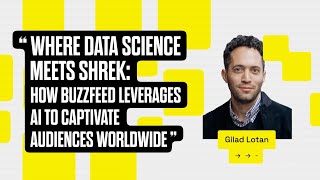
Where Data Science Meets Shrek: How BuzzFeed uses AI

By introducing a range of AI-enhanced products that amplify creativity and interactivity across our platforms, Buzzfeed has been able to connect with the largest global audience of young people online to cement its role as the defining digital media company of the AI era. Notably, some of Buzzfeed's most successful tools and content experiences thrive on the power of small, focused datasets. Still wondering how Shrek fits into the picture? You'll have to watch!

Video from: https://smalldatasf.com/

📓 Resources Big Data is Dead: https://motherduck.com/blog/big-data-... Small Data Manifesto: https://motherduck.com/blog/small-dat... Why Small Data?: https://benn.substack.com/p/is-excel-... Small Data SF: https://www.smalldatasf.com/

➡️ Follow Us LinkedIn: / motherduck
X/Twitter : / motherduck
Bluesky: motherduck.com Blog: https://motherduck.com/blog/


Discover how BuzzFeed's Data team, led by Gilad Cohen, harnesses AI for creative purposes, leveraging large language models (LLMs) and generative image capabilities to enhance content creation. This video explores how machine learning teams build tools to create new interactive media experiences, focusing on augmenting creative workflows rather than replacing jobs, allowing readers to participate more deeply in the content they consume.

We dive into the core data science problem of understanding what a piece of content is about, a crucial step for improving content recommendation systems. Learn why traditional methods fall short and how the team is constantly seeking smaller, faster, and more performant models. This exploration covers the evolution from earlier architectures like DistilBERT to modern, more efficient approaches for better content representation, clustering, and user personalization.

A key technique explored is the use of text embeddings, which are dense, low-dimensional vector representations of data. This video provides an accessible explanation of embeddings as a form of compressed knowledge, showing how BuzzFeed creates a unique vector for each article. This allows for simple vector math to find semantically similar content, forming a foundational infrastructure for powerful ranking and recommender systems.

Explore how BuzzFeed leverages generative image capabilities to create new interactive formats. The journey began with Midjourney experiments and evolved to building custom tools by fine-tuning a Stable Diffusion XL model using LORA (Low-Rank Approximation). This advanced technique provides greater control over image output, enabling the rapid creation of viral AI generators that respond to trending topics and allow for massive user engagement.

Finally, see a practical application of machine learning for content optimization. BuzzFeed uses its vast historical dataset from Bayesian A/B testing to train a model that predicts headline performance. By generating multiple headline candidates with an LLM like Claude and running them through this predictive model, they can identify the winning headline. This showcases how to use unique, in-house data to build powerful tools that improve click-through rates and drive engagement, pointing to a significant transformation in how media is created and consumed.

How do you make data analytics fun and engaging? In this episode, I chat with YouTube sensation Thu Vu. We discuss Python's growing significance, trends in the data job market, plus get a sneak peek into her new initiative, Python for AI Projects. 💌 Join 10k+ aspiring data analysts & get my tips in your inbox weekly 👉 https://www.datacareerjumpstart.com/newsletter 🆘 Feeling stuck in your data journey? Come to my next free "How to Land Your First Data Job" training 👉 https://www.datacareerjumpstart.com/training 👩‍💻 Want to land a data job in less than 90 days? 👉 https://www.datacareerjumpstart.com/daa 👔 Ace The Interview with Confidence 👉 https://www.datacareerjumpstart.com/interviewsimulator ⌚ TIMESTAMPS 05:54 - Creating cool projects with Local LLMs 13:48 - Learning and Teaching Python for AI 24:09 - Trends in Data and Tech Job Market 🔗 CONNECT WITH THU VU 🎥 YouTube Channel: https://www.youtube.com/@Thuvu5 🤝 LinkedIn: https://www.linkedin.com/in/thu-hien-vu-3766b174/ 📸 Instagram: https://www.instagram.com/thuvu.analytics/ 🎵 TikTok: https://www.tiktok.com/@thuvu.datanalytics 💻 Website: https://thuhienvu.com/ Free Data Science & AI tips thu-vu.ck.page/49c5ee08f6 Master Python for AI projects python-course-earlybird.framer.website 🔗 CONNECT WITH AVERY 🎥 YouTube Channel: https://www.youtube.com/@averysmith 🤝 LinkedIn: https://www.linkedin.com/in/averyjsmith/ 📸 Instagram: https://instagram.com/datacareerjumpstart 🎵 TikTok: https://www.tiktok.com/@verydata 💻 Website: https://www.datacareerjumpstart.com/ Mentioned in this episode: Join the last cohort of 2025! The LAST cohort of The Data Analytics Accelerator for 2025 kicks off on Monday, December 8th and enrollment is officially open!

To celebrate the end of the year, we’re running a special End-of-Year Sale, where you’ll get: ✅ A discount on your enrollment 🎁 6 bonus gifts, including job listings, interview prep, AI tools + more

If your goal is to land a data job in 2026, this is your chance to get ahead of the competition and start strong.

👉 Join the December Cohort & Claim Your Bonuses: https://DataCareerJumpstart.com/daa https://www.datacareerjumpstart.com/daa

With GenAI and LLMs comes great potential to delight and damage customer relationships—both during the sale, and in the UI/UX. However, are B2B AI product teams actually producing real outcomes, on the business side and the UX side, such that customers find these products easy to buy, trustworthy and indispensable? 

What is changing with customer problems as a result of LLM and GenAI technologies becoming more readily available to implement into B2B software? Anything?

Is your current product or feature development being driven by the fact you might be able to now solve it with AI? The “AI-first” team sounds like it’s cutting edge, but is that really determining what a customer will actually buy from you? 

Today I want to talk to you about the interplay of GenAI, customer trust (both user and buyer trust), and the role of UX in products using probabilistic technology.  

These thoughts are based on my own perceptions as a “user” of AI “solutions,” (quotes intentional!), conversations with prospects and clients at my company (Designing for Analytics), as well as the bright minds I mentor over at the MIT Sandbox innovation fund. I also wrote an article about this subject if you’d rather read an abridged version of my thoughts.

Highlights/ Skip to:

AI and LLM-Powered Products Do Not Turn Customer Problems into “Now” and “Expensive” Problems (4:03) Trust and Transparency in the Sale and the Product UX: Handling LLM Hallucinations (Confabulations) and Designing for Model Interpretability (9:44) Selling AI Products to Customers Who Aren’t Users (13:28) How LLM Hallucinations and Model Interpretability Impact User Trust of Your Product (16:10) Probabilistic UIs and LLMs Don’t Negate the Need to Design for Outcomes (22:48) How AI Changes (or Doesn’t) Our Benchmark Use Cases and UX Outcomes (28:41) Closing Thoughts (32:36)

Quotes from Today’s Episode

“Putting AI or GenAI into a product does not change the urgency or the depth of a particular customer problem; it just changes the solution space. Technology shifts in the last ten years have enabled founders to come up with all sorts of novel ways to leverage traditional machine learning, symbolic AI, and LLMs to create new products and disrupt established products; however, it would be foolish to ignore these developments as a product leader. All this technology does is change the possible solutions you can create. It does not change your customer situation, problem, or pain, either in the depth, or severity, or frequency. In fact, it might actually cause some new problems. I feel like most teams spend a lot more time living in the solution space than they do in the problem space. Fall in love with the problem and love that problem regardless of how the solution space may continue to change.” (4:51) “Narrowly targeted, specialized AI products are going to beat solutions trying to solve problems for multiple buyers and customers. If you’re building a narrow, specific product for a narrow, specific audience, one of the things you have on your side is a solution focused on a specific domain used by people who have specific domain experience. You may not need a trillion-parameter LLM to provide significant value to your customer. AI products that have a more specific focus and address a very narrow ICP I believe are more likely to succeed than those trying to serve too many use cases—especially when GenAI is being leveraged to deliver the value. I think this can be true even for platform products as well. Narrowing the audience you want to serve also narrows the scope of the product, which in turn should increase the value that you bring to that audience—in part because you probably will have fewer trust, usability, and utility problems resulting from trying to leverage a model for a wide range of use cases.” (17:18) “Probabilistic UIs and LLMs are going to create big problems for product teams, particularly if they lack a set of guiding benchmark use cases. I talk a lot about benchmark use cases as a core design principle and data-rich enterprise products. Why? Because a lot of B2B and enterprise products fall into the game of ‘adding more stuff over time.’ ‘Add it so you can sell it.’ As products and software companies begin to mature, you start having product owners and PMs attached to specific technologies or parts of a product. Figuring out how to improve the customer’s experience over time against the most critical problems and needs they have is a harder game to play than simply adding more stuff— especially if you have no benchmark use cases to hold you accountable. It’s hard to make the product indispensable if it’s trying to do 100 things for 100 people.“ (22:48) “Product is a hard game, and design and UX is by far not the only aspect of product that we need to get right. A lot of designers don’t understand this, and they think if they just nail design and UX, then everything else solves itself. The reason the design and experience part is hard is that it’s tied to behavior change– especially if you are ‘disrupting’ an industry, incumbent tool, application, or product. You are in the behavior-change game, and it’s really hard to get it right. But when you get it right, it can be really amazing and transformative.” (28:01) “If your AI product is trying to do a wide variety of things for a wide variety of personas, it’s going to be harder to determine appropriate benchmarks and UX outcomes to measure and design against. Given LLM hallucinations, the increased problem of trust, model drift problems, etc., your AI product has to actually innovate in a way that is both meaningful and observable to the customer. It doesn’t matter what your AI is trying to “fix.” If they can’t see what the benefit is to them personally, it doesn’t really matter if technically you’ve done something in a new and novel way. They’re just not going to care because that question of what’s in it for me is always sitting behind, in their brain, whether it’s stated out loud or not.” (29:32)

Links

Designing for Analytics mailing list

In this episode, Raja Iqbal welcomes Jay Alammar, a renowned educator, researcher, and visual storyteller in machine learning. Jay shares his fascinating journey into simplifying complex AI concepts through visual storytelling and his passion for making AI education accessible to everyone.

Raja and Jay discuss the power of visual learning, the role of intuition in understanding AI, and the challenges and opportunities in enterprise AI adoption. Jay also explores how AI is reshaping industries, the importance of tools like Retrieval-Augmented Generation (RAG), and his experiences at Cohere, where he helps organizations harness the power of large language models for real-world applications.

This episode is perfect for anyone curious about the evolving world of AI, practical ways to adopt AI in business, and the importance of education in driving innovation.

Today, we’re joined by Mohan Rao, Chief Product & Technology Officer of Knownwell, an AIaaS platform company that synthesizes an organization's natural communications, enterprise data, and public information into actionable intelligence to minimize client churn, maximize client growth, and drive operational efficiency. We talk about:

The changing product development process with AI-native productsEliciting user feedback when the application output is unpredictableOvercoming the cognitive dissonance of using AI toolsSolving the challenges of scaling professional services relationshipsThe value of a ‘Digital Chief of Staff’

As AI advances at breakneck speed, the conversation around its potential risks and ethical implications grows louder. For professionals in the field, this raises important questions about responsibility and foresight. How do you ensure that AI systems align with human values? What role do ethics play in the development and deployment of these technologies? Let's delve into the pressing issues that could define the future of AI and its role in society. Dr. Christopher DiCarlo is a philosopher, educator, and author. He teaches philosophy at the University of Toronto. He also founded Critical Thinking Solutions, a business consultancy, is an Expert Advisor for the Centre for Inquiry Canada, and the Ethics Chair for the Canadian Mental Health Association. His academic work focuses on bioethics and cognitive evolution. He is the author of six books, including the bestselling "How to Become a Really Good Pain in the Ass: A Critical Thinker's Guide to Asking the Right Questions", and his latest "Building a God: The Ethics of Artificial Intelligence and the Race to Control It". In the episode, Richie and Christopher explore the existential risks of powerful AI, ethical considerations in AI development, the importance of public awareness and involvement, the role of international regulation, and much more. Links Mentioned in the Show: Critical Thinking SolutionsConnect with ChristopherCourse: AI EthicsRelated Episode: Can You Use AI-Driven Pricing Ethically? with Jose Mendoza, Academic Director & Clinical Associate Professor at NYURewatch sessions from RADAR: Forward Edition New to DataCamp? Learn on the go using the DataCamp mobile appEmpower your business with world-class data and AI skills with DataCamp for business

Neste episódio especial, celebramos 100 edições do Podcast Data Hackers que já alcançou 1,1 milhões de plays. E nada melhor que, explora tudo que moldou o universo de dados, olhando para o futuro.

Agora, chegou aquele momento do ano em que vamos tentar prever o que será tendência em Dados e AI para o ano de 2025! Será que AI generativas ainda estarão em alta? Será mesmo, que será o fim do SQL, hein? Vem com a gente pra esse papo com nossos Community Managers Mario Filho e Pietro Oliveira, e o nosso mestre dos magos e também Co-fundador Allan Senne.

Lembrando que você pode encontrar todos os podcasts da família Data Hackers no Spotify, iTunes, Google Podcast, Castbox e muitas outras plataformas. Caso queira, você também pode ouvir o episódio aqui no post mesmo!

Falamos no episódio

Nossos convidados:

Mario Filho

Pietro Oliveira

Allan Senne.

Nossa Bancada Data Hackers:

Paulo Vasconcellos — Co-founder da Data Hackers e Principal Data Scientist na Hotmart.

Monique Femme — Head of Community Management na Data Hackers

Gabriel Lages — Co-founder da Data Hackers e Data & Analytics Sr. Director na Hotmart.

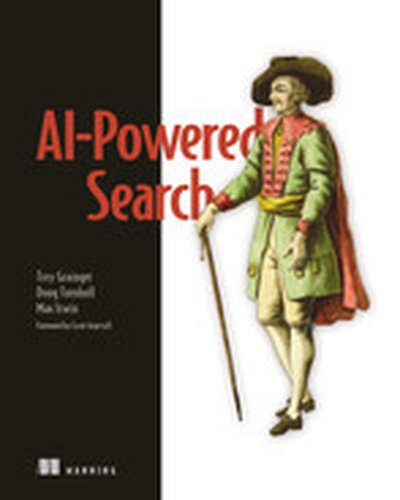
AI-Powered Search

Apply cutting-edge machine learning techniques—from crowdsourced relevance and knowledge graph learning, to Large Language Models (LLMs)—to enhance the accuracy and relevance of your search results. Delivering effective search is one of the biggest challenges you can face as an engineer. AI-Powered Search is an in-depth guide to building intelligent search systems you can be proud of. It covers the critical tools you need to automate ongoing relevance improvements within your search applications. Inside you’ll learn modern, data-science-driven search techniques like: Semantic search using dense vector embeddings from foundation models Retrieval augmented generation (RAG) Question answering and summarization combining search and LLMs Fine-tuning transformer-based LLMs Personalized search based on user signals and vector embeddings Collecting user behavioral signals and building signals boosting models Semantic knowledge graphs for domain-specific learning Semantic query parsing, query-sense disambiguation, and query intent classification Implementing machine-learned ranking models (Learning to Rank) Building click models to automate machine-learned ranking Generative search, hybrid search, multimodal search, and the search frontier AI-Powered Search will help you build the kind of highly intelligent search applications demanded by modern users. Whether you’re enhancing your existing search engine or building from scratch, you’ll learn how to deliver an AI-powered service that can continuously learn from every content update, user interaction, and the hidden semantic relationships in your content. You’ll learn both how to enhance your AI systems with search and how to integrate large language models (LLMs) and other foundation models to massively accelerate the capabilities of your search technology. About the Technology Modern search is more than keyword matching. Much, much more. Search that learns from user interactions, interprets intent, and takes advantage of AI tools like large language models (LLMs) can deliver highly targeted and relevant results. This book shows you how to up your search game using state-of-the-art AI algorithms, techniques, and tools. About the Book AI-Powered Search teaches you to create a search that understands natural language and improves automatically the more it is used. As you work through dozens of interesting and relevant examples, you’ll learn powerful AI-based techniques like semantic search on embeddings, question answering powered by LLMs, real-time personalization, and Retrieval Augmented Generation (RAG). What's Inside Sparse lexical and embedding-based semantic search Question answering, RAG, and summarization using LLMs Personalized search and signals boosting models Learning to Rank, multimodal, and hybrid search About the Reader For software developers and data scientists familiar with the basics of search engine technology. About the Author Trey Grainger is the Founder of Searchkernel and former Chief Algorithms Officer and SVP of Engineering at Lucidworks. Doug Turnbull is a Principal Engineer at Reddit and former Staff Relevance Engineer at Spotify. Max Irwin is the Founder of Max.io and former Managing Consultant at OpenSource Connections. Quotes Belongs on the shelf of every search practitioner! - Khalifeh AlJadda, Google A treasure map! Now you have decades of semantic search knowledge at your fingertips. - Mark Moyou, NVIDIA Modern and comprehensive! Everything you need to build world-class search experiences. - Kelvin Tan, SearchStax Kick starts your ability to implement AI search with easy to understand examples. - David Meza, NASA

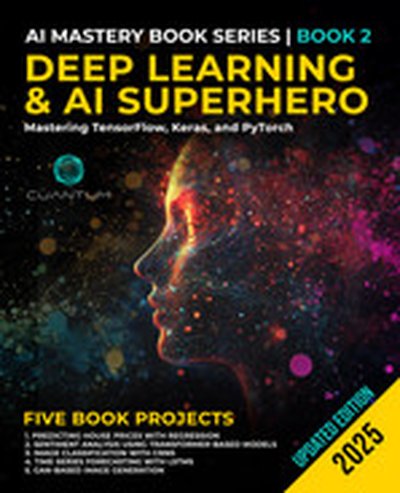
Deep Learning and AI Superhero

"Deep Learning and AI Superhero" is an extensive resource for mastering the core concepts and advanced techniques in AI and deep learning using TensorFlow, Keras, and PyTorch. This comprehensive guide walks you through topics from foundational neural network concepts to implementing real-world machine learning solutions. You will gain hands-on experience and theoretical knowledge to elevate your AI development skills. What this Book will help me do Develop a solid foundation in neural networks, their structure, and their training methodologies. Understand and implement deep learning models using TensorFlow and Keras effectively. Gain experience using PyTorch for creating, training, and optimizing advanced machine learning models. Learn advanced applications such as CNNs for computer vision, RNNs for sequential data, and Transformers for natural language processing. Deploy AI models on cloud and edge platforms through practical examples and optimized workflows. Author(s) Cuantum Technologies LLC has established itself as a pioneer in creating educational resources for advanced AI technologies. Their team consists of experts and practitioners in the field, combining years of industry and academic experience. Their books are crafted to ensure readers can practically apply cutting-edge AI techniques with clarity and confidence. Who is it for? This book is ideally suited for software developers, AI enthusiasts, and data scientists who have a basic understanding of programming and machine learning concepts. It's perfect for those seeking to enhance their skills and tackle real-world AI challenges. Whether your goals are professional development, research, or personal learning, you'll find practical and detailed guidance throughout this book.

Monday’s Inauguration Day in the US will not be a lifting of the policy fog that many are hoping for but rather just the start of a broad set of sweeping policy changes, the effects of which will take months (or longer) to understand. Still, a likely wave of executive orders will begin a period of busy policy and data tracking. Global industry looks to have perked up at year-end but the surveys remain depressed. Tracking the state of global sentiment as it processes the coming flurry of US actions will be particularly important as a leading indicator.

Speakers:

Bruce Kasman

Joseph Lupton

This podcast was recorded on 17 January 2025.

This communication is provided for information purposes only. Institutional clients please visit www.jpmm.com/research/disclosures for important disclosures. © 2025 JPMorgan Chase & Co. All rights reserved. This material or any portion hereof may not be reprinted, sold or redistributed without the written consent of J.P. Morgan. It is strictly prohibited to use or share without prior written consent from J.P. Morgan any research material received from J.P. Morgan or an authorized third-party (“J.P. Morgan Data”) in any third-party artificial intelligence (“AI”) systems or models when such J.P. Morgan Data is accessible by a third-party. It is permissible to use J.P. Morgan Data for internal business purposes only in an AI system or model that protects the confidentiality of J.P. Morgan Data so as to prevent any and all access to or use of such J.P. Morgan Data by any third-party.

In this podcast episode, we talked with Tamara Atanasoska about ​building fair AI systems.

About the Speaker:​Tamara works on ML explainability, interpretability and fairness as Open Source Software Engineer at probable. She is a maintainer of fairlearn, contributor to scikit-learn and skops. Tamara has both computer science/ software engineering and a computational linguistics(NLP) background.During the event, the guest discussed their career journey from software engineering to open-source contributions, focusing on explainability in AI through Scikit-learn and Fairlearn. They explored fairness in AI, including challenges in credit loans, hiring, and decision-making, and emphasized the importance of tools, human judgment, and collaboration. The guest also shared their involvement with PyLadies and encouraged contributions to Fairlearn. 00:00 Introduction to the event and the community 01:51 Topic introduction: Linguistic fairness and socio-technical perspectives in AI 02:37 Guest introduction: Tamara’s background and career 03:18 Tamara’s career journey: Software engineering, music tech, and computational linguistics 09:53 Tamara’s background in language and computer science 14:52 Exploring fairness in AI and its impact on society 21:20 Fairness in AI models26:21 Automating fairness analysis in models 32:32 Balancing technical and domain expertise in decision-making 37:13 The role of humans in the loop for fairness 40:02 Joining Probable and working on open-source projects 46:20 Scopes library and its integration with Hugging Face 50:48 PyLadies and community involvement 55:41 The ethos of Scikit-learn and Fairlearn

🔗 CONNECT WITH TAMARA ATANASOSKA Linkedin - https://www.linkedin.com/in/tamaraatanasoska GitHub- https://github.com/TamaraAtanasoska

🔗 CONNECT WITH DataTalksClub Join DataTalks.Club:⁠⁠https://datatalks.club/slack.html⁠⁠ Our events:⁠⁠https://datatalks.club/events.html⁠⁠ Datalike Substack -⁠⁠https://datalike.substack.com/⁠⁠ LinkedIn:⁠⁠  / datatalks-club  

Welcome to Data Unchained! In this episode, recorded live at the Supercomputing 24 Conference in Atlanta, Georgia, Molly Presley sits down with Mark Seamans from Penguin Solutions to explore the exciting intersection of high-performance computing (HPC) and AI innovations. Episode Highlights: - The explosive growth of AI and large language models in HPC. - How Penguin Solutions helps enterprises overcome GPU and AI complexity. - The role of OriginAI in simplifying AI project deployment. - Challenges of decentralized and unstructured data in AI workflows. - Emerging trends in hybrid cloud solutions and GPU-specific clouds. - The power of ClusterWare for optimizing high-performance clusters. Mark Seamans shares insights on how enterprises can effectively implement AI strategies, manage data complexity, and maximize their IT investments with innovative solutions like ClusterWare and OriginAI. Whether you're navigating AI for the first time or optimizing your HPC systems, this episode is packed with actionable takeaways!

AI #HighPerformanceComputing #DataScience #Supercomputing #PenguinSolutions #Hammerspace #CloudComputing #DataManagement #GPUComputing #AIProjects #TechInnovation #HybridCloud #ClusterWare #OriginAI #Supercomputing24 #Podcast

Cyberpunk by jiglr | https://soundcloud.com/jiglrmusic Music promoted by https://www.free-stock-music.com Creative Commons Attribution 3.0 Unported License https://creativecommons.org/licenses/by/3.0/deed.en_US Hosted on Acast. See acast.com/privacy for more information.

Send us a text Welcome to the cozy corner of the tech world where ones and zeros mingle with casual chit-chat. Datatopics Unplugged is your go-to spot for relaxed discussions around tech, news, data, and society. In this episode, we delve into the big topics shaping our digital landscape: Car Expo - Brussels Motor Show: Highlights from Europe’s leading auto show, including Tesla’s Cybertruck debut and an innovative AI-powered car configurator that personalizes your vehicle experience.Biden Admin’s New AI Chip Export Rules: Exploring restrictions aimed at national security and their impact on global markets, with industry reactions from Nvidia.Meta and Microsoft’s AI Development Plans: From Meta’s goal to replace mid-level engineers with AI to Microsoft forming a dev-focused AI organization, we unpack their strategies and implications.Developer Productivity in 2025: How AI tools are changing workflows, boosting efficiency, and introducing new challenges.UV’s Killer Feature: Discover how ad-hoc environments are transforming development, courtesy of Lukas Valatka's insights.Doom in a PDF: Yes, you read that right—Doom running inside a PDF! Here’s the source code for all the geeks out there.Marimo: An exciting new project redefining collaborative development.AI and Everyday Life: A witty meme highlights AI’s direction—should it help with art and writing, or chores like laundry and dishes?

As AI continues to advance, natural language processing (NLP) is at the forefront, transforming how businesses interact with data. From chatbots to document analysis, NLP offers numerous applications. But with the advent of generative AI, professionals face new challenges: When is it appropriate to use traditional NLP techniques versus more advanced models? How do you balance the costs and benefits of these technologies? Explore the strategic decisions and practical applications of NLP in the modern business world. Meri Nova is the founder of Break Into Data, a data careers company. Her work focuses on helping people switch to a career in data, and using machine learning to improve community engagement. Previously, she was a data scientist and machine learning engineer at Hyloc. Meri is the instructor of DataCamp's 'Retrieval Augmented Generation with LangChain' course. In the episode, Richie and Meri explore the evolution of natural language processing, the impact of generative AI on business applications, the balance between traditional NLP techniques and modern LLMs, the role of vector stores and knowledge graphs, and the exciting potential of AI in automating tasks and decision-making, and much more. Links Mentioned in the Show: Meri’s Breaking Into Data Handbook on GitHubBreak Into Data Discord GroupConnect with MeriSkill Track: Artificial Intelligence (AI) LeadershipRelated Episode: Industry Roundup #2: AI Agents for Data Work, The Return of the Full-Stack Data Scientist and Old languages Make a ComebackRewatch sessions from RADAR: Forward Edition New to DataCamp? Learn on the go using the DataCamp mobile appEmpower your business with world-class data and AI skills with DataCamp for business

podcast_episode
by Michael Toland (Pathfinder Product) , Amritha Arun Babu Mysore (Amazon; Wayfair; Klaviyo (experience across AI platforms, supply chain, and enterprise workflows))

The Data Product Management In Action podcast, brought to you by Soda and executive producer Scott Hirleman, is a platform for data product management practitioners to share insights and experiences. In this special minisode celebrating the podcast's 25th episode milestone, hosts Michael Toland and Amritha Arun Babu reflect on their journey so far. They share the key lessons they've learned, moments they've enjoyed, and their excitement for the future of data product management. From insights into AI and ML to the importance of building strong data communities and infrastructure, this episode highlights the most impactful themes and sets the stage for what’s to come in 2025. About our Host Michael Toland: Michael is a Product Management Coach and Consultant with Pathfinder Product, a Test Double Operation. He has worked in product officially since 2016, where he worked at Verizon on large scale system modernizations and migration initiatives for reference data and decision platforms. Outside of his professional career, Michael serves as the Treasurer for the New Leaders Council, mentors fellows with Venture for America, sings in the Columbus Symphony, writing satire posts for his blog Dignified Product or Test Double, depending on the topic, and is excited to be chatting with folks on Data Product Management. Connect with Michael on LinkedIn. About our Host Amritha Arun Babu Mysore: Amritha is an accomplished Product Leader with over a decade of experience building and scaling products across AI platforms, supply chain systems, and enterprise workflows in industries such as e-commerce, AI/ML, and marketing automation. At Amazon, she led machine learning platform products powering recommendation and personalization engines, building tools for model experimentation, deployment, and monitoring that improved efficiency for 1,500+ ML scientists. At Wayfair, she managed international supply chain systems, overseeing contracts, billing, product catalogs, and vendor operations, delivering cost savings and optimizing large-scale workflows. At Klaviyo, she drives both AI infrastructure and customer-facing AI tools, including recommendation engines, content generation assistants, and workflow automation agents, enabling scalable and personalized marketing workflows. Earlier, she worked on enterprise systems and revenue operations workflows, focusing on cost optimization and process improvements in complex technical environments. Amritha excels at bridging technical depth with strategic clarity, leading cross-functional teams, and delivering measurable business outcomes across diverse domains. Connect with Amritha on LinkedIn. All views and opinions expressed are those of the individuals and do not necessarily reflect their employers or anyone else.  Join the conversation on LinkedIn.  Apply to be a guest or nominate someone that you know.  Do you love what you're listening to? Please rate and review the podcast, and share it with fellow practitioners you know. Your support helps us reach more listeners and continue providing valuable insights!  .

Send us a text The AI Patent Attorney, Robert Plotkin is back!  Founding partner of Blueshift IP and author of AI Armor and The Genie in the Machine.  Robert outlines the new gold rush and how to take advantage of it. 02:59 Meet Robert Plotkin Again06:56 Robert's Brand 09:21 Why do Another Book11:33 What Can be Patented?14:18 Patent Attorneys19:10 Coca-Cola23:19 Patent Litigation26:23 Ignoring Copyrights2847 Open Source vs Patents30:32 4 Stages for IP Protection37:45 The Best Tech Patent40:38 The New Gold Rush 43:10 Is AI Liable49:20 Who Should Read the Book?50:52 Where to Reach Robert51:25 Wrap UpLinkedin: linkedin.com/in/robertplotkin Website: https://www.blueshiftip.com Want to be featured on Making Data Simple? Reach out at [email protected] and share why you should be our next guest. Hosted by Al Martin, AI Enthusiast, Trusted Advisor, and Curious Technologist, the Making Data Simple podcast brings you actionable insights from the leaders shaping AI, data, and innovation.

MakingDataSimple #AIInnovation #PatentLaw #RobertPlotkin #BlueshiftIP #AIArmor #TheGenieInTheMachine #TechLeadership #IntellectualProperty #FutureOfAI #AITrends #InnovationStrategy

Want to be featured as a guest on Making Data Simple? Reach out to us at [email protected] and tell us why you should be next. The Making Data Simple Podcast is hosted by Al Martin, WW VP Technical Sales, IBM, where we explore trending technologies, business innovation, and leadership ... while keeping it simple & fun.

Está no ar, o Data Hackers News !! Os assuntos mais quentes da semana, com as principais notícias da área de Dados, IA e Tecnologia, que você também encontra na nossa Newsletter semanal, agora no Podcast do Data Hackers !!

Aperte o play e ouça agora, o Data Hackers News dessa semana !

Para saber tudo sobre o que está acontecendo na área de dados, se inscreva na Newsletter semanal:

⁠⁠⁠⁠⁠⁠⁠⁠⁠⁠⁠⁠⁠⁠⁠⁠⁠⁠⁠⁠⁠⁠⁠⁠⁠⁠⁠⁠⁠⁠⁠⁠https://www.datahackers.news/⁠⁠⁠⁠⁠⁠⁠⁠⁠⁠⁠⁠⁠⁠⁠⁠⁠⁠⁠⁠⁠⁠⁠⁠⁠⁠⁠⁠⁠⁠⁠⁠

Conheça nossos comentaristas do Data Hackers News:

⁠⁠⁠⁠⁠⁠⁠⁠⁠⁠⁠⁠⁠⁠⁠⁠⁠⁠⁠⁠⁠⁠⁠⁠⁠⁠⁠⁠Monique Femme⁠⁠⁠⁠⁠⁠⁠⁠⁠⁠⁠⁠⁠⁠⁠⁠⁠⁠⁠⁠⁠⁠⁠⁠⁠⁠⁠⁠⁠

Paulo Vasconcellos

⁠Matérias/assuntos comentados:

Salesforce não vai contratar desenvolvedores em 2025; ⁠

Empresas pretendem substituir força de trabalho com IA até 2030

Demais canais do Data Hackers:

⁠⁠⁠⁠⁠⁠⁠⁠⁠⁠⁠⁠⁠⁠⁠⁠⁠⁠⁠⁠⁠⁠⁠⁠⁠⁠⁠⁠⁠⁠⁠⁠Site⁠⁠⁠⁠⁠⁠⁠⁠⁠⁠⁠⁠⁠⁠⁠⁠⁠⁠⁠⁠⁠⁠⁠⁠⁠⁠⁠⁠⁠⁠⁠⁠

⁠⁠⁠⁠⁠⁠⁠⁠⁠⁠⁠⁠⁠⁠⁠⁠⁠⁠⁠⁠⁠⁠⁠⁠⁠⁠⁠⁠⁠⁠⁠⁠Linkedin⁠⁠⁠⁠⁠⁠⁠⁠⁠⁠⁠⁠⁠⁠⁠⁠⁠⁠⁠⁠⁠⁠⁠⁠⁠⁠⁠⁠⁠⁠⁠⁠

⁠⁠⁠⁠⁠⁠⁠⁠⁠⁠⁠⁠⁠⁠⁠⁠⁠⁠⁠⁠⁠⁠⁠⁠⁠⁠⁠⁠⁠⁠⁠⁠Instagram⁠⁠⁠⁠⁠⁠⁠⁠⁠⁠⁠⁠⁠⁠⁠⁠⁠⁠⁠⁠⁠⁠⁠⁠⁠⁠⁠⁠⁠⁠⁠⁠

⁠⁠⁠⁠⁠⁠⁠⁠⁠⁠⁠⁠⁠⁠⁠⁠⁠⁠⁠⁠⁠⁠⁠⁠⁠⁠⁠⁠⁠⁠⁠⁠Tik Tok⁠⁠⁠⁠⁠⁠⁠⁠⁠⁠⁠⁠⁠⁠⁠⁠⁠⁠⁠⁠⁠⁠⁠⁠⁠⁠⁠⁠⁠⁠⁠⁠

⁠⁠⁠⁠⁠⁠⁠⁠⁠⁠⁠⁠⁠⁠⁠⁠⁠⁠⁠⁠⁠⁠⁠⁠⁠⁠⁠⁠⁠⁠⁠⁠You Tube⁠⁠⁠⁠⁠⁠⁠⁠⁠⁠⁠⁠⁠⁠⁠⁠⁠⁠⁠⁠⁠⁠⁠⁠⁠⁠⁠⁠⁠⁠⁠