talk-data.com talk-data.com

Topic

Analytics

data_analysis insights metrics

395

tagged

Activity Trend

398 peak/qtr
2020-Q1 2026-Q1

Activities

Showing filtered results

Filtering by: O'Reilly Data Engineering Books ×
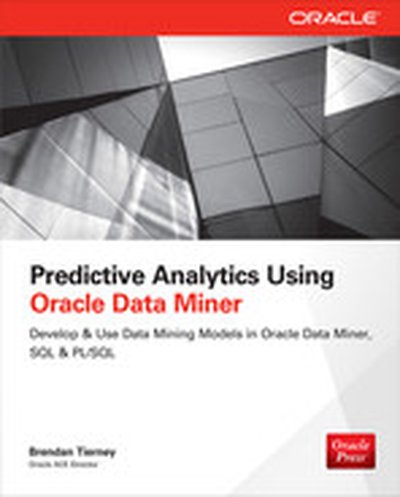
Predictive Analytics Using Oracle Data Miner

Build Next-Generation In-Database Predictive Analytics Applications with Oracle Data Miner “If you have an Oracle Database and want to leverage that data to discover new insights, make predictions, and generate actionable insights, this book is a must read for you! In Predictive Analytics Using Oracle Data Miner: Develop & Use Oracle Data Mining Models in Oracle Data Miner, SQL & PL/SQL, Brendan Tierney, Oracle ACE Director and data mining expert, guides you through the basic concepts of data mining and offers step-by-step instructions for solving data-driven problems using SQL Developer’s Oracle Data Mining extension. Brendan takes it full circle by showing you how to deploy advanced analytical methodologies and predictive models immediately into enterprise-wide production environments using the in-database SQL and PL/SQL functionality. Definitely a must read for any Oracle data professional!” --Charlie Berger, Senior Director Product Management, Oracle Data Mining and Advanced Analytics Perform in-database data mining to unlock hidden insights in data. Written by an Oracle ACE Director, Predictive Analytics Using Oracle Data Miner shows you how to use this powerful tool to create and deploy advanced data mining models. Covering topics for the data scientist, Oracle developer, and Oracle database administrator, this Oracle Press guide shows you how to get started with Oracle Data Miner and build Oracle Data Miner models using SQL and PL/SQL packages. You'll get best practices for integrating your Oracle Data Miner models into applications to automate the discovery and distribution of business intelligence predictions throughout the enterprise. Install and configure Oracle Data Miner for Oracle Database 11 g Release 11.2 and Oracle Database 12 c Create Oracle Data Miner projects and workflows Prepare data for data mining Develop data mining models using association rule analysis, classification, clustering, regression, and anomaly detection Use data dictionary views and prepare your data using in-database transformations Build and use data mining models using SQL and PL/SQL packages Migrate your Oracle Data Miner models, integrate them into dashboards and applications, and run them in parallel Build transient data mining models with the Predictive Queries feature in Oracle Database 12 c
Large Scale and Big Data

Large Scale and Big Data: Processing and Management provides readers with a central source of reference on the data management techniques currently available for large-scale data processing. Presenting chapters written by leading researchers, academics, and practitioners, it addresses the fundamental challenges associated with Big Data processing tools and techniques across a range of computing environments. The book begins by discussing the basic concepts and tools of large-scale Big Data processing and cloud computing. It also provides an overview of different programming models and cloud-based deployment models. The book’s second section examines the usage of advanced Big Data processing techniques in different domains, including semantic web, graph processing, and stream processing. The third section discusses advanced topics of Big Data processing such as consistency management, privacy, and security. Supplying a comprehensive summary from both the research and applied perspectives, the book covers recent research discoveries and applications, making it an ideal reference for a wide range of audiences, including researchers and academics working on databases, data mining, and web scale data processing. After reading this book, you will gain a fundamental understanding of how to use Big Data-processing tools and techniques effectively across application domains. Coverage includes cloud data management architectures, big data analytics visualization, data management, analytics for vast amounts of unstructured data, clustering, classification, link analysis of big data, scalable data mining, and machine learning techniques.

Architecting and Deploying IBM DB2 with BLU Acceleration in Your Analytical Environment

IBM® DB2® with BLU Acceleration is a revolutionary technology that is delivered in DB2 for Linux, UNIX, and Windows Release 10.5. BLU Acceleration delivers breakthrough performance improvements for analytic queries by using dynamic in-memory columnar technologies. Different from other vendor solutions, BLU Acceleration allows the unified computing of online transaction processing (OLTP) and analytics data inside a single database, therefore, removing barriers and accelerating results for users. With observed hundredfold improvement in query response time, BLU Acceleration provides a simple, fast, and easy-to-use solution for the needs of today's organizations; quick access to business answers can be used to gain a competitive edge, lower costs, and more. This IBM Redbooks® publication introduces the concepts of DB2 with BLU Acceleration. It discusses the steps to move from a relational database to using BLU Acceleration, optimizing BLU usage, and deploying BLU into existing analytic solutions today, with an example of IBM Cognos®. This book also describes integration of DB2 with BLU Acceleration into SAP Business Warehouse (SAP BW) and SAP's near-line storage solution on DB2. This publication is intended to be helpful to a wide-ranging audience, including those readers who want to understand the technologies and readers who have planning, deployment, and support responsibilities.

Google BigQuery Analytics

How to effectively use BigQuery, avoid common mistakes, and execute sophisticated queries against large datasets Google BigQuery Analytics is the perfect guide for business and data analysts who want the latest tips on running complex queries and writing code to communicate with the BigQuery API. The book uses real-world examples to demonstrate current best practices and techniques, and also explains and demonstrates streaming ingestion, transformation via Hadoop in Google Compute engine, AppEngine datastore integration, and using GViz with Tableau to generate charts of query results. In addition to the mechanics of BigQuery, the book also covers the architecture of the underlying Dremel query engine, providing a thorough understanding that leads to better query results. Features a companion website that includes all code and data sets from the book Uses real-world examples to explain everything analysts need to know to effectively use BigQuery Includes web application examples coded in Python

Advanced Case Management with IBM Case Manager

Organizations face case management challenges that require insight, responsiveness, and collaboration. IBM® Case Manager, Version 5.2, is an advanced case management product that unites information, process, and people to provide the 360-degree view of case information and achieve optimized outcomes. With IBM Case Manager, knowledge workers can extract critical case information through integrated business rules, collaboration, and analytics. This easy access to information enhances decision-making ability and leads to more successful case outcomes. IBM Case Manager also helps capture industry preferred practices in frameworks and templates to empower business users and accelerate return on investment. This IBM Redbooks® publication introduces the case management concept. It includes the reason for and benefits of case management, and why it is different from the traditional business process management or content management. In addition, this book addresses how you can design and build a case management solution with IBM Case Manager and integrate that solution with external products and components. This book is intended to provide IT architects and IT specialists with the high-level concepts of case management and the capabilities of IBM Case Manager. It also serves as a practical guide for IT professionals who are responsible for designing, building, customizing, and deploying IBM Case Manager solutions.

IBM MobileFirst Strategy Software Approach

IBM® MobileFirst enables an enterprise to support a mobile strategy. With this end-to-end solution, IBM makes it possible for an enterprise to benefit from mobile interactions with customers, with business partners, and in organizations. There are products available from the IBM MobileFirst solution to support management, security, analytics, and development of the application and data platforms in a mobile environment. This IBM Redbooks® publication explores four areas crucial to developing a mobile strategy: Application development Mobile quality management Mobile device management Mobile analytics This IBM Redbooks publication provides an in-depth look at IBM Worklight®, IBM Rational® Test Workbench, IBM Endpoint Manager for Mobile Devices, and IBM Tealeaf® CX Mobile. This book is of interest to architects looking to design mobile enterprise solutions, and to practitioners looking to build these solutions. Related blog post 5 Things To Know About IBM MobileFirst

Big Data Analytics Beyond Hadoop: Real-Time Applications with Storm, Spark, and More Hadoop Alternatives

Master alternative Big Data technologies that can do what Hadoop can't: real-time analytics and iterative machine learning. When most technical professionals think of Big Data analytics today, they think of Hadoop. But there are many cutting-edge applications that Hadoop isn't well suited for, especially real-time analytics and contexts requiring the use of iterative machine learning algorithms. Fortunately, several powerful new technologies have been developed specifically for use cases such as these. Big Data Analytics Beyond Hadoop is the first guide specifically designed to help you take the next steps beyond Hadoop. Dr. Vijay Srinivas Agneeswaran introduces the breakthrough Berkeley Data Analysis Stack (BDAS) in detail, including its motivation, design, architecture, Mesos cluster management, performance, and more. He presents realistic use cases and up-to-date example code for: Spark, the next generation in-memory computing technology from UC Berkeley Storm, the parallel real-time Big Data analytics technology from Twitter GraphLab, the next-generation graph processing paradigm from CMU and the University of Washington (with comparisons to alternatives such as Pregel and Piccolo) Halo also offers architectural and design guidance and code sketches for scaling machine learning algorithms to Big Data, and then realizing them in real-time. He concludes by previewing emerging trends, including real-time video analytics, SDNs, and even Big Data governance, security, and privacy issues. He identifies intriguing startups and new research possibilities, including BDAS extensions and cutting-edge model-driven analytics. Big Data Analytics Beyond Hadoop is an indispensable resource for everyone who wants to reach the cutting edge of Big Data analytics, and stay there: practitioners, architects, programmers, data scientists, researchers, startup entrepreneurs, and advanced students.

Pig Design Patterns

Discover how to simplify Hadoop programming with Pig Design Patterns, helping you create innovative enterprise-level big data solutions. This book takes you step-by-step through practical design patterns for creating efficient data processing workflows with Apache Pig. What this Book will help me do Understand and implement fundamental data processing patterns with Pig. Master advanced Pig techniques for Big Data analytics. Learn to optimize Pig scripts for performance and scalability. Build end-to-end data processing solutions with real-world examples. Integrate Pig workflows into the broader Hadoop ecosystem. Author(s) Pradeep Pasupuleti is an experienced data engineer and software developer specializing in Big Data technologies. With extensive expertise in Hadoop and Pig, Pradeep shares valuable insights and practical techniques beginners and experts alike will appreciate. Who is it for? This book is perfect for software developers and data engineers working with Hadoop who want to streamline their workflow. It is ideal for professionals already familiar with Pig and Hadoop basics looking to advance. It also suits learners aiming to implement optimized data solutions effectively.

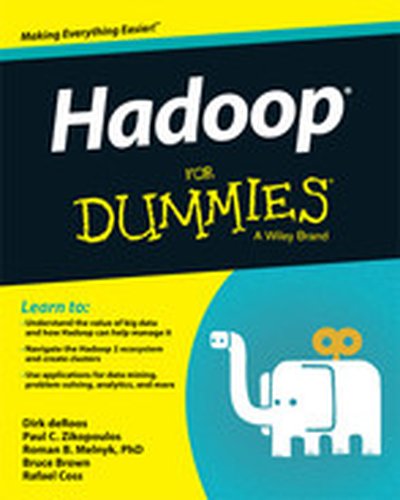
Hadoop For Dummies

Let Hadoop For Dummies help harness the power of your data and rein in the information overload Big data has become big business, and companies and organizations of all sizes are struggling to find ways to retrieve valuable information from their massive data sets with becoming overwhelmed. Enter Hadoop and this easy-to-understand For Dummies guide. Hadoop For Dummies helps readers understand the value of big data, make a business case for using Hadoop, navigate the Hadoop ecosystem, and build and manage Hadoop applications and clusters. Explains the origins of Hadoop, its economic benefits, and its functionality and practical applications Helps you find your way around the Hadoop ecosystem, program MapReduce, utilize design patterns, and get your Hadoop cluster up and running quickly and easily Details how to use Hadoop applications for data mining, web analytics and personalization, large-scale text processing, data science, and problem-solving Shows you how to improve the value of your Hadoop cluster, maximize your investment in Hadoop, and avoid common pitfalls when building your Hadoop cluster From programmers challenged with building and maintaining affordable, scaleable data systems to administrators who must deal with huge volumes of information effectively and efficiently, this how-to has something to help you with Hadoop.

Solr in Action

Solr in Action is a comprehensive guide to implementing scalable search using Apache Solr. This clearly written book walks you through well-documented examples ranging from basic keyword searching to scaling a system for billions of documents and queries. It will give you a deep understanding of how to implement core Solr capabilities. About the Technology About the Book Whether you're handling big (or small) data, managing documents, or building a website, it is important to be able to quickly search through your content and discover meaning in it. Apache Solr is your tool: a ready-to-deploy, Lucene-based, open source, full-text search engine. Solr can scale across many servers to enable real-time queries and data analytics across billions of documents. Solr in Action teaches you to implement scalable search using Apache Solr. This easy-to-read guide balances conceptual discussions with practical examples to show you how to implement all of Solr's core capabilities. You'll master topics like text analysis, faceted search, hit highlighting, result grouping, query suggestions, multilingual search, advanced geospatial and data operations, and relevancy tuning. What's Inside How to scale Solr for big data Rich real-world examples Solr as a NoSQL data store Advanced multilingual, data, and relevancy tricks Coverage of versions through Solr 4.7 About the Reader This book assumes basic knowledge of Java and standard database technology. No prior knowledge of Solr or Lucene is required. About the Authors Trey Grainger is a director of engineering at CareerBuilder. Timothy Potter is a senior member of the engineering team at LucidWorks. The authors work on the scalability and reliability of Solr, as well as on recommendation engine and big data analytics technologies. Quotes The knowledge and techniques you need. - From the Foreword by Yonik Seeley, Creator of Solr Readable and immediately applicable ... an excellent book. - John Viviano, InterCorp, Inc. The go-to guide for Solr ... a definitive resource for both beginners and experts. - Scott Anthony, Business Instruments A well-dosed combination of deep technical knowledge and real-world experience. - Alexandre Madurell, Piksel, Inc.

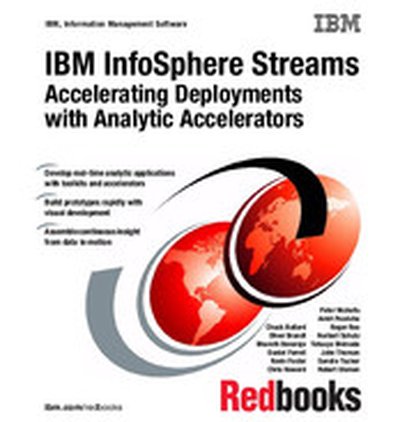
IBM InfoSphere Streams: Accelerating Deployments with Analytic Accelerators

This IBM® Redbooks® publication describes visual development, visualization, adapters, analytics, and accelerators for IBM InfoSphere® Streams (V3), a key component of the IBM Big Data platform. Streams was designed to analyze data in motion, and can perform analysis on incredibly high volumes with high velocity, using a wide variety of analytic functions and data types. The Visual Development environment extends Streams Studio with drag-and-drop development, provides round tripping with existing text editors, and is ideal for rapid prototyping. Adapters facilitate getting data in and out of Streams, and V3 supports WebSphere MQ, Apache Hadoop Distributed File System, and IBM InfoSphere DataStage. Significant analytics include the native Streams Processing Language, SPSS Modeler analytics, Complex Event Processing, TimeSeries Toolkit for machine learning and predictive analytics, Geospatial Toolkit for location-based applications, and Annotation Query Language for natural language processing applications. Accelerators for Social Media Analysis and Telecommunications Event Data Analysis sample programs can be modified to build production level applications. Want to learn how to analyze high volumes of streaming data or implement systems requiring high performance across nodes in a cluster? Then this book is for you. Please note that the additional material referenced in the text is not available from IBM.

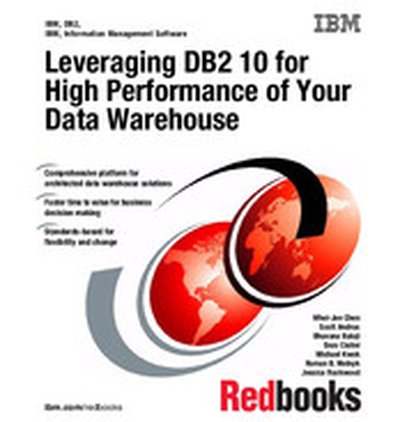
Leveraging DB2 10 for High Performance of Your Data Warehouse

Building on the business intelligence (BI) framework and capabilities that are outlined in InfoSphere Warehouse: A Robust Infrastructure for Business Intelligence, SG24-7813, this IBM® Redbooks® publication focuses on the new business insight challenges that have arisen in the last few years and the new technologies in IBM DB2® 10 for Linux, UNIX, and Windows that provide powerful analytic capabilities to meet those challenges. This book is organized in to two parts. The first part provides an overview of data warehouse infrastructure and DB2 Warehouse, and outlines the planning and design process for building your data warehouse. The second part covers the major technologies that are available in DB2 10 for Linux, UNIX, and Windows. We focus on functions that help you get the most value and performance from your data warehouse. These technologies include database partitioning, intrapartition parallelism, compression, multidimensional clustering, range (table) partitioning, data movement utilities, database monitoring interfaces, infrastructures for high availability, DB2 workload management, data mining, and relational OLAP capabilities. A chapter on BLU Acceleration gives you all of the details about this exciting DB2 10.5 innovation that simplifies and speeds up reporting and analytics. Easy to set up and self-optimizing, BLU Acceleration eliminates the need for indexes, aggregates, or time-consuming database tuning to achieve top performance and storage efficiency. No SQL or schema changes are required to take advantage of this breakthrough technology. This book is primarily intended for use by IBM employees, IBM clients, and IBM Business Partners.

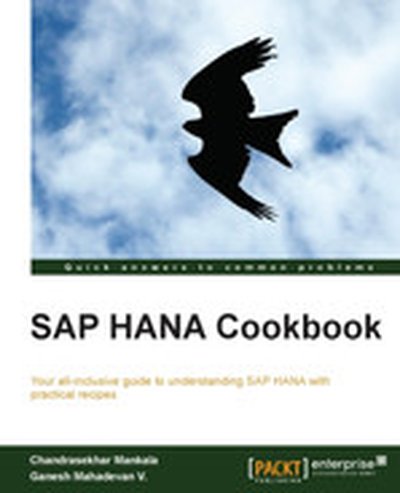
SAP HANA Cookbook

"SAP HANA Cookbook" is a hands-on guide to learning SAP HANA, a powerful in-memory database platform. Through over 50 practical recipes, you'll understand the inner workings of SAP HANA's architecture, and learn techniques to optimize operations and analytics. What this Book will help me do Understand SAP HANA's architecture and in-memory capabilities. Effectively load and integrate data from various source systems. Develop and optimize SAP HANA models such as attribute, analytical, and calculation views. Gain proficiency in using the SAP HANA SQL scripting language. Master user and role management for secure and efficient SAP HANA operation. Author(s) This book is authored by industry specialists with extensive experience in SAP HANA technology. Drawing from real-world projects, the authors provide nuanced insights and practical guidance, enabling readers to implement SAP HANA solutions effectively. Who is it for? This book is suited for solution architects, developers, and managers seeking to develop expertise in SAP HANA. Whether you are new to SAP technologies or looking to deepen your skillset, this resource provides comprehensive and actionable guidance.

Data Just Right: Introduction to Large-Scale Data & Analytics

Making Big Data Work: Real-World Use Cases and Examples, Practical Code, Detailed Solutions Large-scale data analysis is now vitally important to virtually every business. Mobile and social technologies are generating massive datasets; distributed cloud computing offers the resources to store and analyze them; and professionals have radically new technologies at their command, including NoSQL databases. Until now, however, most books on “Big Data” have been little more than business polemics or product catalogs. is different: It’s a completely practical and indispensable guide for every Big Data decision-maker, implementer, and strategist. Data Just Right Michael Manoochehri, a former Google engineer and data hacker, writes for professionals who need practical solutions that can be implemented with limited resources and time. Drawing on his extensive experience, he helps you focus on building applications, rather than infrastructure, because that’s where you can derive the most value. Manoochehri shows how to address each of today’s key Big Data use cases in a cost-effective way by combining technologies in hybrid solutions. You’ll find expert approaches to managing massive datasets, visualizing data, building data pipelines and dashboards, choosing tools for statistical analysis, and more. Throughout, the author demonstrates techniques using many of today’s leading data analysis tools, including Hadoop, Hive, Shark, R, Apache Pig, Mahout, and Google BigQuery. Coverage includes Mastering the four guiding principles of Big Data success—and avoiding common pitfalls Emphasizing collaboration and avoiding problems with siloed data Hosting and sharing multi-terabyte datasets efficiently and economically “Building for infinity” to support rapid growth Developing a NoSQL Web app with Redis to collect crowd-sourced data Running distributed queries over massive datasets with Hadoop, Hive, and Shark Building a data dashboard with Google BigQuery Exploring large datasets with advanced visualization Implementing efficient pipelines for transforming immense amounts of data Automating complex processing with Apache Pig and the Cascading Java library Applying machine learning to classify, recommend, and predict incoming information Using R to perform statistical analysis on massive datasets Building highly efficient analytics workflows with Python and Pandas Establishing sensible purchasing strategies: when to build, buy, or outsource Previewing emerging trends and convergences in scalable data technologies and the evolving role of the Data Scientist

Big Data Application Architecture Q&A: A Problem - Solution Approach

Big Data Application Architecture Pattern Recipes provides an insight into heterogeneous infrastructures, databases, and visualization and analytics tools used for realizing the architectures of big data solutions. Its problem-solution approach helps in selecting the right architecture to solve the problem at hand. In the process of reading through these problems, you will learn harness the power of new big data opportunities which various enterprises use to attain real-time profits. Big Data Application Architecture Pattern Recipes answers one of the most critical questions of this time 'how do you select the best end-to-end architecture to solve your big data problem?'. The book deals with various mission critical problems encountered by solution architects, consultants, and software architects while dealing with the myriad options available for implementing a typical solution, trying to extract insight from huge volumes of data in real-time and across multiple relational and non-relational data types for clients from industries like retail, telecommunication, banking, and insurance. The patterns in this book provide the strong architectural foundation required to launch your next big data application. The architectures for realizing these opportunities are based on relatively less expensive and heterogeneous infrastructures compared to the traditional monolithic and hugely expensive options that exist currently. This book describes and evaluates the benefits of heterogeneity which brings with it multiple options of solving the same problem, evaluation of trade-offs and validation of 'fitness-for-purpose' of the solution. What you'll learn Major considerations in building a big data solution Big data application architectures problems for specific industries What are the components one needs to build and end-to-end big data solution? Does one really need a real-time big data solution or an off-line analytics batch solution? What are the operations and support architectures for a big data solution? What are the scalability considerations, and options for a Hadoop installation? Who this book is for CIOs, CTOs, enterprise architects, and software architects Consultants, solution architects, and information management (IM) analysts who want to architect a big data solution for their enterprise

Query Acceleration for Business Using IBM Informix Warehouse Accelerator

IBM® Informix® Warehouse Accelerator is a state-of-the-art in-memory database that uses affordable innovations in memory and processor technology and trends in novel ways to boost query performance. It is a disruptive technology that changes how organizations provide analytics to its operational and historical data. Informix Warehouse Accelerator uses columnar, in-memory approach to accelerate even the most complex warehouse and operational queries without application changes or tuning. This IBM Redbooks® publication provides a comprehensive look at the technology and architecture behind the system. It contains information about the tools, data synchronization, and query processing capabilities of Informix Warehouse Accelerator, and provides steps to implement data analysis by using Informix Warehouse Accelerator within an organization. This book is intended for IBM Business Partners and clients who are looking for low-cost solutions to boost data warehouse query performance.

Introduction to IBM Real-time Compression Appliances

Continuing its commitment to developing and delivering industry-leading storage technologies, IBM is introducing the IBM Real-time Compression Appliances for NAS, an innovative new storage offering that delivers essential storage efficiency technologies, combined with exceptional ease of use and performance. In an era when the amount of information, particularly in unstructured files, is exploding, but budgets for storing that information are stagnant, IBM Real-time Compression technology offers a powerful tool for better information management, protection, and access. IBM Real-time Compression can help slow the growth of storage acquisition, reducing storage costs while simplifying both operations and management. It also enables organizations to keep more data available for use rather than storing it offsite or on harder-to-access tape, so they can support improved analytics and decision making. IBM Real-time Compression Appliances provide on-line storage optimization through real-time data compression, delivering dramatic cost reduction without performance degradation. This IBM® Redbooks® publication is an easy-to-follow guide that describes how to design solutions successfully using IBM Real-time Compression Appliances (IBM RTCAs). It provides practical installation examples, ease of use, remote management, high availability, and administration techniques. Furthermore, it explains best practices for RTCA solution design, application integration, and practical RTCA use cases.

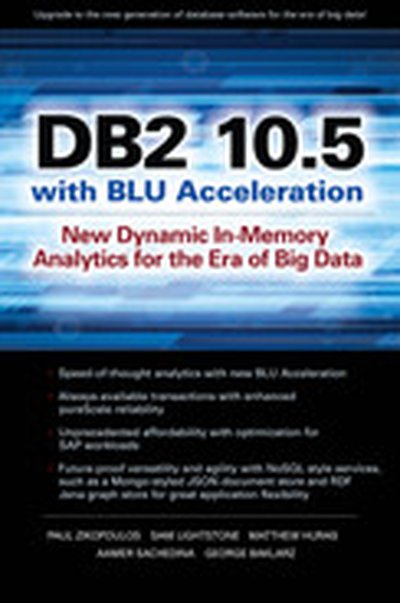
DB2 10.5 with BLU Acceleration

UPGRADE TO THE NEW GENERATION OF DATABASE SOFTWARE FOR THE ERA OF BIG DATA! If big data is an untapped natural resource, how do you find the gold hidden within? Leaders realize that big data means all data, and are moving quickly to extract more value from both structured and unstructured application data. However, analyzing this data can prove costly and complex, especially while protecting the availability, performance and reliability of essential business applications. In the new era of big data, businesses require data systems that can blend always-available transactions with speed-of-thought analytics. DB2 10.5 with BLU Acceleration provides this speed, simplicity, and affordability while making it easier to build next-generation applications with NoSQL features, such as a mongo-styled JSON document store, a graph store, and more. Dynamic in-memory columnar processing and other innovations deliver faster insights from more data, and enhanced pureScale clustering technology delivers high-availability transactions with application-transparent scalability for business continuity. With this book, you'll learn about the power and flexibility of multiworkload, multi-platform database software. Use the comprehensive knowledge from a team of DB2 developers and experts to get started with the latest DB2 trial version you can download at ibm.com/developerworks/downloads/im/db2/. Stay up to date on DB2 by visiting ibm.com/db2/.

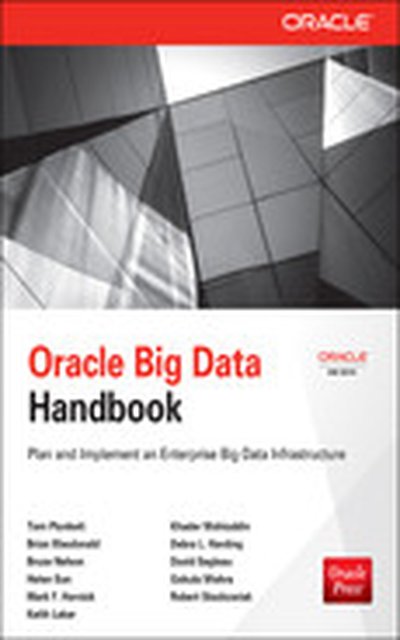
Oracle Big Data Handbook

Transform Big Data into Insight "In this book, some of Oracle's best engineers and architects explain how you can make use of big data. They'll tell you how you can integrate your existing Oracle solutions with big data systems, using each where appropriate and moving data between them as needed." -- Doug Cutting, co-creator of Apache Hadoop Cowritten by members of Oracle's big data team, Oracle Big Data Handbook provides complete coverage of Oracle's comprehensive, integrated set of products for acquiring, organizing, analyzing, and leveraging unstructured data. The book discusses the strategies and technologies essential for a successful big data implementation, including Apache Hadoop, Oracle Big Data Appliance, Oracle Big Data Connectors, Oracle NoSQL Database, Oracle Endeca, Oracle Advanced Analytics, and Oracle's open source R offerings. Best practices for migrating from legacy systems and integrating existing data warehousing and analytics solutions into an enterprise big data infrastructure are also included in this Oracle Press guide. Understand the value of a comprehensive big data strategy Maximize the distributed processing power of the Apache Hadoop platform Discover the advantages of using Oracle Big Data Appliance as an engineered system for Hadoop and Oracle NoSQL Database Configure, deploy, and monitor Hadoop and Oracle NoSQL Database using Oracle Big Data Appliance Integrate your existing data warehousing and analytics infrastructure into a big data architecture Share data among Hadoop and relational databases using Oracle Big Data Connectors Understand how Oracle NoSQL Database integrates into the Oracle Big Data architecture Deliver faster time to value using in-database analytics Analyze data with Oracle Advanced Analytics (Oracle R Enterprise and Oracle Data Mining), Oracle R Distribution, ROracle, and Oracle R Connector for Hadoop Analyze disparate data with Oracle Endeca Information Discovery Plan and implement a big data governance strategy and develop an architecture and roadmap

Hybrid Analytics Solution using IBM DB2 Analytics Accelerator for z/OS V3.1

The IBM® DB2® Analytics Accelerator Version 3.1 for IBM z/OS® (simply called Accelerator in this book) is a union of the IBM System z® quality of service and IBM Netezza® technology to accelerate complex queries in a DB2 for z/OS highly secure and available environment. Superior performance and scalability with rapid appliance deployment provide an ideal solution for complex analysis. In this IBM Redbooks® publication, we provide technical decision-makers with a broad understanding of the benefits of Version 3.1 of the Accelerator's major new functions. We describe their installation and the advantages to existing analytical processes as measured in our test environment. We also describe the IBM zEnterprise® Analytics System 9700, a hybrid System z solution offering that is surrounded by a complete set of optional packs to enable customers to custom tailor the system to their unique needs..