
talk-data.com talk-data.com

Topic

Analytics

data_analysis insights metrics

170

tagged

Activity Trend

398 peak/qtr
2020-Q1 2026-Q1

Activities

Showing filtered results

Filtering by: Databricks DATA + AI Summit 2023 ×
Near Real-Time Analytics with Event Streaming, Live Tables, and Delta Sharing

Microservices is an increasingly popular architecture much loved by application teams, for it allows services to be developed and scaled independently. Data teams, though, often need a centralized repository where all data from different services come together to join and aggregate. The data platform can serve as a single source of company facts, enable near real time analytics, and secure sharing of massive data sets across clouds.

A viable microservices ingestion pattern is Change Data Capture, using AWS Database Migration Services or Debezium. CDC proves to be a scalable solution ideal for stable platforms, but it has several challenges for evolving services: Frequent schema changes, complex, unsupported DDL during migration, and automated deployments are but a few. An event streaming architecture can address these challenges.

Confluent, for example, provides a schema registry service where all services can register their event schemas. Schema registration helps with verifying that the events are being published based on the agreed contracts between data producers and consumers. It also provides a separation between internal service logic and the data consumed downstream. The services write their events to Kafka using the registered schemas with a specific topic based on the type of the event.

Data teams can leverage Spark jobs to ingest Kafka topics into Bronze tables in the Delta Lake. On ingestion, the registered schema from schema registry is used to validate the schema based on the provided version. A merge operation is sometimes called to translate events into final states of the records per business requirements.

Data teams can take advantage of Delta Live Tables on streaming datasets to produce Silver and Gold tables in near real time. Each input data source also has a set of expectations to ensure data quality and business rules. The pipeline allows Engineering and Analytics to collaborate by mixing Python and SQL. The refined data sets are then fed into Auto ML for discovery and baseline modeling.

To expose Gold tables to more consumers, especially non spark users across clouds, data teams can implement Delta Sharing. Recipients can accesses Silver tables from a different cloud and build their own analytics data sets. Analytics teams can also access Gold tables via pandas Delta Sharing client and BI tools.

Connect with us: Website: https://databricks.com Facebook: https://www.facebook.com/databricksinc Twitter: https://twitter.com/databricks LinkedIn: https://www.linkedin.com/company/data... Instagram: https://www.instagram.com/databricksinc/

Opening the Floodgates: Enabling Fast, Unmediated End User Access to Trillion-Row Datasets with SQL

Spreadsheets revolutionized IT by giving end users the ability to create their own analytics. Providing direct end user access to trillion-row datasets generated in financial markets or digital marketing is much harder. New SQL data warehouses like ClickHouse and Druid can provide fixed latency with constant cost on very large datasets, which opens up new possibilities.

Our talk walks through recent experience on analytic apps developed by ClickHouse users that enable end users like market traders to develop their own analytics directly off raw data. We’ll cover the following topics.

  1. Characteristics of new open source column databases and how they enable low-latency analytics at constant cost.

  2. Idiomatic ways to validate new apps by building MVPs that support a wide range of queries on source data including storing source JSON, schema design, applying compression on columns, and building indexes for needle-in-a-haystack queries.

  3. Incrementally identifying hotspots and applying easy optimizations to bring query performance into line with long term latency and cost requirements.

  4. Methods of building accessible interfaces, including traditional dashboards, imitating existing APIs that are already known, and creating app-specific visualizations.

We’ll finish by summarizing a few of the benefits we’ve observed and also touch on ways that analytic infrastructure could be improved to make end user access even more productive. The lessons are as general as possible so that they can be applied across a wide range of analytic systems, not just ClickHouse.

Connect with us: Website: https://databricks.com Facebook: https://www.facebook.com/databricksinc Twitter: https://twitter.com/databricks LinkedIn: https://www.linkedin.com/company/data... Instagram: https://www.instagram.com/databricksinc/
Optimizing Speed and Scale of User-Facing Analytics Using Apache Kafka and Pinot

Apache Kafka is the de facto standard for real-time event streaming, but what do you do if you want to perform user-facing, ad-hoc, real-time analytics too? That's where Apache Pinot comes in.

Apache Pinot is a realtime distributed OLAP datastore, which is used to deliver scalable real time analytics with low latency. It can ingest data from batch data sources (S3, HDFS, Azure Data Lake, Google Cloud Storage) as well as streaming sources such as Kafka. Pinot is used extensively at LinkedIn and Uber to power many analytical applications such as Who Viewed My Profile, Ad Analytics, Talent Analytics, Uber Eats and many more serving 100k+ queries per second while ingesting 1Million+ events per second.

Apache Kafka's highly performant, distributed, fault-tolerant, real-time publish-subscribe messaging platform powers big data solutions at Airbnb, LinkedIn, MailChimp, Netflix, the New York Times, Oracle, PayPal, Pinterest, Spotify, Twitter, Uber, Wikimedia Foundation, and countless other businesses.

Come hear from Neha Power, Founding Engineer at a StarTree and PMC and committer of Apache Pinot, and Karin Wolok, Head of Developer Community at StarTree, on an introduction to both systems and a view of how they work together.

Connect with us: Website: https://databricks.com Facebook: https://www.facebook.com/databricksinc Twitter: https://twitter.com/databricks LinkedIn: https://www.linkedin.com/company/data... Instagram: https://www.instagram.com/databricksinc/
Orchestration Made Easy with Databricks Workflows

Orchestrating and managing end-to-end production pipelines have remained a bottleneck for many organizations. Data teams spend too much time stitching pipeline tasks and manually managing and monitoring the orchestration process – with heavy reliance on external or cloud-specific orchestration solutions, all of which slow down the delivery of new data. In this session, we introduce you to Databricks Workflows: a fully managed orchestration service for all your data, analytics, and AI, built in the Databricks Lakehouse Platform. Join us as we dive deep into the new workflow capabilities, and understand the integration with the underlying platform. You will learn how to create and run reliable production workflows, centrally manage and monitor workflows, and learn how to implement recovery actions such as repair and run, as well as other new features.

Connect with us: Website: https://databricks.com Facebook: https://www.facebook.com/databricksinc Twitter: https://twitter.com/databricks LinkedIn: https://www.linkedin.com/company/data... Instagram: https://www.instagram.com/databricksinc/
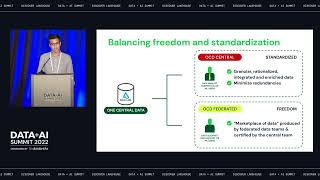
Accidentally Building a Petabyte-Scale Cybersecurity Data Mesh in Azure With Delta Lake at HSBC

Due to the unique cybersecurity challenges that HSBC faces daily - from high data volumes to untrustworthy sources to the privacy and security restrictions of a highly regulated industry - the resulting architecture was an unwieldy set of disparate data silos. So, how do we build a cybersecurity advanced analytics environment to enrich and transform these myriad data sources into a unified, well-documented, robust, resilient, repeatable, scalable, maintainable platform that will empower the cyber analysts of the future? That at the same time remains cost-effective and enables everyone from the less-technical junior reporting user to the senior machine learning engineers?

In this session, Ryan Harris, Principal Cybersecurity Engineer at HSBC, dives into the infrastructure and architecture employed, ranging from the landing zone concepts, secure access workstations, data lake structure, and isolated data ingestion, to the enterprise integration layer. In the process of building the data pipelines and lakehouses, we ended up building a hybrid data mesh leveraging Delta Lake. The result is a flexible, secure, self-service environment that is unlocking the capabilities of our humans.

Connect with us: Website: https://databricks.com Facebook: https://www.facebook.com/databricksinc Twitter: https://twitter.com/databricks LinkedIn: https://www.linkedin.com/company/data... Instagram: https://www.instagram.com/databricksinc/
Building an Analytics Lakehouse at Grab

Grab shares the story of their Lakehouse journey, from the drivers behind their shift to this new paradigm, to lessons learned along the way. From a starting point of a siloed, data warehouse centric architecture that had inherent challenges with scalability, performance and data duplication, Grab has standardized upon Databricks to serve as an open and unified Lakehouse platform to deliver insights at scale, democratizing data through the rapid deployment of AI and BI use cases across their operations.

Connect with us: Website: https://databricks.com Facebook: https://www.facebook.com/databricksinc Twitter: https://twitter.com/databricks LinkedIn: https://www.linkedin.com/company/data... Instagram: https://www.instagram.com/databricksinc/
Building an Operational Machine Learning Organization from Zero and Leveraging ML for Crypto Securit

BlockFi is a cryptocurrency platform that allows its clients to grow wealth through various financial products including loans, trading and interest accounts. In this presentation, we will showcase our journey adopting Databricks to build an operational nerve center for analytics across the company. We will demonstrate how to build a cross-functional organization and solve key business problems to earn executive buy-in. We will showcase two of the early successes we've had using machine learning & data science to solve key business challenges in the domains of cyber security and IT Operations. In the domain of security, we will showcase how we are using Graph Analytics to analyze millions of blockchain transactions to identify dust attacks, account takeover and flag risky transactions. The operational IT use case will showcase how we are using Sarimax to forecast platform usage patterns to scale our infrastructure using hourly crypto prices, and financial indicators.

Connect with us: Website: https://databricks.com Facebook: https://www.facebook.com/databricksinc Twitter: https://twitter.com/databricks LinkedIn: https://www.linkedin.com/company/data... Instagram: https://www.instagram.com/databricksinc/
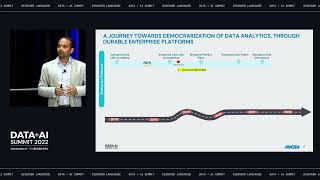
Building Enterprise Scale Data and Analytics Platforms at Amgen

Amgen has developed a suite of enterprise data & analytics platforms powered by modern, cloud native and open source technologies, that have played a vital role in building game changing analytics capabilities within the organization. Our platforms include a mature Data Lake with extensive self service capabilities, a Data Fabric with semantically connected data, a Data Marketplace for advanced cataloging, an intelligent Enterprise search among others to solve for a range of high value business problems. In this talk, we - Amgen and our partner ZS Associates - will share learning from our journey so far, best practices for building enterprise scale data & analytics platforms, and describe several business use cases and how we leverage modern technologies such as Databricks to enable our business teams. We will cover use cases related to Delta Lake, microservices, platform monitoring, fine grained security, and more.

Connect with us: Website: https://databricks.com Facebook: https://www.facebook.com/databricksinc Twitter: https://twitter.com/databricks LinkedIn: https://www.linkedin.com/company/data... Instagram: https://www.instagram.com/databricksinc/
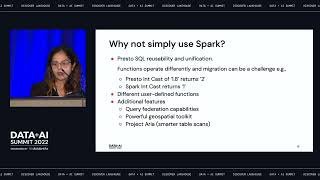
Presto On Spark: A Unified SQL Experience

Presto was originally designed to run interactive queries against data warehouses, but now it has evolved into a unified SQL engine on top of open data lake analytics for both interactive and batch workloads. However, Presto doesn't scale to very large and complex batch pipelines. Presto Unlimited was designed to address such scalability challenges but it didn’t fully solve fault tolerance, isolation, and resource management.

Spark is the tool of choice across the industry for running large scale complex batch ETL pipelines. This motivated the development of Presto On Spark. Presto on Spark runs Presto as a library that is submitted with spark-submit to a Spark cluster. It leverages Spark for scaling shuffle, worker execution, and resource management. It thereby eliminates any query conversion between interactive and batch use cases. This solution helps enable a performant and scalable platform with seamless end-to-end experience to explore and process data.

Many analysts at Intuit use Presto to explore data in the Data Lake/S3 and use Spark for batch processing. These analysts would earlier spend several hours converting these exploration SQLs written for Presto to Spark SQL to operationalize/schedule them as data pipelines. Presto On Spark is now used by analysts at Intuit to run thousands of critical jobs. No query conversion is required here, improved analysts' productivity and empowered them to deliver insights at high speed.

Benefits from session: Attendees will learn about Presto On Spark architecture Attendees will learn when To Use Spark's Execution Engine With Presto Attendees will learn how Intuit runs thousands of presto jobs daily leveraging databricks platform which they can apply to their own work

Connect with us: Website: https://databricks.com Facebook: https://www.facebook.com/databricksinc Twitter: https://twitter.com/databricks LinkedIn: https://www.linkedin.com/company/data... Instagram: https://www.instagram.com/databricksinc/
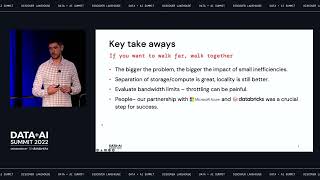
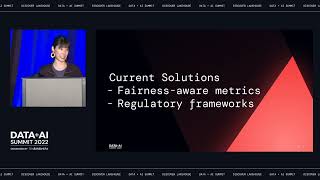
Productionizing Ethical Credit Scoring Systems with Delta Lake, Feature Store and MLFlow

Fairness, Ethics, Accountability and Transparency (FEAT) are must-haves for high-stakes machine learning models. In particular, models within the Financial Services industry such as those that assign credit scores can impact people’s access to housing and utilities and even influence their social standing. Hence, model developers have a moral responsibility to ensure that models do not systematically disadvantage any one group. Nevertheless, implementing such models in industrial settings remains challenging. A lack of concrete guidelines, common standards and technical templates make evaluating models from a FEAT perspective unfeasible. To address these implementation challenges, the Monetary Authority of Singapore (MAS) set up the Veritas Initiative to create a framework for operationalising the FEAT principles, so as to guide the responsible development of AIDA (Artificial Intelligence and Data Analytics) systems.

In January 2021, MAS announced the successful conclusion of Phase 1 of the Veritas Initiative. Deliverables included an assessment methodology for the Fairness principle and open source code for applying Fairness metrics to two use cases - customer marketing and credit scoring. In this talk, we demonstrate how these open-source examples, and their fairness metrics, might be put into production using open source tools such as Delta Lake and MLFlow. Although the Veritas Framework was developed in Singapore, the ethical framework is applicable across geographies.

By doing this, we illustrate how ethical principles can be operationalised, monitored and maintained in production, thus moving beyond only accuracy-based metrics of model performance and towards a more holistic and principled way of developing and productionizing machine learning systems.

Connect with us: Website: https://databricks.com Facebook: https://www.facebook.com/databricksinc Twitter: https://twitter.com/databricks LinkedIn: https://www.linkedin.com/company/data... Instagram: https://www.instagram.com/databricksinc/
Pushing the limits of scale/performance for enterprise-wide analytics: A fire-side chat with Akamai

With the world’s most distributed compute platform — from cloud to edge — Akamai makes it easy for businesses to develop and run applications, while keeping experiences closer to users and threats farther away. ​So when it was time to scale it’s legacy Hadoop-like infrastructure reaching its capacity limits, while keeping their global operations running uninterrupted, Akamai partnered with Microsoft and Databricks to migrate to Azure Databricks.

Connect with us: Website: https://databricks.com Facebook: https://www.facebook.com/databricksinc Twitter: https://twitter.com/databricks LinkedIn: https://www.linkedin.com/company/data... Instagram: https://www.instagram.com/databricksinc/
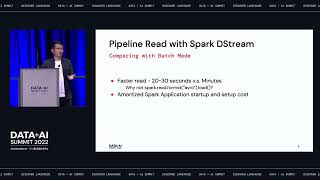
Running a Low Cost, Versatile Data Management Ecosystem with Apache Spark at Core

Data is the key component of Analytics, AI or ML platform. Organizations may not be successful without having a Platform that can Source, Transform, Quality check and present data in a reportable format that can drive actionable insights.

This session will focus on how Capital One HR Team built a Low Cost Data movement Ecosystem that can source data, transform at scale and build the data storage (Redshift) at a level that can be easily consumed by AI/ML programs - by using AWS Services with combination of Open source software(Spark) and Enterprise Edition Hydrograph (UI Based ETL tool with Spark as backend) This presentation is mainly to demonstrate the flexibility that Apache Spark provides for various types ETL Data Pipelines when we code in Spark.

We have been running 3 types of pipelines over 6+ years , over 400+ nightly batch jobs for $1000/mo. (1) Spark on EC2 (2) UI Based ETL tool with Spark backend (on the same EC2) (3) Spark on EMR. We have a CI/CD pipeline that supports easy integration and code deployment in all non-prod and prod regions ( even supports automated unit testing). We will also demonstrate how this ecosystem can failover to a different region in less than 15 minutes , making our application highly resilient.

Connect with us: Website: https://databricks.com Facebook: https://www.facebook.com/databricksinc Twitter: https://twitter.com/databricks LinkedIn: https://www.linkedin.com/company/data... Instagram: https://www.instagram.com/databricksinc/
Scaling Salesforce In-Memory Streaming Analytics Platform for Trillion Events Per Day

In general , in-memory pipelines would scale quite well in Spark if we apply the same processing logic to all records. But for Salesforce the major challenge is, we need to apply custom logic specific to a Log Record Type (LRT). The custom logic includes applying different schemas while processing each event. So performing such custom logic specific to LRT , we need to have a mechanism to collect LRT specific data In-Memory such that we can apply custom logic to each collection. We normally get around 50K files in S3 every 5 minutes and there are around 4 billion log events there in 50K files. Creating a DataFrame from 50K files, then group events by LRTs and applying filters per LRT to create a child DataFrame is one approach. One major challenge is that LRT data distribution is very skewed , so we need an efficient in-memory partitioning strategy to distribute the data. Also just applying filters on parent DataFrame will have many child Data frames with empty partitions due to large skew in data distribution and this creates too many empty tasks while processing child DataFrames. So we need to have a Partitioning schema to distribute data and filter by Log Type but not create unnecessary empty partitions in child DataFrames. We also need a scheduling algorithm to process all child DataFrames to utilize cluster efficiency. We have implemented a custom Spark Streaming for reading SQS notifications and then reading new files in S3 which is designed to scale with ingestion volume . This talk will cover how we performed a Spark RangePartition based on Size distribution of the incoming data and applying schema specific transformation logic. This talk will explain various optimizations at various stages of the processing to meet our latency goal.

Connect with us: Website: https://databricks.com Facebook: https://www.facebook.com/databricksinc Twitter: https://twitter.com/databricks LinkedIn: https://www.linkedin.com/company/data... Instagram: https://www.instagram.com/databricksinc/
Securing Databricks on AWS Using Private Link

Minimizing data transfers over the public internet is among the top priorities for organizations of any size, both for security and cost reasons. Modern cloud-native data analytics platforms need to support deployment architectures that meet this objective. For Databricks on AWS such an architecture is realized thanks to AWS PrivateLink, which allows computing resources deployed on different virtual private networks and different AWS accounts to communicate securely without ever crossing the public internet.

In this session, we want to provide a brief introduction to AWS Private Link and its main use cases in the context of a Databricks deployment: securing communications between control and data plane and securely connecting to the Databricks Web UI. We will then provide step-by-step walkthrough of the steps required in setting up PrivateLink connections with a Databricks deployment and demonstrate how to automate that process using AWS Cloud Formation or Terraform templates.

In this presentation we will cover the following topics: - Brief Introduction to AWS Private Link - How you can use PrivateLink to secure your AWS Databricks deployment - Step-by-step walkthrough of how to set up Private Link - How to automate and scale the setup using AWS CloudFormation or Terraform

Connect with us: Website: https://databricks.com Facebook: https://www.facebook.com/databricksinc Twitter: https://twitter.com/databricks LinkedIn: https://www.linkedin.com/company/data... Instagram: https://www.instagram.com/databricksinc/
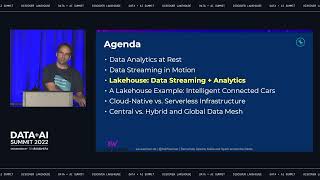
Serverless Kafka and Apache Spark in a Multi-Cloud Data Lakehouse Architecture

Apache Kafka in conjunction with Apache Spark became the de facto standard for processing and analyzing data. Both frameworks are open, flexible, and scalable. Unfortunately, the latter makes operations a challenge for many teams. Ideally, teams can use serverless SaaS offerings to focus on business logic. However, hybrid and multi-cloud scenarios require a cloud-native platform that provides automated and elastic tooling to reduce the operations burden.

This post explores different architecture to build serverless Kafka and Spark multi-cloud architectures across regions and continents. We start from the analytics perspective of a data lake and explore its relation to a fully integrated data streaming layer with Kafka to build a modern data lakehouse. Real-world use cases show the joint value and explore the benefit of the "delta lake" integration.

Connect with us: Website: https://databricks.com Facebook: https://www.facebook.com/databricksinc Twitter: https://twitter.com/databricks LinkedIn: https://www.linkedin.com/company/data... Instagram: https://www.instagram.com/databricksinc/
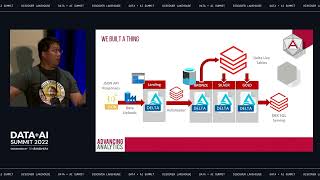
Simon Whiteley + Denny Lee Live Ask Me Anything

Simon and Denny Build A Thing is a live webshow, where Simon Whiteley (Advancing Analytics) and Denny Lee (Databricks) are building out a TV Ratings Analytics tool, working through the various challenges of building out a Data Lakehouse using Databricks. In this session, they'll be talking through their Lakehouse Platform, revisiting various pieces of functionality, and answering your questions, Live!

This is your chance to ask questions around structuring a lake for enterprise data analytics, the various ways we can use Delta Live Tables to simplify ETL or how to get started serving out data using Databricks SQL. We have a whole load of things to talk through, but we want to hear YOUR questions, which we can field from industry experience, community engagement and internal Databricks direction. There's also a chance we'll get distracted and talk about the Expanse for far too long.

Connect with us: Website: https://databricks.com Facebook: https://www.facebook.com/databricksinc Twitter: https://twitter.com/databricks LinkedIn: https://www.linkedin.com/company/data... Instagram: https://www.instagram.com/databricksinc/
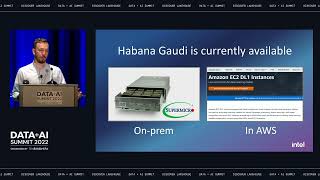
Customer-centric Innovation to Scale Data & AI Everywhere

Imagine a world where you have the flexibility to infuse intelligence into every application, from edge to cloud. In this session, you will learn how Intel is enabling customer-centric innovation and delivering the simplicity, productivity, and performance the developers need to scale their data and AI solutions everywhere. An overview of Intel end-to-end data analytics and AI technologies, developer tools as well as examples of customers use cases will be presented.

Connect with us: Website: https://databricks.com Facebook: https://www.facebook.com/databricksinc Twitter: https://twitter.com/databricks LinkedIn: https://www.linkedin.com/company/data... Instagram: https://www.instagram.com/databricksinc/
Building Spatial Applications with Apache Spark and CARTO

CARTO’s Spatial Extension provides the fundamental building blocks for Location Intelligence in Databricks. Many of the largest organizations using CARTO leverage Databricks for their analytics. Customers very often build custom spatial applications that simplify either a spatial analysis use case or provide a more direct interface to access business intelligence or information. CARTO facilitates the creation of these apps with a complete set of development libraries and APIs. For visualization, CARTO makes use of the powerful deck.gl visualization library. You utilize CARTO Builder to design your maps and perform analytics using Spatial SQL similar to PostGIS, but with the scalability of Apache Spark and then you reference them in your code. CARTO will handle visualizing large datasets, updating the maps, and everything in between. In this talk we will walk you through the process to build spatial applications with CARTO hosted in Apache Spark.

Connect with us: Website: https://databricks.com Facebook: https://www.facebook.com/databricksinc Twitter: https://twitter.com/databricks LinkedIn: https://www.linkedin.com/company/data... Instagram: https://www.instagram.com/databricksinc/
Cloud Native Geospatial Analytics at JLL

Luis Sanz, CEO of CARTO and Yanqing Zeng, Lead Data Scientist at JLL, take us through how cloud native geospatial analytics can be unlocked on the Databricks Lakehouse platform with CARTO. Yanqing will showcase her work on large scale spatial analytics projects to address some of the most critical analysis use cases in Real Estate. Taking a geospatial perspective, Yanqing will share practical examples of how large-scale spatial data and analytics can be used for property portfolio mapping, AI-driven risk assessment, real estate valuation and more.

Connect with us: Website: https://databricks.com Facebook: https://www.facebook.com/databricksinc Twitter: https://twitter.com/databricks LinkedIn: https://www.linkedin.com/company/data... Instagram: https://www.instagram.com/databricksinc/

Correlation Over Causation: Cracking the Relationship Between User Engagement and User Happiness

As a head of product on the Confluence team at Atlassian, I own the metrics associated with user happiness. This a common area of ownership for heads of product, GMs, CEOs. But how do you actually use data to move the needle on user happiness, and how do you convert user activity and engagement insights into clear actions that end up positively impacting user happiness? In this talk, I would like to share the approach we developed jointly with our data analytics team to understand, operationalize and report on our journey on make Confluence users happier. This talk will be useful for data analytics and data science practitioners, product executives, and anyone faced with a task of operationalizing improvement of a "fuzzy" metric like NPS or CSAT.

Connect with us: Website: https://databricks.com Facebook: https://www.facebook.com/databricksinc Twitter: https://twitter.com/databricks LinkedIn: https://www.linkedin.com/company/data... Instagram: https://www.instagram.com/databricksinc/