
talk-data.com talk-data.com

Topic

Flink

Apache Flink

stream_processing batch_processing big_data

8

tagged

Activity Trend

7 peak/qtr
2020-Q1 2026-Q1

Activities

Showing filtered results

Filtering by: Databricks DATA + AI Summit 2023 ×
Cross-Platform Data Lineage with OpenLineage

There are more data tools available than ever before, and it is easier to build a pipeline than it has ever been. These tools and advancements have created an explosion of innovation, resulting in data within today's organizations becoming increasingly distributed and can't be contained within a single brain, a single team, or a single platform. Data lineage can help by tracing the relationships between datasets and providing a map of your entire data universe.

OpenLineage provides a standard for lineage collection that spans multiple platforms, including Apache Airflow, Apache Spark™, Flink®, and dbt. This empowers teams to diagnose and address widespread data quality and efficiency issues in real time. In this session, we will show how to trace data lineage across Apache Spark and Apache Airflow. There will be a walk-through of the OpenLineage architecture and a live demo of a running pipeline with real-time data lineage.

Talk by: Julien Le Dem,Willy Lulciuc

Here’s more to explore: Data, Analytics, and AI Governance: https://dbricks.co/44gu3YU

Connect with us: Website: https://databricks.com Twitter: https://twitter.com/databricks LinkedIn: https://www.linkedin.com/company/databricks Instagram: https://www.instagram.com/databricksinc Facebook: https://www.facebook.com/databricksinc

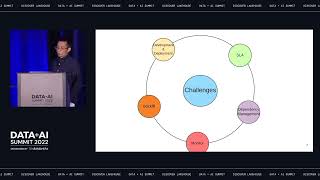
Delta Kernel: Simplifying Building Connectors for Delta

Since the release of Delta 2.0, the project has been growing at a breakneck speed. In this session, we will cover all the latest capabilities that makes Delta Lake the best format for the lakehouse. Based on lessons learned from this past year, we will introduce Project Aqueduct and how we will simplify building Delta Lake APIs from Rust and Go to Trino, Flink, and PySpark.

Talk by: Tathagata Das and Denny Lee

Connect with us: Website: https://databricks.com Twitter: https://twitter.com/databricks LinkedIn: https://www.linkedin.com/company/databricks Instagram: https://www.instagram.com/databricksinc Facebook: https://www.facebook.com/databricksinc

Serving Near Real-Time Features at Scale

This presentation will first introduce the use case, which generates the price adjustments based on the network effect, and the corresponding model relies on the 108 near real-time features computed by Flink pipelines with the raw demand and supply events. Here is the simplified computation logic:

-The pipelines need to process the raw real-time events at the rate of 300k/s including both demand and supply -Each event needs to be computed on the geospatial, temporal and other dimensions -Each event contributes to the computation on the original hexagon and the 1K+ neighbours due to the fan-out effect of Kring smooth -Each event contributions to the aggregation on multiple window sizes up to 32 minutes, sliding by 1 minute, or 63 windows in total

Next the presentation will briefly go through the DAG of the Flink pipeline before optimization and the issues we faced: the pipeline could not run stably due to OOM and backpressure. The presentation will discuss how to optimize a streaming pipeline with the generic performance tuning framework, which focuses on three areas: Network, CPU and Memory, and five domains: Parallelism, Partition, Remote Call, Algorithm and Garbage Collector. The presentation will also show some example techniques being applied onto the pipelines by following the performance tuning framework.

Then the presentation will discuss one particular optimization technique: Customized Sliding Window.

Powering machine learning models with near real-time features can be quite challenging, due to computation logic complexity, write throughput, serving SLA, etc. In this talk, we have introduced some of the problems that we faced and our solutions to them, in the hope of aiding our peers in similar use cases.

Connect with us: Website: https://databricks.com Facebook: https://www.facebook.com/databricksinc Twitter: https://twitter.com/databricks LinkedIn: https://www.linkedin.com/company/data... Instagram: https://www.instagram.com/databricksinc/

Backfill Streaming Data Pipelines in Kappa Architecture

Streaming data pipelines can fail due to various reasons. Since the source data, such as Kafka topics, often have limited retention, prolonged job failures can lead to data loss. Thus, streaming jobs need to be backfillable at all times to prevent data loss in case of failures. One solution is to increase the source's retention so that backfilling is simply replaying source streams, but extending Kafka retention is very costly for Netflix's data sizes. Another solution is to utilize source data stored in DWH, commonly known as the Lambda architecture. However, this method introduces significant code duplication, as it requires engineers to maintain a separate equivalent batch job. At Netflix, we have created the Iceberg Source Connector to provide backfilling capabilities to Flink streaming applications. It allows Flink to stream data stored in Apache Iceberg while mirroring Kafka's ordering semantics, enabling us to backfill large-scale stateful Flink pipelines at low retention cost.

Connect with us: Website: https://databricks.com Facebook: https://www.facebook.com/databricksinc Twitter: https://twitter.com/databricks LinkedIn: https://www.linkedin.com/company/data... Instagram: https://www.instagram.com/databricksinc/
Beyond Daily Batch Processing: Operational Trade-Offs of Microbatch, Incremental, and Real-Time

Are you considering converting some batch daily pipelines to a realtime system? Perhaps restating multiple days of batch data is becoming unscalable for your pipelines. Maybe a short SLA is music to your stakeholders' ears. If you're flink-curious or possibly just sick of pondering your late arriving data, this discussion is for you.

On the Streaming Data Science and Engineering team at Netflix we support business-critical daily batch, hourly batch, incremental, and realtime pipelines with a rotating on-call system. In this presentation I'll discuss tradeoffs we experience between these systems with an emphasis on operational support when things go sideways. I'll also share some learnings about "goodness of fit" per processing type amongst various workloads with an eye for keeping your data timely and your colleagues sane.

Connect with us: Website: https://databricks.com Facebook: https://www.facebook.com/databricksinc Twitter: https://twitter.com/databricks LinkedIn: https://www.linkedin.com/company/data... Instagram: https://www.instagram.com/databricksinc/
Diving into Delta Lake 2.0

The Delta ecosystem rapidly expanded with the release of Delta Lake 1.2 which included integrations with Apache Spark™, Apache Flink, Presto, Trino, features such as OPTIMIZE, data skipping using column statistics, restore APIs, S3 multi-cluster writes, and more.

Join this session to learn about how the wider Delta community collaborated together to bring these features and integrations together; as well as the current roadmap. This will be an interactive session so come prepared with your questions—we should have answers!

Connect with us: Website: https://databricks.com Facebook: https://www.facebook.com/databricksinc Twitter: https://twitter.com/databricks LinkedIn: https://www.linkedin.com/company/data... Instagram: https://www.instagram.com/databricksinc/
Delta Lake 2.0 Overview

After three years of hard work by the Delta community, we are proud to announce the release of Delta Lake 2.0. Completing the work to open-source all of Delta Lake while tens of thousands of organizations were running in production was no small feat and we have the ever-expanding Delta community to thank! Join this session to learn about how the wider Delta community collaborated together to bring these features and integrations together.

Join this session to learn about how the wider Delta community collaborated together to bring these features and integrations together. This includes the Integrations with Apache Spark™, Apache Flink, Apache Pulsar, Presto, Trino, and more.

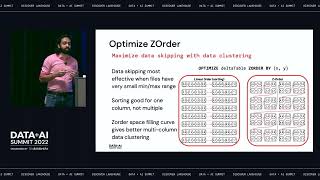
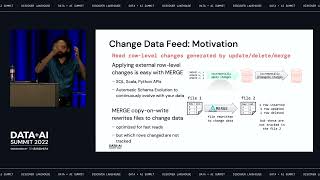
Features such as OPTIMIZE ZORDER, data skipping using column stats, S3 multi-cluster writes, Change Data Feed, and more.

Language APIs including Rust, Python, Ruby, GoLang, Scala, and Java.

Connect with us: Website: https://databricks.com Facebook: https://www.facebook.com/databricksinc Twitter: https://twitter.com/databricks LinkedIn: https://www.linkedin.com/company/data... Instagram: https://www.instagram.com/databricksinc/

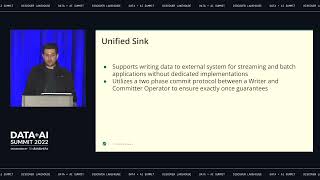
Sink Framework Evolution in Apache Flink

Apache Flink is one of the most popular frameworks for unified stream and batch processing. Like every other big data framework, Apache Flink offers connectors to different external systems to read from and write to. We refer to connectors for writing to external systems as sinks. Over the years, multiple frameworks existed inside Apache Flink for building sinks. The Apache Flink community also noticed the latest trend of ingesting real-time data directly into data lakes for further usage. Therefore with Apache Flink 1.15, we released the next iteration of our sink framework. We designed it to accommodate the needs of modern data lake connectors i.e. lazy file compaction, user-defined shuffling.

In this talk, we first give a brief historical glimpse of the evolution of the frameworks that started as a kind of a simple map operation until a custom operator model that simplified two-phase commit semantics. Secondly, we do a deep dive into Apache Flink’s fault tolerance model to explain how the last iteration of the sink framework supports exactly-once processing and complex operations important for delta lakes. In summary, this talk introduces the principles behind the sink framework in Apache Flink and gives a starting point for developers building a new connector for Apache Flink.

Connect with us: Website: https://databricks.com Facebook: https://www.facebook.com/databricksinc Twitter: https://twitter.com/databricks LinkedIn: https://www.linkedin.com/company/data... Instagram: https://www.instagram.com/databricksinc/