talk-data.com talk-data.com

Topic

Flink

Apache Flink

stream_processing batch_processing big_data

15

tagged

Activity Trend

7 peak/qtr
2020-Q1 2026-Q1

Activities

Showing filtered results

Filtering by: O'Reilly Data Engineering Books ×
Designing Data-Intensive Applications, 2nd Edition

Data is at the center of many challenges in system design today. Difficult issues such as scalability, consistency, reliability, efficiency, and maintainability need to be resolved. In addition, there's an overwhelming variety of tools and analytical systems, including relational databases, NoSQL datastores, plus data warehouses and data lakes. What are the right choices for your application? How do you make sense of all these buzzwords? In this second edition, authors Martin Kleppmann and Chris Riccomini build on the foundation laid in the acclaimed first edition, integrating new technologies and emerging trends. You'll be guided through the maze of decisions and trade-offs involved in building a modern data system, from choosing the right tools like Spark and Flink to understanding the intricacies of data laws like the GDPR. Peer under the hood of the systems you already use, and learn to use them more effectively Make informed decisions by identifying the strengths and weaknesses of different tools Navigate the trade-offs around consistency, scalability, fault tolerance, and complexity Understand the distributed systems research upon which modern databases are built Peek behind the scenes of major online services, and learn from their architectures
Practical Data Engineering with Apache Projects: Solving Everyday Data Challenges with Spark, Iceberg, Kafka, Flink, and More

This book is a comprehensive guide designed to equip you with the practical skills and knowledge necessary to tackle real-world data challenges using Open Source solutions. Focusing on 10 real-world data engineering projects, it caters specifically to data engineers at the early stages of their careers, providing a strong foundation in essential open source tools and techniques such as Apache Spark, Flink, Airflow, Kafka, and many more. Each chapter is dedicated to a single project, starting with a clear presentation of the problem it addresses. You will then be guided through a step-by-step process to solve the problem, leveraging widely-used open-source data tools. This hands-on approach ensures that you not only understand the theoretical aspects of data engineering but also gain valuable experience in applying these concepts to real-world scenarios. At the end of each chapter, the book delves into common challenges that may arise during the implementation of the solution, offering practical advice on troubleshooting these issues effectively. Additionally, the book highlights best practices that data engineers should follow to ensure the robustness and efficiency of their solutions. A major focus of the book is using open-source projects and tools to solve problems encountered in data engineering. In summary, this book is an indispensable resource for data engineers looking to build a strong foundation in the field. By offering practical, real-world projects and emphasizing problem-solving and best practices, it will prepare you to tackle the complex data challenges encountered throughout your career. Whether you are an aspiring data engineer or looking to enhance your existing skills, this book provides the knowledge and tools you need to succeed in the ever-evolving world of data engineering. You Will Learn: The foundational concepts of data engineering and practical experience in solving real-world data engineering problems How to proficiently use open-source data tools like Apache Kafka, Flink, Spark, Airflow, and Trino 10 hands-on data engineering projects Troubleshoot common challenges in data engineering projects Who is this book for: Early-career data engineers and aspiring data engineers who are looking to build a strong foundation in the field; mid-career professionals looking to transition into data engineering roles; and technology enthusiasts interested in gaining insights into data engineering practices and tools.

Engineering Lakehouses with Open Table Formats

Engineering Lakehouses with Open Table Formats introduces the architecture and capabilities of open table formats like Apache Iceberg, Apache Hudi, and Delta Lake. The book guides you through the design, implementation, and optimization of lakehouses that can handle modern data processing requirements effectively with real-world practical insights. What this Book will help me do Understand the fundamentals of open table formats and their benefits in lakehouse architecture. Learn how to implement performant data processing using tools like Apache Spark and Flink. Master advanced topics like indexing, partitioning, and interoperability between data formats. Explore data lifecycle management and integration with frameworks like Apache Airflow and dbt. Build secure lakehouses with regulatory compliance using best practices detailed in the book. Author(s) Dipankar Mazumdar and Vinoth Govindarajan are seasoned professionals with extensive experience in big data processing and software architecture. They bring their expertise from working with data lakehouses and are known for their ability to explain complex technical concepts clearly. Their collaborative approach brings valuable insights into the latest trends in data management. Who is it for? This book is ideal for data engineers, architects, and software professionals aiming to master modern lakehouse architectures. If you are familiar with data lakes or warehouses and wish to transition to an open data architectural design, this book is suited for you. Readers should have basic knowledge of databases, Python, and Apache Spark for the best experience.

Delta Lake: The Definitive Guide

Ready to simplify the process of building data lakehouses and data pipelines at scale? In this practical guide, learn how Delta Lake is helping data engineers, data scientists, and data analysts overcome key data reliability challenges with modern data engineering and management techniques. Authors Denny Lee, Tristen Wentling, Scott Haines, and Prashanth Babu (with contributions from Delta Lake maintainer R. Tyler Croy) share expert insights on all things Delta Lake--including how to run batch and streaming jobs concurrently and accelerate the usability of your data. You'll also uncover how ACID transactions bring reliability to data lakehouses at scale. This book helps you: Understand key data reliability challenges and how Delta Lake solves them Explain the critical role of Delta transaction logs as a single source of truth Learn the Delta Lake ecosystem with technologies like Apache Flink, Kafka, and Trino Architect data lakehouses with the medallion architecture Optimize Delta Lake performance with features like deletion vectors and liquid clustering

Apache Iceberg: The Definitive Guide

Traditional data architecture patterns are severely limited. To use these patterns, you have to ETL data into each tool—a cost-prohibitive process for making warehouse features available to all of your data. The lack of flexibility with these patterns requires you to lock into a set of priority tools and formats, which creates data silos and data drift. This practical book shows you a better way. Apache Iceberg provides the capabilities, performance, scalability, and savings that fulfill the promise of an open data lakehouse. By following the lessons in this book, you'll be able to achieve interactive, batch, machine learning, and streaming analytics with this high-performance open source format. Authors Tomer Shiran, Jason Hughes, and Alex Merced from Dremio show you how to get started with Iceberg. With this book, you'll learn: The architecture of Apache Iceberg tables What happens under the hood when you perform operations on Iceberg tables How to further optimize Iceberg tables for maximum performance How to use Iceberg with popular data engines such as Apache Spark, Apache Flink, and Dremio Discover why Apache Iceberg is a foundational technology for implementing an open data lakehouse.

Mastering Apache Pulsar

Every enterprise application creates data, including log messages, metrics, user activity, and outgoing messages. Learning how to move these items is almost as important as the data itself. If you're an application architect, developer, or production engineer new to Apache Pulsar, this practical guide shows you how to use this open source event streaming platform to handle real-time data feeds. Jowanza Joseph, staff software engineer at Finicity, explains how to deploy production Pulsar clusters, write reliable event streaming applications, and build scalable real-time data pipelines with this platform. Through detailed examples, you'll learn Pulsar's design principles, reliability guarantees, key APIs, and architecture details, including the replication protocol, the load manager, and the storage layer. This book helps you: Understand how event streaming fits in the big data ecosystem Explore Pulsar producers, consumers, and readers for writing and reading events Build scalable data pipelines by connecting Pulsar with external systems Simplify event-streaming application building with Pulsar Functions Manage Pulsar to perform monitoring, tuning, and maintenance tasks Use Pulsar's operational measurements to secure a production cluster Process event streams using Flink and query event streams using Presto

Stream Processing with Apache Spark

Before you can build analytics tools to gain quick insights, you first need to know how to process data in real time. With this practical guide, developers familiar with Apache Spark will learn how to put this in-memory framework to use for streaming data. You’ll discover how Spark enables you to write streaming jobs in almost the same way you write batch jobs. Authors Gerard Maas and François Garillot help you explore the theoretical underpinnings of Apache Spark. This comprehensive guide features two sections that compare and contrast the streaming APIs Spark now supports: the original Spark Streaming library and the newer Structured Streaming API. Learn fundamental stream processing concepts and examine different streaming architectures Explore Structured Streaming through practical examples; learn different aspects of stream processing in detail Create and operate streaming jobs and applications with Spark Streaming; integrate Spark Streaming with other Spark APIs Learn advanced Spark Streaming techniques, including approximation algorithms and machine learning algorithms Compare Apache Spark to other stream processing projects, including Apache Storm, Apache Flink, and Apache Kafka Streams

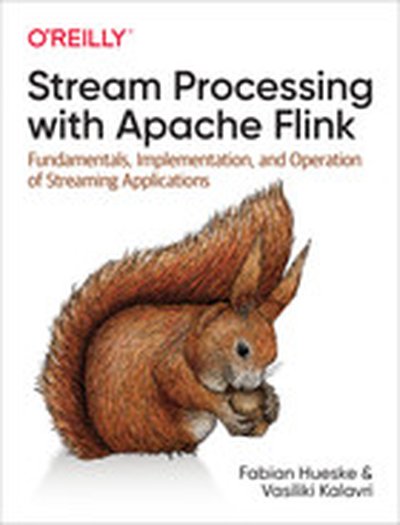
Stream Processing with Apache Flink

Get started with Apache Flink, the open source framework that powers some of the world’s largest stream processing applications. With this practical book, you’ll explore the fundamental concepts of parallel stream processing and discover how this technology differs from traditional batch data processing. Longtime Apache Flink committers Fabian Hueske and Vasia Kalavri show you how to implement scalable streaming applications with Flink’s DataStream API and continuously run and maintain these applications in operational environments. Stream processing is ideal for many use cases, including low-latency ETL, streaming analytics, and real-time dashboards as well as fraud detection, anomaly detection, and alerting. You can process continuous data of any kind, including user interactions, financial transactions, and IoT data, as soon as you generate them. Learn concepts and challenges of distributed stateful stream processing Explore Flink’s system architecture, including its event-time processing mode and fault-tolerance model Understand the fundamentals and building blocks of the DataStream API, including its time-based and statefuloperators Read data from and write data to external systems with exactly-once consistency Deploy and configure Flink clusters Operate continuously running streaming applications

Mastering Hadoop 3

"Mastering Hadoop 3" is your in-depth guide to understanding and mastering the advanced features of the Hadoop ecosystem. With a focus on distributed computing and data processing, this book covers essential tools such as YARN, MapReduce, and Apache Spark to help you build scalable, efficient data pipelines. What this Book will help me do Gain a comprehensive understanding of Hadoop Distributed File System (HDFS) and YARN for effective resource management. Master data processing with MapReduce and learn to integrate with real-time processing engines like Spark and Flink. Develop and secure enterprise-grade Hadoop-based data pipelines by implementing robust security and governance measures. Explore techniques for batch data processing, data modeling, and designing applications tailored for Hadoop environments. Understand best practices for optimizing and troubleshooting Hadoop clusters for enhanced performance and reliability. Author(s) The authors, including None Wong, None Singh, and None Kumar, bring together years of experience in big data engineering, distributed systems, and enterprise application development. They aim to provide a clear pathway to mastering Hadoop ecosystem tools. Who is it for? This book is ideal for budding big data professionals who have some familiarity with Java and basic Hadoop concepts and wish to elevate their expertise. If you're a Hadoop career practitioner keen to expand your understanding of the ecosystem's advanced capabilities or a professional looking to implement Hadoop in organizational workflows, this book is well-suited for you.

Fast Data Architectures for Streaming Applications, 2nd Edition

Why have stream-oriented data systems become so popular, when batch-oriented systems have served big data needs for many years? In the updated edition of this report, Dean Wampler examines the rise of streaming systems for handling time-sensitive problems—such as detecting fraudulent financial activity as it happens. You’ll explore the characteristics of fast data architectures, along with several open source tools for implementing them. Batch processing isn’t going away, but exclusive use of these systems is now a competitive disadvantage. You’ll learn that, while fast data architectures using tools such as Kafka, Akka, Spark, and Flink are much harder to build, they represent the state of the art for dealing with mountains of data that require immediate attention. Learn how a basic fast data architecture works, step-by-step Examine how Kafka’s data backplane combines the best abstractions of log-oriented and message queue systems for integrating components Evaluate four streaming engines, including Kafka Streams, Akka Streams, Spark, and Flink Learn which streaming engines work best for different use cases Get recommendations for making real-world streaming systems responsive, resilient, elastic, and message driven Explore an example IoT streaming application that includes telemetry ingestion and anomaly detection

Big Data Analytics with Hadoop 3

Big Data Analytics with Hadoop 3 is your comprehensive guide to understanding and leveraging the power of Apache Hadoop for large-scale data processing and analytics. Through practical examples, it introduces the tools and techniques necessary to integrate Hadoop with other popular frameworks, enabling efficient data handling, processing, and visualization. What this Book will help me do Understand the foundational components and features of Apache Hadoop 3 such as HDFS, YARN, and MapReduce. Gain the ability to integrate Hadoop with programming languages like Python and R for data analysis. Learn the skills to utilize tools such as Apache Spark and Apache Flink for real-time data analytics within the Hadoop ecosystem. Develop expertise in setting up a Hadoop cluster and performing analytics in cloud environments such as AWS. Master the process of building practical big data analytics pipelines for end-to-end data processing. Author(s) Sridhar Alla is a seasoned big data professional with extensive industry experience in building and deploying scalable big data analytics solutions. Known for his expertise in Hadoop and related ecosystems, Sridhar combines technical depth with clear communication in his writing, providing practical insights and hands-on knowledge. Who is it for? This book is tailored for data professionals, software engineers, and data scientists looking to expand their expertise in big data analytics using Hadoop 3. Whether you're an experienced developer or new to the big data ecosystem, this book provides the step-by-step guidance and practical examples needed to advance your skills and achieve your analytical goals.

Practical Real-time Data Processing and Analytics

This book provides a comprehensive guide to real-time data processing and analytics using modern frameworks like Apache Spark, Flink, Storm, and Kafka. Through practical examples and in-depth explanations, you will learn how to implement efficient, scalable, real-time processing pipelines. What this Book will help me do Understand real-time data processing essentials and the technology stack Learn integration of components like Apache Spark and Kafka Master the concepts of stream processing with detailed case studies Gain expertise in developing monitoring and alerting solutions for real-time systems Prepare to implement production-grade real-time data solutions Author(s) Shilpi Saxena and Saurabh Gupta, the authors, are experienced professionals in distributed systems and data engineering, focusing on practical applications of real-time computing. They bring their extensive industry experience to this book, helping readers understand the complexities of real-time data solutions in an approachable and hands-on manner. Who is it for? This book is ideal for software engineers and data engineers with a background in Java who seek to develop real-time data solutions. It is suitable for readers familiar with concepts of real-time data processing, and enhances knowledge in frameworks like Spark, Flink, Storm, and Kafka. Target audience includes learners building production data solutions and those designing distributed analytics engines.

Streaming Data

Streaming Data introduces the concepts and requirements of streaming and real-time data systems. The book is an idea-rich tutorial that teaches you to think about how to efficiently interact with fast-flowing data. About the Technology As humans, we're constantly filtering and deciphering the information streaming toward us. In the same way, streaming data applications can accomplish amazing tasks like reading live location data to recommend nearby services, tracking faults with machinery in real time, and sending digital receipts before your customers leave the shop. Recent advances in streaming data technology and techniques make it possible for any developer to build these applications if they have the right mindset. This book will let you join them. About the Book Streaming Data is an idea-rich tutorial that teaches you to think about efficiently interacting with fast-flowing data. Through relevant examples and illustrated use cases, you'll explore designs for applications that read, analyze, share, and store streaming data. Along the way, you'll discover the roles of key technologies like Spark, Storm, Kafka, Flink, RabbitMQ, and more. This book offers the perfect balance between big-picture thinking and implementation details. What's Inside The right way to collect real-time data Architecting a streaming pipeline Analyzing the data Which technologies to use and when About the Reader Written for developers familiar with relational database concepts. No experience with streaming or real-time applications required. About the Author Andrew Psaltis is a software engineer focused on massively scalable real-time analytics. Quotes The definitive book if you want to master the architecture of an enterprise-grade streaming application. - Sergio Fernandez Gonzalez, Accenture A thorough explanation and examination of the different systems, strategies, and tools for streaming data implementations. - Kosmas Chatzimichalis, Mach 7x A well-structured way to learn about streaming data and how to put it into practice in modern real-time systems. - Giuliano Araujo Bertoti, FATEC This book is all you need to understand what streaming is all about! - Carlos Curotto, Globant

Introduction to Apache Flink

There’s growing interest in learning how to analyze streaming data in large-scale systems such as web traffic, financial transactions, machine logs, industrial sensors, and many others. But analyzing data streams at scale has been difficult to do well—until now. This practical book delivers a deep introduction to Apache Flink, a highly innovative open source stream processor with a surprising range of capabilities.

Streaming Architecture

More and more data-driven companies are looking to adopt stream processing and streaming analytics. With this concise ebook, you’ll learn best practices for designing a reliable architecture that supports this emerging big-data paradigm. Authors Ted Dunning and Ellen Friedman (Real World Hadoop) help you explore some of the best technologies to handle stream processing and analytics, with a focus on the upstream queuing or message-passing layer. To illustrate the effectiveness of these technologies, this book also includes specific use cases. Ideal for developers and non-technical people alike, this book describes: Key elements in good design for streaming analytics, focusing on the essential characteristics of the messaging layer New messaging technologies, including Apache Kafka and MapR Streams, with links to sample code Technology choices for streaming analytics: Apache Spark Streaming, Apache Flink, Apache Storm, and Apache Apex How stream-based architectures are helpful to support microservices Specific use cases such as fraud detection and geo-distributed data streams Ted Dunning is Chief Applications Architect at MapR Technologies, and active in the open source community. He currently serves as VP for Incubator at the Apache Foundation, as a champion and mentor for a large number of projects, and as committer and PMC member of the Apache ZooKeeper and Drill projects. Ted is on Twitter as @ted_dunning. Ellen Friedman, a committer for the Apache Drill and Apache Mahout projects, is a solutions consultant and well-known speaker and author, currently writing mainly about big data topics. With a PhD in Biochemistry, she has years of experience as a research scientist and has written about a variety of technical topics. Ellen is on Twitter as @Ellen_Friedman.