talk-data.com talk-data.com

Topic

CI/CD

Continuous Integration/Continuous Delivery (CI/CD)

devops automation software_development ci_cd

14

tagged

Activity Trend

21 peak/qtr
2020-Q1 2026-Q1

Activities

Showing filtered results

Filtering by: Databricks DATA + AI Summit 2023 ×
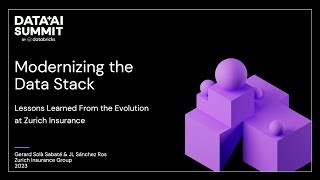
Sponsored: dbt Labs | Modernizing the Data Stack: Lessons Learned From Evolution at Zurich Insurance

In this session, we will explore the path Zurich Insurance took to modernize its data stack and data engineering practices, and the lessons learned along the way. We'll touch on how and why the team chose to:

  • Adopt community standards in code quality, code coverage, code reusability, and CI/CD
  • Rebuild the way data engineering collaborates with business teams
  • Explore data tools accessible to non-engineering users, with considerations for code-first and no-code interfaces
  • Structure our dbt project and orchestration — and the factors that played into our decisions

Talk by: Jose L Sanchez Ros and Gerard Sola

Here’s more to explore: Why the Data Lakehouse Is Your next Data Warehouse: https://dbricks.co/3Pt5unq Lakehouse Fundamentals Training: https://dbricks.co/44ancQs

Connect with us: Website: https://databricks.com Twitter: https://twitter.com/databricks LinkedIn: https://www.linkedin.com/company/databricks Instagram: https://www.instagram.com/databricksinc Facebook: https://www.facebook.com/databricksinc

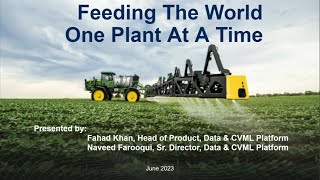
Feeding the World One Plant at a Time

Join this session to learn how the CVML and Data Platform team at BlueRiver Technology utilized Databricks to maximize savings on herbicide usage and revolutionize Precision Agriculture.

Blue River Technology is an agricultural technology company that uses computer vision and machine learning (CVML) to revolutionize the way crops are grown and harvested. BRT’s See & Spray technology, which uses CVML to identify and precisely determine whether the plant is a weed or a crop so it can deliver a small, targeted dose of herbicide directly to the plant, while leaving the crop unharmed. By using this approach, Blue River significantly reduces the amount of herbicides used in agriculture by over 70% and has a positive impact on the environment and human health.

The technical challenges we seek to overcome are:  - Processing massive petabytes of proprietary data at scale and in real time. Equipment in the field can generate up to 40TBs of data per hour per machine. - Aggregating, curating and visualizing at scale data can often be convoluted, error-prone and complex.  - Streamlining pipelines runs from weeks to hours to ensure continuous delivery of data.  - Abstracting and automating  the infra, deployment and data management from each program. - Building downstream data products based on descriptive analysis, predictive analysis or prescriptive analysis to drive the machine behavior.

The business questions we seek to answer for any machine are:  - Are we getting the spray savings we anticipated? - Are we reducing the use of herbicide at the scale we expected? - Are spraying nozzles performing at the expected rate? - Finding the relevant data to troubleshoot new edge conditions.  - Providing a simple interface for data exploration to both technical and non-technical personas to help improve our model. - Identifying repetitive and new faults in our machines. - Filtering out data based on certain incidents. - Identifying anomalies for e.g. sudden drop in spray saving, like frequency of broad spray suddenly is too high.

How we are addressing and plan to address these challenges: - Designating Databricks as our purposeful DB for all data - using the bronze, silver and gold layer standards. - Processing new machine logs using a Delta Live table as a source both in batch and incremental manner. - Democratize access for data scientists, product managers, data engineers who are not proficient with the robotic software stack via notebooks for quick development as well as real time dashboards.

Talk by: Fahad Khan and Naveed Farooqui

Here’s more to explore: LLM Compact Guide: https://dbricks.co/43WuQyb Big Book of MLOps: https://dbricks.co/3r0Pqiz

Connect with us: Website: https://databricks.com Twitter: https://twitter.com/databricks LinkedIn: https://www.linkedin.com/company/databricks Instagram: https://www.instagram.com/databricksinc Facebook: https://www.facebook.com/databricksin

Scaling MLOps for a Demand Forecasting Across Multiple Markets for a Large CPG

In this session, we look at how one of the world’s largest CPG company setup a scalable MLOps pipeline for a demand forecasting use case that predicted demand at 100,000+ DFUs (demand forecasting units) on a weekly basis across more than 20 markets. This implementation resulted in significant cost savings in terms of improved productivity, reduced cloud usage and faster time to value amongst other benefits. You will leave this session with a clearer picture on the following:

  • Best practices in scaling MLOps with Databricks and Azure for a demand forecasting use case with a multi-market and multi-region roll-out.
  • Best practices related to model re-factoring and setting up standard CI-CD pipelines for MLOps.
  • What are some of the pitfalls to avoid in such scenarios?

Talk by: Sunil Ranganathan and Vinit Doshi

Connect with us: Website: https://databricks.com Twitter: https://twitter.com/databricks LinkedIn: https://www.linkedin.com/company/databricks Instagram: https://www.instagram.com/databricksinc Facebook: https://www.facebook.com/databricksinc

Bridging the Production Gap: Develop and Deploy Code Easily With IDEs

Hear from customers how they are using software development best practices to combine the best of Integrated Development Environments (IDEs) with Databricks. See the latest developments that unlock key productivity gains from IDEs like code linters, AI code assistants and integrations with CI/CD tools to make going to production smoother and more reliable.

Attend this session to learn how to use IDEs with Databricks and take advantage of:

  • Native development - Write code, edit files and run on Databricks with the familiarity of your favorite IDE with DB Connect
  • Interactive debugging - Step through code in a cluster to quickly pinpoint and fix errors so that code is more robust and easily maintained
  • CI/CD pipelines - Set up and manage your CI/CD pipelines using the new CLI
  • IDE ecosystems - Use familiar integrations to streamline code reviews and deploy code faster

Sign up today to boost your productivity by combining your favorite IDE with the scale of Databricks.

Talk by: Saad Ansari and Fabian Jakobs

Connect with us: Website: https://databricks.com Twitter: https://twitter.com/databricks LinkedIn: https://www.linkedin.com/company/databricks Instagram: https://www.instagram.com/databricksinc Facebook: https://www.facebook.com/databricksin
Databricks Asset Bundles: A Standard, Unified Approach to Deploying Data Products on Databricks

In this session, we will introduce Databricks Asset Bundles, provide a demonstration of how they work for a variety of data products, and how to fit them into an overall CICD strategy for the well-architected Lakehouse.

Data teams produce a variety of assets; datasets, reports and dashboards, ML models, and business applications. These assets depend upon code (notebooks, repos, queries, pipelines), infrastructure (clusters, SQL warehouses, serverless endpoints), and supporting services/resources like Unity Catalog, Databricks Workflows, and DBSQL dashboards. Today, each organization must figure out a deployment strategy for the variety of data products they build on Databricks as there is no consistent way to describe the infrastructure and services associated with project code.

Databricks Asset Bundles is a new capability on Databricks that standardizes and unifies the deployment strategy for all data products developed on the platform. It allows developers to describe the infrastructure and resources of their project through a YAML configuration file, regardless of whether they are producing a report, dashboard, online ML model, or Delta Live Tables pipeline. Behind the scenes, these configuration files use Terraform to manage resources in a Databricks workspace, but knowledge of Terraform is not required to use Databricks Asset Bundles.

Talk by: Rafi Kurlansik and Pieter Noordhuis

Connect with us: Website: https://databricks.com Twitter: https://twitter.com/databricks LinkedIn: https://www.linkedin.com/company/databricks Instagram: https://www.instagram.com/databricksinc Facebook: https://www.facebook.com/databricksinc

Powering Up the Business with a Lakehouse

Within Wehkamp we required a uniform way to provide reliable and on time data to the business, while making this access compliant with GDPR. Unlocking all the data sources that we have scattered across the company and democratize the data access was of the utmost importance, allowing us to empower the business with more, better and faster data.

Focusing on open source technologies, we've built a data platform almost from the ground up that focuses on 3 levels of data curation - bronze, silver and gold - which follows the LakeHouse Architecture. The ingestion into bronze is where the PII fields are pseudonymized, making the use of the data within the delta lake compliant and, since there is no visible user data, it means everyone can use the entire delta lake for exploration and new use cases. Naturally, specific teams are allowed to see some user data that is necessary for their use cases. Besides the standard architecture, we've developed a library that allows us to ingest new data sources by adding a JSON config file with the characteristics. This combined with the ACID transactions that delta provides and the efficient Structured Stream provided through Auto Loader has allowed a small team to maintain 100+ streams with insignificant downtime.

Some other components of this platform are the following: - Alerting to Slack - Data quality checks - CI/CD - Stream processing with the delta engine

The feedback so far has been encouraging, as more and more teams across the company are starting to use the new platform and taking advantage of all its perks. It is still a long time until we get to turn off some of the components of the old data platform, but it has come a long way.

Connect with us: Website: https://databricks.com Facebook: https://www.facebook.com/databricksinc Twitter: https://twitter.com/databricks LinkedIn: https://www.linkedin.com/company/data... Instagram: https://www.instagram.com/databricksinc/

The Databricks Notebook: Front Door of the Lakehouse

One of the greatest data challenges organizations face is the sprawl of disparate toolchains, multiple vendors, and siloed teams. This can result in each team working on their own subset of data, preventing the delivery of cohesive and comprehensive insights and inhibiting the value that data can provide. This problem is not insurmountable, however; it can be fixed by a collaborative platform that enables users of all personas to discover and share data insights with each other. Whether you're a marketing analyst or a data scientist, the Databricks Notebook is that single platform that lets you tap into the awesome power of the Lakehouse. The Databricks Notebook supercharges data teams’ ability to collaborate, explore data, and create data assets like tables, pipelines, reports, dashboards, and ML models—all in the language of users’ choice. Join this session to discover how the Notebook can unleash the power of the Lakehouse. You will also learn about new data visualizations, the introduction of ipywidgets and bamboolib, workflow automation and orchestration, CI/CD, and integrations with MLflow and Databricks SQL.

Connect with us: Website: https://databricks.com Facebook: https://www.facebook.com/databricksinc Twitter: https://twitter.com/databricks LinkedIn: https://www.linkedin.com/company/data... Instagram: https://www.instagram.com/databricksinc/

Agile Data Engineering: Reliability and Continuous Delivery at Scale

With businesses competing to deliver value while growing rapidly and adapting to changing markets, it is more important than ever for data teams to support faster and reliable insights. We need to fail fast, learn, adapt, release and repeat. For us, Trusted and unified data infrastructure with standardized practices is at the crux of it all

In this talk: we'll go over Atlassian's data engineering team organization, infrastructure and development practices

  • Team organization and roles
  • Overview of our data engineering technical stack
  • Code repositories and CICD setup
  • Testing framework
  • Development walkthrough
  • Production data quality & integrity
  • Alerting & Monitoring
  • Tracking operational metrics (SLI/SLO, Cost)

Connect with us: Website: https://databricks.com Facebook: https://www.facebook.com/databricksinc Twitter: https://twitter.com/databricks LinkedIn: https://www.linkedin.com/company/data... Instagram: https://www.instagram.com/databricksinc/

Announcing General Availability of Databricks Terraform Provider

We all live in the exciting times and the hype of Distributed Data Mesh (or just mess). This talk will cover a couple architectural and organizational approaches on achieving Distributed Data Mesh, which is essentially a combination of mindset, fully automated infrastructure, continuous integration for data pipelines, dedicated team collaborative environments, and security enforcement. As a Data Leader, you’ll learn what kinds of things you’d need to pay attention to, when starting (or reviving) a modern Data Engineering and Data Science strategy and how Databricks Unity Catalog may help you automating that. As DevOps, you’ll learn about the best practices and pitfalls of Continuous Deployment on Databricks With Terraform and Continuous Integration with Databricks Repos. You’ll be excited how you can automate Data Security with Unity Catalog and Terraform. As a Data Scientist, you’ll learn how you can get relevant infrastructure into “production” relatively faster.

Connect with us: Website: https://databricks.com Facebook: https://www.facebook.com/databricksinc Twitter: https://twitter.com/databricks LinkedIn: https://www.linkedin.com/company/data... Instagram: https://www.instagram.com/databricksinc/

Automating Model Lifecycle Orchestration with Jenkins

A key part of the lifecycle involves bringing a model to production. In regular software systems, this is accomplished via a CI/CD pipeline such as one built with Jenkins. However, integrating Jenkins into a typical DS/ML workflow is not straightforward for X, Y, Z reasons. In this hands-on talk, I will talk about what Jenkins and CI/CD practices can bring to your ML workflows, demonstrate a few of these workflows, and share some best practices on how a bit of Jenkins can level up your MLOps processes.

Connect with us: Website: https://databricks.com Facebook: https://www.facebook.com/databricksinc Twitter: https://twitter.com/databricks LinkedIn: https://www.linkedin.com/company/data... Instagram: https://www.instagram.com/databricksinc/

Running a Low Cost, Versatile Data Management Ecosystem with Apache Spark at Core

Data is the key component of Analytics, AI or ML platform. Organizations may not be successful without having a Platform that can Source, Transform, Quality check and present data in a reportable format that can drive actionable insights.

This session will focus on how Capital One HR Team built a Low Cost Data movement Ecosystem that can source data, transform at scale and build the data storage (Redshift) at a level that can be easily consumed by AI/ML programs - by using AWS Services with combination of Open source software(Spark) and Enterprise Edition Hydrograph (UI Based ETL tool with Spark as backend) This presentation is mainly to demonstrate the flexibility that Apache Spark provides for various types ETL Data Pipelines when we code in Spark.

We have been running 3 types of pipelines over 6+ years , over 400+ nightly batch jobs for $1000/mo. (1) Spark on EC2 (2) UI Based ETL tool with Spark backend (on the same EC2) (3) Spark on EMR. We have a CI/CD pipeline that supports easy integration and code deployment in all non-prod and prod regions ( even supports automated unit testing). We will also demonstrate how this ecosystem can failover to a different region in less than 15 minutes , making our application highly resilient.

Connect with us: Website: https://databricks.com Facebook: https://www.facebook.com/databricksinc Twitter: https://twitter.com/databricks LinkedIn: https://www.linkedin.com/company/data... Instagram: https://www.instagram.com/databricksinc/

Survey of Production ML Tech Stacks

Production machine learning demand stitching together many tools ranging from open source standards to cloud-specific and third party solutions. This session surveys the current ML deployment technology landscape to contextualize which tools solve for which features off production ML systems such as CI/CD, REST endpoint, and monitoring. It'll help answer the questions: what tools are out there? Where do I start with the MLops tech stack for my application? What are the pros and cons of open source versus managed solutions? This talk takes a features driven approach to tool selection for MLops tacks to provide best practices in the most rapidly evolving field of data science.

Connect with us: Website: https://databricks.com Facebook: https://www.facebook.com/databricksinc Twitter: https://twitter.com/databricks LinkedIn: https://www.linkedin.com/company/data... Instagram: https://www.instagram.com/databricksinc/

Embedding Privacy by Design Into Data Infrastructure Through Open-Source, Extensible Tooling

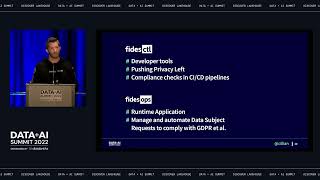
The systemic privacy issues in our digital infrastructure stem largely from a fundamental design flaw: privacy is only considered reactively, once personal data is already flowing. Consumer trust is more valuable than ever, and the legal stakes for respecting personal data continue to climb. Appointing a privacy engineer to check boxes at the time of deployment won't cut it...the status quo for data context and data control - in other words, privacy controls - needs to change.

Analogous to AppSec's leftward shift, privacy responsibility lies with builders and maintainers of data and software systems. This requires resources for developers to embrace their role in tasks like evaluating privacy risk with minimal friction, compatible with the array of modern data infrastructure. Cillian will share actionable steps to implement Privacy by Design and offer just one example of what it could look like in action with open-source devtools for automated privacy checks in the CI pipeline.

Connect with us: Website: https://databricks.com Facebook: https://www.facebook.com/databricksinc Twitter: https://twitter.com/databricks LinkedIn: https://www.linkedin.com/company/data... Instagram: https://www.instagram.com/databricksinc/

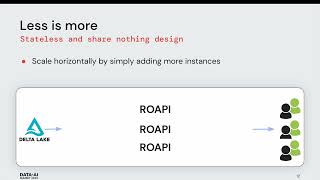
ROAPI: Serve Not So Big Data Pipeline Outputs Online with Modern APIs

Data is the key component of Analytics, AI or ML platform. Organizations may not be successful without having a Platform that can Source, Transform, Quality check and present data in a reportable format that can drive actionable insights.

This session will focus on how Capital One HR Team built a Low Cost Data movement Ecosystem that can source data, transform at scale and build the data storage (Redshift) at a level that can be easily consumed by AI/ML programs - by using AWS Services with combination of Open source software(Spark) and Enterprise Edition Hydrograph (UI Based ETL tool with Spark as backend) This presentation is mainly to demonstrate the flexibility that Apache Spark provides for various types ETL Data Pipelines when we code in Spark.

We have been running 3 types of pipelines over 6+ years , over 400+ nightly batch jobs for $1000/mo. (1) Spark on EC2 (2) UI Based ETL tool with Spark backend (on the same EC2) (3) Spark on EMR. We have a CI/CD pipeline that supports easy integration and code deployment in all non-prod and prod regions ( even supports automated unit testing). We will also demonstrate how this ecosystem can failover to a different region in less than 15 minutes , making our application highly resilient.

Connect with us: Website: https://databricks.com Facebook: https://www.facebook.com/databricksinc Twitter: https://twitter.com/databricks LinkedIn: https://www.linkedin.com/company/data... Instagram: https://www.instagram.com/databricksinc/