talk-data.com talk-data.com

Topic

data-science

2091

tagged

Activity Trend

1 peak/qtr
2020-Q1 2026-Q1

Activities

Showing filtered results

Filtering by: O'Reilly Data Science Books ×
Excel 2007 PivotTables Recipes: A Problem-Solution Approach

Debra Dalgleish, Microsoft Office Excel "Most Valuable Professional" since 2001, and an expert and trainer in Excel, brings together a one-stop resource for anyone curious about representing, analyzing, and using their data with PivotTables and PivotCharts. You'll find this book inimitable when facing any new or difficult problem in PivotTables, covering the entire breadth of situations you could ever encounter, from planning and creating, to formatting and extracting data, to maximizing performance and troubleshooting. The author presents tips and techniques in this collection of recipes that can't be found in Excel's Help section, while carefully explaining the most confusing features of PivotTables to help you realize their powerful potential. The chapters in this book have been organized into a collection of recipes to take you step by step from the problem you are experiencing to the solution you are aiming for. Without fuss, you'll find clear and precise information to help you assess your situation, whether common or unique, and solve your problem. Working examples of complex PivotTables and numerous PivotTable programming examples will help you solve problems quickly, without the need to digest heavy content.
Excel® 2007 PivotTables and PivotCharts

Though many consumers know the basics of using Excel, few users understand the powerful capabilities of the PivotTable and PivotChart features. These tools can help turn long lists of unreadable data into dynamically generated, easy-to-read tables and charts that highlight useful and pertinent business information. Companies rely on this type of data from marketing, accounting, and finance to help make better decisions about products, sales and even human resources. Charts are interactive, allowing the consumer to tweak results with the click of a mouse and PivotTables allow you to fuse data from several sources into one document. This book shows users how to work with PivotTables and PivotCharts to make sense of their data. It covers features such as: understanding PivotTable benefits and uses; creating and customizing PivotTables; using PivotTables to analyze business data; building custom calculations; linking to external data sources, including Access databases, Word tables, Web pages, XML data, SQL Server databases, and OLAP cubes; publishing PivotTables to the Web; multiple consolidation of data, for example, summarizing annual fiscal data by quarters; preparing financial reporting, budgeting, and data analysis across departments; and using VBA to create macros that automate frequently used PivotTable tasks.

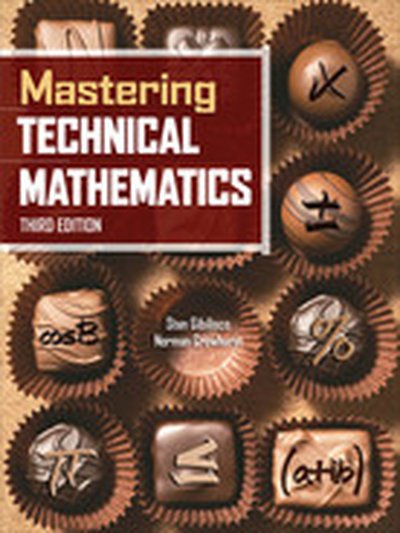
Mastering Technical Mathematics, Third Edition, 3rd Edition

A thorough revision of the classic tutorial of scientific and engineering mathematics For more than fifteen years, Mastering Technical Mathematics has been the definitive self-teaching guide for those wishing to boost their career by learning the principles of mathematics as they apply to science and engineering. Featuring the same user-friendly pedagogy, practical examples, and detailed illustrations that have made this resource a favorite of the scientific and technical communities, the new third edition delivers four entirely new chapters and expanded treatment of cutting-edge topics.

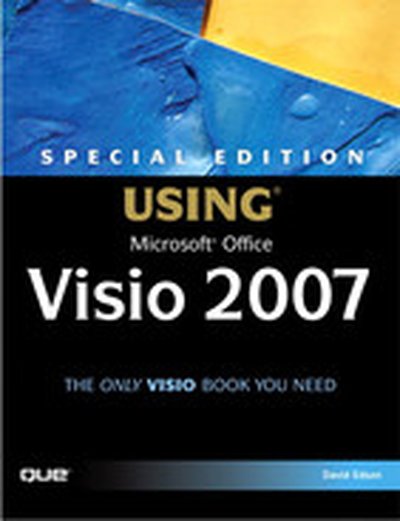
Special Edition Using Microsoft® Office Visio® 2007

THE ONLY VISIO 2007 BOOK YOU NEED “This book makes Visio as much fun as a video game.” Bob and Joy Schwabach, “On Computers,” Universal Press Syndicate We crafted this book to grow with you, providing the reference material you need as you move toward Visio® 2007 proficiency and the use of more advanced features. If you buy only one book on Visio® 2007, Special Edition Using Microsoft Office Visio® 2007 is the only book you need. • Working with shapes, stencils, and themes • Using the Data Graphics feature for extra customization • Importing content from Microsoft Excel and Microsoft Project • Displaying data as text, data bars, icons, and color-coding using Data Graphics • Creating custom stencils, icons, and templates • Storing and displaying employee information in organization charts • Customizing the layout of organization charts • Creating database models, flowcharts, and Gantt charts • Connecting shapes in network drawings • Using digital ink and animation • Creating macros • Handling guides and rulers • Working with layers • Getting the most from ShapeSheets

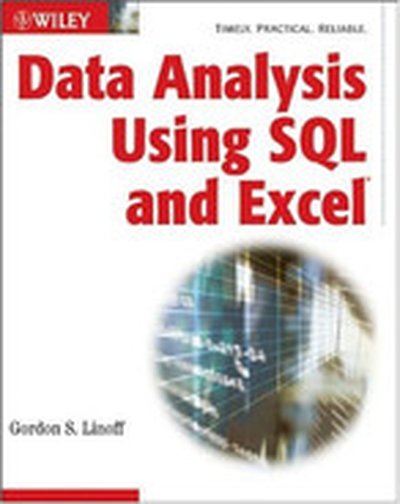
Data Analysis Using SQL and Excel

One of the leading experts on business data mining shows managers how to leverage SQL and Excel to perform sophisticated types of business analysis without the expense of data mining tools and consultants Explains how to use the relatively simple tools of SQL and Excel to extract useful business information from relational databases Each chapter discusses why and when to perform a particular type of business analysis to obtain a useful business result, how to design and perform the analysis using SQL and Excel, and what the results look like in SQL and Excel Presents hints, warnings, and technical asides about Excel, SQL, and data analysis/mining

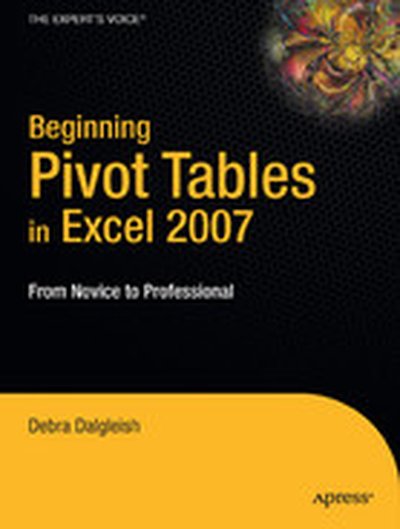
Beginning Pivot Tables in Excel 2007

Beginning PivotTables in Excel 2007 explains what PivotTables are, how you can benefit from using them, how to create them and modify them, and how to use their enhanced features. Using a Pivot Table in Microsoft Office Excel 2007 is a quick and exciting way to slice and dice a large amount of data. Carefully explains the benefits of using Pivot Tables for fast data analysis Provides a step-by-step approach to those new to Pivot Tables Offers tips and tricks that cannot be found elsewhere

JMP® Start Statistics: A Guide to Statistics and Data Analysis Using JMP®, 4th Edition

JMP Start Statistics: A Guide to Statistics and Data Analysis Using JMP, Fourth Edition, is a complete and orderly introduction to analyzing data using JMP statistical discovery software from SAS. A mix of software manual and statistics text, this book provides hands-on tutorials with just the right amount of conceptual and motivational material to illustrate how to use JMP's intuitive interface for data analysis. Each chapter features concept-specific tutorials, examples, brief reviews of concepts, step-by-step illustrations, and exercises. Written by John Sall, Lee Creighton, and Ann Lehman, this book is a great tool for statistics students or practitioners needing a software-related statistics review.

SAS® Programming for Enterprise Guide® Users

In this pragmatic, example-driven book, author Neil Constable demonstrates how you can use SAS code to enhance the capabilities of SAS Enterprise Guide. Designed to help you gain extra value from the products you already have, SAS Programming for Enterprise Guide Users contains tips and techniques that show you a variety of features that cannot be accessed directly through the task interfaces. In all cases, techniques are shown with examples that you can try and test, plus additional exercises are included to give you more practice. The end result is more efficient and resilient use of SAS Enterprise Guide in a wider variety of business areas. Included is a discussion of the following subject areas: the Output Delivery System advanced formatting macro variables and macros advanced reporting using PROC REPORT highlighting in reports hyperlinking between reports and graphs data manipulation using SQL data manipulation using the DATA step extended graphics By adding small amounts of code in key areas, SAS Enterprise Guide users can get more out of the product than the tasks reveal. Users should be familiar with the SAS Enterprise Guide user interface and tasks. No programming experience is necessary.

Google Analytics

Web analytics is the process of measuring your web site, analyzing the data, and making changes based on the analysis. Many businesses are just starting to learn how they can increase the performance of their web site by using web analytics. For many people, their first exposure to web analytics is Google Analytics, a free tool available to everyone. Although analysis is vital to web analytics, you can't do analysis without good data. Configuring Google Analytics correctly is the key to collecting good data. This Short Cut provides a thorough description of how the Google Analytics system works, information about many different types of implementations, and ways to avoid common pitfalls. It also shares some best practices to get your setup correct the first time.

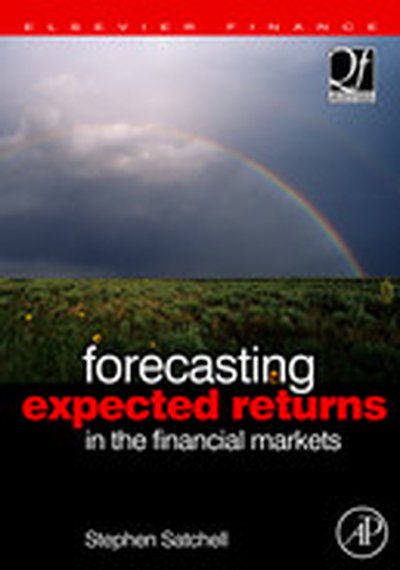
Forecasting Expected Returns in the Financial Markets

Forecasting returns is as important as forecasting volatility in multiple areas of finance. This topic, essential to practitioners, is also studied by academics. In this new book, Dr Stephen Satchell brings together a collection of leading thinkers and practitioners from around the world who address this complex problem using the latest quantitative techniques. Forecasting expected returns is an essential aspect of finance and highly technical The first collection of papers to present new and developing techniques *International authors present both academic and practitioner perspectives

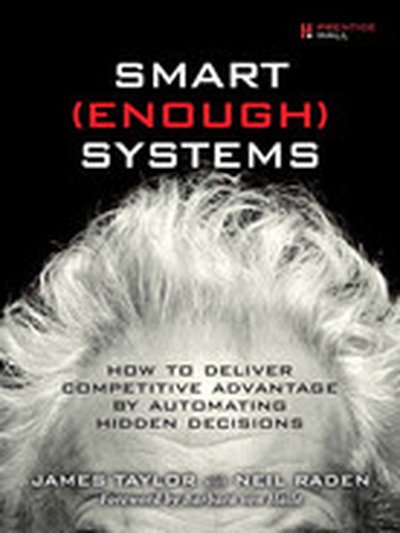
Smart (Enough) Systems: How to Deliver Competitive Advantage by Automating the Decisions Hidden in Your Business

“Automated decisions systems are probably already being used in your industry, and they will undoubtedly grow in importance. If your business needs to make quick, accurate decisions on an industrialized scale, you need to read this book.” Thomas H. Davenport, Professor, Babson College, Author of Competing on Analytics The computer-based systems most organizations rely on to support their businesses are not very smart. Many of the business decisions these companies make tend to be hidden in systems that make poor decisions, or don’t make them at all. Further, most systems struggle to keep up with the pace of change. The answer is not to implement newer, “intelligent” systems. The fact is that much of today’s existing technology has the potential to be “smart enough” to make a big difference to an organization’s business. This book tells you how. Although the business context and underlying principles are explained in a nontechnical manner, the book also contains how-to guidance for more technical readers. The book’s companion site, www.smartenoughsystems.com, has additional information and references for practitioners as well as news and updates. Additional Praise for Smart (Enough) Systems “James Taylor and Neil Raden are on to something important in this book–the tremendous value of improving the large number of routine decisions that are made in organizations every day.” Dr. Hugh J. Watson, Chair of Business Administration, University of Georgia “This is a very important book. It lays out the agenda for business technology in the new century–nothing less than how to reorganize every aspect of how a company treats its customers.” David Raab, President, ClientXClient “This book is an important contribution to business productivity because it covers the opportunity from both the business executive’s and technologist’s perspective. This should be on every operational executive’s and every CIO’s list of essential reading.” John Parkinson, Former CTO, Capgemini, North American Region “This book shows how to use proven technology to make business processes smarter. It clearly makes the case that organizations need to optimize their operational decisions. It is a must-have reference for process professionals throughout your organization.” Jim Sinur, Chief Strategy Officer, Global 360, Inc.

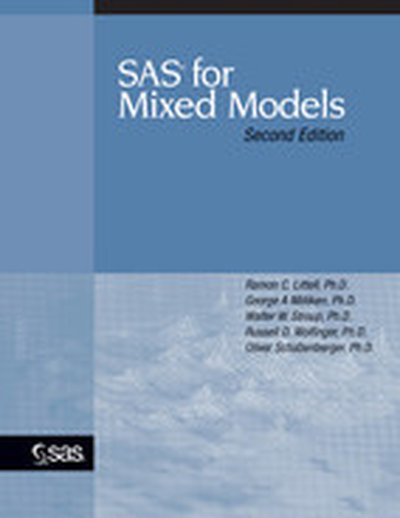
SAS for Mixed Models, Second Edition, 2nd Edition
The indispensable, up-to-date guide to mixed models using SAS. Discover the latest capabilities available for a variety of applications featuring the MIXED, GLIMMIX, and NLMIXED procedures in SAS for Mixed Models, Second Edition, the comprehensive mixed models guide for data analysis, completely revised and updated for SAS 9 by authors Ramon Littell, George Milliken, Walter Stroup, Russell Wolfinger, and Oliver Schabenberger. The theory underlying the models, the forms of the models for various applications, and a wealth of examples from different fields of study are integrated in the discussions of these models: random effect only and random coefficients models; split-plot, multilocation, and repeated measures models; hierarchical models with nested random effects; analysis of covariance models; spatial correlation models; generalized linear mixed models; and nonlinear mixed models.

Professionals and students with a background in two-way ANOVA and regression and a basic knowledge of linear models and matrix algebra will benefit from the topics covered.

This book is part of the SAS Press program.

The R Book

The high-level language of R is recognized as one of the most powerful and flexible statistical software environments, and is rapidly becoming the standard setting for quantitative analysis, statistics and graphics. R provides free access to unrivalled coverage and cutting-edge applications, enabling the user to apply numerous statistical methods ranging from simple regression to time series or multivariate analysis. Building on the success of the author's bestselling Statistics: An Introduction using R, The R Book is packed with worked examples, providing an all inclusive guide to R, ideal for novice and more accomplished users alike. The book assumes no background in statistics or computing and introduces the advantages of the R environment, detailing its applications in a wide range of disciplines. Provides the first comprehensive reference manual for the R language, including practical guidance and full coverage of the graphics facilities. Introduces all the statistical models covered by R, beginning with simple classical tests such as chi-square and t-test. Proceeds to examine more advance methods, from regression and analysis of variance, through to generalized linear models, generalized mixed models, time series, spatial statistics, multivariate statistics and much more. The R Book is aimed at undergraduates, postgraduates and professionals in science, engineering and medicine. It is also ideal for students and professionals in statistics, economics, geography and the social sciences.

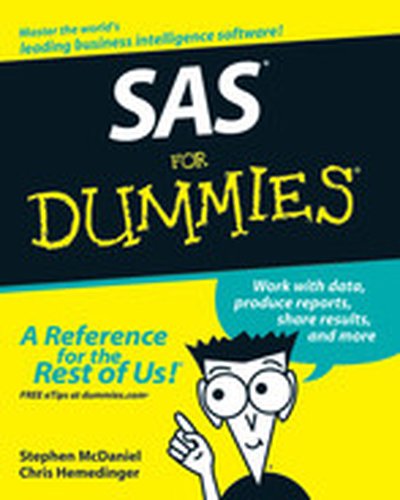
SAS For Dummies

Created in partnership with SAS, this book explores SAS, a business intelligence software that can be used in any business setting or enterprise for data delivery, reporting, data mining, forecasting, statistical analysis, and more. SAS employee and technologist Stephen McDaniel combines real-world expertise and a friendly writing style to introduce readers to SAS basics. It covers crucial topics such as getting various types of data into the software, producing reports, working with the data, basic SAS programming, macros, and working with SAS and databases.

Visualizing Information with Microsoft® Office Visio® 2007

Create and distribute data-connected Microsoft Office Visio diagrams and reports Get full details on the powerful features of Microsoft Office Visio 2007 inside this comprehensive volume. Written by Visio expert David Parker, Visualizing Information with Microsoft Office Visio 2007 demonstrates how to effectively visualize, explore, and communicate complex business information. Learn to use PivotDiagrams, Data Graphics, and Smart Tags, as well as link data to shapes and create meaningful Visio documents and reports. Plus, you'll get vital security information, time-saving tips, troubleshooting techniques, and downloadable macros and code samples. Essential Skills for Database Users and Professionals Create shapes and link them to data Summarize and analyze information using PivotDiagrams Use Data Graphics, Smart Tags, and SmartShapes to reinforce information Generate robust Excel, HTML, and XML reports Create custom, reusable templates, stencils, and masters Update and enhance diagrams with Reviewer's comments and markups Integrate Visio diagrams with other Windows applications Publish and securely distribute Visio documents and summaries Extend functionality using VBA macros, add-ins, and wrapper applications

Web Analytics

Written by an in-the-trenches practitioner, this step-by-step guide shows you how to implement a successful Web analytics strategy. Web analytics expert Avinash Kaushik, in his thought-provoking style, debunks leading myths and leads you on a path to gaining actionable insights from your analytics efforts. Discover how to move beyond clickstream analysis, why qualitative data should be your focus, and more insights and techniques that will help you develop a customer-centric mindset without sacrificing your company’s bottom line. Note: CD-ROM/DVD and other supplementary materials are not included as part of eBook file.

Actionable Web Analytics: Using Data To Make Smart Business Decisions

Knowing everything you can about each click to your Web site can help you make strategic decisions regarding your business. This book is about the why, not just the how, of web analytics and the rules for developing a "culture of analysis" inside your organization. Why you should collect various types of data. Why you need a strategy. Why it must remain flexible. Why your data must generate meaningful action. The authors answer these critical questions—and many more—using their decade of experience in Web analytics.