talk-data.com talk-data.com

Topic

data-science

2252

tagged

Activity Trend

1 peak/qtr
2020-Q1 2026-Q1

Activities

2252 activities · Newest first

JMP 11 Reliability and Survival Methods

JMP 11 Reliability and Survival Methods provides details about evaluating and improving reliability in a product or system and analyzing survival data for people and products. The book explains how to fit the best distribution to your time-to-event data or analyze destruction data. A few other topics include analyzing competing causes of failure, modeling reliability as improvements are made over time, and analyzing recurring events.

JMP 11 Specialized Models

JMP 11 Specialized Models provides details about modeling techniques such as partitioning, neural networks, nonlinear regression, and time series analysis. Topics include the Gaussian platform, which is useful in analyzing computer simulation experiments. The book also covers the Response Screening platform, which is useful in testing the effect of a predictor when you have many responses.

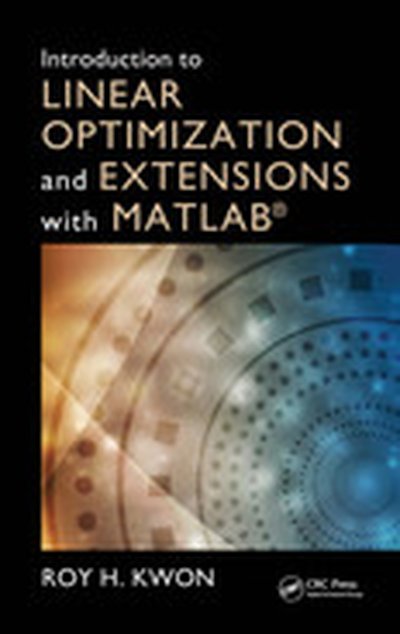
Introduction to Linear Optimization and Extensions with MATLAB®

Filling the need for an introductory book on linear programming that discusses the important ways to mitigate parameter uncertainty, Introduction to Linear Optimization and Extensions with MATLAB® provides a concrete and intuitive yet rigorous introduction to modern linear optimization. In addition to fundamental topics, the book discusses current linear optimization technologies such as predictor-path following interior point methods for both linear and quadratic optimization as well as the inclusion of linear optimization of uncertainty i.e. stochastic programming with recourse and robust optimization. The author introduces both stochastic programming and robust optimization as frameworks to deal with parameter uncertainty. The author’s unusual approach—developing these topics in an introductory book—highlights their importance. Since most applications require decisions to be made in the face of uncertainty, the early introduction of these topics facilitates decision making in real world environments. The author also includes applications and case studies from finance and supply chain management that involve the use of MATLAB. Even though there are several LP texts in the marketplace, most do not cover data uncertainty using stochastic programming and robust optimization techniques. Most emphasize the use of MS Excel, while this book uses MATLAB which is the primary tool of many engineers, including financial engineers. The book focuses on state-of-the-art methods for dealing with parameter uncertainty in linear programming, rigorously developing theory and methods. But more importantly, the author’s meticulous attention to developing intuition before presenting theory makes the material come alive.

Mondrian in Action

Mondrian in Action teaches business users and developers how to use Mondrian and related tools for strategic business analysis. You'll learn how to design and populate a data warehouse and present the data via a multidimensional model. You'll follow examples showing how to create a Mondrian schema and then expand it to add basic security based on the users' roles. About the Technology Mondrian is an open source, lightning-fast data analysis engine designed to help you explore your business data and perform speed-of-thought analysis. Mondrian can be integrated into a wide variety of business analysis applications and learning it requires no specialized technical knowledge. About the Book Mondrian in Action teaches you to use Mondrian for strategic business analysis. In it, you'll learn how to organize and present data in a multidimensional manner. You'll follow apt and thoroughly explained examples showing how to create a Mondrian schema and then expand it to add basic security based on users' roles. Developers will discover how to integrate Mondrian using its olap4j Java API and web service calls via XML for Analysis. What's Inside Mondrian from the ground up -- no experience required A primer on business analytics Using Mondrian with a variety of leading applications Optimizing and restricting business data for fast, secure analysis About the Reader Written for developers building data analysis solutions. Appropriate for tech-savvy business users and DBAs needing to query and report on data. About the Authors William D. Back is an Enterprise Architect and Director of Pentaho Services. Nicholas Goodman is a Business Intelligence pro who has authored training courses on OLAP and Mondrian. Julian Hyde founded Mondrian and is the project's lead developer. Quotes A wonderful introduction to Business Intelligence and Analytics. - Lorenzo De Leon, Authentify, Inc. A great overview of the Mondrian engine that guided me through all the technical details. - Alexander Helf, veenion GmbH A significant complement to the online documentation, and an excellent introduction to how to think about designing a data warehouse. - Mark Newman, Heads Up Analytics Comprehensive ... highly recommended. - Najib Coutya, IMD Group

The Heston Model and its Extensions in Matlab and C#, + Website

Tap into the power of the most popular stochastic volatility model for pricing equity derivatives Since its introduction in 1993, the Heston model has become a popular model for pricing equity derivatives, and the most popular stochastic volatility model in financial engineering. This vital resource provides a thorough derivation of the original model, and includes the most important extensions and refinements that have allowed the model to produce option prices that are more accurate and volatility surfaces that better reflect market conditions. The book's material is drawn from research papers and many of the models covered and the computer codes are unavailable from other sources. The book is light on theory and instead highlights the implementation of the models. All of the models found here have been coded in Matlab and C#. This reliable resource offers an understanding of how the original model was derived from Ricatti equations, and shows how to implement implied and local volatility, Fourier methods applied to the model, numerical integration schemes, parameter estimation, simulation schemes, American options, the Heston model with time-dependent parameters, finite difference methods for the Heston PDE, the Greeks, and the double Heston model. A groundbreaking book dedicated to the exploration of the Heston model—a popular model for pricing equity derivatives Includes a companion website, which explores the Heston model and its extensions all coded in Matlab and C# Written by Fabrice Douglas Rouah a quantitative analyst who specializes in financial modeling for derivatives for pricing and risk management Engaging and informative, this is the first book to deal exclusively with the Heston Model and includes code in Matlab and C# for pricing under the model, as well as code for parameter estimation, simulation, finite difference methods, American options, and more. Note: The ebook version does not provide access to the companion files.

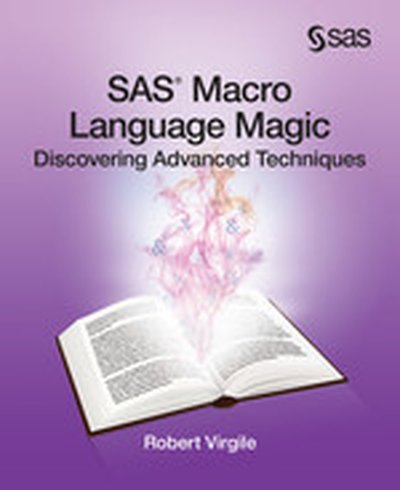
SAS Macro Language Magic

SAS Macro Language Magic: Discovering Advanced Techniques pushes the SAS macro language to the limit. It explores how even common tools, when used to their full advantage, can transform into amazing applications. This book assumes a basic knowledge of the SAS macro language and then shows how to apply that knowledge in new and different ways.

This book enables you to find a technique that you like and then explore it to discover what works and what the possibilities are. You can experiment, focusing more on the application and less on the syntax, while at the same time visualizing the SAS program you want to generate.

Discover and develop powerful programming techniques down the path to demystifying MACROS. All the tricks and secrets are revealed, enabling you to write SAS macros that work like MAGIC.

This book is part of the SAS Press program.

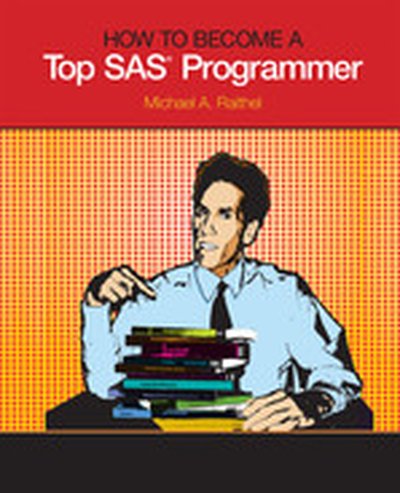
How to Become a Top SAS Programmer

Would you like to be a top SAS programmer? Would you like to be the person that other SAS programmers turn to for solutions to programming problems? If so, then How to Become a Top SAS Programmer, written by Michael Raithel is the book for you.

This self-help book provides invaluable strategies for enhancing your SAS programming skills and introduces you to a wide variety of SAS resources that are readily available to you. Inside this book, you will learn: what makes a top SAS programmer fundamentals that every top SAS programmer should master ideas for advancing your SAS career within your organization where to find SAS documentation to learn new programming techniques how to participate in local and regional SAS user groups and SAS Global Forum how to make SAS training and certification work for you how to take part in SAS virtual communities to learn, contribute, and become well-known …and much more

Want to increase your SAS acumen, solidify the use of SAS in your organization, be a greater benefit to your organization as a SAS programmer, contribute to the world-wide SAS community, and enjoy good career growth? Michael’s book will help the novice SAS programmer or a seasoned professional to do all that and more.

Start reading it now and become the top SAS programmer in your organization who everyone goes to for insight and guidance into the many aspects of the SAS world!

This book is part of the SAS Press program.

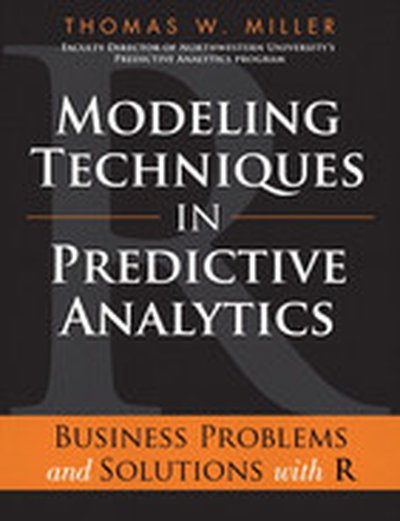
Modeling Techniques in Predictive Analytics: Business Problems and Solutions with R

Today, successful firms compete and win based on analytics. Modeling Techniques in brings together all the concepts, techniques, and R code you need to excel in any role involving analytics. Thomas W. Miller’s unique balanced approach combines business context Predictive Analytics and quantitative tools, appealing to managers, analysts, programmers, and students alike. Miller addresses multiple business challenges and business cases, including segmentation, brand positioning, product choice modeling, pricing research, finance, sports, text analytics, sentiment analysis, and social network analysis. He illuminates the use of cross-sectional data, time series, spatial, and even spatio-temporal data. For each problem, Miller explains why the problem matters, what data is relevant, how to explore your data once you’ve identified it, and then how to successfully model that data. You’ll learn how to model data conceptually, with words and figures; and then how to model it with realistic R programs that deliver actionable insights and knowledge. Miller walks you through model construction, explanatory variable subset selection, and validation, demonstrating best practices for improving out-of-sample predictive performance. He employs data visualization and statistical graphics in exploring data, presenting models, and evaluating performance. All example code is presented in R, today’s #1 system for applied statistics, statistical research, and predictive modeling; code is set apart from other text so it’s easy to find for those who want it (and easy to skip for those who don’t).

IBM Cognos 10 Report Studio Cookbook - Second Edition

This cookbook is a comprehensive guide to mastering IBM Cognos 10 Report Studio, enabling users to become proficient in developing professional-grade reports. Through practical recipes, you will learn how to harness the full potential of Report Studio, mastering both fundamental and advanced features for real-world application. What this Book will help me do Efficiently organize and process data using advanced sorting and filtering techniques. Create visually engaging and functional reports, including dynamic drill-through links and enhanced formatting options. Master the use of conditional formatting, cascaded prompts, and master-detailed queries in your reports. Enhance reports with Active Reports, direct XML editing, and by integrating JavaScript and HTML elements. Adopt industry best practices for report development, including version control and regression testing. Author(s) The author of this cookbook is an experienced IBM Cognos consultant with years of experience in developing business intelligence solutions and creating comprehensive reports. They focus on combining technical expertise with practical examples, presenting information in an approachable and user-friendly manner. Who is it for? This book is ideal for Business Intelligence Developers with a working knowledge of IBM Cognos 10 who seek to enhance their report-building skills. It also serves Business Analysts or Power Users familiar with basic report authoring who aim to explore advanced features. Prior knowledge of IBM Cognos 10 architecture and basic Report Studio functionalities is assumed.

Big Data Analytics

Big Data Analytics will assist managers in providing an overview of the drivers for introducing big data technology into the organization and for understanding the types of business problems best suited to big data analytics solutions, understanding the value drivers and benefits, strategic planning, developing a pilot, and eventually planning to integrate back into production within the enterprise. Guides the reader in assessing the opportunities and value proposition Overview of big data hardware and software architectures Presents a variety of technologies and how they fit into the big data ecosystem

Handbook of Economic Forecasting

The highly prized ability to make financial plans with some certainty about the future comes from the core fields of economics. In recent years the availability of more data, analytical tools of greater precision, and ex post studies of business decisions have increased demand for information about economic forecasting. Volumes 2A and 2B, which follows Nobel laureate Clive Granger's Volume 1 (2006), concentrate on two major subjects. Volume 2A covers innovations in methodologies, specifically macroforecasting and forecasting financial variables. Volume 2B investigates commercial applications, with sections on forecasters' objectives and methodologies. Experts provide surveys of a large range of literature scattered across applied and theoretical statistics journals as well as econometrics and empirical economics journals. The Handbook of Economic Forecasting Volumes 2A and 2B provide a unique compilation of chapters giving a coherent overview of forecasting theory and applications in one place and with up-to-date accounts of all major conceptual issues. Focuses on innovation in economic forecasting via industry applications Presents coherent summaries of subjects in economic forecasting that stretch from methodologies to applications Makes details about economic forecasting accessible to scholars in fields outside economics

Handbook of Economic Forecasting

The highly prized ability to make financial plans with some certainty about the future comes from the core fields of economics. In recent years the availability of more data, analytical tools of greater precision, and ex post studies of business decisions have increased demand for information about economic forecasting. Volumes 2A and 2B, which follows Nobel laureate Clive Granger's Volume 1 (2006), concentrate on two major subjects. Volume 2A covers innovations in methodologies, specifically macroforecasting and forecasting financial variables. Volume 2B investigates commercial applications, with sections on forecasters' objectives and methodologies. Experts provide surveys of a large range of literature scattered across applied and theoretical statistics journals as well as econometrics and empirical economics journals. The Handbook of Economic Forecasting Volumes 2A and 2B provide a unique compilation of chapters giving a coherent overview of forecasting theory and applications in one place and with up-to-date accounts of all major conceptual issues. Focuses on innovation in economic forecasting via industry applications Presents coherent summaries of subjects in economic forecasting that stretch from methodologies to applications Makes details about economic forecasting accessible to scholars in fields outside economics

Credible Checklists and Quality Questionnaires

Credible Checklists and Quality Questionnaires starts off with an examination of the critical but commonly overlooked checklist method. In the second chapter, questionnaires and surveys are discussed. Asking questions sounds simple, but the hard truth is that asking questions (and designing questionnaires) is a difficult task. This chapter discusses being mindful of the choice of words, order of questions and how early questions influence later questions, answer scales and how they impact the user response, questionnaire design, and much more. The final chapter provides examples of some common questionnaires (both free and fee-based) for assessing the usability of products. After reading this book, readers will be able to use these user design tools with greater confidence and certainty.

SAS Business Intelligence for the Health Care Industry

SAS Business Intelligence for the Health Care Industry: Practical Applications teaches health care executives, managers, providers, and business analysts how to use SAS Business Intelligence (BI) tools to convert data into knowledge and value at all levels in the health care industry.

This book demonstrates how SAS BI solutions can be applied to the health care industry and offers detailed explanations of code and tasks in an approachable case study format. All applications are created with sample data that has the richness and complexity of operational health care data. Topics include:

using SAS Add-In for Microsoft Office and SAS Stored Processes technology to better track and forecast revenues and margins

creating OLAP and relational web reports that enable care management programs to locate and assist the neediest patients

implementing data access restrictions on OLAP and relational data in accordance with the industry’s need for secure data access

creating dashboards to help executives monitor their health care organization

With its level of depth and perfect blend of technology and business contexts, this book provides health care analysts, researchers, and statisticians with information and examples that can be used effectively and immediately. It is an indispensable aid to the health care professional in keeping up with a fast-changing industry.

This book is part of the SAS Press program.

A/B Testing: The Most Powerful Way to Turn Clicks Into Customers

A guide to delivering a better user experience through A/B testing A/B Testing outlines a simple way to test several different versions of a web page with live traffic, and then measure the effect each version has on visitors. Using A/B testing you can determine the most effective way to increase conversion rate—the rate at which visitors convert into customers. The average conversion rate across the web is only 2%. That means 98% of visitors to most websites don't end up converting. Using A/B testing, companies can improve the effectiveness of their marketing and user experience and in doing so can sometimes double or triple their conversion rates. In the past, marketing teams were dependent on IT and engineering to implement A/B tests, and that proved to be a costly bottleneck. Today, the market for A/B testing is growing very fast, in no small part due to this transition from IT to marketing. Offers best practices and lessons learned from over 100,000 experiments run by over 2,000 Optimizely customers Details a roadmap for how to use A/B testing to personalize your customer's web experience and a practical guide to start A/B testing today Authors Dan Siroker and Pete Koomen are cofounders of Optimizely.com, an user-friendly testing system that more than 2,000 organizations use Marketers and web professionals will become obsolete if they don't embrace a data-driven approach to decision making. This book shows you how, no matter your technical expertise.

Demand-Driven Forecasting: A Structured Approach to Forecasting, 2nd Edition

An updated new edition of the comprehensive guide to better business forecasting Many companies still look at quantitative forecasting methods with suspicion, but a new awareness is emerging across many industries as more businesses and professionals recognize the value of integrating demand data (point-of-sale and syndicated scanner data) into the forecasting process. Demand-Driven Forecasting equips you with solutions that can sense, shape, and predict future demand using highly sophisticated methods and tools. From a review of the most basic forecasting methods to the most advanced and innovative techniques in use today, this guide explains demand-driven forecasting, offering a fundamental understanding of the quantitative methods used to sense, shape, and predict future demand within a structured process. Offering a complete overview of the latest business forecasting concepts and applications, this revised Second Edition of Demand-Driven Forecasting is the perfect guide for professionals who need to improve the accuracy of their sales forecasts. Completely updated to include the very latest concepts and methods in forecasting Includes real case studies and examples, actual data, and graphical displays and tables to illustrate how effective implementation works Ideal for CEOs, CFOs, CMOs, vice presidents of supply chain, vice presidents of demand forecasting and planning, directors of demand forecasting and planning, supply chain managers, demand planning managers, marketing analysts, forecasting analysts, financial managers, and any other professional who produces or contributes to forecasts Accurate forecasting is vital to success in today's challenging business climate. Demand-Driven Forecasting offers proven and effective insight on making sure your forecasts are right on the money.

Tableau 8: The Official Guide

Present a unified view of complex BI using the entire Tableau 8 toolkit Create and distribute dynamic, feature-rich data visualizations and highly interactive BI dashboards—quickly and easily! Tableau 8: The Official Guide provides the hands-on instruction and best practices you need to meet your business intelligence objectives and drive better decision making. Discover how to work from the Tableau GUI, load BI from disparate sources, drag and drop to analyze data, set up custom visualizations, and build robust dashboards. This practical guide shows you, step by step, how to design and publish meaningful business communications to end users across your enterprise. Navigate the Tableau user interface and data window Connect to spreadsheets, databases, and other sources Select data fields and drag them to desired screen locations Work with pre-defined visualizations and sample workbooks Display background maps and perform geographic analysis Add calculated fields, graphs, charts, tables, and statistics Combine multiple data sources into real-time dashboards Export your visualizations to the Web or in various file formats Electronic content includes: Videos that demonstrate the techniques presented in the book Sample Tableau workbooks