talk-data.com talk-data.com

Topic

data

3406

tagged

Activity Trend

3 peak/qtr
2020-Q1 2026-Q1

Activities

Showing filtered results

Filtering by: O'Reilly Data Engineering Books ×
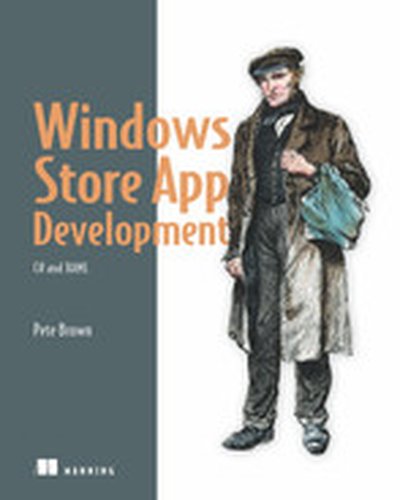
Windows Store App Development: C# and XAML

Windows Store App Development introduces C# developers to working with Windows Store apps. It provides full coverage of XAML, and addresses both app design and development. Following numerous carefully crafted examples, you'll learn about new Windows 8 features, the WinRT API, and .NET 4.5. Along the way, you'll pick up tips for deploying apps, including sale through the Windows Store. And, of course, you'll find the same deep and unique insights Pete provides in his Silverlight books. About the Technology The Windows Store provides an amazing array of productivity tools, games, and other apps directly to the millions of customers already using Windows 8.x or Surface. Windows Store apps boast new features like touch and pen input, standardized app-to-app communication, and tight integration with the web. And, you can build Windows Store apps using the tools you already know: C# and XAML. About the Book Windows Store App Development introduces the Windows 8.x app model to readers familiar with traditional desktop development. You'll explore dozens of carefully crafted examples as you master Windows features, the Windows Runtime, and the best practices of app design. Along the way, you'll pick up tips for deploying apps, including selling through the Windows Store. What's Inside Designing, creating, and selling Windows Store apps Developing touch and sensor-centric apps Working C# examples, from feature-level techniques to complete app design Making apps that talk to each other Mixing in C++ for even more features About the Reader This book requires some knowledge of C#. No experience with Windows 8 is needed. About the Author Pete Brown is a Developer Evangelist at Microsoft and author of Silverlight 4 in Action and Silverlight 5 in Action. Quotes Informative, fun, and easy to read. - Todd Miranda, NxtDimension Solutions Broad coverage of all aspects of W8 XAML development. - Roland Civet, iSolutions For You! Pete is a consistently great author, and once again he nails his subject. - Gordon Mackie, Openfeatured Ltd. Your roadmap to modern Windows design. - Patrick Toohey, Mettler-Toledo Hi-Speed Much less a book than a must-have tool for efficient and quality app development. - Dave Campbell, WynApse
GDPS Family An Introduction to Concepts and Facilities

This IBM® Redbooks publication presents an overview of the IBM Geographically Dispersed Parallel Sysplex™ (IBM GDPS®) family of offerings and the role they play in delivering a business IT resilience solution. The book begins with a discussion of general concepts of business IT resilience and disaster recovery, along with issues related to high application availability, data integrity, and performance. These topics are considered within the framework of government regulation, increasing application and infrastructure complexity, and the competitive and rapidly changing modern business environment. Next, it describes the GDPS family of offerings with specific reference to how they can achieve your defined goals for disaster recover and high availability. Also covered are the features that simplify and enhance data replication activities, the prerequisites for implementing each offering, and hints for planning for the future and immediate business requirements. Tables provide easy-to-use summaries and comparisons of the offerings, and the additional planning and implementation services available from IBM are explained. The introductory chapters of this publication are intended for a broad technical audience including IT System Architects, Availability Managers, Technical IT Managers, System Programmers, and Disaster Recovery Planners. The subsequent chapters provide more technical details about the GDPS offerings, and each can be read in isolation for those who are interested. Because of this, if you do read all the chapters, be aware that some information is repeated.

IBM System z Personal Development Tool Vol. 4 Coupling and Parallel Sysplex

This IBM® Redbooks® publication describes the usage of Coupling Facility (CF) functions with the IBM System z® Personal Development Tool (zPDT). It describes the System z Coupling Application Developer Controlled Distribution, which is a Parallel Sysplex® “starter system” based on the AD-CD package and lists the exact steps taken to turn the normal AD-CD z/OS® system into a Parallel Sysplex base. This document assumes that the reader is familiar with basic zPDT usage and terminology, with z/OS, with the z/OS AD-CD system, with basic z/VM® usage, and with general Parallel Sysplex concepts. It is not intended as an introduction to any of these topics. This version of the document is based on z/VM 6.2 (as available to authorized users in an AD-CD package) and z/OS 1.13 (as available to authorized users in the January 2013 update of the AD-CD package).

IBM zEnterprise EC12 Configuration Setup

This IBM® Redbooks® publication helps you install, configure, and maintain the IBM zEnterprise EC12 server. The zEC12 offers new functions that require a comprehensive understanding of the available configuration options. This book presents configuration setup scenarios, and describes implementation examples in detail. This book is intended for systems engineers, hardware planners, and anyone who needs to understand IBM System z® configuration and implementation. Readers should be generally familiar with current IBM System z technology and terminology. For details about the zEC12 server, see IBM zEnterprise EC12 Technical Introduction, SG24-8050, and IBM zEnterprise EC12 Technical Guide, SG24-8049.

Instant Apache ActiveMQ Messaging Application Development How-to

Instant Apache ActiveMQ Messaging Application Development How-to is a concise guide to building messaging applications using ActiveMQ and the JMS API. It covers the critical concepts and hands-on examples for utilizing ActiveMQ's messaging capabilities. You will learn how to implement both basic and advanced messaging functionalities in your applications. What this Book will help me do Master the setup of Apache ActiveMQ brokers for development environments. Develop message-driven applications using Java Message Service (JMS) API. Leverage message queues and topics to broadcast and manage asynchronous communication. Implement advanced messaging features such as message scheduling and fault tolerance. Integrate ActiveMQ directly into JVM-based applications for seamless operation. Author(s) Timothy A. Bish, an experienced software developer, specializes in messaging systems and ActiveMQ. With extensive knowledge in JMS and message-based application development, he provides clear and usable guidance to developers. His practical approach ensures that readers gain both foundational understanding and advanced skills effectively. Who is it for? This book is ideal for software developers who are new to messaging systems and wish to explore Java Message Service (JMS) with a focus on ActiveMQ. It is suitable for professionals aiming to build robust communication systems and developers wanting to expand their expertise in real-time event-driven applications. Beginners with basic Java knowledge will find this approachable and highly educational.

IBM ProtecTIER Implementation and Best Practices Guide

This IBM® Redbooks® publication provides best practice guidance for planning, installing, and configuring the IBM TS7600 ProtecTIER® family of products. This guide provides all the latest best practices for using ProtecTIER Software Version 3.3 and the revolutionary and patented IBM HyperFactor® deduplication engine, along with other data storage efficiency techniques, such as compression and defragmentation. The IBM System Storage® TS7650G ProtecTIER Deduplication Gateway and the IBM System Storage TS7620 ProtecTIER Deduplication Appliance Express are disk-based data storage systems that are configured for three available interfaces: The Virtual Tape Library (VTL) interface is the foundation of ProtecTIER and emulates traditional automated tape libraries. The Symantec NetBackup OpenStorage (OST) API can be integrated with Symantec NetBackup to provide backup-to-disk without having to emulate traditional tape libraries. The newly available File System Interface (FSI) supports Common Internet File System (CIFS) and Network File System (NFS) as backup targets. When you build a ProtecTIER data deduplication environment, this guide helps your IT architects and solution designers plan for the best option and scenario for data deduplication for their environments. This guide helps you optimize your deduplication ratio, while reducing the hardware, power and cooling, and management costs. This guide provides expertise that was gained from the IBM ProtecTIER Field Technical Sales Support (FTSS/CSS) Group, development, and Quality Assurance teams.

Implementing the Storwize V3500

Businesses of all sizes are faced with the challenge of managing huge volumes of data that are becoming increasingly valuable. But storing this data can be costly, and extracting value from the data is becoming more and more difficult. IT organizations have limited resources and cannot afford to make investment mistakes. The IBM® Storwize® V3500 system provides a smarter solution that is affordable, simple, and efficient, which enables businesses to overcome their storage challenges. IBM Storwize V3500 is the most recent addition to the IBM Storwize family of disk systems. It delivers easy-to-use, entry-level configurations that are specifically designed to meet the modest budgets of small and medium-sized businesses. IBM Storwize V3500 features the following highlights: - Consolidate and share data with low cost iSCSI storage networking.

Relational Theory for Computer Professionals

All of today’s mainstream database products support the SQL language, and relational theory is what SQL is supposed to be based on. But are those products truly relational? Sadly, the answer is no. This book shows you what a real relational product would be like, and how and why it would be so much better than what’s currently available. With this unique book, you will: Learn how to see database systems as programming systems Get a careful, precise, and detailed definition of the relational model Explore a detailed analysis of SQL from a relational point of view There are literally hundreds of books on relational theory or the SQL language or both. But this one is different. First, nobody is more qualified than Chris Date to write such a book. He and Ted Codd, inventor of the relational model, were colleagues for many years, and Chris’s involvement with the technology goes back to the time of Codd’s first papers in 1969 and 1970. Second, most books try to use SQL as a vehicle for teaching relational theory, but this book deliberately takes the opposite approach. Its primary aim is to teach relational theory as such. Then it uses that theory as a vehicle for teaching SQL, showing in particular how that theory can help with the practical problem of using SQL correctly and productively. Any computer professional who wants to understand what relational systems are all about can benefit from this book. No prior knowledge of databases is assumed.

The Complete Book of Data Anonymization

The Complete Book of Data Anonymization: From Planning to Implementation supplies a 360-degree view of data privacy protection using data anonymization. It examines data anonymization from both a practitioner's and a program sponsor's perspective. Discussing analysis, planning, setup, and governance, it illustrates the entire process of adapting and implementing anonymization tools and programs. Part I of the book begins by explaining what data anonymization is. It describes how to scope a data anonymization program as well as the challenges involved when planning for this initiative at an enterprisewide level. Part II describes the different solution patterns and techniques available for data anonymization. It explains how to select a pattern and technique and provides a phased approach towards data anonymization for an application. A cutting-edge guide to data anonymization implementation, this book delves far beyond data anonymization techniques to supply you with the wide-ranging perspective required to ensure comprehensive protection against misuse of data.

Principles of Big Data

Principles of Big Data helps readers avoid the common mistakes that endanger all Big Data projects. By stressing simple, fundamental concepts, this book teaches readers how to organize large volumes of complex data, and how to achieve data permanence when the content of the data is constantly changing. General methods for data verification and validation, as specifically applied to Big Data resources, are stressed throughout the book. The book demonstrates how adept analysts can find relationships among data objects held in disparate Big Data resources, when the data objects are endowed with semantic support (i.e., organized in classes of uniquely identified data objects). Readers will learn how their data can be integrated with data from other resources, and how the data extracted from Big Data resources can be used for purposes beyond those imagined by the data creators. Learn general methods for specifying Big Data in a way that is understandable to humans and to computers Avoid the pitfalls in Big Data design and analysis Understand how to create and use Big Data safely and responsibly with a set of laws, regulations and ethical standards that apply to the acquisition, distribution and integration of Big Data resources

MongoDB: The Definitive Guide, 2nd Edition

Manage the huMONGOus amount of data collected through your web application with MongoDB. This authoritative introduction—written by a core contributor to the project—shows you the many advantages of using document-oriented databases, and demonstrates how this reliable, high-performance system allows for almost infinite horizontal scalability. This updated second edition provides guidance for database developers, advanced configuration for system administrators, and an overview of the concepts and use cases for other people on your project. Ideal for NoSQL newcomers and experienced MongoDB users alike, this guide provides numerous real-world schema design examples. Get started with MongoDB core concepts and vocabulary Perform basic write operations at different levels of safety and speed Create complex queries, with options for limiting, skipping, and sorting results Design an application that works well with MongoDB Aggregate data, including counting, finding distinct values, grouping documents, and using MapReduce Gather and interpret statistics about your collections and databases Set up replica sets and automatic failover in MongoDB Use sharding to scale horizontally, and learn how it impacts applications Delve into monitoring, security and authentication, backup/restore, and other administrative tasks

Oracle Data Integrator 11g Cookbook

"Oracle Data Integrator 11g Cookbook" provides an insightful exploration into the advanced features and functions of Oracle Data Integrator. Through practical insights and recipes, it guides you from understanding deployment to mastering advanced development techniques, including using the ODI SDK and web services. By reading this book, you'll enhance your skills and effectively execute data integration solutions. What this Book will help me do Install, configure, and deploy Oracle Data Integrator for effective integration solutions. Develop and utilize Knowledge Modules and leverage ODI Topology for advanced integration needs. Employ variables, interfaces, and packages in innovative ways to streamline processes. Understand how to use XML, web services, and the ODI SDK for extending functionality. Incorporate best practices for administration, diagnostics, and maintenance tasks. Author(s) The authors of "Oracle Data Integrator 11g Cookbook" are experienced data integration professionals with a profound understanding of Oracle technologies. With hands-on expertise and years of consulting experience, they bring practical knowledge and actionable insights to the book. Their approach emphasizes clarity, practical application, and fostering understanding through real-world examples. Who is it for? The ideal reader for "Oracle Data Integrator 11g Cookbook" includes data integration specialists and developers with a foundational understanding of Oracle Data Integrator. The book caters to those looking to deepen their expertise, enhance deployment practices, and utilize advanced capabilities. It is suitable for professionals aiming to solve complex integration challenges or streamline the implementation of enterprise solutions.

IBM System Blue Gene Solution: Blue Gene/Q Hardware Overview and Installation Planning

This document is one of a series of IBM® Redbooks® written specifically for the IBM System Blue Gene® supercomputer, IBM Blue Gene/Q®. Blue Gene/Q is the third generation of massively parallel supercomputers from IBM in the Blue Gene series. This document provides an overview of components that comprise a Blue Gene/Q system. It helps System Planners and Customer Engineers plan for the installation of the Blue Gene/Q system. Information is provided about the physical requirements for the machine room where the Blue Gene/Q system is to be located. Examples of these requirements include floor (weight and cutouts), cooling, and electrical specifications.

IBM System Blue Gene Solution: Blue Gene/Q System Administration

This IBM® Redbooks® publication is one in a series of books that are written specifically for the IBM System Blue Gene® supercomputer, Blue Gene/Q®, which is the third generation of massively parallel supercomputers from IBM in the Blue Gene series. This book provides an overview of the system administration environment for Blue Gene/Q. It is intended to help administrators understand the tools that are available to maintain this system. This book details Blue Gene Navigator, which has grown to be a full featured web-based system administration tool on Blue Gene/Q. The book also describes many of the day-to-day administrative functions, such as running diagnostics, performing service actions, and monitoring hardware. There are also sections that cover BGmaster and the Control System processes that it monitors. This book is intended for Blue Gene/Q system administrators. It helps them use the tools that are available to maintain the Blue Gene/Q system.

Access® 2013 on Demand

Need answers quickly? Access 2013 on Demand provides those answers in a visual step-by-step format. We will show you exactly what to do through lots of full color illustrations and easy-to-follow instructions. Inside the Book • Create desktop databases or web apps for traditional and online users to gather, organize, and share data • Use professional templates to help you create desktop databases or web apps • Create web apps on SharePoint Team Services to collaborate and share information • Use tools for building a database or web app that makes information easier to find and use • Import data from other programs, HTML, XML files, and other databases • Use forms, filters, queries, and reports to capture and analyze data • Organize information and add impact with themes, pictures, tables, and charts • Add hyperlinks and web pages to forms and reports to use content on the Internet • Use macros and Visual Basic for Applications (VBA) to automate and add functionality to databases • Prepare for the Microsoft Office Specialist (MOS) exam Numbered Steps guide you through each task See Also points you to related information in the book Did You Know? alerts you to tips and techniques Illustrations with matching steps Tasks are presented on one or two pages Register your book at queondemand.com to gain access to: • Workshops and related files • Keyboard shortcuts Visit the author site: perspection.com

Advanced Case Management with IBM Case Manager

Organizations face case management challenges that require insight, responsiveness, and collaboration. IBM® Case Manager, Version 5.1.1, is an advanced case management product that unites information, process, and people to provide the 360-degree view of case information and achieve optimized outcomes. With IBM Case Manager, knowledge workers can extract critical case information through integrated business rules, collaboration, and analytics. This easy access to information enhances decision making ability and leads to more successful case outcomes. IBM Case Manager also helps capture industry best practices in frameworks and templates to empower business users and accelerate return on investment. This IBM Redbooks® publication introduces the case management concept. It includes the reason for and benefits of case management, and why it is different from the traditional business process management or content management. In addition, this book addresses how you can design and build a case management solution with IBM Case Manager, and integrate that solution with external products and components. This book is intended to provide IT architects and IT specialists with the high-level concepts of case management and the capabilities of IBM Case Manager. In addition, it serves as a practical guide for IT professionals who are responsible for designing, building, and deploying IBM Case Manager solutions.

IBM System Blue Gene Solution: Blue Gene/Q Hardware Installation and Maintenance Guide

This document is one of a series of IBM® Redbooks® written specifically for the IBM Blue Gene/Q® system. The Blue Gene/Q system is the third generation of massively parallel supercomputers from IBM in the Blue Gene® series. This document explains how to install the Blue Gene/Q rack and the Blue Gene/Q I/O enclosure. It shows you how to remove and replace parts.

Adopting IBM PureApplication System V1.0

This IBM® Redbooks® publication introduces users to the concepts of the IBM PureApplication™ System V1.0. This book covers the most common problems, solutions, best practices, and use cases about adopting the IBM PureApplication System V1.0. The target audience for this book is anyone from the IT industry who wants to acquire a better understanding of IBM PureApplication System, including technical consultants, business partners, and independent software vendors who are considering migrating to a cloud computing solution. This book also is applicable to system administrators, middleware specialists, and software engineers who need a more in-depth approach to PureApplication System features and capabilities.

IBM PowerHA SystemMirror 7.1.2 Enterprise Edition for AIX

This IBM® Redbooks® publication helps strengthen high availability solutions for IBM Power Systems™ with IBM PowerHA® SystemMirror® Enterprise Edition (hardware, software, and tools) with a well-defined and documented deployment model within an IBM Power Systems environment, offering clients a planned foundation for a dynamic, highly available infrastructure for their enterprise applications. This book addresses topics to leverage the strengths of IBM PowerHA SystemMirror 7.1.2 Enterprise Edition for AIX on IBM Power Systems to solve client application high availability challenges, and maximize system availability, and management. The book examines the tools, utilities, documentation, and other resources available to help the IBM technical teams provide solutions and support for IBM high availability solutions with IBM PowerHA in an IBM Power Systems environment. This book is targeted toward technical professionals (consultants, technical support staff, IT Architects, and IT Specialists) responsible for providing high availability solutions and support with IBM Power Systems and IBM PowerHA.

MySQL Workbench: Data Modeling & Development

The only Oracle Press guide to MySQL Workbench explains how to design and model MySQL databases. MySQL Workbench Data Modeling and Development helps developers learn how to effectively use this powerful product for database modeling, reverse engineering, and interaction with the database without writing SQL statements. MySQL Workbench is a graphical user interface that can be used to create and maintain MySQL databases without coding. The book covers the interface and explains how to accomplish each step by illustrating best practices visually. Clear examples, instructions, and explanations reveal, in a single volume, the art of database modeling. This Oracle Press guide shows you how to get the tool to do what you want. Annotated screen shots demonstrate all interactions with the tool, and text explains the how, what, and why of each step. Complete coverage Installation and Configuration; Creating and Managing Connections; Data Modeling Concepts; Creating an ERD; Defining the Physical Schemata; Creating and Managing Tables; Creating and Managing Relationships; Creating and Managing Views; Creating and Managing Routines; Creating and Managing Routine Groups; Creating and Managing User & Groups; Creating and Managing SQL Scripts; Generating SQL Scripts; Forward Engineering a Data Model; Synchronize a Model with a Database; Reverse Engineering a Database; Managing Differences in the Data Catalog; Creating and Managing Model Notes; Editing Table Data; Editing Generated Scripts; Creating New Instances; Managing Import and Export; Managing Security; Managing Server Instances