talk-data.com talk-data.com

Topic

data

2093

tagged

Activity Trend

3 peak/qtr
2020-Q1 2026-Q1

Activities

Showing filtered results

Filtering by: O'Reilly Data Science Books ×
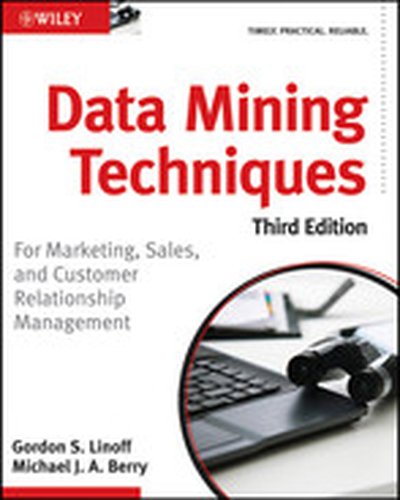
Data Mining Techniques: For Marketing, Sales, and Customer Relationship Management, Third Edition

The leading introductory book on data mining, fully updated and revised! When Berry and Linoff wrote the first edition of Data Mining Techniques in the late 1990s, data mining was just starting to move out of the lab and into the office and has since grown to become an indispensable tool of modern business. This new edition—more than 50% new and revised—is a significant update from the previous one, and shows you how to harness the newest data mining methods and techniques to solve common business problems. The duo of unparalleled authors share invaluable advice for improving response rates to direct marketing campaigns, identifying new customer segments, and estimating credit risk. In addition, they cover more advanced topics such as preparing data for analysis and creating the necessary infrastructure for data mining at your company. Features significant updates since the previous edition and updates you on best practices for using data mining methods and techniques for solving common business problems Covers a new data mining technique in every chapter along with clear, concise explanations on how to apply each technique immediately Touches on core data mining techniques, including decision trees, neural networks, collaborative filtering, association rules, link analysis, survival analysis, and more Provides best practices for performing data mining using simple tools such as Excel Data Mining Techniques, Third Edition covers a new data mining technique with each successive chapter and then demonstrates how you can apply that technique for improved marketing, sales, and customer support to get immediate results.
25 Recipes for Getting Started with R

R is a powerful tool for statistics and graphics, but getting started with this language can be frustrating. This short, concise book provides beginners with a selection of how-to recipes to solve simple problems with R. Each solution gives you just what you need to know to use R for basic statistics, graphics, and regression. You'll find recipes on reading data files, creating data frames, computing basic statistics, testing means and correlations, creating a scatter plot, performing simple linear regression, and many more. These solutions were selected from O'Reilly's , which contains more than 200 recipes for R that you'll find useful once you move beyond the basics. R Cookbook

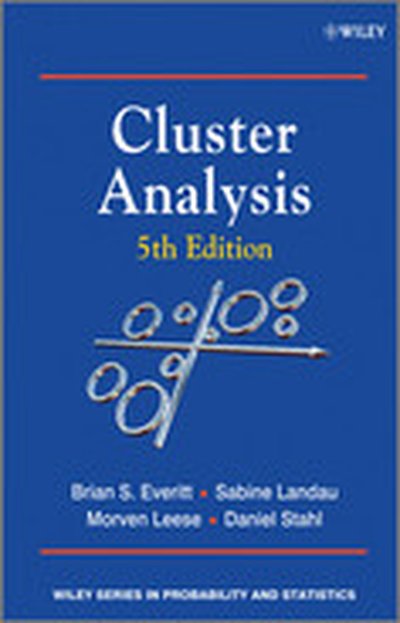
Cluster Analysis, 5th Edition

Cluster analysis comprises a range of methods for classifying multivariate data into subgroups. By organizing multivariate data into such subgroups, clustering can help reveal the characteristics of any structure or patterns present. These techniques have proven useful in a wide range of areas such as medicine, psychology, market research and bioinformatics. This fifth edition of the highly successful Cluster Analysis includes coverage of the latest developments in the field and a new chapter dealing with finite mixture models for structured data. Real life examples are used throughout to demonstrate the application of the theory, and figures are used extensively to illustrate graphical techniques. The book is comprehensive yet relatively non-mathematical, focusing on the practical aspects of cluster analysis. Key Features: Presents a comprehensive guide to clustering techniques, with focus on the practical aspects of cluster analysis. Provides a thorough revision of the fourth edition, including new developments in clustering longitudinal data and examples from bioinformatics and gene studies Updates the chapter on mixture models to include recent developments and presents a new chapter on mixture modeling for structured data. Practitioners and researchers working in cluster analysis and data analysis will benefit from this book.

BIRT: A Field Guide, Third Edition

More than seven million people have downloaded BIRT (Business Intelligence and Reporting Tools) from the Eclipse web site, and more than one million developers are estimated to be using BIRT. Built on the open source Eclipse platform, BIRT is a powerful report development system that provides an end-to-end solution–from creating and deploying reports to integrating report capabilities in enterprise applications. The first in a two-book series about this exciting technology, is the authoritative guide to using BIRT Report Designer, the graphical tool that enables users of all levels to build reports, from simple to complex, without programming. BIRT: A Field Guide to Reporting, Third Edition, This book is an essential resource for users who want to create presentation-quality reports quickly. The extensive examples, step-by-step instructions, and abundant illustrations help new users develop report design skills. Power users can find the information they need to make the most of the product’s rich set of features to build sophisticated and compelling reports. Readers of this book learn how to Design effective corporate reports that convey complex business information using images, charts, tables, and cross tabs Build reports using data from multiple sources, including databases, spreadsheets, web services, and XML documents Enliven reports with interactive features, such as hyperlinks, tooltips, and highlighting Create reports using a consistent style, and, drawing on templates and libraries of reusable elements, collaborate with other report designers Localize reports for an international audience The third edition, newly revised for BIRT 2.6, adds updated examples, contains close to 1,000 new and replacement screenshots, and covers all the new and improved product features, including Result-set sharing to create dashboard-style reports Data collation conforming to local conventions Using cube data in charts, new chart types, and functionality Displaying bidirectional text, used in right-to-left languages Numerous enhancements to cross tabs, page management, and report layout

Mining the Social Web

Popular social networks such as Facebook and Twitter generate a tremendous amount of valuable data on topics and use patterns. Who's talking to whom? What are they talking about? How often are they talking? This concise and practical book shows you how to answer these questions and more by harvesting and analyzing data using social web APIs, Python, and pragmatic storage technologies such as Redis, CouchDB, and NetworkX. With Mining the Social Web, intermediate to advanced programmers will learn how to harvest and analyze social data in way that lends itself to hacking as well as more industrial-strength analysis. Algorithms are designed with robustness and efficiency in mind so that the approaches scale well on an ordinary piece of commodity hardware. The book is highly readable from cover to cover as content progressively grows in complexity, but also lends itself to being read in an ad-hoc fashion. Use easily adaptable scripts to access popular social network APIs including Twitter, OpenSocial, and Facebook Learn approaches for slicing and dicing social data that's been harvested from social web APIs as well as other common formats such as email and markup formats Harvest data from other sources such as Freebase and other sites to enrich your analytic capabilities with additional context Visualize and analyze data in interactive ways with tools built upon rich UI JavaScript toolkits Get a concise and straightforward synopsis of some practical technologies from the semantic web landscape that you can incorporate into your analysis This book is still in progress, but you can get going on this technology through our Rough Cuts edition, which lets you read the manuscript as it's being written, either online or via PDF.

21 Recipes for Mining Twitter

Millions of public Twitter streams harbor a wealth of data, and once you mine them, you can gain some valuable insights. This short and concise book offers a collection of recipes to help you extract nuggets of Twitter information using easy-to-learn Python tools. Each recipe offers a discussion of how and why the solution works, so you can quickly adapt it to fit your particular needs. The recipes include techniques to: Use OAuth to access Twitter data Create and analyze graphs of retweet relationships Use the streaming API to harvest tweets in realtime Harvest and analyze friends and followers Discover friendship cliques Summarize webpages from short URLs This book is a perfect companion to O’Reilly's Mining the Social Web.

Practical Applications of Data Mining

Practical Applications of Data Mining emphasizes both theory and applications of data mining algorithms. Various topics of data mining techniques are identified and described throughout, including clustering, association rules, rough set theory, probability theory, neural networks, classification, and fuzzy logic. Each of these techniques is explored with a theoretical introduction and its effectiveness is demonstrated with various chapter examples. This book will help any database and IT professional understand how to apply data mining techniques to real-world problems.

Following an introduction to data mining principles, Practical Applications of Data Mining introduces association rules to describe the generation of rules as the first step in data mining. It covers classification and clustering methods to show how data can be classified to retrieve information from data. Statistical functions and drough set theory are discussed to demonstrate how statistical and rough set formulas can be used for data analytics and knowlege discovery. Neural networks is an important branch in computational intelligence. It is introduced and explored in the text to investigate the role of neural network algorithms in data analytics.

Entity Resolution and Information Quality

Entity Resolution and Information Quality presents topics and definitions, and clarifies confusing terminologies regarding entity resolution and information quality. It takes a very wide view of IQ, including its six-domain framework and the skills formed by the International Association for Information and Data Quality {IAIDQ). The book includes chapters that cover the principles of entity resolution and the principles of Information Quality, in addition to their concepts and terminology. It also discusses the Fellegi-Sunter theory of record linkage, the Stanford Entity Resolution Framework, and the Algebraic Model for Entity Resolution, which are the major theoretical models that support Entity Resolution. In relation to this, the book briefly discusses entity-based data integration (EBDI) and its model, which serve as an extension of the Algebraic Model for Entity Resolution. There is also an explanation of how the three commercial ER systems operate and a description of the non-commercial open-source system known as OYSTER. The book concludes by discussing trends in entity resolution research and practice. Students taking IT courses and IT professionals will find this book invaluable. First authoritative reference explaining entity resolution and how to use it effectively Provides practical system design advice to help you get a competitive advantage Includes a companion site with synthetic customer data for applicatory exercises, and access to a Java-based Entity Resolution program.

MATLAB®: An Introduction with Applications, Fourth Edition

MATLAB: An Introduction with Applications 4th Edition walks readers through the ins and outs of this powerful software for technical computing. The first chapter describes basic features of the program and shows how to use it in simple arithmetic operations with scalars. The next two chapters focus on the topic of arrays (the basis of MATLAB), while the remaining text covers a wide range of other applications. MATLAB: An Introduction with Applications 4th Edition is presented gradually and in great detail, generously illustrated through computer screen shots and step-by-step tutorials, and applied in problems in mathematics, science, and engineering.

Computational Intelligence and Pattern Analysis in Biological Informatics

An invaluable tool in Bioinformatics, this unique volume provides both theoretical and experimental results, and describes basic principles of computational intelligence and pattern analysis while deepening the reader's understanding of the ways in which these principles can be used for analyzing biological data in an efficient manner. This book synthesizes current research in the integration of computational intelligence and pattern analysis techniques, either individually or in a hybridized manner. The purpose is to analyze biological data and enable extraction of more meaningful information and insight from it. Biological data for analysis include sequence data, secondary and tertiary structure data, and microarray data. These data types are complex and advanced methods are required, including the use of domain-specific knowledge for reducing search space, dealing with uncertainty, partial truth and imprecision, efficient linear and/or sub-linear scalability, incremental approaches to knowledge discovery, and increased level and intelligence of interactivity with human experts and decision makers Chapters authored by leading researchers in CI in biology informatics. Covers highly relevant topics: rational drug design; analysis of microRNAs and their involvement in human diseases. Supplementary material included: program code and relevant data sets correspond to chapters. Note: The ebook version does not provide access to the companion files.

Doing Bayesian Data Analysis

There is an explosion of interest in Bayesian statistics, primarily because recently created computational methods have finally made Bayesian analysis tractable and accessible to a wide audience. Doing Bayesian Data Analysis, A Tutorial Introduction with R and BUGS, is for first year graduate students or advanced undergraduates and provides an accessible approach, as all mathematics is explained intuitively and with concrete examples. It assumes only algebra and ‘rusty’ calculus. Unlike other textbooks, this book begins with the basics, including essential concepts of probability and random sampling. The book gradually climbs all the way to advanced hierarchical modeling methods for realistic data. The text provides complete examples with the R programming language and BUGS software (both freeware), and begins with basic programming examples, working up gradually to complete programs for complex analyses and presentation graphics. These templates can be easily adapted for a large variety of students and their own research needs.The textbook bridges the students from their undergraduate training into modern Bayesian methods. -Accessible, including the basics of essential concepts of probability and random sampling -Examples with R programming language and BUGS software -Comprehensive coverage of all scenarios addressed by non-bayesian textbooks- t-tests, analysis of variance (ANOVA) and comparisons in ANOVA, multiple regression, and chi-square (contingency table analysis). -Coverage of experiment planning -R and BUGS computer programming code on website -Exercises have explicit purposes and guidelines for accomplishment

Data Analysis with Open Source Tools

Collecting data is relatively easy, but turning raw information into something useful requires that you know how to extract precisely what you need. With this insightful book, intermediate to experienced programmers interested in data analysis will learn techniques for working with data in a business environment. You'll learn how to look at data to discover what it contains, how to capture those ideas in conceptual models, and then feed your understanding back into the organization through business plans, metrics dashboards, and other applications. Along the way, you'll experiment with concepts through hands-on workshops at the end of each chapter. Above all, you'll learn how to think about the results you want to achieve -- rather than rely on tools to think for you. Use graphics to describe data with one, two, or dozens of variables Develop conceptual models using back-of-the-envelope calculations, as well asscaling and probability arguments Mine data with computationally intensive methods such as simulation and clustering Make your conclusions understandable through reports, dashboards, and other metrics programs Understand financial calculations, including the time-value of money Use dimensionality reduction techniques or predictive analytics to conquer challenging data analysis situations Become familiar with different open source programming environments for data analysis "Finally, a concise reference for understanding how to conquer piles of data."--Austin King, Senior Web Developer, Mozilla "An indispensable text for aspiring data scientists."--Michael E. Driscoll, CEO/Founder, Dataspora

Telemedicine Technologies: Information Technologies in Medicine and Telehealth

This book brings together a broad range of topics demonstrating how information and wireless technologies can be used in healthcare In this book, the authors focus on how medical information can be reliably transmitted through wireless communication networks. It explains how they can be optimized to carry medical information in various situations by utilizing readily available traditional wireless local area network (WLAN) and broadband wireless access (BWA) systems. In addition, the authors discuss consumer healthcare technology, which is becoming more popular as reduction in manufacturing cost of electronics products makes healthcare products more affordable to the general public. Finally, the book explores topics such as communication networks and services, patient monitoring, information processing, system deployment, data security and privacy, information technology in alternative medicine, multimedia and health informatics, and caring for the community. Key Features: Focuses on the transmission of medical information over wireless communication networks, and addresses topics such as communication networks and services, patient monitoring, information processing, system deployment, data security and privacy, and many others Provides an in-depth introduction to the various factors that need to be considered for supporting healthcare services with information technology Covers advancements in topics such as RFID in healthcare Discusses medical signal processing as well as ECG and signal processing techniques This book will be of interest to advanced students and professors in biomedical engineering, bioinformatics, and information engineering. Medical and IT professionals involved in specifying new facilities, healthcare practitioners in telemedicine, researchers in wireless communications and information technology, and network administrators will also find this book insightful.

Signals and Systems using MATLAB

This new textbook in signals and systems provides a pedagogically rich approach to what can commonly be a mathematically dry subject. With features like historical notes, highlighted common mistakes, and applications in controls, communications, and signal processing, Chaparro helps students appreciate the usefulness of the techniques described in the book. Each chapter contains a section with MatLab applications. Pedagogically rich introduction to signals and systems using historical notes, pointing out "common mistakes", and relating concepts to realistic examples throughout to motivate learning the material Introduces both continuous and discrete systems early, then studies each (separately) in more depth later Extensive set of worked examples and homework assignments, with applications to controls, communications, and signal processing throughout Provides review of all the background math necessary to study the subject MatLab applications in every chapter

Performance Dashboards: Measuring, Monitoring, and Managing Your Business, 2nd Edition

Tips, techniques, and trends on harnessing dashboard technology to optimize business performance In Performance Dashboards, Second Edition, author Wayne Eckerson explains what dashboards are, where they can be used, and why they are important to measuring and managing performance. As Director of Research for The Data Warehousing Institute, a worldwide association of business intelligence professionals, Eckerson interviewed dozens of organizations that have built various types of performance dashboards in different industries and lines of business. Their practical insights explore how you can effectively turbo-charge performance–management initiatives with dashboard technology. Includes all-new case studies, industry research, news chapters on "Architecting Performance Dashboards" and "Launching and Managing the Project" and updated information on designing KPIs, designing dashboard displays, integrating dashboards, and types of dashboards. Provides a solid foundation for understanding performance dashboards, business intelligence, and performance management Addresses the next generation of performance dashboards, such as Mashboards and Visual Discovery tools, and including new techniques for designing dashboards and developing key performance indicators Offers guidance on how to incorporate predictive analytics, what-if modeling, collaboration, and advanced visualization techniques This updated book, which is 75% rewritten, provides a foundation for understanding performance dashboards, business intelligence, and performance management to optimize performance and accelerate results.

Data Mining For Business Intelligence: Concepts, Techniques, and Applications in Microsoft Office Excel® with XLMiner®, Second Edition

Data Mining for Business Intelligence, Second Edition uses real data and actual cases to illustrate the applicability of data mining (DM) intelligence in the development of successful business models. Featuring complimentary access to XLMiner®, the Microsoft Office Excel® add-in, this book allows readers to follow along and implement algorithms at their own speed, with a minimal learning curve. In addition, students and practitioners of DM techniques are presented with hands-on, business-oriented applications. An abundant amount of exercises and examples, now doubled in number in the second edition, are provided to motivate learning and understanding. This book helps readers understand the beneficial relationship that can be established between DM and smart business practices, and is an excellent learning tool for creating valuable strategies and making wiser business decisions. New topics include detailed coverage of visualization (enhanced by Spotfire subroutines) and time series forecasting, among a host of other subject matter.

IBM Cognos Business Intelligence V10.1 Handbook

IBM® Cognos® Business Intelligence (BI) helps organizations meet This IBM Redbooks® publication addresses IBM Cognos Business Intelligence V10.1. You can use this book to: This book uses a fictional business scenario to demonstrate the power of IBM Cognos BI. The book is primarily focused on the roles of Advanced Business User, Professional Report Author, Modeler, Administrator, and IT Architect.

Statistical Programming with SAS/IML Software

SAS/IML software is a powerful tool for data analysts because it enables implementation of statistical algorithms that are not available in any SAS procedure. Rick Wicklin's Statistical Programming with SAS/IML Software is the first book to provide a comprehensive description of the software and how to use it. He presents tips and techniques that enable you to use the IML procedure and the SAS/IML Studio application efficiently. In addition to providing a comprehensive introduction to the software, the book also shows how to create and modify statistical graphs, call SAS procedures and R functions from a SAS/IML program, and implement such modern statistical techniques as simulations and bootstrap methods in the SAS/IML language. Written for data analysts working in all industries, graduate students, and consultants, Statistical Programming with SAS/IML Software includes numerous code snippets and more than 100 graphs.

This book is part of the SAS Press program.

Knight's Microsoft® Business Intelligence 24-Hour Trainer: Leveraging Microsoft SQL Server® Integration, Analysis, and Reporting Services with Excel® and SharePoint®

A book-and-video introduction to Microsoft's Business Intelligence tools If you are just starting to get a handle on Microsoft Business Intelligence (BI) tools, this book and accompanying video provides you with the just the right amount of information to perform basic business analysis and reporting. You'll explore the components and related tools that comprise the Microsoft BI toolset as well as the new BI features of Office 2010. After a basic primer on BI and data modeling, the expert team of authors provides you with step-by-step lessons in the book and videos on the accompanying Video on how to use SQL Server Integration Services, SQL Server Analysis Services, SQL Server Reporting Services, Excel BI (including PowerPivot), and SharePoint. Integrates instructional videos with each of the lessons found in the book to enhance your learning experience Explores the Microsoft Business Intelligence (BI) toolset as well as the new BI features of Office 2010 Encourages you to practice what you've learned in "Try It Out" sections Contains video demonstrations that walk you through how to tackle each lesson featured in the book With Knight's Microsoft Business Intelligence 24-Hour Trainer, veteran authors present you with an ideal introductory book-and-video package so that you can get started working with the BI toolset immediately!