talk-data.com talk-data.com

Topic

data

5765

tagged

Activity Trend

3 peak/qtr
2020-Q1 2026-Q1

Activities

5765 activities · Newest first

XML by Example

XML by Example teaches Web developers to make the most of XML with short, self-contained examples every step of the way. The book presumes knowledge of HTML, the Web, Web scripting, and covers such topics as: Document Type Definitions, Namespaces, Parser Debugging, XSL (Extensible Stylesheet Language), and DOM and SAX APIs. At the end, developers will review the concepts taught in the book by building a full, real-world e-commerce application.

Cody’s Data Cleaning Techniques Using SAS® Software

The key to ensuring accurate data is having clean data. This book develops and describes data cleaning programs and macros. You can use many of the programs and macros that are provided, as is, or you can modify them for your own special data cleaning tasks. Ron has carefully explained and documented each of the programs and macros, thus providing you with SAS programming instruction on an intermediate-to-advanced level. Topics presented include validation checks on character data, numeric data, missing values, and date values; searching for duplicate records; working with multiple files; double entry and verification using the COMPARE procedure; and SQL solutions and using validation data sets. Written in Ron's signature informal, tutorial style, this book gives anyone who manages data thoroughly documented, step-by-step instructions for the development of data cleaning programs and macros. Supports releases 6.12 and higher of SAS software.

Oracle Internals: An Introduction

This concise book contains detailed information about Oracle internals -- information that's not readily available to Oracle customers. It lays a foundation for advanced performance tuning of the Oracle database. Based on Oracle8i release 8.1, the book describes many of the secrets of Oracle's internal services: data structures, algorithms, and undocumented Oracle system statistics. Main topics include: Waits - how Oracle processes communicate via semaphores, and how to use the Oracle wait statistics to identify the source of performance problems. Latches - how they keep multiple processes from inspecting protected data structures at the same time, and how to examine and control latch behavior and statistics. Locks - how they work with latches to protect data structures (locks allow multiple sessions to share resources in some cases), and how locks affect performance. There is also a detailed discussion of instance locks, which are used in parallel server environments. Memory - how Oracle uses memory (e.g., the various elements of the System Global Area), and how Oracle dynamically allocates and manages memory. Oracle8i Internal Services is aimed especially at administrators and developers who need detailed internal information to do advanced performance tuning. The book will expand your repertoire of tuning solutions and troubleshooting techniques by explaining how you can use Oracle's hidden parameters and undocumented system statistics to best advantage. NOTE: The author has collected the scripts he has developed for tuning and analysis into a toolkit (known as APT, for Advanced Performance Tuning). These scripts access the Oracle X$ tables directly and provide information not otherwise available. The scripts are available to readers for free from the O'Reilly web site.

XML Pocket Reference

XML, the Extensible Markup Language, is the next-generation markup language for the Web. It provides a more structured (and therefore more powerful) medium than HTML, allowing us to define new document types and stylesheets as needed. Although the generic tags of HTML are sufficient for everyday text, XML gives us a way to add rich, well-defined markup to electronic documents. The XML Pocket Reference is both a handy introduction to XML terminology and syntax, and a quick reference to XML instructions, attributes, entities, and datatypes. It also covers XSL (Extensible Stylesheet Language), necessary to ensure that your XML documents have a consistent look and feel across platforms. Although XML itself is complex, its basic concepts are simple. This small book acts both as a perfect tutorial for learning the basics of XML, and as a reference to the XML and XSL specifications.

Sams Teach Yourself SQL in 10 Minutes

Sams Teach Yourself SQL in 10 Minutes is a tutorial-based book, organized into a series of easy-to-follow, 10-minute lessons. These well-targeted lessons teach you in 10 minutes what some books take several hours or days to teach. It is for those users who don't have the time to read lengthy chapters, or are not inclined to read "manuals." You will learn retrieving and sorting data, advanced data filtering, using wildcard filtering, manipulating data, combining queries, using views, creating and using stored procedures, and creating triggers.

Oracle Web Applications: PL/SQL Developer's Intro

This compact guide provides the jump-start Oracle developers need to make the transition from traditional programming to the development of useful Web applications for Oracle8i. Even readers who start out knowing nothing about HTML, PL/SQL, or Oracle's other tools will learn how to create simple Web applications in a matter of days. The book focuses on Oracle8i, but also covers Web development for earlier Oracle versions (Oracle8 and Oracle7). Background: The explosion in the use of the Internet and the Web has resulted in a whole new way of doing business. Developers who only yesterday were using COBOL to write accounts payable systems are now being asked to create a broad range of new Internet-based applications ranging from electronic commerce (e-commerce) Web sites to internal data warehouses to enterprise resource planning (ERP) systems. Unfortunately, the filesystem architectures of most Web systems aren't up to the task. The new breed of Web applications -- which are quickly becoming critical resources that companies need to survive -- demand a platform that provides production-quality tools for content management, application development, and application integration. And current Web techniques are inadequate in many ways. Oracle8i, Oracle's "Internet database," gives Web developers a way to build Web technology on top of a relational database, rather than on a traditional filesystem. With Oracle8i, companies can apply well understood, reliable, production-quality database methodologies to Web content management. Oracle8i also supports a wide variety of application development platforms and tools that are tightly integrated to the core database. Finally, Oracle8i supports technologies that help companies tie their Web-based applications into legacy applications. There is a lot to learn in Oracle8i. Not only does it enhance basic database features, it introduces Java and a variety of Web development tools. Oracle8i provides a soup-to-nuts platform for Web site and Web application development that extends traditional database concepts to Web content. It replaces the traditional filesystem used by most Web servers with a database management system. Many users are intimidated by the vast array of new technologies in Oracle8i. And yet, they are under pressure to use these technologies to build complex Web applications right now. This book gives such users a way to start using Oracle8i immediately to create useful Web applications. It is a concise, easy-to-read guide to the basic technologies developers need to understand in order to build Web applications. Contains: The book describes the following Web development tools: PL/SQL-- a structured programming language that combines procedural constructs and standard SQL. It offers such features as cursors, loops, conditional and sequential control statements, exception handlers, records, tables, and constructs for developing modular code (functions, procedures, and packages). PL/SQL Toolkit -- a set of PL/SQL packages supplied by Oracle for use in developing Web applications. HTML -- an ASCII-based markup language used to create Web pages. WebDB -- A software system for building, monitoring, and creating content-driven Web sites; it allows users to use a Web browser to access and store information in the Oracle8i database. Oracle Application Server (OAS) -- an extensible Web server that uses plug-in programs called cartridges to allow database-integrated Web systems to be developed in a variety of languages (e.g., PL/SQL, Java, Perl). XML -- An emerging standard for creating self-describing documents. It is similar to HTML but allows you to create your own markup tags. XML is expected to be a key technology in electronic commerce systems. The book also presents several fully realized sample Web applications that will teach you how to build such applications of your own. NOTE: Although this book touches on the Java features of Oracle8i, it doesn't cover Java development per se. Switching to Java represents an enormous change for most Oracle developers. This book provides an evolutionary path for readers who want to do useful Oracle8i Web development now, using mostly familiar tools. Additional books will provide Java training for those who have mastered these Web tools and want to take the next step.

Access Database Design and Programming, Second Edition

When using software products with graphical interfaces, we frequently focus so much on the details of how to use the interface that we forget about the more general concepts that allow us to understand and put the software to effective use. This is particularly true of a powerful database product like Microsoft Access. Novice, and sometimes even experienced, programmers are so concerned with how something is done in Access that they often lose sight of the general principles that underlie their database applications. Access Database Design & Programming, 2nd Edition, an update to the bestselling first edition, features: A discussion of Access' new VBA Integrated Development Environment, which, for the first time, is the one used by Word, Excel, and PowerPoint An expansion of the discussion of the VBA language itself, in response to reader requests A discussion of Microsoft's latest data access technology, called Active Data Objects (or ADO), along with a discussion of Open Database Connectivity(ODBC), which is intimately connected with ADO Unlike other Access books that take the long, detailed approach to every topic of concern to Access programmers, this book focuses instead on the core concepts, enabling programmers to develop solid, effective database applications. As a result, important topics such as designing forms and reports, database security, database replication, and programming for multiuser applications are simply not discussed. This book is a kind of "second course" in Access that provides a relatively experienced Access user who is new to programming with the frequently overlooked techniques necessary to successfully develop in the Microsoft Access environment. Anyone interested in learning Access in-depth, rather than just scraping the surface, will enjoy and immensely benefit from reading this book. Although this book is really an introduction directed to intermediate Microsoft Access users who are novice programmers, it should appeal to all levels of Access developers. For novice programmers, it focuses on a key body of knowledge that is typically neglected, but is nevertheless essential for developing effective database applications. For intermediate and advanced developers, its treatment of database design and queries provides a handy treatment that otherwise has to be gleaned from relatively uninteresting textbooks, while its programming chapters constitute a handy reference to some basic operations that can be performed using DAO or the Access object model.

MySQL and mSQL

MySQL and mSQL are popular and robust database products that support key subsets of SQL on both Linux and Unix systems. Both products are free for nonprofit use and cost a small amount for commercial use. Even a small organization or web site has uses for a database. Perhaps you keep track of all your customers and find that your information is outgrowing the crude, flat-file format you started with. Or you want to ask your web site's visitors for their interests and preferences and put up a fresh web page that tallies the results. Unlike commercial databases, MySQL and mSQL are affordable and easy to use. If you know basic C, Java, Perl, or Python, you can quickly write a program to interact with your database. In addition, you can embed queries and updates right in an HTML file so that a web page becomes its own interface to the database. This book is all you need to make use of MySQL or mSQL. It takes you through the whole process from installation and configuration to programming interfaces and basic administration. Includes reference chapters and ample tutorial material. Topics include: Introductions to simple database design and SQL Building, installation, and configuration Basic programming APIs for C, C++, Java (JDBC), Perl, and Python CGI programming with databases in C and Perl Web interfaces: PHP, W3-mSQL, Lite, and mSQLPerl

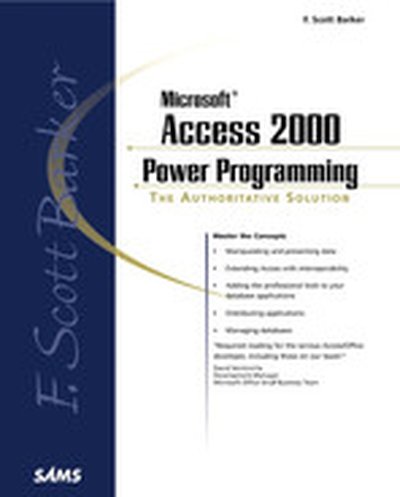
F. Scott Barker's Microsoft® Access 2000 Power Programming

Access 2000 Power Programming gives many practical techniques for the corporate and independent developer. New features of Access 2000 are covered thoroughly and useful examples which will be implemented by programmers in their everyday applications. New topics include a chapter devoted to Data Pages, Microsoft's way of bringing the Web interface into everyday office solutions. Also, a new chapter clarifies the confusion over ADP/MDB and DAO/ADO, including when and where to use each. The book covers a number of new additions to VBA which developers will need good exposure to in order to take advantage of them.

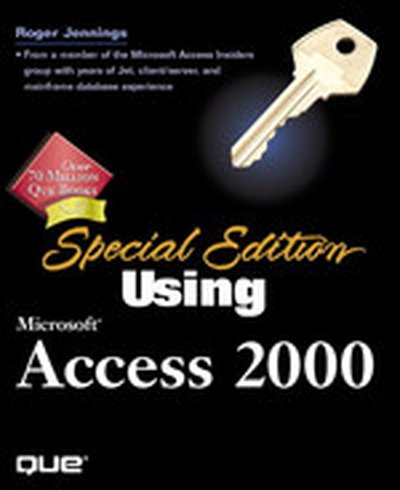
Special Edition Using Microsoft® Access 2000

Special Edition Using Access 2000 is your authoritative guide to mastering the essentials of this powerful 32-bit database development platform. Get started quickly by using the Database Wizard to create a working Access 2000 application in less than 30 minutes. Detailed, step-by-step instructions guide you through the process of designing and using Access tables, queries, forms, and reports. Chapters on VBA techniques pave your way to Access programming. Make the Access-Internet connection by exporting table, queries, and reports to static Web pages, then move into work with Data Access Pages and Active Server pages.

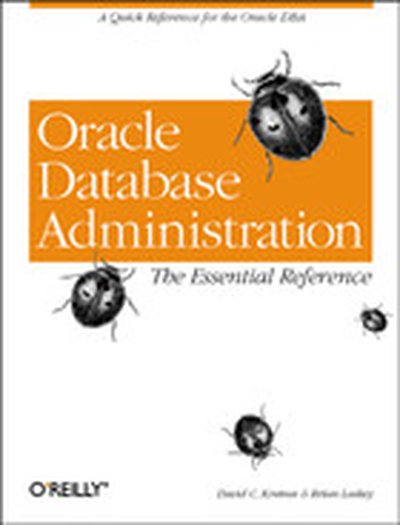
Oracle Database Administration: The Essential Refe

Visit the catalog page for Oracle Database Administration: The Essential RefeVisit the errata page for Oracle Database Administration: The Essential RefeDownload the supplemental electronic content for Oracle Database Administration: The Essential Refe Oracle database administration requires a vast amount of information and an ability to perform a myriad of tasks--from installation to tuning to network troubleshooting to overall daily administration. Oracle provides many tools for performing these tasks; the trick is knowing what tool is right for the job, what commands you need to issue (and when), and what parameters and privileges you need to set. And, as every DBA knows, you need to know how do all this under pressure, while you face crisis after crisis. This book provides a concise reference to the enormous store of information an Oracle DBA needs every day (as well as what's needed only when disaster strikes). It's crammed full of quick-reference tables, task lists, and other summary material that both novice and expert DBAs will use time and time again. It covers the commands and operations new to Oracle8, but also provides Oracle7 information for sites still running earlier versions. Oracle Database Administration provides two types of material: DBA tasks--chapters summarizing how to perform critical DBA functions: installation, performance tuning, preventing data loss, networking, security and monitoring, auditing, query optimization, and the use of various Oracle tools and utilities DBA reference--chapters providing a quick reference to the Oracle instance and database, the initialization (INIT.ORA) parameters, the SQL statements commonly used by DBAs, the data dictionary tables, the system privileges and roles, and the SQLPlus, Export, Import, and SQLLoader syntax The book also includes a resource summary with references to additional books, Web sites, and other online and offline resources of special use to Oracle DBAs. Oracle Database Administration is the single essential reference you'll turn to again and again. If you must choose only one book to use at the office, keep at home, or carry to a site you're troubleshooting, this will be that book.

Oracle Distributed Systems

Any organization that uses the Oracle relational database management system (RDBMS) these days needs to use multiple databases. There are many reasons to use more than a single database in a distributed database system: Different databases may be associated with particular business functions, such as manufacturing or human resources. Databases may be aligned with geographical boundaries, such as a behemoth database at a headquarters site and smaller databases at regional offices. Two different databases may be required to access the same data in different ways, such as an order entry database whose transactions are aggregated and analyzed in a data warehouse. A busy Internet commerce site may create multiple copies of the same database to attain horizontal scalability. A copy of a production database may be created to serve as a development test bed. Tunability Platform autonomy Fault tolerance Scalability Location transparency Site autonomy Introduction to Distributed Database Systems SQLNet and Net8 Configuration and Administration Distributed Database Security Designing the Distributed System Oracle's Distributed System Implementation Sample Configurations 8. Engineering Considerations Oracle Replication Architecture Advanced Replication Option Installation Basic Replication Multi-Master Replication Updateable Snapshots Procedural Replication Conflict Avoidance and Resolution Techniques In a distributed database environment, data in two or more databases is accessible as if it were in a single database. Usually, the different databases are on different servers, which may be located at the same site or a continent away. Communication between the servers takes place via SQLNet (for Oracle7) or Net8 (for Oracle8). Distributed database environments offer a number of benefits over single- database systems, including: This book describes how you can use multiple databases and the distributed features of Oracle to best advantage. It covers: Table of contents: Part I: The Distributed System Part II: Replication Part III: Appendixes Appendix A: Built-in Packages for Distributed Systems Appendix B: Scripts

Oracle PL/SQL Language Pocket Reference

This pocket reference provides quick-reference information that will help you use Oracle's PL/SQL language. It is a companion to Steven Feuerstein and Bill Pribyl's bestselling book, Oracle PL/SQL Programming, and includes coverage of the latest version of Oracle, Oracle8i. Oracle is the most popular database management system in use today, and PL/SQL plays a pivotal role in current and projected Oracle products and applications. PL/SQL provides procedural extensions to the SQL relational database language and to an ever-growing number of Oracle development tools. It offers a myriad of data types, and such features as cursors, loops, conditional and sequential control statements, exception handlers, records, tables, and constructs for developing modular code (functions, procedures, and packages). Originally a rather limited tool, PL/SQL became with Oracle7 a mature and effective language for developers. Now, with the introduction of Oracle8, PL/SQL has taken the next step towards becoming a fully realized programming language providing sophisticated object-oriented capabilities. The book on which this pocket reference is based, Oracle PL/SQL Programming, filled a huge gap in the Oracle market, providing developers with a single, comprehensive guide to building applications with PL/SQL -- and building them the right way. That book has become the bible for PL/SQL developers who have raved about its completeness, readability, and practicality. The book is packed with strategies, code architectures, tips, techniques, and fully realized code. The second edition of the book updated the text with the new Oracle8 PL/SQL features, including object types, collections, external procedures, and large object data types and functions. The pocket reference boils down the most vital information from the large (nearly 1000 pages) book into an accessible quick reference that summarizes the basics of PL/SQL -- its block structure, fundamental language elements (e.g., identifiers, declarations, defaults), data structures (including Oracle8 objects), and statements for program control, loops, exception handling, and database access. It also covers the the basics of using Oracle's procedures, functions, and packages, and the latest features for Oracle8i.

Logistic Regression Using SAS®: Theory and Application

If you are a researcher or student with experience in multiple linear regression and want to learn about logistic regression, this book is for you! Informal and nontechnical, this book both explains the theory behind logistic regression and looks at all the practical details involved in its implementation using the SAS System. Several social science real-world examples are included in full detail. This book also explains the differences and similarities among the many generalizations of the logistic regression model. The following topics are covered: binary logit analysis, logit analysis of contingency tables, multinomial logit analysis, ordered logit analysis, discrete-choice analysis with the PHREG procedure, and Poisson regression. Other highlights include discussions on how to use the GENMOD procedure to do loglinear analysis and GEE estimation for longitudinal binary data. Only basic knowledge of the SAS DATA step is assumed. Supports releases 6.12 and higher of SAS software.

Oracle SQL*Plus: The Definitive Guide

This book is the definitive guide to SQLPlus. If you want to take best advantage of the power and flexibility of this popular Oracle tool, you need this book. SQLPlus is an interactive query tool that is ubiquitous in the Oracle world. It is present in every Oracle installation and is available to almost every Oracle developer and database administrator. SQLPlus has been shipped with Oracle since at least version 6. It continues to be supported and enhanced with each new version of Oracle, including Oracle8 and Oracle8i. It is still the only widely available tool for writing SQL scripts. Despite this wide availability and usage, few developers and DBAs know how powerful SQLPlus really is. This book introduces SQLPlus, includes a quick reference to all of its syntax options, and, most important, provides chapters that describe, in step-by-step fashion, how to perform all of the tasks that Oracle developers and DBAs want to perform with SQLPlus -- and maybe some they didn't realize they COULD perform with SQLPlus. You will learn how to write and execute script files, generate ad hoc reports, extract data from the database, query the data dictionary tables, customize your SQLPlus environment, and use the SQLPlus administrative features (new in Oracle8i). This book is an indispensable resource for readers who are new to SQLPlus, a task-oriented learning tool for those who are already using it, and a quick reference for every user. A table of contents follows: Preface Introduction to SQLPlus Interacting with SQLPlus Generating Reports with SQLPlus Writing SQLPlus Scripts Extracting Data with SQLPlus Exploring Your Database with SQLPlus Advanced Scripting Tuning and Timing The Product User Profile Administration with SQLPlus Customizing Your SQLPlus Environment A. SQLPlus Command Reference B. Connect Strings and the SQLPlus Command Appendices

Sams Teach Yourself SAP R/3 in 10 Minutes

Sams Teach Yourself SAP R/3 in 10 Minutes covers general tasks including basic navigation skills, working with master data and running reports. With Timesaving Tips, Plain English definitions, Panic Button advice and easy-to-follow tutorials that can be completed in 10 minutes or less, you can get productive immediately. Covers the general SAP functions that every end-user of SAP-based applications must know. The book focuses on the user interface, access issues, and basic navigation skills using mini-tutorials. You'll learn all the essential tasks for running SAP-based applications smoothly and easily. 10 minutes is all you need to learn how to log on to SAP R/3, access the SAP R/3 modules, use basic navigation skills, work with master data, generate reports, read and interpret common error messages, and access extensive online help features.

APPLIED MULTIVARIATE STATISTICS: WITH SAS® SOFTWARE

Real-world problems and data sets are the backbone of Ravindra Khattree and Dayanand Naik's Applied Multivariate Statistics with SAS Software, Second Edition, which provides a unique approach to the topic, integrating statistical methods, data analysis, and applications. Now extensively revised, the book includes new information about mixed effects models, applications of the MIXED procedure, regression diagnostics with the corresponding IML procedure code, and covariance structures. The authors' approach to the information will aid professors, researchers, and students in a variety of disciplines and industries. Extensive SAS code and the corresponding high-resolution output accompany sample problems, and clear explanations of SAS procedures are included. Emphasis is on correct interpretation of the output to draw meaningful conclusions. Featuring both the theoretical and the practical, topics covered include multivariate analysis of experimental data and repeated measures data, graphical representation of data including biplots, and multivariate regression. In addition, a quick introduction to the IML procedure with special reference to multivariate data is available in an appendix. SAS programs and output integrated with the text make it easy to read and follow the examples.

Data Warehousing: Architecture and Implementation

8090B-0 A start-to-finish process for deploying successful data warehouses. This book delivers what every data warehousing project participant needs most: a thorough overview of today's best solutions, and a reliable step-by-step process for building warehouses that meet their objectives. It answers the key questions asked by everyone involved in a data warehouse initiative: project sponsors, developers, managers, and CIOs. And, with over 75 figures, it doesn't just tell you how to get the job done: it shows you. Migration strategies and scenarios Management and support: issue resolution, capacity planning, security, backup, and more Specific answers for project sponsors, managers, and CIOs 12 steps for implementation Best techniques for schema design and metadata Choosing the right hardware, software, and platforms Evolving as new technologies mature Rely on this book's up-to-date listings of vendors and Web resources. Learn to evolve your data warehouse as new technologies mature-including metadata interchange standards, Web solutions, and Windows …Ø NT. Whatever your goals, Data Warehousing for IT Professionals will help you achieve them faster and at lower cost.