talk-data.com talk-data.com

Topic

data

5765

tagged

Activity Trend

3 peak/qtr
2020-Q1 2026-Q1

Activities

5765 activities · Newest first

EU GDPR: A Pocket Guide, second edition

EU GDPR – A Pocket Guide, second edition provides an accessible overview of the changes you need to make in your organisation to comply with the new law. The EU General Data Protection Regulation unifies data protection across the EU. It applies to every organisation in the world that does business with EU residents. The Regulation introduces a number of key changes for organisations – and the change from DPA compliance to GDPR compliance is a complex one. New for the second edition: Updated to take into account the latest guidance from WP29 and ICO. Improved guidance around related laws such as the NIS Directive and the future ePrivacy Regulation. This pocket guide also sets out: A brief history of data protection and national data protection laws in the EU (such as the UK DPA, German BDSG and French LIL). The terms and definitions used in the GDPR, including explanations. The key requirements of the GDPR How to comply with the Regulation A full index of the Regulation, enabling you to find relevant Articles quickly and easily. This guide is the ideal resource for anyone wanting a clear, concise primer on the EU GDPR.

INFORMS Analytics Body of Knowledge

Standardizes the definition and framework of analytics ABOK stands for Analytics Body of Knowledge. Based on the authors’ definition of analytics—which is “a process by which a team of people helps an organization make better decisions (the objective) through the analysis of data (the activity)”— this book from Institute for Operations Research and the Management Sciences (INFORMS) represents the perspectives of some of the most respected experts on analytics. The INFORMS ABOK documents the core concepts and skills with which an analytics professional should be familiar; establishes a dynamic resource that will be used by practitioners to increase their understanding of analytics; and, presents instructors with a framework for developing academic courses and programs in analytics. The INFORMS ABOK offers in-depth insight from peer-reviewed chapters that provide readers with a better understanding of the dynamic field of analytics. Chapters cover: Introduction to Analytics; Getting Started with Analytics; The Analytics Team; The Data; Solution Methodology; Model Building; Machine Learning; Deployment and Life Cycle Management; and The Blossoming Analytics Talent Pool: An Overview of the Analytics Ecosystem. Across industries and academia, readers with various backgrounds in analytics – from novices who are interested in learning more about the basics of analytics to experienced professionals who want a different perspective on some aspect of analytics – will benefit from reading about and implementing the concepts and methods covered by the INFORMS ABOK.

Matplotlib 3.0 Cookbook

Matplotlib 3.0 Cookbook is your go-to guide for mastering the Matplotlib library in Python for creating a wide range of data visualizations. Through 150+ practical recipes, you will learn how to design intuitive and detailed charts, graphs, and dashboards, navigating from simple plots to advanced interactive and 3D visualizations. What this Book will help me do Develop professional-quality data visualizations using Matplotlib. Leverage Matplotlib's API for both quick plotting and advanced customization. Create interactive and animative plots for engaging data representation. Extend Matplotlib functionalities with toolkits like cartopy and axisartist. Integrate Matplotlib figures into GUI applications for broader usage. Author(s) None Poladi and None Borkar are experienced Python developers and enthusiasts who have collaborated in creating a resourceful guide to Matplotlib. They bring extensive experience in data science visualization and Python programming. Their collaborative effort ensures clarity and an approachable learning curve for anyone delving into graphical data representation using Matplotlib. Who is it for? This book is ideal for data scientists, Python developers, and visualization enthusiasts eager to enhance their technical plotting skills. The content covers both fundamentals and advanced topics, suitable for users ranging from beginners curious about Python visualization to experts seeking streamlined workflows and advanced techniques.

Pervasive Intelligence Now
  This book looks at strategies to help companies become more intelligent, connected, and agile. It discusses how companies can define and measure high-impact outcomes and use effectively analytics technology to achieve them. It also looks at the technology needed to implement the analytics necessary to achieve high-impact outcomes—from both analytics tool and technical infrastructure perspective. Also discussed are ancillary, but critical, topics such as data security and governance that may not traditionally be a part of analytics discussions but are essential in helping companies maintain a secure environment for their analytics and access the quality data they need to gain critical insights and drive better decision-making.
Jump into JMP Scripting, Second Edition, 2nd Edition

Learn the essentials of the JMP Scripting Language with this beginner’s guide. Written in an easy-to-understand style based on the authors’ extensive experience, Jump into JMP Scripting, Second Edition teaches beginner scripters how to take advantage of the robust JMP Scripting Language (JSL) using step-by-step instructions and real-world situations. The authors demonstrate how JSL offers the freedom to create scripts from the very simple and specific to the most generic and complex. With a new chapter on JSL language foundations, the first half of the book explains the fundamentals of JSL and walks you through creating your first scripts, such as opening a data table, adding columns, or selecting rows. A new chapter on the Dashboard and Application Builders provides helpful tips on creating custom dashboards and learning how to build applications. Also new to this edition, a chapter on advanced topics introduces more helpful tools and concepts in JSL. After learning the basics, you are ready to tackle specific tasks using JSL. The second half of the book provides more than 50 examples using a unique question-and-answer format. This book is part of the SAS Press program.

Data Analytics for IT Networks: Developing Innovative Use Cases, First Edition

Use data analytics to drive innovation and value throughout your network infrastructure Network and IT professionals capture immense amounts of data from their networks. Buried in this data are multiple opportunities to solve and avoid problems, strengthen security, and improve network performance. To achieve these goals, IT networking experts need a solid understanding of data science, and data scientists need a firm grasp of modern networking concepts. Data Analytics for IT Networks fills these knowledge gaps, allowing both groups to drive unprecedented value from telemetry, event analytics, network infrastructure metadata, and other network data sources. Drawing on his pioneering experience applying data science to large-scale Cisco networks, John Garrett introduces the specific data science methodologies and algorithms network and IT professionals need, and helps data scientists understand contemporary network technologies, applications, and data sources. After establishing this shared understanding, Garrett shows how to uncover innovative use cases that integrate data science algorithms with network data. He concludes with several hands-on, Python-based case studies reflecting Cisco Customer Experience (CX) engineers’ supporting its largest customers. These are designed to serve as templates for developing custom solutions ranging from advanced troubleshooting to service assurance. Understand the data analytics landscape and its opportunities in Networking See how elements of an analytics solution come together in the practical use cases Explore and access network data sources, and choose the right data for your problem Innovate more successfully by understanding mental models and cognitive biases Walk through common analytics use cases from many industries, and adapt them to your environment Uncover new data science use cases for optimizing large networks Master proven algorithms, models, and methodologies for solving network problems Adapt use cases built with traditional statistical methods Use data science to improve network infrastructure analysisAnalyze control and data planes with greater sophistication Fully leverage your existing Cisco tools to collect, analyze, and visualize data

Communication Systems Principles Using MATLAB

Discover the basic telecommunications systems principles in an accessible learn-by-doing format Communication Systems Principles Using MATLAB covers a variety of systems principles in telecommunications in an accessible format without the need to master a large body of theory. The text puts the focus on topics such as radio and wireless modulation, reception and transmission, wired networks and fiber optic communications. The book also explores packet networks and TCP/IP as well as digital source and channel coding, and the fundamentals of data encryption. Since MATLAB® is widely used by telecommunications engineers, it was chosen as the vehicle to demonstrate many of the basic ideas, with code examples presented in every chapter. The text addresses digital communications with coverage of packet-switched networks. Many fundamental concepts such as routing via shortest-path are introduced with simple and concrete examples. The treatment of advanced telecommunications topics extends to OFDM for wireless modulation, and public-key exchange algorithms for data encryption. Throughout the book, the author puts the emphasis on understanding rather than memorization. The text also: Includes many useful take-home skills that can be honed while studying each aspect of telecommunications Offers a coding and experimentation approach with many real-world examples provided Gives information on the underlying theory in order to better understand conceptual developments Suggests a valuable learn-by-doing approach to the topic Written for students of telecommunications engineering, Communication Systems Principles Using MATLAB® is the hands-on resource for mastering the basic concepts of telecommunications in a learn-by-doing format.

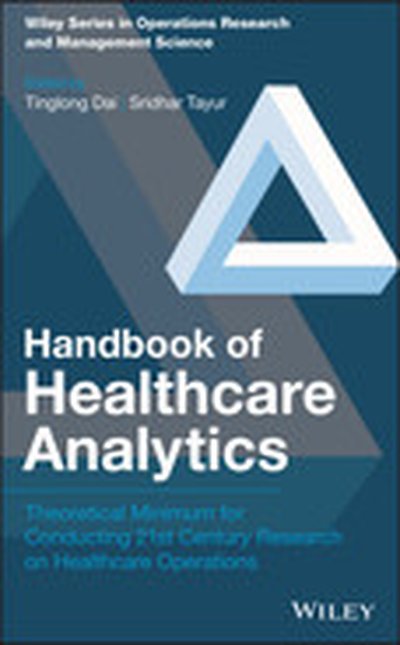
Handbook of Healthcare Analytics

How can analytics scholars and healthcare professionals access the most exciting and important healthcare topics and tools for the 21st century? Editors Tinglong Dai and Sridhar Tayur, aided by a team of internationally acclaimed experts, have curated this timely volume to help newcomers and seasoned researchers alike to rapidly comprehend a diverse set of thrusts and tools in this rapidly growing cross-disciplinary field. The Handbook covers a wide range of macro-, meso- and micro-level thrusts—such as market design, competing interests, global health, personalized medicine, residential care and concierge medicine, among others—and structures what has been a highly fragmented research area into a coherent scientific discipline. The handbook also provides an easy-to-comprehend introduction to five essential research tools—Markov decision process, game theory and information economics, queueing games, econometric methods, and data science—by illustrating their uses and applicability on examples from diverse healthcare settings, thus connecting tools with thrusts. The primary audience of the Handbook includes analytics scholars interested in healthcare and healthcare practitioners interested in analytics. This Handbook: Instills analytics scholars with a way of thinking that incorporates behavioral, incentive, and policy considerations in various healthcare settings. This change in perspective—a shift in gaze away from narrow, local and one-off operational improvement efforts that do not replicate, scale or remain sustainable—can lead to new knowledge and innovative solutions that healthcare has been seeking so desperately. Facilitates collaboration between healthcare experts and analytics scholar to frame and tackle their pressing concerns through appropriate modern mathematical tools designed for this very purpose. The handbook is designed to be accessible to the independent reader, and it may be used in a variety of settings, from a short lecture series on specific topics to a semester-long course.

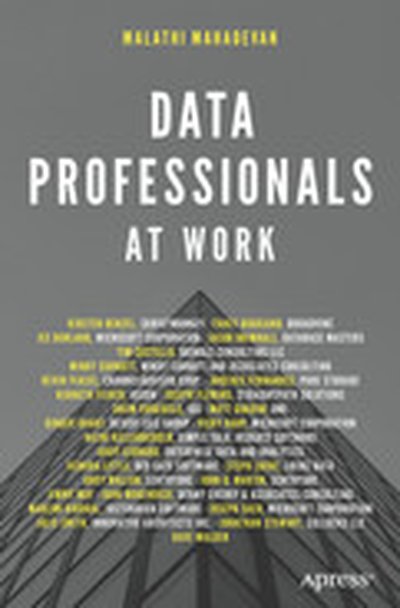
Data Professionals at Work

Enjoy reading interviews with more than two dozen data professionals to see a picture of what it’s like to work in the industry managing and analyzing data, helping you to know what it takes to move from your current expertise into one of the fastest growing areas of technology today. Data is the hottest word of the century, and data professionals are in high demand. You may already be a data professional such as a database administrator or business intelligence analyst. Or you may be one of the many people who want to work as a data professional, and are curious how to get there. Either way, this collection helps you understand how data professionals work, what makes them successful, and what they do to keep up. You’ll find interviews in this book with database administrators, database programmers, data architects, business intelligence professionals, and analytics professionals. Interviewees work across industry sectors ranging from healthcare and banking tofinance and transportation and beyond. Each chapter illuminates a successful professional at the top of their game, who shares what helped them get to the top, and what skills and attitudes combine to make them successful in their respective fields. Interviewees in the book include: Mindy Curnutt, Julie Smith, Kenneth Fisher, Andy Leonard, Jes Borland, Kevin Feasel, Ginger Grant, Vicky Harp, Kendra Little, Jason Brimhall, Tim Costello, Andy Mallon, Steph Locke, Jonathan Stewart, Joseph Sack, John Q. Martin, John Morehouse, Kathi Kellenberger, Argenis Fernandez, Kirsten Benzel, Tracy Boggiano, Dave Walden, Matt Gordon, Jimmy May, Drew Furgiuele, Marlon Ribunal, and Joseph Fleming. All of them have been successful in their careers, and share their perspectives on working and succeeding in the field as data and database professionals. What You'll Learn Stand out as an outstanding professional in your area of data work by developing the right set of skills and attitudes that lead to success Avoid common mistakes and pitfalls, and recover from operational failures and bad technology decisions Understand current trends and best practices, and stay out in front as the field evolves Break into working with data through database administration, business intelligence, or any of the other career paths represented in this book Manage stress and develop a healthy work-life balance no matter which career path you decide upon Choose a suitable path for yourself from among the different career paths in working with data Who This Book Is For Database administrators and developers, database and business intelligence architects, consultants, and analytic professionals, as well as those intent on moving into one of those career paths. Aspiring data professionals and those in related technical fields who want to make a move toward managing or analyzing data on a full-time basis will find the book useful. Existing data professionals who want to be outstanding and successful at what they do will also appreciate the book's advice and guidance.


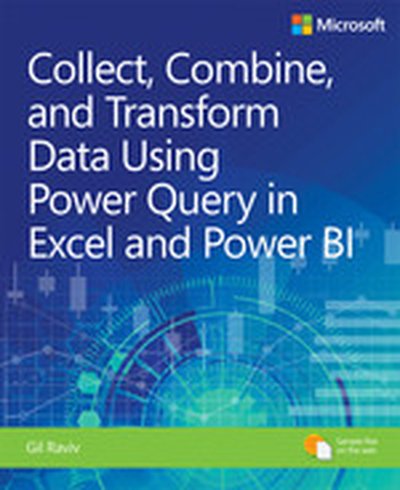
Collect, Combine, and Transform Data Using Power Query in Excel and Power BI, First Edition

Using Power Query, you can import, reshape, and cleanse any data from a simple interface, so you can mine that data for all of its hidden insights. Power Query is embedded in Excel, Power BI, and other Microsoft products, and leading Power Query expert Gil Raviv will help you make the most of it. Discover how to eliminate time-consuming manual data preparation, solve common problems, avoid pitfalls, and more. Then, walk through several complete analytics challenges, and integrate all your skills in a realistic chapter-length final project. By the time you're finished, you'll be ready to wrangle any data–and transform it into actionable knowledge. Prepare and analyze your data the easy way, with Power Query · Quickly prepare data for analysis with Power Query in Excel (also known as Get & Transform) and in Power BI · Solve common data preparation problems with a few mouse clicks and simple formula edits · Combine data from multiple sources, multiple queries, and mismatched tables · Master basic and advanced techniques for unpivoting tables · Customize transformations and build flexible data mashups with the M formula language · Address collaboration challenges with Power Query · Gain crucial insights into text feeds · Streamline complex social network analytics so you can do it yourself For all information workers, analysts, and any Excel user who wants to solve their own business intelligence problems.

Continuous Time Dynamical Systems

This book presents the developments in problems of state estimation and optimal control of continuous-time dynamical systems using orthogonal functions since 1975. It deals with both full and reduced-order state estimation and problems of linear time-invariant systems. It also addresses optimal control problems of varieties of continuous-time systems such as linear and nonlinear systems, time-invariant and time-varying systems, as well as delay-free and time-delay systems. Content focuses on development of recursive algorithms for studying state estimation and optimal control problems.

Database Benchmarking and Stress Testing: An Evidence-Based Approach to Decisions on Architecture and Technology

Provide evidence-based answers that can be measured and relied upon by your business. Database administrators will be able to make sound architectural decisions in a fast-changing landscape of virtualized servers and container-based solutions based on the empirical method presented in this book for answering “what if” questions about database performance. Today’s database administrators face numerous questions such as: What if we consolidate databases using multitenant features? What if we virtualize database servers as Docker containers? What if we deploy the latest in NVMe flash disks to speed up IO access? Do features such as compression, partitioning, and in-memory OLTP earn back their price? What if we move our databases to the cloud? As an administrator, do you know the answers or even how to test the assumptions? Database Benchmarking and Stress Testing introduces you to database benchmarking using industry-standard test suites such as the TCP series of benchmarks, which are the same benchmarks that vendors rely upon. You’ll learn to run these industry-standard benchmarks and collect results to use in answering questions about the performance impact of architectural changes, technology changes, and even down to the brand of database software. You’ll learn to measure performance and predict the specific impact of changes to your environment. You’ll know the limitations of the benchmarks and the crucial difference between benchmarking and workload capture/reply. This book teaches you how to create empirical evidence in support of business and technology decisions. It’s about not guessing when you should be measuring. Empirical testing is scientific testing that delivers measurable results. Begin with a hypothesis about the impact of a possible architecture or technology change. Then run the appropriate benchmarks to gather data and predict whether the change you’re exploring will be beneficial, and by what order of magnitude. Stop guessing. Start measuring. Let Database Benchmarking and Stress Testing show the way. What You'll Learn Understand the industry-standard database benchmarks, and when each is best used Prepare for a database benchmarking effort so reliable results can be achieved Perform database benchmarking for consolidation, virtualization, and cloud projects Recognize and avoid common mistakes in benchmarking database performance Measure and interpret results in a rational, concise manner for reliable comparisons Choose and provide advice on benchmarking tools based on their pros and cons Who This Book Is For Database administrators and professionals responsible for advising on architectural decisions such as whether to use cloud-based services, whether to consolidate and containerize, and who must make recommendations on storage or any other technology that impacts database performance

Modeling and Control of Precision Actuators

This book offers a concise description of procedures for precision actuator modeling and control. It addresses four main schemes: modeling and control of precise actuators; nonlinear control of precise actuators, including sliding mode control and neural network feedback control; fault detection and fault-tolerant control; and advanced air bearing control. A substantial part of the book addresses application issues in the modeling and control of precise actuators, providing several interesting case studies for more application-oriented readers.

Douglas Montgomery's Introduction to Statistical Quality Control

Master Statistical Quality Control using JMP ! Using examples from the popular textbook by Douglas Montgomery, Introduction to Statistical Quality Control: A JMP Companion demonstrates the powerful Statistical Quality Control (SQC) tools found in JMP. Geared toward students and practitioners of SQC who are using these techniques to monitor and improve products and processes, this companion provides step-by-step instructions on how to use JMP to generate the output and solutions found in Montgomery’s book. The authors combine their many years of experience as passionate practitioners of SQC and their expertise using JMP to highlight the recent advances in JMP’s Analyze menu, and in particular, Quality and Process. Key JMP platforms include: Control Chart Builder CUSUM Control Chart Control Chart (XBar, IR, P, NP, C, U, UWMA, EWMA, CUSUM) Process Screening Process Capability Measurement System Analysis Time Series Multivariate Control Chart Multivariate and Principal Components Distribution For anyone who wants to learn how to use JMP to more easily explore data using tools associated with Statistical Process Control, Process Capability Analysis, Measurement System Analysis, Advanced Statistical Process Control, and Process Health Assessment, this book is a must!

Computation for Humanity

This book discusses various aspects of computational science and engineering in combination with applied science. It highlights sustainability to demonstrate how computation can improve different aspects of life. The editors provide a collection of numerous computation-related projects that form a foundation from which to cross-pollinate between different disciplines and further extensive collaboration. They present a clear and profound understanding of computing in today's world. The detailed application examples provide the reader with contributions that behold approaches to provide fundamental solutions to some of the most pertinent humanity-related problems.

Pharmaceutical Quality by Design Using JMP

Solve your pharmaceutical product development and manufacturing problems using JMP . Pharmaceutical Quality by Design Using JMP : Solving Product Development and Manufacturing Problems provides broad-based techniques available in JMP to visualize data and run statistical analyses for areas common in healthcare product manufacturing. As international regulatory agencies push the concept of Quality by Design (QbD), there is a growing emphasis to optimize the processing of products. This book uses practical examples from the pharmaceutical and medical device industries to illustrate easy-to-understand ways of incorporating QbD elements using JMP. Pharmaceutical Quality by Design Using JMP opens by demonstrating the easy navigation of JMP to visualize data through the distribution function and the graph builder and then highlights the following: the powerful dynamic nature of data visualization that enables users to be able to quickly extract meaningful information tools and techniques designed for the use of structured, multivariate sets of experiments examples of complex analysis unique to healthcare products such as particle size distributions/drug dissolution, stability of drug products over time, and blend uniformity/content uniformity. Scientists, engineers, and technicians involved throughout the pharmaceutical and medical device product life cycles will find this book invaluable. This book is part of the SAS Press program.

IBM z14 Model ZR1 Technical Introduction

Abstract This IBM® Redbooks® publication introduces the latest member of the IBM Z platform, the IBM z14 Model ZR1 (Machine Type 3907). It includes information about the Z environment and how it helps integrate data and transactions more securely, and provides insight for faster and more accurate business decisions. The z14 ZR1 is a state-of-the-art data and transaction system that delivers advanced capabilities, which are vital to any digital transformation. The z14 ZR1 is designed for enhanced modularity, which is in an industry standard footprint. This system excels at the following tasks: Securing data with pervasive encryption Transforming a transactional platform into a data powerhouse Getting more out of the platform with IT Operational Analytics Providing resilience towards zero downtime Accelerating digital transformation with agile service delivery Revolutionizing business processes Mixing open source and Z technologies This book explains how this system uses new innovations and traditional Z strengths to satisfy growing demand for cloud, analytics, and open source technologies. With the z14 ZR1 as the base, applications can run in a trusted, reliable, and secure environment that improves operations and lessens business risk.

IBM z14 Technical Introduction

Abstract This IBM® Redbooks® publication introduces the latest IBM z platform, the IBM z14™. It includes information about the Z environment and how it helps integrate data and transactions more securely, and can infuse insight for faster and more accurate business decisions. The z14 is a state-of-the-art data and transaction system that delivers advanced capabilities, which are vital to the digital era and the trust economy. This system includes the following functionality: Securing data with pervasive encryption Transforming a transactional platform into a data powerhouse Getting more out of the platform with IT Operational Analytics Providing resilience with key to zero downtime Accelerating digital transformation with agile service delivery Revolutionizing business processes Blending open source and Z technologies This book explains how this system uses both new innovations and traditional Z strengths to satisfy growing demand for cloud, analytics, and mobile applications. With the z14 as the base, applications can run in a trusted, reliable, and secure environment that both improves operations and lessens business risk.