
talk-data.com talk-data.com

Topic

Databricks

big_data analytics spark

561

tagged

Activity Trend

515 peak/qtr
2020-Q1 2026-Q1

Activities

Showing filtered results

Filtering by: Databricks DATA + AI Summit 2023 ×
Unlocking the Power of Databricks SDKs: The Power to Integrate, Streamline, and Automate

In today's data-driven landscape, the demands placed upon data engineers are diverse and multifaceted. With the integration of Java, Python, or Go microservices, Databricks SDKs provide a powerful bridge between the established ecosystems and Databricks. They allow data engineers to unlock new levels of integration and collaboration, as well as integrate Unity Catalog into processes to create advanced workflows straight from notebooks.

In this session, learn best practices for when and how to use SDK, command-line interface, or Terraform integration to seamlessly integrate with Databricks and revolutionize how you integrate with the Databricks Lakehouse. The session covers using shell scripts to automate complex tasks and streamline operations that improve scalability.

Talk by: Serge Smertin

Connect with us: Website: https://databricks.com Twitter: https://twitter.com/databricks LinkedIn: https://www.linkedin.com/company/databricks Instagram: https://www.instagram.com/databricksinc Facebook: https://www.facebook.com/databricksinc
Using NLP to Evaluate 100 Million Global Webpages Daily to Contextually Target Consumers

This session will cover the challenges and the solution that The Trade Desk went through to scale their ML models for NLP for 100 million web pages per day.

TTD's contextual targeting team needs to analyze 100 million web pages per day. Fifty percent of the webpages are non-English. Half of the content was not being properly analyzed and targeted intelligently. TTD attempted to build a model using Spark NLP, however the package could not scale and was not cost-effective. GPU utilization was low and the solution was cost prohibitive. TTD engaged with Databricks in early 2022 to build an NLP model on Databricks. Our teams partnered closely together. We were able to build a solution using distributed inference (150-200 GPUs running at 80%+ utilization); Each day, Databricks translated two hundred times faster across 50 million web pages that are in for over 35 + languages and at a fraction of the cost. This solution enables TTD teams to standardize on English for contextual targeting ML models. TTD can now be a one-stop shop for their customers' global advertising needs.

The Trade Desk is headquartered in Ventura, California. It is the largest independent demand-side platform in the world, competing against Google, Facebook, and others. Unlike traditional marketing, programmatic marketing is operated by real-time, split-second decisions based on user identity, device information, and other data points. It enables highly personalized consumer experiences and improves return-on-investment for companies and advertisers.

Talk by: Xuefu Wang and Mark Lee

Connect with us: Website: https://databricks.com Twitter: https://twitter.com/databricks LinkedIn: https://www.linkedin.com/company/databricks Instagram: https://www.instagram.com/databricksinc Facebook: https://www.facebook.com/databricksinc
Deep Dive Into Grammarly's Data Platform

Grammarly helps 30 million people and 50,000 teams to communicate more effectively. Using the Databricks Lakehouse Platform, we can rapidly ingest, transform, aggregate, and query complex data sets from an ecosystem of sources, all governed by Unity Catalog. This session will overview Grammarly’s data platform and the decisions that shaped the implementation. We will dive deep into some architectural challenges the Grammarly Data Platform team overcame as we developed a self-service framework for incremental event processing.

Our investment in the lakehouse and Unity Catalog has dramatically improved the speed of our data value chain: making 5 billion events (ingested, aggregated, de-identified, and governed) available to stakeholders (data scientists, business analysts, sales, marketing) and downstream services (feature store, reporting/dashboards, customer support, operations) available within 15. As a result, we have improved our query cost performance (110% faster at 10% the cost) compared to our legacy system on AWS EMR.

I will share architecture diagrams, their implications at scale, code samples, and problems solved and to be solved in a technology-focused discussion about Grammarly’s iterative lakehouse data platform.

Talk by: Faraz Yasrobi and Christopher Locklin

Connect with us: Website: https://databricks.com Twitter: https://twitter.com/databricks LinkedIn: https://www.linkedin.com/company/databricks Instagram: https://www.instagram.com/databricksinc Facebook: https://www.facebook.com/databricksinc
Unity Catalog, Delta Sharing and Data Mesh on Databricks Lakehouse

In this technical deep dive, we will detail how customers implemented data mesh on Databricks and how standardizing on delta format enabled delta-to-delta share to non-Databricks consumers.

  • Current state of the IT landscape
  • Data silos (problems with organizations not having connected data in the ecosystem)
  • A look back on why we moved away from data warehouses and choose cloud in the first place
  • What caused the data chaos in the cloud (instrumentation and too much stitching together) ~ periodic table list of services of the cloud
  • How to strike the balance between autonomy and centralization
  • Why Databricks Unity Catalog puts you in the right path to implementing data mesh strategy
  • What are the process and features that enable and end-to-end Implementation of a data strategy
  • How customers were able to successfully implement the data mesh on out of the box Unity Catalog and delta sharing without overwhelming their IT tool stack
  • Use cases
  • Delta-to-delta data sharing
  • Delta-to-others data sharing
  • How do you navigate when data today is available across regions, across clouds, on-prem and external systems
  • Change data feed to share only “data that has changed”
  • Data stewardship
  • Why ABAC is important
  • How file based access policies and governance play an important role
  • Future state and its pitfalls
  • Egress costs
  • Data compliances

Talk by: Surya Turaga and Thomas Roach

Connect with us: Website: https://databricks.com Twitter: https://twitter.com/databricks LinkedIn: https://www.linkedin.com/company/databricks Instagram: https://www.instagram.com/databricksinc Facebook: https://www.facebook.com/databricksinc
Deep Dive into the New Features of Apache Spark™ 3.4

Join us for this Technical Deep Dive session. In 2022, Apache Spark™ was awarded the prestigious SIGMOD Systems Award, because Spark is the de facto standard for data processing.

In this session, we will share the latest progress in Apache Spark community. With tremendous contribution from the open source community, Spark 3.4 managed to resolve in excess of 2,400 Jira tickets. We will talk about the major features and improvements in Spark 3.4. The major updates are Spark Connect, numerous PySpark and SQL language features, engine performance enhancements, as well as operational improvements in Spark UX and error handling.

Talk by: Xiao Li and Daniel Tenedorio

Connect with us: Website: https://databricks.com Twitter: https://twitter.com/databricks LinkedIn: https://www.linkedin.com/company/databricks Instagram: https://www.instagram.com/databricksinc Facebook: https://www.facebook.com/databricksinc
PII Detection at Scale on the Lakehouse

SEEK is Australia’s largest online employment marketplace and a market leader spanning ten countries across Asia Pacific and Latin America. SEEK provides employment opportunities for roughly 16 million monthly active users and process 25 million candidate applications to listings. Processing millions of resumes involves handling and managing highly sensitive candidate information, usually inputted in a highly unstructured format. With recent high-profile data leaks in Australia, personally identifiable information (PII) protection has become a major focus area for large digital organizations.

The first step is detection, and SEEK has developed a custom framework built using HuggingFace transformers fine-tuned with nuances around employment. For example, “Software Engineer at Databricks” is not PII, but “CEO at Databricks” is PII. After identifying and anonymizing PII in stream and batch data, SEEK uses Unity Catalog’s data lineage to track PII through their reporting, ETL, and other downstream ML use-cases and govern access control achieving an organization-wide data management capability driven by deep learning and enforcement using Databricks.

Talk by: Ajmal Aziz and Rachael Straiton

Connect with us: Website: https://databricks.com Twitter: https://twitter.com/databricks LinkedIn: https://www.linkedin.com/company/databricks Instagram: https://www.instagram.com/databricksinc Facebook: https://www.facebook.com/databricksinc
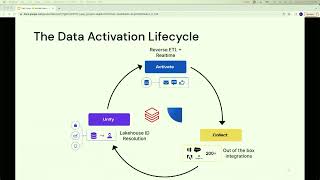
How Rec Room Processes Billions of Events Per Day with Databricks and RudderStack

Learn how Rec Room, a fast-growing augmented and virtual reality software startup, is saving 50% of their engineering team's time by using Databricks and RudderStack to power real-time analytics and insights for their 85 million gaming customers.

In this session, you will walk through a step-by-step explanation of how Rec Room set up efficient processes for ingestion into their data lakehouse, transformation, reverse-ETL and product analytics. You will also see how Rec Room is using incremental materialization of tables to save costs and establish an uptime of close to 100%.

Talk by: Albert Hu and Lewis Mbae

Connect with us: Website: https://databricks.com Twitter: https://twitter.com/databricks LinkedIn: https://www.linkedin.com/company/databricks Instagram: https://www.instagram.com/databricksinc Facebook: https://www.facebook.com/databricksinc
What’s New with Data Sharing and Collaboration on the Lakehouse: From Delta Sharing to Clean Rooms

Get ready to accelerate your data and AI collaboration game with the Databricks product team. Join us as we build the next generation of secure data collaboration capabilities on the lakehouse. Whether you're just starting your data sharing journey or exploring advanced data collaboration features like data cleanrooms, this session is tailor-made for you.

In this demo-packed session, you'll discover what’s new in Delta Sharing including dynamic and materialized views for sharing, sharing other assets such as notebooks, ML models, new Delta Sharing open source connectors for the tools of your choice, and updates to Databricks cleanroom. Learn how lakehouse is the perfect solution for your data and AI collaboration requirements, across clouds, regions and platforms and without any vendor lock-in. Plus, you'll get a peek into our upcoming roadmap. Ask any burning questions you have for our expert product team as they build a collaborative lakehouse for data, analytics and AI.

Talk by: Erika Ehrli, Kelly Albano, and Xiaotong Sun

Connect with us: Website: https://databricks.com Twitter: https://twitter.com/databricks LinkedIn: https://www.linkedin.com/company/databricks Instagram: https://www.instagram.com/databricksinc Facebook: https://www.facebook.com/databricksinc
Sponsored by: Microsoft | Next-Level Analytics with Power BI and Databricks

The widely-adopted combination of Power BI and Databricks has been a game-changer in providing a comprehensive solution for modern data analytics. In this session, you’ll learn how self-service analytics combined with the Databricks Lakehouse Platform can allow users to make better-informed decisions by unlocking insights hidden in complex data. We’ll provide practical examples of how organizations have leveraged these technologies together to drive digital transformation, lower total cost of ownership (TCO), and increase revenue. By the end of the presentation and demo, you’ll understand how Power BI and Databricks can help drive real-time insights at scale for organizations in any industry.

Talk by: Bob Zhang and Mahesh Prakriya

Connect with us: Website: https://databricks.com Twitter: https://twitter.com/databricks LinkedIn: https://www.linkedin.com/company/databricks Instagram: https://www.instagram.com/databricksinc Facebook: https://www.facebook.com/databricksinc
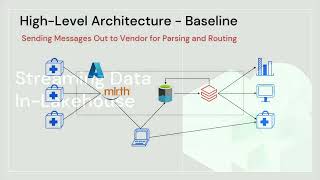
Taking Control of Streaming Healthcare Data

Chesapeake Regional Information System for our Patients (CRISP), a nonprofit healthcare information exchange (HIE), initially partnered with Slalom to build a Databricks data lakehouse architecture in response to the analytics demands of the COVID-19 pandemic, since then they have expanded the platform to additional use cases. Recently they have worked together to engineer streaming data pipelines to process healthcare messages, such as HL7, to help CRISP become vendor independent.

This session will focus on the improvements CRISP has made to their data lakehouse platform to support streaming use cases and the impact these changes have had for the organization. We will touch on using Databricks Auto Loader to efficiently ingest incoming files, ensuring data quality with Delta Live Tables, and sharing data internally with a SQL warehouse, as well as some of the work CRISP has done to parse and standardize HL7 messages from hundreds of sources. These efforts have allowed CRISP to stream over 4 million messages daily in near real-time with the scalability it needs to continue to onboard new healthcare providers so it can continue to facilitate care and improve health outcomes.

Talk by: Andy Hanks and Chris Mantz

Connect with us: Website: https://databricks.com Twitter: https://twitter.com/databricks LinkedIn: https://www.linkedin.com/company/databricks Instagram: https://www.instagram.com/databricksinc Facebook: https://www.facebook.com/databricksinc
Databricks As Code:Effectively Automate a Secure Lakehouse Using Terraform for Resource Provisioning

At Rivian, we have automated more than 95% of our Databricks resource provisioning workflows using an in-house Terraform module, affording us a lean admin team to manage over 750 users. In this session, we will cover the following elements of our approach and how others can benefit from improved team efficiency.

  • User and service principal management
  • Our permission model on Unity Catalog for data governance
  • Workspace and secrets resource management
  • Managing internal package dependencies using init scripts
  • Facilitating dashboards, SQL queries and their associated permissions
  • Scaling source of truth Petabyte scale Delta Lake table ingestion jobs and workflows

Talk by: Jason Shiverick and Vadivel Selvaraj

Connect with us: Website: https://databricks.com Twitter: https://twitter.com/databricks LinkedIn: https://www.linkedin.com/company/databricks Instagram: https://www.instagram.com/databricksinc Facebook: https://www.facebook.com/databricksinc
MLOps at Gucci: From Zero to Hero

Delta Lake is an open-source storage format that can be ideally used for storing large-scale datasets, which can be used for single-node and distributed training of deep learning models. Delta Lake storage format gives deep learning practitioners unique data management capabilities for working with their datasets. The challenge is that, as of now, it’s not possible to use Delta Lake to train PyTorch models directly.

PyTorch community has recently introduced a Torchdata library for efficient data loading. This library supports many formats out of the box, but not Delta Lake. This talk will demonstrate using the Delta Lake storage format for single-node and distributed PyTorch training using the torchdata framework and standalone delta-rs Delta Lake implementation.

Talk by: Michael Shtelma

Connect with us: Website: https://databricks.com Twitter: https://twitter.com/databricks LinkedIn: https://www.linkedin.com/company/databricks Instagram: https://www.instagram.com/databricksinc Facebook: https://www.facebook.com/databricksinc
What's New in Databricks SQL -- With Live Demos

We’ve been pushing ahead to make the lakehouse even better for data warehousing across several pillars: native serverless experience, best in class price performance, intelligent workload management & observability and enhanced connectivity, analyst & developer experiences. As we look to double down on that pace of innovation, we want to deep dive into everything that’s been keeping us busy.

In this session we will share an update on key roadmap items. To bring things to life, you will see live demos of the most recent capabilities, from data ingestion, transformation, and consumption, using the modern data stack along with Databricks SQL.

Talk by: Can Efeoglu

Connect with us: Website: https://databricks.com Twitter: https://twitter.com/databricks LinkedIn: https://www.linkedin.com/company/databricks Instagram: https://www.instagram.com/databricksinc Facebook: https://www.facebook.com/databricksinc
How to Build a Metadata Driven Data Pipelines with Delta Live Tables

In this session, you will learn how you can use metaprogramming to automate the creation and management of Delta Live Tables pipelines at scale. The goal is to make it easy to use DLT for large-scale migrations, and other use cases that require ingesting and managing hundreds or thousands of tables, using generic code components and configuration-driven pipelines that can be dynamically reused across different projects or datasets.

Talk by: Mojgan Mazouchi and Ravi Gawai

Connect with us: Website: https://databricks.com Twitter: https://twitter.com/databricks LinkedIn: https://www.linkedin.com/company/databricks Instagram: https://www.instagram.com/databricksinc Facebook: https://www.facebook.com/databricksinc
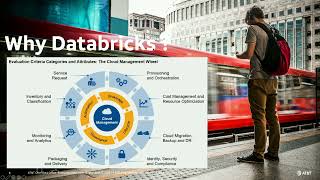
Building & Managing a Data Platform for a Delta Lake Exceeding 13PB & 1000s of Users: AT&T's Story

Data runs AT&T’s business, just like it runs most businesses these days. Data can lead to a greater understanding of a business and when translated correctly into information can provide human and business systems valuable insights to make better decisions. Unique to AT&T is the volume of data we support, how much of our work that is driven by AI and the scale at which data and AI drive value for our customers and stakeholders.

Our cloud migration journey includes making data and AI more accessible to employees throughout AT&T so they can use their deep business expertise to leverage data more easily and rapidly. We always had to balance this data democratization and desire for speed with keeping our data private and secure. We loved the open ecosystem model of Lakehouse that enables data, BI and ML tools to be seamlessly integrated on a single pane arena; it simplifies the architecture and reduces dependencies between technologies in the cloud. Being clear in our architecture guidelines and patterns was very important to us for our success.

We are seeing more interest from our business unit partners and continuing to build the AI capability AI as a service to support more citizen data scientists. To scale up our Lakehouse journey, we built a Databricks center of excellence (CoE) function in AT&T which today has approximately 1400+ active members, further concentrating existing expertise and resources in ML/AI discipline to collaborate on all things Databricks like technical support, trainings, FAQ’s and best practices to attain and sustain world-class performance and drive business value for AT&T. Join us to learn more about how we process and manage over 10 petabytes of our network Lakehouse with Delta Lake and Databricks.

Build Your Data Lakehouse with a Modern Data Stack on Databricks

Are you looking for an introduction to the Lakehouse and what the related technology is all about? This session is for you. This session explains the value that lakehouses bring to the table using examples of companies that are actually modernizing their data, showing demos throughout. The data lakehouse is the future for modern data teams that want to simplify data workloads, ease collaboration, and maintain the flexibility and openness to stay agile as a company scales.

Come to this session and learn about the full stack, including data engineering, data warehousing in a lakehouse, data streaming, governance, and data science and AI. Learn how you can create modern data solutions of your own.

Talk by: Ari Kaplan and Pearl Ubaru

Connect with us: Website: https://databricks.com Twitter: https://twitter.com/databricks LinkedIn: https://www.linkedin.com/company/databricks Instagram: https://www.instagram.com/databricksinc Facebook: https://www.facebook.com/databricksinc
Lakehouse Federation: Access and Governance of External Data Sources from Unity Catalog

Are you tired of spending time and money moving data across multiple sources and platforms to access the right data at the right time? Join our session and discover Databricks new Lakehouse Federation feature, which allows you to access, query, and govern your data in place without leaving the Lakehouse. Our experts will demonstrate how you can leverage the latest enhancements in Unity Catalog, including query federation, Hive interface, and Delta Sharing, to discover and govern all your data in one place, regardless of where it lives.

Talk by: Can Efeoglu and Todd Greenstein

Connect with us: Website: https://databricks.com Twitter: https://twitter.com/databricks LinkedIn: https://www.linkedin.com/company/databricks Instagram: https://www.instagram.com/databricksinc Facebook: https://www.facebook.com/databricksinc

How to Build LLMs on Your Company’s Data While on a Budget

Large Language Models (LLMs) are taking AI mainstream across companies and individuals. However, public LLMs are trained on general-purpose data. They do not include your own corporate data and they are black boxes on how they are trained. Because terminology is different for healthcare, financial, retail, digital-native and other industries, companies today are looking for industry-specific LLMs to better understand the terminology, context and knowledge that better suits their needs. In contrast to closed LLMs, open source-based models can be used for commercial usage or customized to suit an enterprise’s needs on their own data. Learn how Databricks makes it easy for you to build, tune and use custom models, including a deep dive into Dolly, the first open source, instruction-following LLM, fine-tuned on a human-generated instruction dataset licensed for research and commercial use.

In this session, you will:

  • See a real-life demo of creating your own LLMs specific to your industry
  • Learn how to securely train on your own documents if needed
  • Learn how Databricks makes it quick, scalable and inexpensive
  • Deep dive into Dolly and its applications

Talk by: Sean Owen

Connect with us: Website: https://databricks.com Twitter: https://twitter.com/databricks LinkedIn: https://www.linkedin.com/company/databricks Instagram: https://www.instagram.com/databricksinc Facebook: https://www.facebook.com/databricksinc

Databricks Connect Powered by Spark Connect: Develop and Debug Spark From Any Developer Tool

Spark developers want to develop and debug their code using their tools of choice and development best practices while ensuring high-production fidelity on the target remote cluster. However, Spark's driver architecture is monolithic, with no built-in capability to directly connect to a remote Spark cluster from languages other than SQL. This makes it hard to enable such interactive developer experiences from a user’s local IDE of choice. Spark Connect’s decoupled client-server architecture introduces remote connectivity to Spark clusters and with that, enables interactive development experience - Spark and its open ecosystem can be leveraged from everywhere.

In this session, we show how we leverage Spark Connect to build a completely redesigned version of Databricks Connect, a first-class IDE-based developer experience that offers interactive debugging from any IDE. We show how developers can easily ensure consistency between their local and remote environments. We walk the audience through real-live examples of how to locally debug code running on Databrick. We also show how Databricks Connect integrates into the Databricks Visual Studio Code extension for an even better developer experience.

Talk by: Martin Grund and Stefania Leone

Connect with us: Website: https://databricks.com Twitter: https://twitter.com/databricks LinkedIn: https://www.linkedin.com/company/databricks Instagram: https://www.instagram.com/databricksinc Facebook: https://www.facebook.com/databricksinc
Using DMS and DLT for Change Data Capture

Bringing in Relational Data Store (RDS) data into your data lake is a critical and important process to facilitate use cases. By leveraging AWS Database Migration Services (DMS) and Databricks Delta Live Tables (DLT) we can simplify change data capture from your RDS. In this talk, we will be breaking down this complex process by discussing the fundamentals and best practices. There will also be a demo where we bring this all together.

Talk by: Neil Patel and Ganesh Chand

Connect with us: Website: https://databricks.com Twitter: https://twitter.com/databricks LinkedIn: https://www.linkedin.com/company/databricks Instagram: https://www.instagram.com/databricksinc Facebook: https://www.facebook.com/databricksinc