
talk-data.com talk-data.com

Topic

DevOps

software_development it_operations continuous_delivery

6

tagged

Activity Trend

25 peak/qtr
2020-Q1 2026-Q1

Activities

Showing filtered results

Filtering by: Databricks DATA + AI Summit 2023 ×
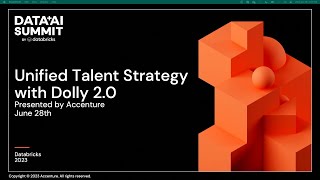
How We Made a Unified Talent Solution Using Databricks Machine Learning, Fine-Tuned LLM & Dolly 2.0

Using Databricks, we built a “Unified Talent Solution” backed by a robust data and AI engine for analyzing skills of a combined pool of permanent employees, contractors, part-time employees and vendors, inferring skill gaps, future trends and recommended priority areas to bridge talent gaps, which ultimately greatly improved operational efficiency, transparency, commercial model, and talent experience of our client. We leveraged a variety of ML algorithms such as boosting, neural networks and NLP transformers to provide better AI-driven insights.

One inevitable part of developing these models within a typical DS workflow is iteration. Databricks' end-to-end ML/DS workflow service, MLflow, helped streamline this process by organizing them into experiments that tracked the data used for training/testing, model artifacts, lineage and the corresponding results/metrics. For checking the health of our models using drift detection, bias and explainability techniques, MLflow's deploying, and monitoring services were leveraged extensively.

Our solution built on Databricks platform, simplified ML by defining a data-centric workflow that unified best practices from DevOps, DataOps, and ModelOps. Databricks Feature Store allowed us to productionize our models and features jointly. Insights were done with visually appealing charts and graphs using PowerBI, plotly, matplotlib, that answer business questions most relevant to clients. We built our own advanced custom analytics platform on top of delta lake as Delta’s ACID guarantees allows us to build a real-time reporting app that displays consistent and reliable data - React (for front-end), Structured Streaming for ingesting data from Delta table with live query analytics on real time data ML predictions based on analytics data.

Talk by: Nitu Nivedita

Connect with us: Website: https://databricks.com Twitter: https://twitter.com/databricks LinkedIn: https://www.linkedin.com/company/databricks Instagram: https://www.instagram.com/databricksinc Facebook: https://www.facebook.com/databricksinc
A Low-Code Approach to 10x Data Engineering

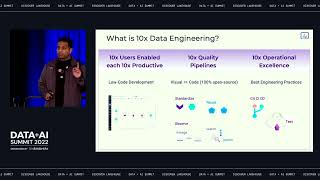
Can we take Data Engineering on Spark 10x beyond where it is today?

Yes, we can enable 10x more users on Spark, and make them 10x more productive from day 1. Data engineering can run at scale, and it can still be 10x simpler and faster to develop, deploy, and manage pipelines.

Low code is the key. A modern data engineering platform built on low code will enable all data users, from new graduates to experts, to visually develop high-quality pipelines. With Visual = Code, the visual elements will be stored as PySpark code on Git and deployed using the best software practices taken from DevOps. Search and lineage help data engineers and their customers in analytics understand how each column value was produced, when it was updated, and the associated quality metric.

See how a complete, low-code data engineering platform can reduce complexity and effort, enabling you to rapidly deploy, scale, and use Spark, making data and analytics a strategic asset in your company.

Connect with us: Website: https://databricks.com Facebook: https://www.facebook.com/databricksinc Twitter: https://twitter.com/databricks LinkedIn: https://www.linkedin.com/company/data... Instagram: https://www.instagram.com/databricksinc/
Amgen’s Journey To Building a Global 360 View of its Customers with the Lakehouse

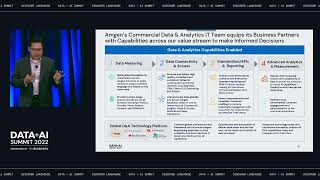
Serving patients in over 100 countries, Amgen is a leading global biotech company focused on developing therapies that have the power to save lives. Delivering on this mission requires our commercial teams to regularly meet with healthcare providers to discuss new treatments that can help patients in need. With the onset of the pandemic, where face-to-face interactions with doctors and other Healthcare Providers (HCPs) were severely impacted, Amgen had to rethink these interactions. With that in mind, the Amgen Commercial Data and Analytics team leveraged a modern data and AI architecture built on the Databricks Lakehouse to help accelerate its digital and data insights capabilities. This foundation enabled Amgen’s teams to develop a comprehensive, customer-centric view to support flexible go-to-market models and provide personalized experiences to our customers. In this presentation, we will share our recent journey of how we took an agile approach to bringing together over 2.2 petabytes of internally generated and externally sourced vendor data , and onboard into our AWS Cloud and Databricks environments to enable a standardized, scalable and robust capabilities to meet the business requirements in our fast-changing life sciences environment. We will share use cases of how we harmonized and managed our diverse sets of data to deliver efficiency, simplification, and performance outcomes for the business. We will cover the following aspects of our journey along with best practices we learned over time: • Our architecture to support Amgen’s Commercial Data & Analytics constant processing around the globe • Engineering best practices for building large scale Data Lakes and Analytics platforms such as Team organization, Data Ingestion and Data Quality Frameworks, DevOps Toolkit and Maturity Frameworks, and more • Databricks capabilities adopted such as Delta Lake, Workspace policies, SQL workspace endpoints, and MLflow for model registry and deployment. Also, various tools were built for Databricks workspace administration • Databricks capabilities being explored for future, such as Multi-task Orchestration, Container-based Apache Spark Processing, Feature Store, Repos for Git integration, etc. • The types of commercial analytics use cases we are building on the Databricks Lakehouse platform Attendees building global and Enterprise scale data engineering solutions to meet diverse sets of business requirements will benefit from learning about our journey. Technologists will learn how we addressed specific Business problems via reusable capabilities built to maximize value.

Connect with us: Website: https://databricks.com Facebook: https://www.facebook.com/databricksinc Twitter: https://twitter.com/databricks LinkedIn: https://www.linkedin.com/company/data... Instagram: https://www.instagram.com/databricksinc/
Announcing General Availability of Databricks Terraform Provider

We all live in the exciting times and the hype of Distributed Data Mesh (or just mess). This talk will cover a couple architectural and organizational approaches on achieving Distributed Data Mesh, which is essentially a combination of mindset, fully automated infrastructure, continuous integration for data pipelines, dedicated team collaborative environments, and security enforcement. As a Data Leader, you’ll learn what kinds of things you’d need to pay attention to, when starting (or reviving) a modern Data Engineering and Data Science strategy and how Databricks Unity Catalog may help you automating that. As DevOps, you’ll learn about the best practices and pitfalls of Continuous Deployment on Databricks With Terraform and Continuous Integration with Databricks Repos. You’ll be excited how you can automate Data Security with Unity Catalog and Terraform. As a Data Scientist, you’ll learn how you can get relevant infrastructure into “production” relatively faster.

Connect with us: Website: https://databricks.com Facebook: https://www.facebook.com/databricksinc Twitter: https://twitter.com/databricks LinkedIn: https://www.linkedin.com/company/data... Instagram: https://www.instagram.com/databricksinc/
Rethinking Orchestration as Reconciliation: Software-Defined Assets in Dagster

This talk discusses “software-defined assets”, a declarative approach to orchestration and data management that makes it drastically easier to trust and evolve datasets and ML models. Dagster is an open source orchestrator built for maintaining software-defined assets.

In traditional data platforms, code and data are only loosely coupled. As a consequence, deploying changes to data feels dangerous, backfills are error-prone and irreversible, and it’s difficult to trust data, because you don’t know where it comes from or how it’s intended to be maintained. Each time you run a job that mutates a data asset, you add a new variable to account for when debugging problems.

Dagster proposes an alternative approach to data management that tightly couples data assets to code - each table or ML model corresponds to the function that’s responsible for generating it. This results in a “Data as Code” approach that mimics the “Infrastructure as Code” approach that’s central to modern DevOps. Your git repo becomes your source of truth on your data, so pushing data changes feels as safe as pushing code changes. Backfills become easy to reason about. You trust your data assets because you know how they’re computed and can reproduce them at any time. The role of the orchestrator is to ensure that physical assets in the data warehouse match the logical assets that are defined in code, so each job run is a step towards order.

Software-defined assets is a natural approach to orchestration for the modern data stack, in part because dbt models are a type of software-defined asset.

Attendees of this session will learn how to build and maintain lakehouses of software-defined assets with Dagster.

Connect with us: Website: https://databricks.com Facebook: https://www.facebook.com/databricksinc Twitter: https://twitter.com/databricks LinkedIn: https://www.linkedin.com/company/data... Instagram: https://www.instagram.com/databricksinc/

MLflow Pipelines: Accelerating MLOps from Development to Production

Despite being an emerging topic, MLOps is hard and there are no widely established approaches for MLOps. What makes it even harder is that in many companies the ownership of MLOps usually falls through the cracks between data science teams and production engineering teams. Data scientists are mostly focused on modeling the business problems and reasoning about data, features, and metrics, while the production engineers/ops are mostly focused on traditional DevOps for software development, ignoring ML-specific Ops like ML development cycles, experiment tracking, data/model validation, etc. In this talk, we will introduce MLflow Pipelines, an opinionated approach for MLOps. It provides predefined ML pipeline templates for common ML problems and opinionated development workflows to help data scientists bootstrap ML projects, accelerate model development, and ship production-grade code with little help from production engineers.

Connect with us: Website: https://databricks.com Facebook: https://www.facebook.com/databricksinc Twitter: https://twitter.com/databricks LinkedIn: https://www.linkedin.com/company/data... Instagram: https://www.instagram.com/databricksinc/