talk-data.com talk-data.com

Topic

statistics

505

tagged

Activity Trend

1 peak/qtr
2020-Q1 2026-Q1

Activities

Showing filtered results

Filtering by: O'Reilly Data Science Books ×
Building Statistical Models in Python

Building Statistical Models in Python is your go-to guide for mastering statistical modeling techniques using Python. By reading this book, you will explore how to use Python libraries like stats models and others to tackle tasks such as regression, classification, and time series analysis. What this Book will help me do Develop a deep practical knowledge of statistical concepts and their implementation in Python. Create regression and classification models to solve real-world problems. Gain expertise analyzing time series data and generating valuable forecasts. Learn to perform hypothesis verification to interpret data correctly. Understand survival analysis and apply it in various industry scenarios. Author(s) Huy Hoang Nguyen, Paul N Adams, and Stuart J Miller bring their extensive expertise in data science and Python programming to the table. With years of professional experience in both industry and academia, they aim to make statistical modeling approachable and applicable. Combining technical depth with hands-on coding, their goal is to ensure readers not only understand the theory but also gain confidence in its application. Who is it for? This book is tailored for beginners and intermediate programmers seeking to learn statistical modeling without a prerequisite in mathematics. It's ideal for data analysts, data scientists, and Python enthusiasts who want to leverage statistical models to gain insights from data. With this book, you will journey from the basics to advanced applications, making it perfect for those who aim to master statistical analysis.

M-statistics

M-STATISTICS A comprehensive resource providing new statistical methodologies and demonstrating how new approaches work for applications M-statistics introduces a new approach to statistical inference, redesigning the fundamentals of statistics, and improving on the classical methods we already use. This book targets exact optimal statistical inference for a small sample under one methodological umbrella. Two competing approaches are offered: maximum concentration (MC) and mode (MO) statistics combined under one methodological umbrella, which is why the symbolic equation M=MC+MO. M-statistics defines an estimator as the limit point of the MC or MO exact optimal confidence interval when the confidence level approaches zero, the MC and MO estimator, respectively. Neither mean nor variance plays a role in M-statistics theory. Novel statistical methodologies in the form of double-sided unbiased and short confidence intervals and tests apply to major statistical parameters: Exact statistical inference for small sample sizes is illustrated with effect size and coefficient of variation, the rate parameter of the Pareto distribution, two-sample statistical inference for normal variance, and the rate of exponential distributions. M-statistics is illustrated with discrete, binomial, and Poisson distributions. Novel estimators eliminate paradoxes with the classic unbiased estimators when the outcome is zero. Exact optimal statistical inference applies to correlation analysis including Pearson correlation, squared correlation coefficient, and coefficient of determination. New MC and MO estimators along with optimal statistical tests, accompanied by respective power functions, are developed. M-statistics is extended to the multidimensional parameter and illustrated with the simultaneous statistical inference for the mean and standard deviation, shape parameters of the beta distribution, the two-sample binomial distribution, and finally, nonlinear regression. Our new developments are accompanied by respective algorithms and R codes, available at GitHub, and as such readily available for applications. M-statistics is suitable for professionals and students alike. It is highly useful for theoretical statisticians and teachers, researchers, and data science analysts as an alternative to classical and approximate statistical inference.

SPSS Statistics Workbook For Dummies

Practice making sense of data with IBM’s SPSS Statistics software SPSS Statistics Workbook For Dummies gives you the practice you need to navigate the leading statistical software suite. Data management and analysis, advanced analytics, business intelligence—SPSS is a powerhouse of a research platform, and this book helps you master the fundamentals and analyze data more effectively. You’ll work through practice problems that help you understand the calculations you need to perform, complete predictive analyses, and produce informative graphs. This workbook gives you hands-on exercises to hone your statistical analysis skills with SPSS Statistics 28. Plus, explanations and insider tips help you navigate the software with ease. Practical and easy-to-understand, in classic Dummies style. Practice organizing, analyzing, and graphing data Learn to write, edit, and format SPSS syntax Explore the upgrades and features new to SPSS 28 Try your hand at advanced data analysis procedures For academics using SPSS for research, business analysts and market researchers looking to extract valuable insights from data, and anyone with a hankering for more stats practice.

Demand Forecasting Best Practices

Lead your demand planning process to excellence and deliver real value to your supply chain. In Demand Forecasting Best Practices you’ll learn how to: Lead your team to improve quality while reducing workload Properly define the objectives and granularity of your demand planning Use intelligent KPIs to track accuracy and bias Identify areas for process improvement Help planners and stakeholders add value Determine relevant data to collect and how best to collect it Utilize different statistical and machine learning models An expert demand forecaster can help an organization avoid overproduction, reduce waste, and optimize inventory levels for a real competitive advantage. Demand Forecasting Best Practices teaches you how to become that virtuoso demand forecaster. This one-of-a-kind guide reveals forecasting tools, metrics, models, and stakeholder management techniques for delivering more effective supply chains. Everything you learn has been proven and tested in a live business environment. Discover author Nicolas Vandeput’s original five step framework for demand planning excellence and learn how to tailor it to your own company’s needs. Illustrations and real-world examples make each concept easy to understand and easy to follow. You’ll soon be delivering accurate predictions that are driving major business value. About the Technology An expert demand forecaster can help an organization avoid overproduction, reduce waste, and optimize inventory levels for a real competitive advantage. This book teaches you how to become that virtuoso demand forecaster. About the Book Demand Forecasting Best Practices reveals forecasting tools, metrics, models, and stakeholder management techniques for managing your demand planning process efficiently and effectively. Everything you learn has been proven and tested in a live business environment. Discover author Nicolas Vandeput’s original five step framework for demand planning excellence and learn how to tailor it to your own company’s needs. Illustrations and real-world examples make each concept easy to understand and easy to follow. You’ll soon be delivering accurate predictions that are driving major business value. What's Inside Enhance forecasting quality while reducing team workload Utilize intelligent KPIs to track accuracy and bias Identify process areas for improvement Assist stakeholders in sales, marketing, and finance Optimize statistical and machine learning models About the Reader For demand planners, sales and operations managers, supply chain leaders, and data scientists. About the Author Nicolas Vandeput is a supply chain data scientist, the founder of consultancy company SupChains in 2016, and a teacher at CentraleSupélec, France. Quotes This new book continues to push the FVA mindset, illustrating practices that drive the efficiency and effectiveness of the business forecasting process. - Michael Gilliland, Editor-in-Chief, Foresight: Journal of Applied Forecasting A must-read for any SCM professional, data scientist, or business owner. It's practical, accessible, and packed with valuable insights. - Edouard Thieuleux, Founder of AbcSupplyChain An exceptional resource that covers everything from basic forecasting principles to advanced forecasting techniques using artificial intelligence and machine learning. The writing style is engaging, making complex concepts accessible to both beginners and experts. - Daniel Stanton, Mr. Supply Chain® Nicolas did it again! Demand Forecasting Best Practices provides practical and actionable advice for improving the demand planning process. - Professor Spyros Makridakis, The Makridakis Open Forecasting Center, Institute For the Future (IFF), University of Nicosia This book is now my companion on all of our planning and forecasting projects. A perfect foundation for implementation and also to recommend process improvements. - Werner Nindl, Chief Architect – CPM Practice Director, Pivotal Drive This author understands the nuances of forecasting, and is able to explain them well. - Burhan Ul Haq, Director of Products, Enablers Both broader and deeper than I expected. - Maxim Volgin, Quantitative Marketing Manager, KLM Great book with actionable insights. - Simon Tschöke, Head of Research, German Edge Cloud

Time Series Indexing

Time series data is at the heart of many applications, from finance and system monitoring to weather forecasting and medical data analysis. "Time Series Indexing" offers a hands-on guide to implementing and leveraging the iSAX indexing technique in Python to efficiently manage, search, and analyze time series data. What this Book will help me do Gain the know-how to implement algorithms like SAX and iSAX with illustrative Python examples. Learn to construct robust time series indexes tailored to real-world data sets. Understand the theoretical underpinnings of time series processing and indexing techniques. Explore and employ visualization techniques to interpret time series structures and insights. Gain the skills to adapt iSAX methodologies to other programming environments and practices. Author(s) Mihalis Tsoukalos is an accomplished developer and author specializing in Python programming and data processing techniques. With years of experience translating complex academic research into practical applications, Mihalis excels at bridging the gap between theory and practice. His writing approach ensures readers grasp both the foundational principles and the hands-on methods needed to succeed. Who is it for? This book best suits researchers, analysts, and developers who work with time series data and seek to elevate their proficiency in indexing and managing such data. It is perfect for professionals with a foundational knowledge of Python and programming concepts. This material also supports learners eager to derive actionable insights from theory-heavy academic research.

Computational Statistical Methodologies and Modeling for Artificial Intelligence

This book covers computational statistics-based approaches for Artificial Intelligence. The aim of this book is to provide comprehensive coverage of the fundamentals through the applications of the different kinds of mathematical modelling and statistical techniques and describing their applications in different Artificial Intelligence systems.

Forecasting Time Series Data with Prophet - Second Edition

Discover how to effectively forecast time series data using Prophet, the versatile open-source tool developed by Meta. Whether you're a business analyst or a machine learning expert, this book provides comprehensive insights into creating, diagnosing, and refining forecasting models. By mastering Prophet, you'll be equipped to make accurate predictions that drive decisions. What this Book will help me do Master the core principles of using Prophet for time series forecasting. Ensure your forecasts are accurate and robust for better decision-making. Gain experience in handling real-world forecasting challenges, like seasonality and outliers. Learn how to fine-tune and optimize models using additional regressors. Understand productionalization of forecasting models to apply solutions at scale. Author(s) Greg Rafferty is a seasoned data scientist specializing in time series analysis and machine learning. With years of practical experience building forecasting models in industries ranging from finance to e-commerce, Greg is dedicated to teaching accessible and actionable approaches to data science. Through clear explanations and practical examples, he empowers readers to solve challenging forecasting problems with confidence. Who is it for? Ideal for data scientists, business analysts, machine learning engineers, and software developers seeking to enhance their forecasting skills with Prophet. Whether you're familiar with time series concepts or just starting to explore forecasting methods, this book helps you advance from fundamental understanding to practical application of state-of-the-art techniques for impactful results.

Loss Data Analysis, 2nd Edition

This volume deals with two complementary topics. On one hand the book deals with the problem of determining the the probability distribution of a positive compound random variable, a problem which appears in the banking and insurance industries, in many areas of operational research and in reliability problems in the engineering sciences. On the other hand, the methodology proposed to solve such problems, which is based on an application of the maximum entropy method to invert the Laplace transform of the distributions, can be applied to many other problems. The book contains applications to a large variety of problems, including the problem of dependence of the sample data used to estimate empirically the Laplace transform of the random variable. Contents Introduction Frequency models Individual severity models Some detailed examples Some traditional approaches to the aggregation problem Laplace transforms and fractional moment problems The standard maximum entropy method Extensions of the method of maximum entropy Superresolution in maxentropic Laplace transform inversion Sample data dependence Disentangling frequencies and decompounding losses Computations using the maxentropic density Review of statistical procedures

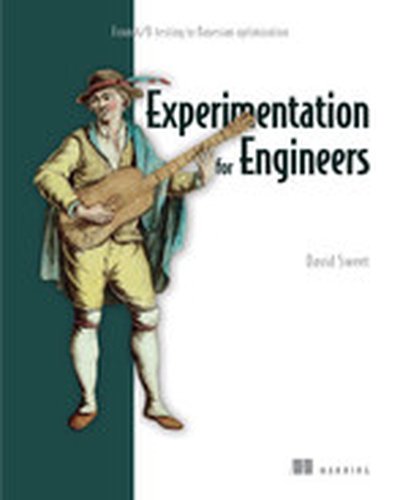
Experimentation for Engineers

Optimize the performance of your systems with practical experiments used by engineers in the world’s most competitive industries. In Experimentation for Engineers: From A/B testing to Bayesian optimization you will learn how to: Design, run, and analyze an A/B test Break the "feedback loops" caused by periodic retraining of ML models Increase experimentation rate with multi-armed bandits Tune multiple parameters experimentally with Bayesian optimization Clearly define business metrics used for decision-making Identify and avoid the common pitfalls of experimentation Experimentation for Engineers: From A/B testing to Bayesian optimization is a toolbox of techniques for evaluating new features and fine-tuning parameters. You’ll start with a deep dive into methods like A/B testing, and then graduate to advanced techniques used to measure performance in industries such as finance and social media. Learn how to evaluate the changes you make to your system and ensure that your testing doesn’t undermine revenue or other business metrics. By the time you’re done, you’ll be able to seamlessly deploy experiments in production while avoiding common pitfalls. About the Technology Does my software really work? Did my changes make things better or worse? Should I trade features for performance? Experimentation is the only way to answer questions like these. This unique book reveals sophisticated experimentation practices developed and proven in the world’s most competitive industries that will help you enhance machine learning systems, software applications, and quantitative trading solutions. About the Book Experimentation for Engineers: From A/B testing to Bayesian optimization delivers a toolbox of processes for optimizing software systems. You’ll start by learning the limits of A/B testing, and then graduate to advanced experimentation strategies that take advantage of machine learning and probabilistic methods. The skills you’ll master in this practical guide will help you minimize the costs of experimentation and quickly reveal which approaches and features deliver the best business results. What's Inside Design, run, and analyze an A/B test Break the “feedback loops” caused by periodic retraining of ML models Increase experimentation rate with multi-armed bandits Tune multiple parameters experimentally with Bayesian optimization About the Reader For ML and software engineers looking to extract the most value from their systems. Examples in Python and NumPy. About the Author David Sweet has worked as a quantitative trader at GETCO and a machine learning engineer at Instagram. He teaches in the AI and Data Science master's programs at Yeshiva University. Quotes Putting an ‘improved’ version of a system into production can be really risky. This book focuses you on what is important! - Simone Sguazza, University of Applied Sciences and Arts of Southern Switzerland A must-have for anyone setting up experiments, from A/B tests to contextual bandits and Bayesian optimization. - Maxim Volgin, KLM Shows a non-mathematical programmer exactly what they need to write powerful mathematically-based testing algorithms. - Patrick Goetz, The University of Texas at Austin Gives you the tools you need to get the most out of your experiments. - Marc-Anthony Taylor, Raiffeisen Bank International

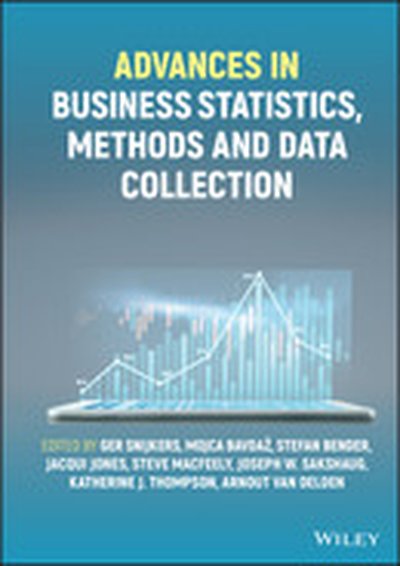
Advances in Business Statistics, Methods and Data Collection

ADVANCES IN BUSINESS STATISTICS, METHODS AND DATA COLLECTION Advances in Business Statistics, Methods and Data Collection delivers insights into the latest state of play in producing establishment statistics, obtained from businesses, farms and institutions. Presenting materials and reflecting discussions from the 6 th International Conference on Establishment Statistics (ICES-VI), this edited volume provides a broad overview of methodology underlying current establishment statistics from every aspect of the production life cycle while spotlighting innovative and impactful advancements in the development, conduct, and evaluation of modern establishment statistics programs. Highlights include: Practical discussions on agile, timely, and accurate measurement of rapidly evolving economic phenomena such as globalization, new computer technologies, and the informal sector. Comprehensive explorations of administrative and new data sources and technologies, covering big (organic) data sources and methods for data integration, linking, machine learning and visualization. Detailed compilations of statistical programs’ responses to wide-ranging data collection and production challenges, among others caused by the Covid-19 pandemic. In-depth examinations of business survey questionnaire design, computerization, pretesting methods, experimentation, and paradata. Methodical presentations of conventional and emerging procedures in survey statistics techniques for establishment statistics, encompassing probability sampling designs and sample coordination, non-probability sampling, missing data treatments, small area estimation and Bayesian methods. Providing a broad overview of most up-to-date science, this book challenges the status quo and prepares researchers for current and future challenges in establishment statistics and methods. Perfect for survey researchers, government statisticians, National Bank employees, economists, and undergraduate and graduate students in survey research and economics, Advances in Business Statistics, Methods and Data Collection will also earn a place in the toolkit of researchers working –with data– in industries across a variety of fields.

Bayesian Analysis with Excel and R

Leverage the full power of Bayesian analysis for competitive advantage Bayesian methods can solve problems you can't reliably handle any other way. Building on your existing Excel analytics skills and experience, Microsoft Excel MVP Conrad Carlberg helps you make the most of Excel's Bayesian capabilities and move toward R to do even more. Step by step, with real-world examples, Carlberg shows you how to use Bayesian analytics to solve a wide array of real problems. Carlberg clarifies terminology that often bewilders analysts, provides downloadable Excel workbooks you can easily adapt to your own needs, and offers sample R code to take advantage of the rethinking package in R and its gateway to Stan. As you incorporate these Bayesian approaches into your analytical toolbox, you'll build a powerful competitive advantage for your organization---and yourself. Explore key ideas and strategies that underlie Bayesian analysis Distinguish prior, likelihood, and posterior distributions, and compare algorithms for driving sampling inputs Use grid approximation to solve simple univariate problems, and understand its limits as parameters increase Perform complex simulations and regressions with quadratic approximation and Richard McElreath's quap function Manage text values as if they were numeric Learn today's gold-standard Bayesian sampling technique: Markov Chain Monte Carlo (MCMC) Use MCMC to optimize execution speed in high-complexity problems Discover when frequentist methods fail and Bayesian methods are essential---and when to use both in tandem ...

Statistics All-in-One For Dummies

The odds-on best way to master stats. Statistics All-in-One For Dummies is packed with lessons, examples, and practice problems to help you slay your stats course. Develop confidence and understanding in statistics with easy-to-understand (even fun) explanations of key concepts. Plus, you’ll get access to online chapter quizzes and other resources that will turn you into a stats master. This book teaches you how to interpret graphs, determine probability, critique data, and so much more. Written by an expert author and serious statistics nerd, Statistics AIO For Dummies explains everything in terms anyone can understand. Get a grasp of basic statistics concepts required in every statistics course Clear up the process of interpreting graphs, understanding polls, and analyzing data Master correlation, regression, and other data analysis tools Score higher on stats tests and get a better grade in your high school or college class Statistics All-in-One For Dummies follows the curriculum of intro college statistics courses (including AP Stats!) so you can learn everything you need to know to get the grade you need—the Dummies way.

Nonparametric Statistics with Applications to Science and Engineering with R, 2nd Edition

NONPARAMETRIC STATISTICS WITH APPLICATIONS TO SCIENCE AND ENGINEERING WITH R Introduction to the methods and techniques of traditional and modern nonparametric statistics, incorporating R code Nonparametric Statistics with Applications to Science and Engineering with R presents modern nonparametric statistics from a practical point of view, with the newly revised edition including custom R functions implementing nonparametric methods to explain how to compute them and make them more comprehensible. Relevant built-in functions and packages on CRAN are also provided with a sample code. R codes in the new edition not only enable readers to perform nonparametric analysis easily, but also to visualize and explore data using R’s powerful graphic systems, such as ggplot2 package and R base graphic system. The new edition includes useful tables at the end of each chapter that help the reader find data sets, files, functions, and packages that are used and relevant to the respective chapter. New examples and exercises that enable readers to gain a deeper insight into nonparametric statistics and increase their comprehension are also included. Some of the sample topics discussed in Nonparametric Statistics with Applications to Science and Engineering with R include: Basics of probability, statistics, Bayesian statistics, order statistics, Kolmogorov–Smirnov test statistics, rank tests, and designed experiments Categorical data, estimating distribution functions, density estimation, least squares regression, curve fitting techniques, wavelets, and bootstrap sampling EM algorithms, statistical learning, nonparametric Bayes, WinBUGS, properties of ranks, and Spearman coefficient of rank correlation Chi-square and goodness-of-fit, contingency tables, Fisher exact test, MC Nemar test, Cochran’s test, Mantel–Haenszel test, and Empirical Likelihood Nonparametric Statistics with Applications to Science and Engineering with R is a highly valuable resource for graduate students in engineering and the physical and mathematical sciences, as well as researchers who need a more comprehensive, but succinct understanding of modern nonparametric statistical methods.