talk-data.com talk-data.com

Event

O'Reilly Data Science Books

2013-08-09 – 2026-02-25 Oreilly Visit website ↗

Activities tracked

2118

Collection of O'Reilly books on Data Science.

Sessions & talks

Showing 801–825 of 2118 · Newest first

Search within this event →
Principles and Practice of Big Data, 2nd Edition

Principles and Practice of Big Data: Preparing, Sharing, and Analyzing Complex Information, Second Edition updates and expands on the first edition, bringing a set of techniques and algorithms that are tailored to Big Data projects. The book stresses the point that most data analyses conducted on large, complex data sets can be achieved without the use of specialized suites of software (e.g., Hadoop), and without expensive hardware (e.g., supercomputers). The core of every algorithm described in the book can be implemented in a few lines of code using just about any popular programming language (Python snippets are provided). Through the use of new multiple examples, this edition demonstrates that if we understand our data, and if we know how to ask the right questions, we can learn a great deal from large and complex data collections. The book will assist students and professionals from all scientific backgrounds who are interested in stepping outside the traditional boundaries of their chosen academic disciplines. Presents new methodologies that are widely applicable to just about any project involving large and complex datasets Offers readers informative new case studies across a range scientific and engineering disciplines Provides insights into semantics, identification, de-identification, vulnerabilities and regulatory/legal issues Utilizes a combination of pseudocode and very short snippets of Python code to show readers how they may develop their own projects without downloading or learning new software
Location Analytics for Business

It’s estimated that 80 percent of an organization’s data contains location attributes, but many don’t understand how to unlock the potential of this data for their organizations to make better decisions. You have just been handed the keys by finding this book. Readers will unlock these methods by learning about location analytics as well as taking a deep dive into the Planned Grocery® platform created in part by the author. The Planned Grocery® location analytics platform has been mentioned in the Wall Street Journal (twice), Forbes, Bloomberg, and Business Insider. A sampling of clients of Planned Grocery® include: Philips Edison and Company, Just Fresh, Slate Retail REIT, Wegmans, and Whole Foods. The practical information in this book is designed to prepare you to recognize and take advantage of situations where you and your organization can become more successful using location analytics. This will be accomplished by taking you through an explanation of the fundamentals of location analytics, by looking at various case studies, by learning how to identify and analyze spatial data sets, and by learning about the companies that are doing interesting work in this space.

Data Management Solutions Using SAS Hash Table Operations

Hash tables can do a lot more than you might think! Data Management Solutions Using SAS Hash Table Operations: A Business Intelligence Case Study concentrates on solving your challenging data management and analysis problems via the power of the SAS hash object, whose environment and tools make it possible to create complete dynamic solutions. To this end, this book provides an in-depth overview of the hash table as an in-memory database with the CRUD (Create, Retrieve, Update, Delete) cycle rendered by the hash object tools. By using this concept and focusing on real-world problems exemplified by sports data sets and statistics, this book seeks to help you take advantage of the hash object productively, in particular, but not limited to, the following tasks: Using this book, you will be able to answer your toughest questions quickly and in the most efficient way possible! select proper hash tools to perform hash table operations use proper hash table operations to support specific data management tasks use the dynamic, run-time nature of hash object programming understand the algorithmic principles behind hash table data look-up, retrieval, and aggregation learn how to perform data aggregation, for which the hash object is exceptionally well suited manage the hash table memory footprint, especially when processing big data use hash object techniques for other data processing tasks, such as filtering, combining, splitting, sorting, and unduplicating.

Sparse Optimization Theory and Methods

This book presents the state-of-the-art in theory and algorithms for signal recovery under the sparsity assumption. The unique conditions for the sparsest solution of underdetermined linear systems are described, and the results for sparse signal recovery under the range space property (RSP) are introduced. This framework is generalized to 1-bit compressed sensing, leading to a novel sign recovery theory in this area. Two efficient sparsity-seeking algorithms are presented, and theoretical efficiency of these algorithms are rigorously analysed. Under the RSP assumption, the author also provides a unified stability analysis for several popular optimization methods for sparse signal recovery.

Learning SAS by Example

Learn to program SAS by example! Learning SAS by Example, A Programmer’s Guide, Second Edition, teaches SAS programming from very basic concepts to more advanced topics. Because most programmers prefer examples rather than reference-type syntax, this book uses short examples to explain each topic. The second edition has brought this classic book on SAS programming up to the latest SAS version, with new chapters that cover topics such as PROC SGPLOT and Perl regular expressions. This book belongs on the shelf (or e-book reader) of anyone who programs in SAS, from those with little programming experience who want to learn SAS to intermediate and even advanced SAS programmers who want to learn new techniques or identify new ways to accomplish existing tasks. In an instructive and conversational tone, author Ron Cody clearly explains each programming technique and then illustrates it with one or more real-life examples, followed by a detailed description of how the program works. The text is divided into four major sections: Getting Started, DATA Step Processing, Presenting and Summarizing Your Data, and Advanced Topics. Subjects addressed include Reading data from external sources Learning details of DATA step programming Subsetting and combining SAS data sets Understanding SAS functions and working with arrays Creating reports with PROC REPORT and PROC TABULATE Getting started with the SAS macro language Leveraging PROC SQL Generating high-quality graphics Using advanced features of user-defined formats and informats Restructuring SAS data sets Working with multiple observations per subject Getting started with Perl regular expressions You can test your knowledge and hone your skills by solving the problems at the end of each chapter.

Hands-On Data Analysis with NumPy and pandas

Dive into 'Hands-On Data Analysis with NumPy and pandas' to explore the world of Python for data analysis. This book guides you through using these powerful Python libraries to handle and manipulate data efficiently. You will learn hands-on techniques to read, sort, group, and visualize data for impactful analysis. What this Book will help me do Learn to set up a Python environment for data analysis with tools like Jupyter notebooks. Master data handling using NumPy, focusing on array creation, slicing, and operations. Understand the functionalities of pandas for managing datasets, including DataFrame operations. Discover techniques for data preparation, such as handling missing data and hierarchical indexing. Explore data visualization using pandas and create impactful plots for data insights. Author(s) The book is authored by None Miller, a seasoned Python developer and data analyst. With a strong background in leveraging Python for data processing, None focuses on creating content that is practical and accessible. The author's teaching approach emphasizes hands-on practice and understanding, making technical topics approachable and engaging. Who is it for? This book is ideal for Python developers at a beginner to intermediate level looking to venture into data analysis. If you are transitioning from general programming to data-focused work or need to enhance your skills in data manipulation and processing, this book will be a strong foundation. It requires no prior experience with data analysis, so it is accessible to many learners.

Mastering Numerical Computing with NumPy

"Mastering Numerical Computing with NumPy" is a comprehensive guide to becoming proficient in numerical computing using Python's NumPy library. This book will teach you how to perform advanced numerical operations, explore data statistically, and build predictive models effectively. By mastering the provided concepts and exercises, you'll be empowered in your scientific computing projects. What this Book will help me do Perform and optimize vector and matrix operations effectively using NumPy. Analyze data using exploratory data analysis techniques and predictive modeling. Implement unsupervised learning algorithms such as clustering with relevant datasets. Understand advanced benchmarks and select optimal configurations for performance. Write efficient and scalable programs utilizing advanced NumPy features. Author(s) The authors of "Mastering Numerical Computing with NumPy" include domain experts and educators with years of experience in Python programming, numerical computing, and data science. They bring a practical and detailed approach to teaching advanced topics and guide you through every step of mastering NumPy. Who is it for? This book is ideal for Python programmers, data analysts, and data science enthusiasts who aim to deepen their understanding of numerical computing. If you have basic mathematics skills and want to utilize NumPy to solve complex data problems, this book is an excellent resource. Whether you're a beginner or an intermediate user, you will find this content approachable and enriching. Advanced users will benefit from the highly specialized content and real-world examples.

Domain-Specific Languages in R: Advanced Statistical Programming

Gain an accelerated introduction to domain-specific languages in R, including coverage of regular expressions. This compact, in-depth book shows you how DSLs are programming languages specialized for a particular purpose, as opposed to general purpose programming languages. Along the way, you’ll learn to specify tasks you want to do in a precise way and achieve programming goals within a domain-specific context. Domain-Specific Languages in R includes examples of DSLs including large data sets or matrix multiplication; pattern matching DSLs for application in computer vision; and DSLs for continuous time Markov chains and their applications in data science. After reading and using this book, you’ll understand how to write DSLs in R and have skills you can extrapolate to other programming languages. What You'll Learn Program with domain-specific languages using R Discover the components of DSLs Carry out large matrix expressions and multiplications Implement metaprogramming with DSLs Parse and manipulate expressions Who This Book Is For Those with prior programming experience. R knowledge is helpful but not required.

Python Graphics: A Reference for Creating 2D and 3D Images

This book will show you how to use Python to create graphic objects for technical illustrations and data visualization. Often, the function you need to produce the image you want cannot be found in a standard Python library. Knowing how to create your own graphics will free you from the chore of looking for a function that may not exist or be difficult to use. This book will give you the tools to eliminate that process and create and customize your own graphics to satisfy your own unique requirements. Using basic geometry and trigonometry, you will learn how to create math models of 2D and 3D shapes. Using Python, you will then learn how to project these objects onto the screen of your monitor, translate and rotate them in 2D and 3D, remove hidden lines, add shading, view in perspective, view intersections between surfaces, and display shadows cast from one object onto another. You will also learn how to visualize and analyze 2D and 3D data sets, fit lines, splines and functions. The final chapter includes demonstrations from quantum mechanics, astronomy and climate science. Includes Python programs written in a clear and open style with detailed explanation of the code. What You Will Learn How to create math and Python models of 2D and 3D shapes. How to rotate, view in perspective, shade, remove hidden lines, display projected shadows, and more. How to analyze and display data sets as curves and surfaces, fit lines and functions. Who This Book Is For Python developers, scientists, engineers, and students using Python to produce technical illustrations, display and analyze data sets. Assumes familiarity with vectors, matrices, geometry and trigonometry.

Python vs. R for Data Science

Python and R are two of the mainstream languages in data science. Fundamentally, Python is a language for programmers, whereas R is a language for statisticians. In a data science context, there is a significant degree of overlap when it comes to the capabilities of each language in the fields of regression analysis and machine learning. Your choice of language will depend highly on the environment in which you are operating. In a production environment, Python integrates with other languages much more seamlessly and is therefore the modus operandi in this context. However, R is much more common in research environments due to its more extensive selection of libraries for statistical analysis.

Foundations of Computational Finance with MATLAB

Graduate from Excel to MATLAB® to keep up with the evolution of finance data Foundations of Computational Finance with MATLAB® is an introductory text for both finance professionals looking to branch out from the spreadsheet, and for programmers who wish to learn more about finance. As financial data grows in volume and complexity, its very nature has changed to the extent that traditional financial calculators and spreadsheet programs are simply no longer enough. Today’s analysts need more powerful data solutions with more customization and visualization capabilities, and MATLAB provides all of this and more in an easy-to-learn skillset. This book walks you through the basics, and then shows you how to stretch your new skills to create customized solutions. Part I demonstrates MATLAB’s capabilities as they apply to traditional finance concepts, and PART II shows you how to create interactive and reusable code, link with external data sources, communicate graphically, and more. Master MATLAB’s basic operations including matrices, arrays, and flexible data structures Learn how to build your own customized solutions when the built-ins just won’t do Learn how to handle financial data and industry-specific variables including risk and uncertainty Adopt more accurate modeling practices for portfolios, options, time series, and more MATLAB is an integrated development environment that includes everything you need in one well-designed user interface. Available Toolboxes provide tested algorithms that save you hours of code, and the skills you learn using MATLAB make it easier to learn additional languages if you choose to do so. Financial firms are catching up to universities in MATLAB usage, so this is skill set that will follow you throughout your career. When you’re ready to step into the new age of finance, Foundations of Computational Finance with MATLAB provides the expert instruction you need to get started quickly.

Hands-On Data Science with Anaconda

Hands-On Data Science with Anaconda is your guide to harnessing the full potential of Anaconda, a powerful platform for data science and machine learning. With this book, you will learn how to set up Anaconda, manage packages, explore advanced data processing techniques, and create robust machine learning models using Python, R, and Julia. What this Book will help me do Master data preprocessing techniques including cleaning, sorting, and classification using Anaconda. Understand and utilize the conda package manager for efficient package management. Learn to explore and visualize data using packages and frameworks supported by Anaconda. Perform advanced operations like clustering, regression, and building predictive models. Implement distributed computing and manage environments effectively with Anaconda Cloud. Author(s) Yuxing Yan and co-author None Yan are seasoned data science professionals with extensive experience in utilizing cutting-edge tools like Anaconda to simplify and enhance data science workflows. With a focus on making complex concepts accessible, they offer a practical and systematic approach to mastering tools that power real-world data science projects. Who is it for? This book is for data science practitioners, analysts, or developers with a basic understanding of Python, R, and linear algebra who want to scale their skills and learn to utilize the Anaconda platform for their projects. If you're seeking to work more effectively within the Anaconda ecosystem or equip yourself with efficient tools for data analysis and machine learning, this book is for you.

Introducing Microsoft Flow: Automating Workflows Between Apps and Services

Use Microsoft Flow in your business to improve productivity through automation with this step-by-step introductory text from a Microsoft Flow expert. You’ll see the prerequisites to get started with this cloud-based service, including how to create a flow and how to use different connectors. Introducing Microsoft Flow takes you through connecting with SharePoint, creating approval flows, and using mobile apps. This vital information gives you a head-start when planning your Microsoft Flow implementation. The second half of the book continues with managing connections and gateways, where you’ll cover the configuration, creation, and deletion of connectors and how to connect to a data gateway. The final topic is Flow administration and techniques to manage the environment. After reading this book, you will be able to create and manage Flow from desktop, laptop, or mobile devices and connect with multiple services such as SharePoint, Twitter, Facebook, and other networking sites. What You Will Learn Create flows from built-in and blank templates Manage flows, connections, and gateways Create approvals, connect with multiple services, and use mobile apps Who This Book Is For Administrators and those who are interested in creating automated workflows using templates and connecting with multiple services without writing a single line of code.

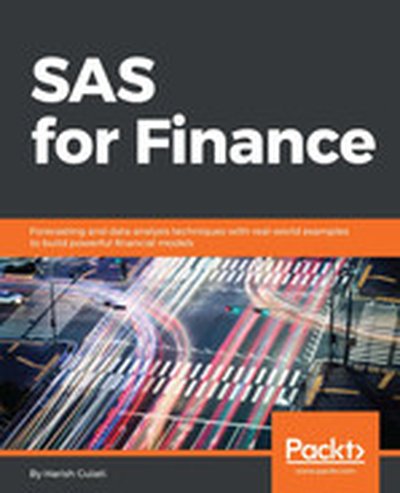
SAS for Finance

SAS for Finance introduces readers to utilizing SAS software for robust financial data analysis and model construction. Through hands-on examples and industry-focused techniques, this book demonstrates how to harness the power of SAS to develop effective analytical models, allowing you to uncover deeper insights and facilitate data-informed decision-making. What this Book will help me do Master the fundamentals of financial time series analysis using SAS effectively. Develop advanced forecasting models utilizing econometric techniques with SAS. Use clustering and similarity analysis in SAS to understand customer behavior. Create and interpret survival models for customer loyalty analysis. Gain proficiency in financial risk assessment using SAS for diversified applications. Author(s) None Gulati brings years of expertise in financial analytics and technical instruction to this publication. With a rich background in leveraging statistical software, the author has guided financial analysts and data scientists in building data models that solve real-world challenges. Known for practical insights, None's approach makes advanced concepts accessible and actionable. Who is it for? This book is tailored for financial analysts and data scientists aspiring to enhance their analytical capabilities with SAS. While prior familiarity with SAS software provides an advantage, beginners can also find value, provided they have a foundational understanding of finance. Ideal for professionals aiming to model data, forecast trends, and derive actionable insights in the financial domain.

Essentials of Time Series for Financial Applications

Essentials of Time Series for Financial Applications serves as an agile reference for upper level students and practitioners who desire a formal, easy-to-follow introduction to the most important time series methods applied in financial applications (pricing, asset management, quant strategies, and risk management). Real-life data and examples developed with EViews illustrate the links between the formal apparatus and the applications. The examples either directly exploit the tools that EViews makes available or use programs that by employing EViews implement specific topics or techniques. The book balances a formal framework with as few proofs as possible against many examples that support its central ideas. Boxes are used throughout to remind readers of technical aspects and definitions and to present examples in a compact fashion, with full details (workout files) available in an on-line appendix. The more advanced chapters provide discussion sections that refer to more advanced textbooks or detailed proofs. Provides practical, hands-on examples in time-series econometrics Presents a more application-oriented, less technical book on financial econometrics Offers rigorous coverage, including technical aspects and references for the proofs, despite being an introduction Features examples worked out in EViews (9 or higher)

Financial Forecasting and Decision Making

Many companies fail to succeed due to poor planning, which is one reason why accountants are in big demand. Skilled at forecasting, accountants can plan a company's future by determining the maximum sustainable growth and predict its external fund requirements. This book provides you with the basic tools necessary to project the balance sheet and statements of income and cash flow, enabling you to add a unique value to your client(s) work. This book will prepare you to do the following: Recall the basics of planning and forecasting financial statements Recall considerations related to a basic forecasting model Identify the evidence of growth mismanagement and develop the skills to determine maximum sustainable growth Apply statistical procedures to forecasting Analyze projected or forecasted financial statements

Power System Analysis

Power System Analysis: A Dynamic Perspective a text designed to serve as a bridge between the undergraduate course on power systems and the complex modelling and computational tools used in the dynamic analysis of practical power systems. With extensive teaching and research experience in the field, the author presents fundamental and advanced concepts using rigorous mathematical analysis and extensive time-domain simulation results. The text also includes numerous plots with clear explanation for easy understanding.

Reliability Modelling and Analysis in Discrete Time

Reliability Modelling and Analysis in Discrete Time provides an overview of the probabilistic and statistical aspects connected with discrete reliability systems. This engaging book discusses their distributional properties and dependence structures before exploring various orderings associated between different reliability structures. Though clear explanations, multiple examples, and exhaustive coverage of the basic and advanced topics of research in this area, the work gives the reader a thorough understanding of the theory and concepts associated with discrete models and reliability structures. A comprehensive bibliography assists readers who are interested in further research and understanding. Requiring only an introductory understanding of statistics, this book offers valuable insight and coverage for students and researchers in Probability and Statistics, Electrical Engineering, and Reliability/Quality Engineering. The book also includes a comprehensive bibliography to assist readers seeking to delve deeper. Includes a valuable introduction to Reliability Theory before covering advanced topics of research and real world applications Features an emphasis on the mathematical theory of reliability modeling Provides many illustrative examples to foster reader understanding

Analytics and Big Data for Accountants

Analytics is the new force driving business. Tools have been created to measure program impacts and ROI, visualize data and business processes, and uncover the relationship between key performance indicators, many using the unprecedented amount of data now flowing into organizations. Featuring updated examples and surveys, this dynamic book covers leading-edge topics in analytics and finance. It is packed with useful tips and practical guidance you can apply immediately. This book prepares accountants to: Deal with major trends in predictive analytics, optimization, correlation of metrics, and big data. Interpret and manage new trends in analytics techniques affecting your organization. Use new tools for data analytics. Critically interpret analytics reports and advise decision makers.

Data Mining Models, Second Edition

Data mining has become the fastest growing topic of interest in business programs in the past decade. This book is intended to describe the benefits of data mining in business, the process and typical business applications, the workings of basic data mining models, and demonstrate each with widely available free software. The book focuses on demonstrating common business data mining applications. It provides exposure to the data mining process, to include problem identification, data management, and available modeling tools. The book takes the approach of demonstrating typical business data sets with open source software. KNIME is a very easy-to-use tool, and is used as the primary means of demonstration. R is much more powerful and is a commercially viable data mining tool. We also demonstrate WEKA, which is a highly useful academic software, although it is difficult to manipulate test sets and new cases, making it problematic for commercial use.

Infographics Powered by SAS

Create compelling business infographics with SAS and familiar office productivity tools. A picture is worth a thousand words, but what if there are a billion words? When analyzing big data, you need a picture that cuts through the noise. This is where infographics come in. Infographics are a representation of information in a graphic format designed to make the data easily understandable. With infographics, you don’t need deep knowledge of the data. The infographic combines story telling with data and provides the user with an approachable entry point into business data. Infographics Powered by SAS : Data Visualization Techniques for Business Reporting shows you how to create graphics to communicate information and insight from big data in the boardroom and on social media. Learn how to create business infographics for all occasions with SAS and learn how to build a workflow that lets you get the most from your SAS system without having to code anything, unless you want to! This book combines the perfect blend of creative freedom and data governance that comes from leveraging the power of SAS and the familiarity of Microsoft Office. Topics covered in this book include: SAS Visual Analytics SAS Office Analytics SAS/GRAPH software (SAS code examples) Data visualization with SAS Creating reports with SAS Using reports and graphs from SAS to create business presentations Using SAS within Microsoft Office

Matplotlib for Python Developers - Second Edition

"Matplotlib for Python Developers" is your comprehensive guide to creating interactive and informative data visualizations using the Matplotlib library in Python. This book covers all the essentials-from building static plots to integrating dynamic graphics with web applications. What this Book will help me do Design and customize stunning data visualizations including heatmaps and scatter plots. Integrate Matplotlib visualization seamlessly into GUI applications using GTK3 or Qt. Utilize advanced plotting libraries like Seaborn and GeoPandas for enhanced visual representation. Develop web-based dashboards and plots that dynamically update using Django. Master techniques to prepare your Matplotlib projects for deployment in a cloud-based environment. Author(s) Authors Aldrin Yim, Claire Chung, and Allen Yu are seasoned developers and data scientists with extensive experience in Python and data visualization. They bring a practical touch to technical concepts, aiming to bridge theory with hands-on applications. With such a skilled team behind this book, you'll gain both foundational knowledge and advanced insights into Matplotlib. Who is it for? This book is the ideal resource for Python developers and data analysts looking to enhance their data visualization skills. If you're familiar with Python and want to create engaging, clear, and dynamic visualizations, this book will give you the tools to achieve that. Designed for a range of expertise, from beginners understanding the basics to experienced users diving into complex integrations, this book has something for everyone. You'll be guided through every step, ensuring you build the confidence and skills needed to thrive in this area.