talk-data.com talk-data.com

Event

Databricks DATA + AI Summit 2023

2026-01-11 YouTube Visit website ↗

Activities tracked

73

Filtering by: SQL ×

Sessions & talks

Showing 26–50 of 73 · Newest first

Search within this event →
Unleashing Large Language Models with Databricks SQL's AI Functions

Unleashing Large Language Models with Databricks SQL's AI Functions

2023-07-26 Watch
video

This talk introduces AI Functions, a new feature in Databricks SQL that enables seamless integration of Large Language Models (LLMs) into SQL workflows. We illustrate how AI Functions simplifies the use of LLMs like OpenAI’s ChatGPT for tasks such as text classification, and bypassing the need for complex pipelines.

By demonstrating the setup and application of AI Functions, this shows how this tool democratizes AI and puts the power of LLMs directly into the hands of your data analysts and scientists. The talk concludes with a look towards the future of AI Functions and the exciting possibilities they unlock for businesses.

Talk by: Shitao Li and Yu Gong

Connect with us: Website: https://databricks.com Twitter: https://twitter.com/databricks LinkedIn: https://www.linkedin.com/company/databricks Instagram: https://www.instagram.com/databricksinc Facebook: https://www.facebook.com/databricksinc

Deep Dive into the New Features of Apache Spark™ 3.4

Deep Dive into the New Features of Apache Spark™ 3.4

2023-07-25 Watch
video

Join us for this Technical Deep Dive session. In 2022, Apache Spark™ was awarded the prestigious SIGMOD Systems Award, because Spark is the de facto standard for data processing.

In this session, we will share the latest progress in Apache Spark community. With tremendous contribution from the open source community, Spark 3.4 managed to resolve in excess of 2,400 Jira tickets. We will talk about the major features and improvements in Spark 3.4. The major updates are Spark Connect, numerous PySpark and SQL language features, engine performance enhancements, as well as operational improvements in Spark UX and error handling.

Talk by: Xiao Li and Daniel Tenedorio

Connect with us: Website: https://databricks.com Twitter: https://twitter.com/databricks LinkedIn: https://www.linkedin.com/company/databricks Instagram: https://www.instagram.com/databricksinc Facebook: https://www.facebook.com/databricksinc

Taking Control of Streaming Healthcare Data

Taking Control of Streaming Healthcare Data

2023-07-25 Watch
video

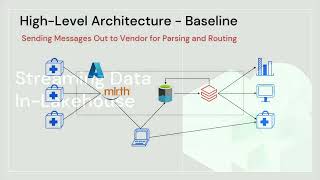
Chesapeake Regional Information System for our Patients (CRISP), a nonprofit healthcare information exchange (HIE), initially partnered with Slalom to build a Databricks data lakehouse architecture in response to the analytics demands of the COVID-19 pandemic, since then they have expanded the platform to additional use cases. Recently they have worked together to engineer streaming data pipelines to process healthcare messages, such as HL7, to help CRISP become vendor independent.

This session will focus on the improvements CRISP has made to their data lakehouse platform to support streaming use cases and the impact these changes have had for the organization. We will touch on using Databricks Auto Loader to efficiently ingest incoming files, ensuring data quality with Delta Live Tables, and sharing data internally with a SQL warehouse, as well as some of the work CRISP has done to parse and standardize HL7 messages from hundreds of sources. These efforts have allowed CRISP to stream over 4 million messages daily in near real-time with the scalability it needs to continue to onboard new healthcare providers so it can continue to facilitate care and improve health outcomes.

Talk by: Andy Hanks and Chris Mantz

Connect with us: Website: https://databricks.com Twitter: https://twitter.com/databricks LinkedIn: https://www.linkedin.com/company/databricks Instagram: https://www.instagram.com/databricksinc Facebook: https://www.facebook.com/databricksinc

Databricks As Code:Effectively Automate a Secure Lakehouse Using Terraform for Resource Provisioning

Databricks As Code:Effectively Automate a Secure Lakehouse Using Terraform for Resource Provisioning

2023-07-25 Watch
video

At Rivian, we have automated more than 95% of our Databricks resource provisioning workflows using an in-house Terraform module, affording us a lean admin team to manage over 750 users. In this session, we will cover the following elements of our approach and how others can benefit from improved team efficiency.

  • User and service principal management
  • Our permission model on Unity Catalog for data governance
  • Workspace and secrets resource management
  • Managing internal package dependencies using init scripts
  • Facilitating dashboards, SQL queries and their associated permissions
  • Scaling source of truth Petabyte scale Delta Lake table ingestion jobs and workflows

Talk by: Jason Shiverick and Vadivel Selvaraj

Connect with us: Website: https://databricks.com Twitter: https://twitter.com/databricks LinkedIn: https://www.linkedin.com/company/databricks Instagram: https://www.instagram.com/databricksinc Facebook: https://www.facebook.com/databricksinc

What's New in Databricks SQL -- With Live Demos

What's New in Databricks SQL -- With Live Demos

2023-07-25 Watch
video
Can Efeoglu (Databricks)

We’ve been pushing ahead to make the lakehouse even better for data warehousing across several pillars: native serverless experience, best in class price performance, intelligent workload management & observability and enhanced connectivity, analyst & developer experiences. As we look to double down on that pace of innovation, we want to deep dive into everything that’s been keeping us busy.

In this session we will share an update on key roadmap items. To bring things to life, you will see live demos of the most recent capabilities, from data ingestion, transformation, and consumption, using the modern data stack along with Databricks SQL.

Talk by: Can Efeoglu

Connect with us: Website: https://databricks.com Twitter: https://twitter.com/databricks LinkedIn: https://www.linkedin.com/company/databricks Instagram: https://www.instagram.com/databricksinc Facebook: https://www.facebook.com/databricksinc

Databricks Connect Powered by Spark Connect: Develop and Debug Spark From Any Developer Tool

Databricks Connect Powered by Spark Connect: Develop and Debug Spark From Any Developer Tool

2023-07-25 Watch
video
Martin Grund (Databricks) , Stefania Leone (Databricks)

Spark developers want to develop and debug their code using their tools of choice and development best practices while ensuring high-production fidelity on the target remote cluster. However, Spark's driver architecture is monolithic, with no built-in capability to directly connect to a remote Spark cluster from languages other than SQL. This makes it hard to enable such interactive developer experiences from a user’s local IDE of choice. Spark Connect’s decoupled client-server architecture introduces remote connectivity to Spark clusters and with that, enables interactive development experience - Spark and its open ecosystem can be leveraged from everywhere.

In this session, we show how we leverage Spark Connect to build a completely redesigned version of Databricks Connect, a first-class IDE-based developer experience that offers interactive debugging from any IDE. We show how developers can easily ensure consistency between their local and remote environments. We walk the audience through real-live examples of how to locally debug code running on Databrick. We also show how Databricks Connect integrates into the Databricks Visual Studio Code extension for an even better developer experience.

Talk by: Martin Grund and Stefania Leone

Connect with us: Website: https://databricks.com Twitter: https://twitter.com/databricks LinkedIn: https://www.linkedin.com/company/databricks Instagram: https://www.instagram.com/databricksinc Facebook: https://www.facebook.com/databricksinc

The English SDK for Apache Spark™

The English SDK for Apache Spark™

2023-07-25 Watch
video
Gengliang Wang (Databricks) , Allison Wang (Databricks)

In the fast-paced world of data science and AI, we will explore how large language models (LLMs) can elevate the development process of Apache Spark applications.

We'll demonstrate how LLMs can simplify SQL query creation, data ingestion, and DataFrame transformations, leading to faster development and clearer code that's easier to review and understand. We'll also show how LLMs can assist in creating visualizations and clarifying data insights, making complex data easy to understand.

Furthermore, we'll discuss how LLMs can be used to create user-defined data sources and functions, offering a higher level of adaptability in Apache Spark applications.

Our session, filled with practical examples, highlights the innovative role of LLMs in the realm of Apache Spark development. We invite you to join us in this exploration of how these advanced language models can drive innovation and boost efficiency in the sphere of data science and AI.

Talk by: Gengliang Wang and Allison Wang

Connect with us: Website: https://databricks.com Twitter: https://twitter.com/databricks LinkedIn: https://www.linkedin.com/company/databricks Instagram: https://www.instagram.com/databricksinc Facebook: https://www.facebook.com/databricksinc

Databricks Asset Bundles: A Standard, Unified Approach to Deploying Data Products on Databricks

Databricks Asset Bundles: A Standard, Unified Approach to Deploying Data Products on Databricks

2023-07-25 Watch
video

In this session, we will introduce Databricks Asset Bundles, provide a demonstration of how they work for a variety of data products, and how to fit them into an overall CICD strategy for the well-architected Lakehouse.

Data teams produce a variety of assets; datasets, reports and dashboards, ML models, and business applications. These assets depend upon code (notebooks, repos, queries, pipelines), infrastructure (clusters, SQL warehouses, serverless endpoints), and supporting services/resources like Unity Catalog, Databricks Workflows, and DBSQL dashboards. Today, each organization must figure out a deployment strategy for the variety of data products they build on Databricks as there is no consistent way to describe the infrastructure and services associated with project code.

Databricks Asset Bundles is a new capability on Databricks that standardizes and unifies the deployment strategy for all data products developed on the platform. It allows developers to describe the infrastructure and resources of their project through a YAML configuration file, regardless of whether they are producing a report, dashboard, online ML model, or Delta Live Tables pipeline. Behind the scenes, these configuration files use Terraform to manage resources in a Databricks workspace, but knowledge of Terraform is not required to use Databricks Asset Bundles.

Talk by: Rafi Kurlansik and Pieter Noordhuis

Connect with us: Website: https://databricks.com Twitter: https://twitter.com/databricks LinkedIn: https://www.linkedin.com/company/databricks Instagram: https://www.instagram.com/databricksinc Facebook: https://www.facebook.com/databricksinc

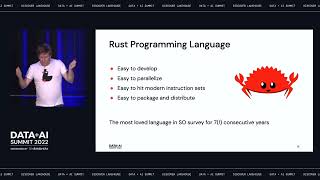
Sound Data Engineering in Rust—From Bits to DataFrames

Sound Data Engineering in Rust—From Bits to DataFrames

2022-07-19 Watch
video

Spark applications often need to query external data sources such as file-based data sources or relational data sources. In order to do this, Spark provides Data Source APIs to access structured data through Spark SQL.

Data Source APIs have optimization rules such as filter push down and column pruning to reduce the amount of data that needs to be processed to improve query performance. As part of our ongoing project to provide generic Data Source V2 push down APIs, we have introduced partial aggregate push down, which significantly speeds up spark jobs by dramatically reducing the amount of data transferred between data sources and Spark. We have implemented aggregate push down in both JDBC and parquet.

Connect with us: Website: https://databricks.com Facebook: https://www.facebook.com/databricksinc Twitter: https://twitter.com/databricks LinkedIn: https://www.linkedin.com/company/data... Instagram: https://www.instagram.com/databricksinc/

The Databricks Notebook: Front Door of the Lakehouse

The Databricks Notebook: Front Door of the Lakehouse

2022-07-19 Watch
video

One of the greatest data challenges organizations face is the sprawl of disparate toolchains, multiple vendors, and siloed teams. This can result in each team working on their own subset of data, preventing the delivery of cohesive and comprehensive insights and inhibiting the value that data can provide. This problem is not insurmountable, however; it can be fixed by a collaborative platform that enables users of all personas to discover and share data insights with each other. Whether you're a marketing analyst or a data scientist, the Databricks Notebook is that single platform that lets you tap into the awesome power of the Lakehouse. The Databricks Notebook supercharges data teams’ ability to collaborate, explore data, and create data assets like tables, pipelines, reports, dashboards, and ML models—all in the language of users’ choice. Join this session to discover how the Notebook can unleash the power of the Lakehouse. You will also learn about new data visualizations, the introduction of ipywidgets and bamboolib, workflow automation and orchestration, CI/CD, and integrations with MLflow and Databricks SQL.

Connect with us: Website: https://databricks.com Facebook: https://www.facebook.com/databricksinc Twitter: https://twitter.com/databricks LinkedIn: https://www.linkedin.com/company/data... Instagram: https://www.instagram.com/databricksinc/
How To Use Databricks SQL for Analytics on Your Lakehouse

How To Use Databricks SQL for Analytics on Your Lakehouse

2022-07-19 Watch
video

Most organizations run complex cloud data architectures that silo applications, users, and data. As a result, most analysis is performed with stale data and there isn’t a single source of truth of data for analytics.

Join this interactive follow-along deep dive demo to learn how Databricks SQL allows you to operate a multicloud lakehouse architecture that delivers data warehouse performance at data lake economics — with up to 12x better price/performance than traditional cloud data warehouses. Now data analysts and scientists can work with the freshest and most complete data and quickly derive new insights for accurate decision-making.

Here’s what we’ll cover: • Managing data access and permissions and monitoring how the data is being used and accessed in real time across your entire lakehouse infrastructure • Configuring and managing compute resources for fast performance, low latency, and high user concurrency to your data lake • Creating and working with queries, dashboards, query refresh, troubleshooting features and alerts • Creating connections to third-party BI and database tools (Power BI, Tableau, DbVisualizer, etc.) so that you can query your lakehouse without making changes to your analytical and dashboarding workflows

Connect with us: Website: https://databricks.com Facebook: https://www.facebook.com/databricksinc Twitter: https://twitter.com/databricks LinkedIn: https://www.linkedin.com/company/data... Instagram: https://www.instagram.com/databricksinc/
How unsupervised machine learning can scale data quality monitoring in Databricks

How unsupervised machine learning can scale data quality monitoring in Databricks

2022-07-19 Watch
video

Technologies like Databricks Delta Lake and Databricks SQL enable enterprises to store and query their data. But existing rules and metrics approaches to monitoring the quality of this data are tedious to set up and maintain, fail to catch unexpected issues, and generate false positive alerts that lead to alert fatigue.

In this talk, Jeremy will describe a set of fully unsupervised machine learning algorithms for monitoring data quality at scale in Databricks. He will cover how the algorithms work, their strengths and weaknesses, and how they are tested and calibrated.

Participants will leave this talk with an understanding of unsupervised data quality monitoring, its strengths and weaknesses, and how to begin monitoring data using it in Databricks.

Connect with us: Website: https://databricks.com Facebook: https://www.facebook.com/databricksinc Twitter: https://twitter.com/databricks LinkedIn: https://www.linkedin.com/company/data... Instagram: https://www.instagram.com/databricksinc/
Power to the (SQL) People: Python UDFs in DBSQL

Power to the (SQL) People: Python UDFs in DBSQL

2022-07-19 Watch
video

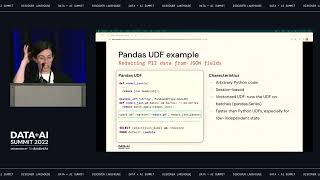
Databricks SQL (DB SQL) allows customers to leverage the simple and powerful Lakehouse architecture with up to 12x better price/performance compared to traditional cloud data warehouses. Analysts can use standard SQL to easily query data and share insights using a query editor, dashboards or a BI tool of their choice, and analytics engineers can build and maintain efficient data pipelines, including with tools like dbt.

While SQL is great at querying and transforming data, sometimes you need to extend its capabilities with the power of Python, a full programming language. Users of Databricks notebooks already enjoy seamlessly mixing SQL, Python and several other programming languages. Use cases include masking or encrypting and decrypting sensitive data, complex transformation logic, using popular open source libraries or simply reusing code that has already been written elsewhere in Databricks. In many cases, it is simply prohibitive or even impossible to rewrite the logic in SQL.

Up to now, there was no way to use Python from within DBSQL. We are removing this restriction with the introduction of Python User Defined Functions (UDFs). DBSQL users can now create, manage and use Python UDFs using standard SQL. UDFs are registered in Unity Catalog, which means they can be governed and used throughout Databricks, including in notebooks.

Connect with us: Website: https://databricks.com Facebook: https://www.facebook.com/databricksinc Twitter: https://twitter.com/databricks LinkedIn: https://www.linkedin.com/company/data... Instagram: https://www.instagram.com/databricksinc/
Amgen’s Journey To Building a Global 360 View of its Customers with the Lakehouse

Amgen’s Journey To Building a Global 360 View of its Customers with the Lakehouse

2022-07-19 Watch
video

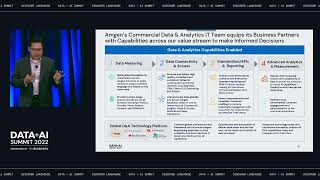
Serving patients in over 100 countries, Amgen is a leading global biotech company focused on developing therapies that have the power to save lives. Delivering on this mission requires our commercial teams to regularly meet with healthcare providers to discuss new treatments that can help patients in need. With the onset of the pandemic, where face-to-face interactions with doctors and other Healthcare Providers (HCPs) were severely impacted, Amgen had to rethink these interactions. With that in mind, the Amgen Commercial Data and Analytics team leveraged a modern data and AI architecture built on the Databricks Lakehouse to help accelerate its digital and data insights capabilities. This foundation enabled Amgen’s teams to develop a comprehensive, customer-centric view to support flexible go-to-market models and provide personalized experiences to our customers. In this presentation, we will share our recent journey of how we took an agile approach to bringing together over 2.2 petabytes of internally generated and externally sourced vendor data , and onboard into our AWS Cloud and Databricks environments to enable a standardized, scalable and robust capabilities to meet the business requirements in our fast-changing life sciences environment. We will share use cases of how we harmonized and managed our diverse sets of data to deliver efficiency, simplification, and performance outcomes for the business. We will cover the following aspects of our journey along with best practices we learned over time: • Our architecture to support Amgen’s Commercial Data & Analytics constant processing around the globe • Engineering best practices for building large scale Data Lakes and Analytics platforms such as Team organization, Data Ingestion and Data Quality Frameworks, DevOps Toolkit and Maturity Frameworks, and more • Databricks capabilities adopted such as Delta Lake, Workspace policies, SQL workspace endpoints, and MLflow for model registry and deployment. Also, various tools were built for Databricks workspace administration • Databricks capabilities being explored for future, such as Multi-task Orchestration, Container-based Apache Spark Processing, Feature Store, Repos for Git integration, etc. • The types of commercial analytics use cases we are building on the Databricks Lakehouse platform Attendees building global and Enterprise scale data engineering solutions to meet diverse sets of business requirements will benefit from learning about our journey. Technologists will learn how we addressed specific Business problems via reusable capabilities built to maximize value.

Connect with us: Website: https://databricks.com Facebook: https://www.facebook.com/databricksinc Twitter: https://twitter.com/databricks LinkedIn: https://www.linkedin.com/company/data... Instagram: https://www.instagram.com/databricksinc/
Improving Interactive Querying Experience on Spark SQL

Improving Interactive Querying Experience on Spark SQL

2022-07-19 Watch
video

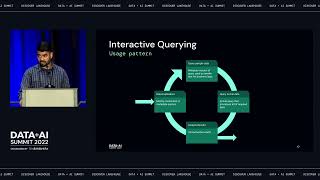
Being a data driven company, interactive querying on 100s of petabytes of data is a common and important function at Pinterest. Interactive querying has different requirements and challenges from batch querying.

In this talk, we will talk about various architectural alternatives one can choose from to perform interactive querying with Spark SQL. Through discussion on trade-offs of those architectures and requirements for interactive querying, we will elaborate on our design choice. We will share enhancements we made to open source projects including Apache Spark, Apache Livy and Dr. Elephant along with in-house technologies we built to improve interactive querying experience at Pinterest. We will share enhancements like DDL query speed ups, spark session caching, spark session sharing, Apache Yarn’s diagnostic message improvements, query failure handling and tuning recommendations. We will also discuss some challenges we faced along the way and future improvements we are working on.

Connect with us: Website: https://databricks.com Facebook: https://www.facebook.com/databricksinc Twitter: https://twitter.com/databricks LinkedIn: https://www.linkedin.com/company/data... Instagram: https://www.instagram.com/databricksinc/

Migrating Complex SAS Processes to Databricks - Case Study

Migrating Complex SAS Processes to Databricks - Case Study

2022-07-19 Watch
video

Many federal agencies use SAS software for critical operational data processes. While SAS has historically been a leader in analytics, it has often been used by data analysts for ETL purposes as well. However, modern data science demands on ever-increasing volumes and types of data require a shift to modern, cloud architectures and data management tools and paradigms for ETL/ELT. In this presentation, we will provide a case study at Centers for Medicare and Medicaid Services (CMS) detailing the approach and results of migrating a large, complex legacy SAS process to modern, open-source/open-standard technology - Spark SQL & Databricks – to produce results ~75% faster without reliance on proprietary constructs of the SAS language, with more scalability, and in a manner that can more easily ingest old rules and better govern the inclusion of new rules and data definitions. Significant technical and business benefits derived from this modernization effort are described in this session.

Connect with us: Website: https://databricks.com Facebook: https://www.facebook.com/databricksinc Twitter: https://twitter.com/databricks LinkedIn: https://www.linkedin.com/company/data... Instagram: https://www.instagram.com/databricksinc/
Near Real-Time Analytics with Event Streaming, Live Tables, and Delta Sharing

Near Real-Time Analytics with Event Streaming, Live Tables, and Delta Sharing

2022-07-19 Watch
video

Microservices is an increasingly popular architecture much loved by application teams, for it allows services to be developed and scaled independently. Data teams, though, often need a centralized repository where all data from different services come together to join and aggregate. The data platform can serve as a single source of company facts, enable near real time analytics, and secure sharing of massive data sets across clouds.

A viable microservices ingestion pattern is Change Data Capture, using AWS Database Migration Services or Debezium. CDC proves to be a scalable solution ideal for stable platforms, but it has several challenges for evolving services: Frequent schema changes, complex, unsupported DDL during migration, and automated deployments are but a few. An event streaming architecture can address these challenges.

Confluent, for example, provides a schema registry service where all services can register their event schemas. Schema registration helps with verifying that the events are being published based on the agreed contracts between data producers and consumers. It also provides a separation between internal service logic and the data consumed downstream. The services write their events to Kafka using the registered schemas with a specific topic based on the type of the event.

Data teams can leverage Spark jobs to ingest Kafka topics into Bronze tables in the Delta Lake. On ingestion, the registered schema from schema registry is used to validate the schema based on the provided version. A merge operation is sometimes called to translate events into final states of the records per business requirements.

Data teams can take advantage of Delta Live Tables on streaming datasets to produce Silver and Gold tables in near real time. Each input data source also has a set of expectations to ensure data quality and business rules. The pipeline allows Engineering and Analytics to collaborate by mixing Python and SQL. The refined data sets are then fed into Auto ML for discovery and baseline modeling.

To expose Gold tables to more consumers, especially non spark users across clouds, data teams can implement Delta Sharing. Recipients can accesses Silver tables from a different cloud and build their own analytics data sets. Analytics teams can also access Gold tables via pandas Delta Sharing client and BI tools.

Connect with us: Website: https://databricks.com Facebook: https://www.facebook.com/databricksinc Twitter: https://twitter.com/databricks LinkedIn: https://www.linkedin.com/company/data... Instagram: https://www.instagram.com/databricksinc/

Opening the Floodgates: Enabling Fast, Unmediated End User Access to Trillion-Row Datasets with SQL

Opening the Floodgates: Enabling Fast, Unmediated End User Access to Trillion-Row Datasets with SQL

2022-07-19 Watch
video

Spreadsheets revolutionized IT by giving end users the ability to create their own analytics. Providing direct end user access to trillion-row datasets generated in financial markets or digital marketing is much harder. New SQL data warehouses like ClickHouse and Druid can provide fixed latency with constant cost on very large datasets, which opens up new possibilities.

Our talk walks through recent experience on analytic apps developed by ClickHouse users that enable end users like market traders to develop their own analytics directly off raw data. We’ll cover the following topics.

  1. Characteristics of new open source column databases and how they enable low-latency analytics at constant cost.

  2. Idiomatic ways to validate new apps by building MVPs that support a wide range of queries on source data including storing source JSON, schema design, applying compression on columns, and building indexes for needle-in-a-haystack queries.

  3. Incrementally identifying hotspots and applying easy optimizations to bring query performance into line with long term latency and cost requirements.

  4. Methods of building accessible interfaces, including traditional dashboards, imitating existing APIs that are already known, and creating app-specific visualizations.

We’ll finish by summarizing a few of the benefits we’ve observed and also touch on ways that analytic infrastructure could be improved to make end user access even more productive. The lessons are as general as possible so that they can be applied across a wide range of analytic systems, not just ClickHouse.

Connect with us: Website: https://databricks.com Facebook: https://www.facebook.com/databricksinc Twitter: https://twitter.com/databricks LinkedIn: https://www.linkedin.com/company/data... Instagram: https://www.instagram.com/databricksinc/
Apache Arrow Flight SQL: High Performance, Simplicity, and Interoperability for Data Transfers

Apache Arrow Flight SQL: High Performance, Simplicity, and Interoperability for Data Transfers

2022-07-19 Watch
video

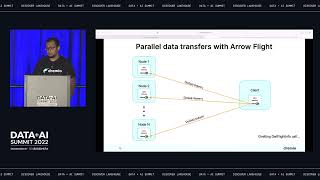
Network protocols for transferring data generally have one of two problems: they’re slow for large data transfers but have simple APIs (e.g. JDBC) or they’re fast for large data transfers but have complex APIs specific to the system. Apache Arrow Flight addresses the former by providing high performance data transfers and half of the latter by having a standard API independent of systems. However, while the Arrow Flight API is performant and an open standard, it can be more complex to use than simpler APIs like JDBC.

Arrow Flight SQL rounds out the solution, providing both great performance and a simple universal API.

In this talk, we’ll show the performance benefits of Arrow Flight, the client difference between interacting with Arrow Flight and Arrow Flight SQL, and an overview of a JDBC driver built on Arrow Flight SQL, enabling clients to take advantage of this increased performance with zero application changes.

Connect with us: Website: https://databricks.com Facebook: https://www.facebook.com/databricksinc Twitter: https://twitter.com/databricks LinkedIn: https://www.linkedin.com/company/data... Instagram: https://www.instagram.com/databricksinc/
Apache Spark SQL Aggregate Improvement at Meta (Facebook)

Apache Spark SQL Aggregate Improvement at Meta (Facebook)

2022-07-19 Watch
video

Aggregate (group-by) is one of most important SQL operations in data warehouses. It is required when we want to get aggregated insights from input datasets. Over the last year, we added a series of aggregate optimizations internally at Facebook Spark SQL, and we started to contribute back to Apache Spark recently.

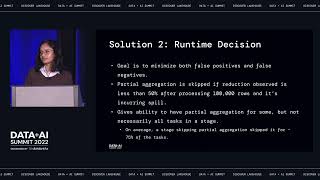
(1).sort aggregate (SPARK-32461): add code generation to improve query performance, replace hash with sort aggregate when child is sorted, etc. (2).object hash aggregate (SPARK-34286): adaptive sort-based fallback based on JVM heap memory usage during query execution. (3).hash aggregate (SPARK-31973): adaptive bypass partial aggregate when aggregate reduction ratio is low. (4).data source aggregate push down (SPARK-34960): aggregate push down to ORC data source by utilizing column statistics (5).files statistics aggregate: aggregate output files (and all columns) statistics distributively when writing query output

we’ll take deep dive of above features and lessons learned.

Connect with us: Website: https://databricks.com Facebook: https://www.facebook.com/databricksinc Twitter: https://twitter.com/databricks LinkedIn: https://www.linkedin.com/company/data... Instagram: https://www.instagram.com/databricksinc/
Build an Enterprise Lakehouse for Free with Trino and Delta Lake

Build an Enterprise Lakehouse for Free with Trino and Delta Lake

2022-07-19 Watch
video

Delta Lake has quickly grown in usage across data lakes everywhere due to the growing use cases that require DML capabilities that Delta Lake brings. Outside of support for ACID transactions, users want the ability to interactively query the data in their data lake. This is where a query engine like Trino (formerly PrestoSQL) comes in. Starburst provides an enterprise version of the popular Trino MPP SQL query engine and has recently open sourced their Delta Lake connector.

In this talk, Tom and Claudius will talk about the connector, its features, and how their users are taking advantage of expanding the functionality of their data lakes with improved performance and the ability to handle colliding modifications. Get started with this feature-rich and open stack without the need of a multi-million dollar budget.

Connect with us: Website: https://databricks.com Facebook: https://www.facebook.com/databricksinc Twitter: https://twitter.com/databricks LinkedIn: https://www.linkedin.com/company/data... Instagram: https://www.instagram.com/databricksinc/
Presto On Spark: A Unified SQL Experience

Presto On Spark: A Unified SQL Experience

2022-07-19 Watch
video

Presto was originally designed to run interactive queries against data warehouses, but now it has evolved into a unified SQL engine on top of open data lake analytics for both interactive and batch workloads. However, Presto doesn't scale to very large and complex batch pipelines. Presto Unlimited was designed to address such scalability challenges but it didn’t fully solve fault tolerance, isolation, and resource management.

Spark is the tool of choice across the industry for running large scale complex batch ETL pipelines. This motivated the development of Presto On Spark. Presto on Spark runs Presto as a library that is submitted with spark-submit to a Spark cluster. It leverages Spark for scaling shuffle, worker execution, and resource management. It thereby eliminates any query conversion between interactive and batch use cases. This solution helps enable a performant and scalable platform with seamless end-to-end experience to explore and process data.

Many analysts at Intuit use Presto to explore data in the Data Lake/S3 and use Spark for batch processing. These analysts would earlier spend several hours converting these exploration SQLs written for Presto to Spark SQL to operationalize/schedule them as data pipelines. Presto On Spark is now used by analysts at Intuit to run thousands of critical jobs. No query conversion is required here, improved analysts' productivity and empowered them to deliver insights at high speed.

Benefits from session: Attendees will learn about Presto On Spark architecture Attendees will learn when To Use Spark's Execution Engine With Presto Attendees will learn how Intuit runs thousands of presto jobs daily leveraging databricks platform which they can apply to their own work

Connect with us: Website: https://databricks.com Facebook: https://www.facebook.com/databricksinc Twitter: https://twitter.com/databricks LinkedIn: https://www.linkedin.com/company/data... Instagram: https://www.instagram.com/databricksinc/
Radical Speed on the Lakehouse: Photon Under the Hood

Radical Speed on the Lakehouse: Photon Under the Hood

2022-07-19 Watch
video

Many organizations are standardizing on the lakehouse, however, this new architecture poses challenges with an underlying query execution engine for accessing structured and unstructured data. The execution engine needs to provide the performance of a data warehouse and the scalability of data lakes. To ensure optimum performance, the Databricks Lakehouse Platform offers Photon. This next-gen vectorized query execution engine outperforms existing data warehouses in SQL workloads and implements a more general execution framework for efficient processing of data with support of the Apache Spark™ API. With Photon, analytical queries are seeing a 3 to 5x speed increase, with a 40% reduction in compute hours for ETL workloads. In this session, we will dive into Photon, describe its integration with the Databricks Platform and Apache Spark™ runtimes, talk through customer use cases, and show how your SQL and DataFrame workloads can benefit from the performance of Photon.

Connect with us: Website: https://databricks.com Facebook: https://www.facebook.com/databricksinc Twitter: https://twitter.com/databricks LinkedIn: https://www.linkedin.com/company/data... Instagram: https://www.instagram.com/databricksinc/
Scaling Your Workloads with Databricks Serverless

Scaling Your Workloads with Databricks Serverless

2022-07-19 Watch
video

Databricks SQL provides a first-class user experience for BI and SQL directly on the lakehouse platform. But you still need to administer and maintain clusters of virtual machines. What if you could focus on your Databricks SQL queries and never need to worry about the underlying compute infrastructure? Learn how Databricks Serverless, built into the Databricks Lakehouse Platform, eliminates cluster management, provides instant compute, and lowers total cost of ownership for Databricks SQL. In this session, you will see demos, hear from customers, learn how Databricks Serverless works under the hood, be equipped with everything you need to get started – and ultimately get the best out of Databricks Serverless.

Connect with us: Website: https://databricks.com Facebook: https://www.facebook.com/databricksinc Twitter: https://twitter.com/databricks LinkedIn: https://www.linkedin.com/company/data... Instagram: https://www.instagram.com/databricksinc/
Simon Whiteley + Denny Lee Live Ask Me Anything

Simon Whiteley + Denny Lee Live Ask Me Anything

2022-07-19 Watch
video
Denny Lee (Databricks) , Simon Whiteley (Advancing Analytics)

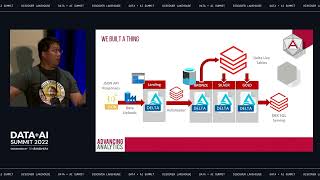
Simon and Denny Build A Thing is a live webshow, where Simon Whiteley (Advancing Analytics) and Denny Lee (Databricks) are building out a TV Ratings Analytics tool, working through the various challenges of building out a Data Lakehouse using Databricks. In this session, they'll be talking through their Lakehouse Platform, revisiting various pieces of functionality, and answering your questions, Live!

This is your chance to ask questions around structuring a lake for enterprise data analytics, the various ways we can use Delta Live Tables to simplify ETL or how to get started serving out data using Databricks SQL. We have a whole load of things to talk through, but we want to hear YOUR questions, which we can field from industry experience, community engagement and internal Databricks direction. There's also a chance we'll get distracted and talk about the Expanse for far too long.

Connect with us: Website: https://databricks.com Facebook: https://www.facebook.com/databricksinc Twitter: https://twitter.com/databricks LinkedIn: https://www.linkedin.com/company/data... Instagram: https://www.instagram.com/databricksinc/