
talk-data.com talk-data.com

Event

Databricks DATA + AI Summit 2023

2026-01-11 YouTube Visit website ↗

Activities tracked

73

Filtering by: SQL ×

Sessions & talks

Showing 51–73 of 73 · Newest first

Search within this event →
Building Spatial Applications with Apache Spark and CARTO

Building Spatial Applications with Apache Spark and CARTO

2022-07-19 Watch
video

CARTO’s Spatial Extension provides the fundamental building blocks for Location Intelligence in Databricks. Many of the largest organizations using CARTO leverage Databricks for their analytics. Customers very often build custom spatial applications that simplify either a spatial analysis use case or provide a more direct interface to access business intelligence or information. CARTO facilitates the creation of these apps with a complete set of development libraries and APIs. For visualization, CARTO makes use of the powerful deck.gl visualization library. You utilize CARTO Builder to design your maps and perform analytics using Spatial SQL similar to PostGIS, but with the scalability of Apache Spark and then you reference them in your code. CARTO will handle visualizing large datasets, updating the maps, and everything in between. In this talk we will walk you through the process to build spatial applications with CARTO hosted in Apache Spark.

Connect with us: Website: https://databricks.com Facebook: https://www.facebook.com/databricksinc Twitter: https://twitter.com/databricks LinkedIn: https://www.linkedin.com/company/data... Instagram: https://www.instagram.com/databricksinc/
Coral and Transport Portable SQL and UDFs for the Interoperability of Spark and Other Engines

Coral and Transport Portable SQL and UDFs for the Interoperability of Spark and Other Engines

2022-07-19 Watch
video

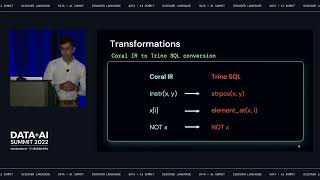
In this talk, we present two open source projects, Coral and Transport, that enable deep SQL and UDF interoperability between Spark and other engines, such as Trino and Hive. Coral is a SQL analysis, rewrite, and translation engine that enables compute engines to interoperate and analyze different SQL dialects and plans, through the conversion to a common relational algebraic intermediate representation. Transport is a UDF framework that enables users to write UDFs against a single API but execute them as native UDFs of multiple engines, such as Spark, Trino, and Hive. Further, we discuss how LinkedIn leverages Coral and Transport, and present a production use case for accessing views of other engines in Spark as well as enhancing Spark DataFrame and Dataset view schema. We discuss other potential applications such as automatic data governance and data obfuscation, query optimization, materialized view selection, incremental compute, and data source SQL and UDF communication.

Connect with us: Website: https://databricks.com Facebook: https://www.facebook.com/databricksinc Twitter: https://twitter.com/databricks LinkedIn: https://www.linkedin.com/company/data... Instagram: https://www.instagram.com/databricksinc/
Spark Data Source V2 Performance Improvement: Aggregate Push Down

Spark Data Source V2 Performance Improvement: Aggregate Push Down

2022-07-19 Watch
video

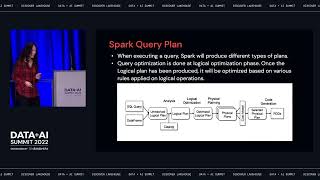
Spark applications often need to query external data sources such as file-based data sources or relational data sources. In order to do this, Spark provides Data Source APIs to access structured data through Spark SQL.

Data Source APIs have optimization rules such as filter push down and column pruning to reduce the amount of data that needs to be processed to improve query performance. As part of our ongoing project to provide generic Data Source V2 push down APIs, we have introduced partial aggregate push down, which significantly speeds up spark jobs by dramatically reducing the amount of data transferred between data sources and Spark. We have implemented aggregate push down in both JDBC and parquet.

Connect with us: Website: https://databricks.com Facebook: https://www.facebook.com/databricksinc Twitter: https://twitter.com/databricks LinkedIn: https://www.linkedin.com/company/data... Instagram: https://www.instagram.com/databricksinc/
Unity Catalog: Journey to Unified Governance for Your Data and AI Assets on Lakehouse

Unity Catalog: Journey to Unified Governance for Your Data and AI Assets on Lakehouse

2022-07-19 Watch
video

Modern data assets take many forms: not just files or tables, but dashboards, ML models, and unstructured data like video and images, all of which cannot be governed and managed by legacy data governance solutions. Join this session to learn how data teams can use Unity Catalog to centrally manage all data and AI assets with a common governance model based on familiar ANSI SQL, ensuring much better native performance and security. Built-in automated data lineage provides end-to-end visibility into how data flows from source to consumption, so that organizations can identify and diagnose the impact of data changes. Unity Catalog delivers the flexibility to leverage existing data catalogs and solutions and establish a future-proof, centralized governance without expensive migration costs. It also creates detailed audit reports for data compliance and security, while ensuring data teams can quickly discover and reference data for BI, analytics, and ML workloads, accelerating time to value.

Connect with us: Website: https://databricks.com Facebook: https://www.facebook.com/databricksinc Twitter: https://twitter.com/databricks LinkedIn: https://www.linkedin.com/company/data... Instagram: https://www.instagram.com/databricksinc/
Databricks SQL Under the Hood: What's New with Live Demos

Databricks SQL Under the Hood: What's New with Live Demos

2022-07-19 Watch
video

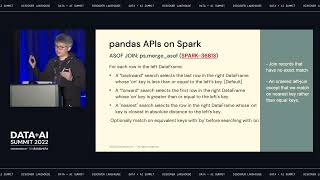
With serverless SQL compute and built-in governance, Databricks SQL lets every analyst and analytics engineer easily ingest, transform, and query the freshest data directly on your data lake, using their tools of choice like Fivetran, dbt, PowerBI or Tableau, and standard SQL. There is no need to move data to another system. All this takes place at virtually any scale, at a fraction of the cost of traditional cloud data warehouses. Join this session for a deep dive into how Databricks SQL works under the hood, and see a live end-to-end demo of the data and analytics on Databricks from data ingestion, transformation, and consumption, using the modern data stack along with Databricks SQL.

Connect with us: Website: https://databricks.com Facebook: https://www.facebook.com/databricksinc Twitter: https://twitter.com/databricks LinkedIn: https://www.linkedin.com/company/data... Instagram: https://www.instagram.com/databricksinc/
Deep Dive into the New Features of Apache Spark 3.2 and 3.3

Deep Dive into the New Features of Apache Spark 3.2 and 3.3

2022-07-19 Watch
video

Apache Spark has become the most widely-used engine for executing data engineering, data science and machine learning on single-node machines or clusters. The number of monthly maven downloads of Spark has rapidly increased to 20 million.

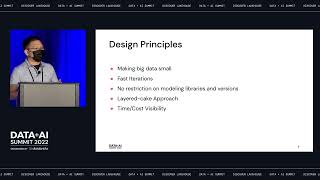
We will talk about the higher-level features and improvements in Spark 3.2 and 3.3. The talk also dives deeper into the following features + Introducing pandas API on Apache Spark to unify small data API and big data API. + Completing the ANSI SQL compatibility mode to simplify migration of SQL workloads. + Productionizing adaptive query execution to speed up Spark SQL at runtime. + Introducing RocksDB state store to make state processing more scalable

Connect with us: Website: https://databricks.com Facebook: https://www.facebook.com/databricksinc Twitter: https://twitter.com/databricks LinkedIn: https://www.linkedin.com/company/data... Instagram: https://www.instagram.com/databricksinc/

Distributed Machine Learning at Lyft

Distributed Machine Learning at Lyft

2022-07-19 Watch
video

Data collection, preprocessing, feature engineering are the fundamental steps in any Machine Learning Pipeline. After feature engineering, being able to parallelize training on multiple low cost machines helps to reduce cost and time both. And, then being able to train models in a distributed manner speeds up Hyperparameter Tuning. How can we unify these stages of ML Pipeline in one unified distributed training platform together? And that too on Kubernetes?

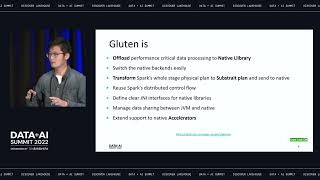
Our ML platform is completely based on Kubernetes because of its scalability and rapid bootstrapping time of resources. In this talk we will demonstrate how Lyft uses Spark on Kubernetes, Fugue (our home grown unifying compute abstraction layer) to design a holistic end to end ML Pipeline system for distributed feature engineering, training & prediction experience for our customers on our ML Platform on top of Spark on K8s. We will also do a deep dive to show how we are abstracting and hiding infrastructure complexities so that our Data Scientists and Research Scientist can focus only on the business logic for their models through simple pythonic APIs and SQL. We let the users focus on ''what to do'' and the platform takes care of ''how to do''. We will share our challenges, learning and the fun we had while implementing. Using Spark on K8s have helped us achieve large scale data processing with 90% less cost and at times bringing down processing time from 2 hours to less than 20 mins.

Connect with us: Website: https://databricks.com Facebook: https://www.facebook.com/databricksinc Twitter: https://twitter.com/databricks LinkedIn: https://www.linkedin.com/company/data... Instagram: https://www.instagram.com/databricksinc/
FugueSQL—The Enhanced SQL Interface for Pandas and Spark DataFrames

FugueSQL—The Enhanced SQL Interface for Pandas and Spark DataFrames

2022-07-19 Watch
video

SQL users working with Pandas and Spark quickly realize SQL is a second-class interface, invoked between predominantly Python code.

We will introduce FugueSQL, an enhanced SQL interface that allows SQL lovers to express end-to-end workflows predominantly in SQL. With a Jupyter notebook extension, SQL commands can be used in Databricks notebooks for interactive handling of in-memory datasets. This allows heavy SQL users to fully leverage Spark in their preferred grammar.

Connect with us: Website: https://databricks.com Facebook: https://www.facebook.com/databricksinc Twitter: https://twitter.com/databricks LinkedIn: https://www.linkedin.com/company/data... Instagram: https://www.instagram.com/databricksinc/
Gazelle-Jni: A Middle Layer to Offload Spark SQL to Native Engines for Execution Acceleration

Gazelle-Jni: A Middle Layer to Offload Spark SQL to Native Engines for Execution Acceleration

2022-07-19 Watch
video

This session will introduce Gazelle-Jni, which was proposed to better integrate the various native SQL engines as Spark SQL’s backend. It implemented a shared JVM and JNI middle layer. With the help of Gazlle-Jni, Spark SQL execution can be offloaded to native engines by passing Substrait transformed physical plan.

Examples will be presented on how to integrate native engines with Spark SQL.

Connect with us: Website: https://databricks.com Facebook: https://www.facebook.com/databricksinc Twitter: https://twitter.com/databricks LinkedIn: https://www.linkedin.com/company/data... Instagram: https://www.instagram.com/databricksinc/
Goodbye Hell of Unions in Spark SQL

Goodbye Hell of Unions in Spark SQL

2022-07-19 Watch
video

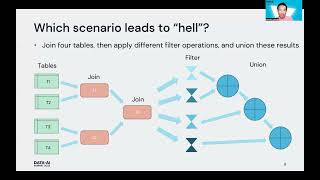
It is known that applications, which heavily use Spark SQL union() operation, cause performance problems. The union() operation combines multiple rows into one table. When union() operation merges many Dataframes, the size of the generated Spark SQL planning tree will be huge while the Spark SQL code is small. The huge planning tree may lead to performance problems. This talk reviews performance problems from the Spark SQL planning perspective and explains how to avoid the performance issues with common practices.

Connect with us: Website: https://databricks.com Facebook: https://www.facebook.com/databricksinc Twitter: https://twitter.com/databricks LinkedIn: https://www.linkedin.com/company/data... Instagram: https://www.instagram.com/databricksinc/
Auditing Your Data and Answering the Lifelong Question—Is It the End of the Day Yet?

Auditing Your Data and Answering the Lifelong Question—Is It the End of the Day Yet?

2022-07-19 Watch
video

Huge volumes of data flow through a robust Kafka architecture, into several ETLs, receiving, transforming and storing the data. We clearly understood our ETLs’ workflow and our data architecture, from source to destination.

But how much did we know about the way our data makes though our systems? And what about the life long question, is it the end of the day yet?

In this talk I’m going to present to you the design process behind our Data Auditing system, Life Line. From tracking and producing, to analyzing and storing auditing information, using technologies such as Kafka, Avro, Spark, Lambda functions and complex SQL queries. We’re going to cover: * AVRO Audit header * Auditing heart beat - designing your metadata * Designing and optimizing your auditing table - what does this data look like anyway? * Creating an alert based monitoring system * Answering the most important question of all - is it the end of the day yet?

Connect with us: Website: https://databricks.com Facebook: https://www.facebook.com/databricksinc Twitter: https://twitter.com/databricks LinkedIn: https://www.linkedin.com/company/data... Instagram: https://www.instagram.com/databricksinc/

Data Warehousing on the Lakehouse

Data Warehousing on the Lakehouse

2022-07-19 Watch
video

Most organizations routinely operate their business with complex cloud data architectures that silo applications, users and data. As a result, there is no single source of truth of data for analytics, and most analysis is performed with stale data. To solve these challenges, the lakehouse has emerged as the new standard for data architecture, with the promise to unify data, AI and analytic workloads in one place. In this session, we will cover why the data lakehouse is the next best data warehouse. You will hear from the experts success stories, use cases, and best practices learned from the field and discover how the data lakehouse ingests, stores and governs business-critical data at scale to build a curated data lake for data warehousing, SQL and BI workloads. You will also learn how Databricks SQL can help you lower costs and get started in seconds with instant, elastic SQL serverless compute, and how to empower every analytics engineers and analysts to quickly find and share new insights using their favorite BI and SQL tools, like Fivetran, dbt, Tableau or PowerBI.

Connect with us: Website: https://databricks.com Facebook: https://www.facebook.com/databricksinc Twitter: https://twitter.com/databricks LinkedIn: https://www.linkedin.com/company/data... Instagram: https://www.instagram.com/databricksinc/
dbt and Databricks: Analytics Engineering on the Lakehouse

dbt and Databricks: Analytics Engineering on the Lakehouse

2022-07-19 Watch
video
Aaron Steichen (dbt Labs)

dbt's analytics engineering workflow has been adopted by 11,000+ teams, and quickly become an industry standard for data transformation. This is a great chance to see why.

dbt allows anyone who knows SQL to develop, document, test, and deploy models. With the native, SQL-first integration between Databricks and dbt Cloud, analytics teams can collaborate in the same workspace as data engineers and data scientists to build production-grade data transformation pipelines on the lakehouse.

In this live session, Aaron Steichen, Solutions Architect at dbt Labs will walk you through dbt's workflow, how it works with Databricks, and what it makes possible.

Connect with us: Website: https://databricks.com Facebook: https://www.facebook.com/databricksinc Twitter: https://twitter.com/databricks LinkedIn: https://www.linkedin.com/company/data... Instagram: https://www.instagram.com/databricksinc/

dbt and Python—Better Together

dbt and Python—Better Together

2022-07-19 Watch
video
Drew Banin (Fishtown Analytics)

Drew Banin is the co-founder of dbt Labs and one of the maintainers of dbt Core, the open source standard in data modeling and transformation. In this talk, he will demonstrate an approach to unifying SQL and Python workloads under a single dbt execution graph, illustrating the powerful, flexible nature of dbt running on Databricks.

Connect with us: Website: https://databricks.com Facebook: https://www.facebook.com/databricksinc Twitter: https://twitter.com/databricks LinkedIn: https://www.linkedin.com/company/data... Instagram: https://www.instagram.com/databricksinc/
dbt + Machine Learning: What Makes a Great Baton Pass?

dbt + Machine Learning: What Makes a Great Baton Pass?

2022-07-19 Watch
video

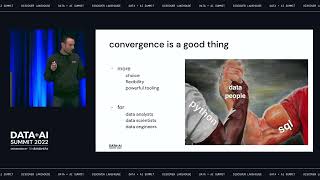
dbt has done a great job of building an elegant, common interface between data engineers and data analysts: uniting on SQL. As the data industry evolves, there's plenty of pain and room to grow in building that interface between data scientists and data analysts. There isn't a good answer for when things go wrong in the machine learning arena: should the data analyst own fine-tuning the pre-processing data(think: prepping transformed data even more for machine learning models to better work with the data). Should we increase the SQL surface area to build ML models or should we leave that to non-SQL interfaces(python/scala/etc.)? Does this have to be an either/or future? Whatever the interface evolves into, it must center people, create a low bar and high ceiling, and focus on outcomes and not the mystique of features/tools behind a learning curve.

Connect with us: Website: https://databricks.com Facebook: https://www.facebook.com/databricksinc Twitter: https://twitter.com/databricks LinkedIn: https://www.linkedin.com/company/data... Instagram: https://www.instagram.com/databricksinc/

DELETE, UPDATE, MERGE Operations in Data Source

DELETE, UPDATE, MERGE Operations in Data Source

2022-07-19 Watch
video

If you’ve ever had to delete a set of records for regulatory compliance, update a set of records to fix an issue in the ingestion pipeline, or apply changes in a transaction log to a fact table, you know that row-level operations are becoming critical for modern data lake workflows. This talk will focus on some of the upcoming features in Spark 3.3 that will enable execution of row-level operations and allow Spark to only pass to connectors what rows to delete, update, or insert. As a result, data sources won’t have to provide low-level SQL extensions for Spark and will be able to benefit from a scalable built-in implementation that works across all connectors. The presentation will be useful for data source developers as well as data engineers and analysts interested in performing DELETE, UPDATE, MERGE operations in Spark.

Connect with us: Website: https://databricks.com Facebook: https://www.facebook.com/databricksinc Twitter: https://twitter.com/databricks LinkedIn: https://www.linkedin.com/company/data... Instagram: https://www.instagram.com/databricksinc/
Enable Production ML with Databricks Feature Store

Enable Production ML with Databricks Feature Store

2022-07-19 Watch
video

Productionalizing ML models is hard. In fact, very few ML projects make it to production, and one of the hardest problems is data! Most AI platforms are disconnected from the data platform, making it challenging to keep features constantly updated and available in real-time. Offline/online skew prevents models from being used in real-time or, worse, introduces bugs and biases in production. Building systems to enable real-time inference requires valuable production engineering resources. As a result of these challenges, most ML models do not see the light of day.

Learn how you can simplify production ML using Databricks Feature Store, the first feature store built on the data lakehouse. Data sources for features are drawn from a central data lakehouse, and the feature tables themselves are tables in the lakehouse, accessible in Spark and SQL for both machine learning and analytics use cases. Features, data pipelines, source data, and models can all be co-governed in a central platform. Feature Store is seamlessly integrated with Apache Spark™, enabling automatic lineage tracking, and with MLflow, enabling models to look up feature values at inference time automatically. See these capabilities in action and how you can use it for your ML projects.

Connect with us: Website: https://databricks.com Facebook: https://www.facebook.com/databricksinc Twitter: https://twitter.com/databricks LinkedIn: https://www.linkedin.com/company/data... Instagram: https://www.instagram.com/databricksinc/

Cloud Fetch: High-bandwidth Connectivity With BI Tools

Cloud Fetch: High-bandwidth Connectivity With BI Tools

2022-07-19 Watch
video

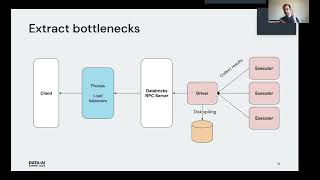
Business Intelligence (BI) tools such as Tableau and Microsoft Power BI are notoriously slow at extracting large query results from traditional data warehouses because they typically fetch the data in a single thread through a SQL endpoint that becomes a data transfer bottleneck. Data analysts can connect their BI tools to Databricks SQL endpoints to query data in tables through an ODBC/JDBC protocol integrated in our Simba drivers. With Cloud Fetch, which we released in Databricks Runtime 8.3 and Simba ODBC 2.6.17 driver, we introduce a new mechanism for fetching data in parallel via cloud storage such as AWS S3 and Azure Data Lake Storage to bring the data faster to BI tools. In our experiments using Cloud Fetch, we observed a 10x speed-up in extract performance due to parallelism.

Connect with us: Website: https://databricks.com Facebook: https://www.facebook.com/databricksinc Twitter: https://twitter.com/databricks LinkedIn: https://www.linkedin.com/company/data... Instagram: https://www.instagram.com/databricksinc/

Computational Data Governance at Scale

Computational Data Governance at Scale

2022-07-19 Watch
video

This talk is about the implementation of a Data Mesh in a Fozzy Group. In our experience, the biggest bottleneck in transition to Data Mesh is unclear data ownership. This and other issues can be solved with (federated) computational data governance. We will go through the process of building a global data lineage with 200k tables, 40k table replications, and 70k SQL stored procedures. Also, we will cover our lessons from building data product culture with explicit and automated tracking of ownership and data quality. Fozzy Group is a holding company that comprises about 40 different businesses with 60k employees in various domains: retail, banking, insurance, logistics, agriculture, HoReCa, E-Commerce, etc.

Connect with us: Website: https://databricks.com Facebook: https://www.facebook.com/databricksinc Twitter: https://twitter.com/databricks LinkedIn: https://www.linkedin.com/company/data... Instagram: https://www.instagram.com/databricksinc/
From PostGIS to Spark SQL: The History and Future of Spatial SQL

From PostGIS to Spark SQL: The History and Future of Spatial SQL

2022-07-19 Watch
video

In this talk, we'll review the major milestones that have defined Spatial SQL as the powerful tool for geospatial analytics that it is today.

From the early foundations of the JTS Topology Suite and GEOS and its application on the PostGIS extension for PostgreSQL, to the latest implementation in Spark SQL using libraries such as the CARTO Analytics Toolbox for Databricks, Spatial SQL has been a key component of many geospatial analytics products and solutions, leveraging the computing power of different databases with SQL as lingua franca, allowing easy adoption by data scientists, analysts and engineers.

The latest innovation in this area is the CARTO Spatial Extension for Databricks, which makes the most of the near-unlimited scalability provided by Spark and the cutting-edge geospatial capabilities that CARTO offers.

Connect with us: Website: https://databricks.com Facebook: https://www.facebook.com/databricksinc Twitter: https://twitter.com/databricks LinkedIn: https://www.linkedin.com/company/data... Instagram: https://www.instagram.com/databricksinc/

Hassle-Free Data Ingestion into the Lakehouse

Hassle-Free Data Ingestion into the Lakehouse

2022-07-19 Watch
video

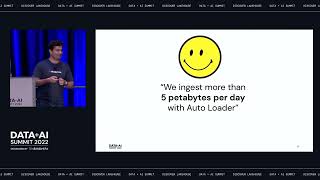
Ingesting data from hundreds of different data sources is critical before organizations can execute advanced analytics, data science, and machine learning. Unfortunately, ingesting and unifying this data to create a reliable single source of truth is usually extremely time-consuming and costly. In this session, discover how Databricks simplifies data ingestion, at low latency, with SQL-only ingestion capabilities. We will discuss and demonstrate how you can easily and quickly ingest any data into the lakehouse. The session will also cover newly-released features and tools that make data ingestion even simpler on the Databricks Lakehouse Platform.

Connect with us: Website: https://databricks.com Facebook: https://www.facebook.com/databricksinc Twitter: https://twitter.com/databricks LinkedIn: https://www.linkedin.com/company/data... Instagram: https://www.instagram.com/databricksinc/
Ingesting data into Lakehouse with COPY INTO

Ingesting data into Lakehouse with COPY INTO

2022-07-19 Watch
video

COPY INTO is a popular data ingestion SQL command for Databricks users, especially for customers using Databricks SQL. In this talk, we want to discuss the data ingestion use cases in Databricks and how COPY INTO fits your data ingestion needs. We will discuss a few new COPY INTO features and how to achieve the following use cases: 1. Loading data into a Delta Table incrementally ; 2. Fixing errors in already loaded data and helping you with data cleansing; 3. Evolving your schema over time; 4. Previewing data before ingesting; 5. Loading data from a third party data source. In this session, we will demo the new features, discuss the architecture for the implementation, and how other Databricks features are using COPY INTO under the hood.

Connect with us: Website: https://databricks.com Facebook: https://www.facebook.com/databricksinc Twitter: https://twitter.com/databricks LinkedIn: https://www.linkedin.com/company/data... Instagram: https://www.instagram.com/databricksinc/

Presto 101: An Introduction to Open Source Presto

Presto 101: An Introduction to Open Source Presto

2022-07-19 Watch
video

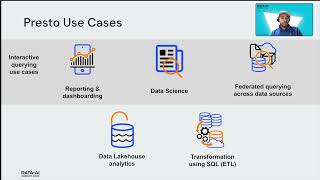
Presto is a widely adopted distributed SQL engine for data lake analytics. With Presto, you can perform ad hoc querying of data in place, which helps solve challenges around time to discover and the amount of time it takes to do ad hoc analysis. Additionally, new features like the disaggregated coordinator, Presto-on-Spark, scan optimizations, a reusable native engine, and a Pinot connector enable added benefits around performance, scale, and ecosystem.

In this session, Philip and Rohan will introduce the Presto technology and share why it’s becoming so popular – in fact, companies like Facebook, Uber, Twitter, Alibaba, and much more use Presto for interactive ad hoc queries, reporting & dashboarding data lake analytics, and much more. We’ll also show a quick demo on getting Presto running in AWS.

Connect with us: Website: https://databricks.com Facebook: https://www.facebook.com/databricksinc Twitter: https://twitter.com/databricks LinkedIn: https://www.linkedin.com/company/data... Instagram: https://www.instagram.com/databricksinc/