In this episode, Conor talks about his recent experience with Cursor, Claude 3.7, Gemini 2.5 Pro and several C++ unit testing frameworks! Link to Episode 233 on WebsiteDiscuss this episode, leave a comment, or ask a question (on GitHub)Socials ADSP: The Podcast: TwitterConor Hoekstra: Twitter | BlueSky | MastodonShow Notes Date Generated: 2025-05-07 Date Released: 2025-05-09 GoogleTestboost/ext-utMinUnitDocTestIntro Song Info Miss You by Sarah Jansen https://soundcloud.com/sarahjansenmusic Creative Commons — Attribution 3.0 Unported — CC BY 3.0 Free Download / Stream: http://bit.ly/l-miss-you Music promoted by Audio Library https://youtu.be/iYYxnasvfx8
 talk-data.com
Topic
AI/ML
Artificial Intelligence/Machine Learning
data_science
algorithms
predictive_analytics
9014
tagged
Activity Trend
1532
peak/qtr
2020-Q1
2026-Q1
Top Events
Google Cloud Next '25
761
Microsoft Ignite 2025
699
Google Cloud Next '24
553
Data + AI Summit 2025
425
O'Reilly Data Science Books
333
Databricks DATA + AI Summit 2023
287
Data Engineering Podcast
271
O'Reilly Data Engineering Books
240
DataFramed
239
Making Data Simple
223
AWS re:Invent 2024
223
DATA MINER Big Data Europe Conference 2020
215
Dia Adams and Gordon Wong join me for a chat about data strategy in the age of AI.
Takeaways Code2Story Pro turns Python code into engaging blog posts. Traditional documentation methods are often insufficient. Effective communication of code is crucial for collaboration. The tool allows users to select tone and emotion for their writing. Mukund built the tool out of frustration with documentation. The technical setup involves Streamlit and OpenAI's GPT-4. Users can generate blog posts in under 30 seconds. Future updates will include file uploads and image generation. The tool is aimed at helping developers share their work easily. Storytelling in coding can enhance career opportunities.
Blog: https://medium.com/data-science-collective/i-built-an-ai-tool-that-turns-any-python-code-into-an-emotionally-engaging-blog-post-f6d14daeddbd
Website: Subscribe for free access to the code: https://mukundansankar.substack.com/
Graham Hosking shares tips and tricks for building use-case specific agents and leveraging state-of-the-art AI features in the Microsoft Cloud.
Steve Goodman explains how to manage and stay current with Microsoft 365 AI and Copilot features.
Welcome to DataFramed Industry Roundups! In this series of episodes, Adel & Richie sit down to discuss the latest and greatest in data & AI. In this episode, we touch upon the launch of OpenAI’s O3 and O4-mini models, Meta’s rocky release of Llama 4, Google’s new agent tooling ecosystem, the growing arms race in AI, the latest from the Stanford AI Index report, the plausibility of AGI and superintelligence, how agents might evolve in the enterprise, global attitudes toward AI, and a deep dive into the speculative—but chilling—AI 2027 scenario. All that, Easter rave plans, and much more. Links Mentioned in the Show: Introducing OpenAI o3 and o4-miniThe Median: Scaling Models or Scaling People? Llama 4, A2A, and the State of AI in 2025LLama 4Google: Announcing the Agent2Agent Protocol (A2A)Stanford University's Human Centered AI Institute Releases 2025 AI Index ReportAI 2027Rewatch sessions from RADAR: Skills Edition New to DataCamp? Learn on the go using the DataCamp mobile appEmpower your business with world-class data and AI skills with DataCamp for business
Supported by Our Partners • Modal — The cloud platform for building AI applications • CodeRabbit — Cut code review time and bugs in half. Use the code PRAGMATIC to get one month free. — What happens when LLMs meet real-world codebases? In this episode of The Pragmatic Engineer, I am joined by Varun Mohan, CEO and Co-Founder of Windsurf. Varun talks me through the technical challenges of building an AI-native IDE (Windsurf) —and how these tools are changing the way software gets built. We discuss: • What building self-driving cars taught the Windsurf team about evaluating LLMs • How LLMs for text are missing capabilities for coding like “fill in the middle” • How Windsurf optimizes for latency • Windsurf’s culture of taking bets and learning from failure • Breakthroughs that led to Cascade (agentic capabilities) • Why the Windsurf teams build their LLMs • How non-dev employees at Windsurf build custom SaaS apps – with Windsurf! • How Windsurf empowers engineers to focus on more interesting problems • The skills that will remain valuable as AI takes over more of the codebase • And much more! — Timestamps (00:00) Intro (01:37) How Windsurf tests new models (08:25) Windsurf’s origin story (13:03) The current size and scope of Windsurf (16:04) The missing capabilities Windsurf uncovered in LLMs when used for coding (20:40) Windsurf’s work with fine-tuning inside companies (24:00) Challenges developers face with Windsurf and similar tools as codebases scale (27:06) Windsurf’s stack and an explanation of FedRAMP compliance (29:22) How Windsurf protects latency and the problems with local data that remain unsolved (33:40) Windsurf’s processes for indexing code (37:50) How Windsurf manages data (40:00) The pros and cons of embedding databases (42:15) “The split brain situation”—how Windsurf balances present and long-term (44:10) Why Windsurf embraces failure and the learnings that come from it (46:30) Breakthroughs that fueled Cascade (48:43) The insider’s developer mode that allows Windsurf to dogfood easily (50:00) Windsurf’s non-developer power user who routinely builds apps in Windsurf (52:40) Which SaaS products won’t likely be replaced (56:20) How engineering processes have changed at Windsurf (1:00:01) The fatigue that goes along with being a software engineer, and how AI tools can help (1:02:58) Why Windsurf chose to fork VS Code and built a plugin for JetBrains (1:07:15) Windsurf’s language server (1:08:30) The current use of MCP and its shortcomings (1:12:50) How coding used to work in C#, and how MCP may evolve (1:14:05) Varun’s thoughts on vibe coding and the problems non-developers encounter (1:19:10) The types of engineers who will remain in demand (1:21:10) How AI will impact the future of software development jobs and the software industry (1:24:52) Rapid fire round — The Pragmatic Engineer deepdives relevant for this episode: • IDEs with GenAI features that Software Engineers love • AI tooling for Software Engineers in 2024: reality check • How AI-assisted coding will change software engineering: hard truths • AI tools for software engineers, but without the hype — See the transcript and other references from the episode at https://newsletter.pragmaticengineer.com/podcast — Production and marketing by https://penname.co/. For inquiries about sponsoring the podcast, email [email protected].
Get full access to The Pragmatic Engineer at newsletter.pragmaticengineer.com/subscribe
Send us a text What makes IBM TechXchange different — and why is it a must-attend for techies? In this episode, we’re joined by two powerhouses behind the scenes: Amy Tennison, VP of IBM TechXchange & Client Advocacy, and Graeme Noseworthy, TechXchange Content & Experiences. We explore the ethos of TechXchange, how it's curated for technologists of all skill levels, and why it's more than just an event — it's an experience that continues all year long. From strategic content design to the future of tech conferences, you’ll hear insider insights and behind-the-scenes stories that bring TechXchange to life. ⏱️ Time Markers: 03:06 Meet Amy Tennison03:54 Meet Graeme Noseworthy05:51 What IS TechXchange10:31 TechXchange is Always On!16:32 The Cost of Learning: Time22:12 Targeting Different Skill Levels27:07 Where Are Tech Events Heading?28:52 Session Curation33:03 The WHY of TechXchange34:00 Finally, What to Know36:29 For Fun💡 Whether you're a hands-on architect, an emerging developer, or a tech lead looking to sharpen your edge — this episode is for you. #TechXchange #IBMPodcast #MakingDataSimple Want to be featured as a guest on Making Data Simple? Reach out to us at [email protected] and tell us why you should be next. The Making Data Simple Podcast is hosted by Al Martin, WW VP Technical Sales, IBM, where we explore trending technologies, business innovation, and leadership ... while keeping it simple & fun.
Why don’t fast-growing worms end up giants and slow ones stay tiny? In this episode, we explore how Caenorhabditis elegans uses a clever trick: coupling growth rate with developmental speed to keep body sizes uniform.
Live imaging reveals that worms with faster growth develop quicker, while slower growers take their time — cancelling out size differences. Instead of strict size checkpoints (like many cells use), C. elegans uses a “folder” strategy, fine-tuned by an internal genetic oscillator.
We cover:
Why worms don’t follow traditional “adder” or “sizer” models How growth and development are linked by a biological clock How tweaking this oscillator shifts final body size Why this simple coupling helps worms beat random size divergence
📖 Based on the research article: “Coupling of growth rate and developmental tempo reduces body size heterogeneity in C. elegans” Klement Stojanovski, Helge Großhans & Benjamin D. Towbin. Published in Nature Communications (2022). 🔗 https://doi.org/10.1038/s41467-022-29720-8
🎧 Subscribe to the WoRM Podcast for more stories where physics, biology, and evolution collide!
This podcast is generated with artificial intelligence and curated by Veeren. If you’d like your publication featured on the show, please get in touch.
📩 More info: 🔗 www.veerenchauhan.com 📧 [email protected]
Joint briefing by Supermicro and NVIDIA on transforming financial services at the edge of innovation.
Panel discussion on building IDPs, AI's role, empowering developers with self-service capabilities—from no-code/low-code to libraries—and how to manage cost, security, and more.
If you're thinking about doing the Google Data Analytics Certificate, you need to hear this: DON'T. In this episode, I list five reasons why it is a waste of time. The ONLY Framework to Become a Data Analyst in 2025 (SPN Method): https://youtu.be/XUxWQgh3soo?si=v3SQV3zJ4h0jH1uQ 💌 Join 10k+ aspiring data analysts & get my tips in your inbox weekly 👉 https://www.datacareerjumpstart.com/newsletter 🆘 Feeling stuck in your data journey? Come to my next free "How to Land Your First Data Job" training 👉 https://www.datacareerjumpstart.com/training 👩💻 Want to land a data job in less than 90 days? 👉 https://www.datacareerjumpstart.com/daa 👔 Ace The Interview with Confidence 👉 https://www.datacareerjumpstart.com/interviewsimulator ⌚ TIMESTAMPS 00:00 - Introduction 00:11 - Reason 1: Certificates Don't Matter in the Data Industry 02:45 - Reason 2: The Course Teaches the Wrong Skills 06:32 - Reason 3: The Course is Slow and Theoretical 09:21 - Reason 4: Lack of Projects and Portfolios 14:15 - Reason 5: No Career or Networking Support 🔗 CONNECT WITH AVERY 🎥 YouTube Channel: https://www.youtube.com/@averysmith 🤝 LinkedIn: https://www.linkedin.com/in/averyjsmith/ 📸 Instagram: https://instagram.com/datacareerjumpstart 🎵 TikTok: https://www.tiktok.com/@verydata 💻 Website: https://www.datacareerjumpstart.com/ Mentioned in this episode: Join the last cohort of 2025! The LAST cohort of The Data Analytics Accelerator for 2025 kicks off on Monday, December 8th and enrollment is officially open!
To celebrate the end of the year, we’re running a special End-of-Year Sale, where you’ll get: ✅ A discount on your enrollment 🎁 6 bonus gifts, including job listings, interview prep, AI tools + more
If your goal is to land a data job in 2026, this is your chance to get ahead of the competition and start strong.
👉 Join the December Cohort & Claim Your Bonuses: https://DataCareerJumpstart.com/daa https://www.datacareerjumpstart.com/daa
by
Derek Gaston
(Idaho National Laboratory (INL), Nuclear Science & Technology Directorate)
,
Kirk Offel
Dr. Derek Gaston is the Chief Computational Scientist for the Nuclear Science & Technology Directorate at Idaho National Laboratory (INL). He earned his Ph.D. in computational nuclear engineering from Massachusetts Institute of Technology (MIT) in 2020, studying under advisors Dr. Benoit Forget and Dr. Kord Smith. Whether you’re a tech enthusiast, a data center insider, or just someone who cares about the future of energy and technology, get ready for a thoughtful, accessible, and powerful conversation that will change the way you think about nuclear energy and its role in the world to come.
For more about us: https://linktr.ee/overwatchmissioncritical
The roles within AI engineering are as diverse as the challenges they tackle. From integrating models into larger systems to ensuring data quality, the day-to-day work of AI professionals is anything but routine. How do you navigate the complexities of deploying AI applications? What are the key steps from prototype to production? For those looking to refine their processes, understanding the full lifecycle of AI development is essential. Let's delve into the intricacies of AI engineering and the strategies that lead to successful implementation. Maxime Labonne is a Senior Staff Machine Learning Scientist at Liquid AI, serving as the head of post-training. He holds a Ph.D. in Machine Learning from the Polytechnic Institute of Paris and is recognized as a Google Developer Expert in AI/ML. An active blogger, he has made significant contributions to the open-source community, including the LLM Course on GitHub, tools such as LLM AutoEval, and several state-of-the-art models like NeuralBeagle and Phixtral. He is the author of the best-selling book “Hands-On Graph Neural Networks Using Python,” published by Packt. Paul-Emil Iusztin designs and implements modular, scalable, and production-ready ML systems for startups worldwide. He has extensive experience putting AI and generative AI into production. Previously, Paul was a Senior Machine Learning Engineer at Metaphysic.ai and a Machine Learning Lead at Core.ai. He is a co-author of The LLM Engineer's Handbook, a best seller in the GenAI space. In the episode, Richie, Maxime, and Paul explore misconceptions in AI application development, the intricacies of fine-tuning versus few-shot prompting, the limitations of current frameworks, the roles of AI engineers, the importance of planning and evaluation, the challenges of deployment, and the future of AI integration, and much more. Links Mentioned in the Show: Maxime’s LLM Course on HuggingFaceMaxime and Paul’s Code Alongs on DataCampDecoding ML on SubstackConnect with Maxime and PaulSkill Track: AI FundamentalsRelated Episode: Building Multi-Modal AI Applications with Russ d'Sa, CEO & Co-founder of LiveKitRewatch sessions from RADAR: Skills Edition New to DataCamp? Learn on the go using the DataCamp mobile appEmpower your business with world-class data and AI skills with DataCamp for business
Summary In this episode of the Data Engineering Podcast Sida Shen, product manager at CelerData, talks about StarRocks, a high-performance analytical database. Sida discusses the inception of StarRocks, which was forked from Apache Doris in 2020 and evolved into a high-performance Lakehouse query engine. He explains the architectural design of StarRocks, highlighting its capabilities in handling high concurrency and low latency queries, and its integration with open table formats like Apache Iceberg, Delta Lake, and Apache Hudi. Sida also discusses how StarRocks differentiates itself from other query engines by supporting on-the-fly joins and eliminating the need for denormalization pipelines, and shares insights into its use cases, such as customer-facing analytics and real-time data processing, as well as future directions for the platform.
Announcements Hello and welcome to the Data Engineering Podcast, the show about modern data managementData migrations are brutal. They drag on for months—sometimes years—burning through resources and crushing team morale. Datafold's AI-powered Migration Agent changes all that. Their unique combination of AI code translation and automated data validation has helped companies complete migrations up to 10 times faster than manual approaches. And they're so confident in their solution, they'll actually guarantee your timeline in writing. Ready to turn your year-long migration into weeks? Visit dataengineeringpodcast.com/datafold today for the details.Your host is Tobias Macey and today I'm interviewing Sida Shen about StarRocks, a high performance analytical database supporting shared nothing and shared data patternsInterview IntroductionHow did you get involved in the area of data management?Can you describe what StarRocks is and the story behind it?There are numerous analytical databases on the market. What are the attributes of StarRocks that differentiate it from other options?Can you describe the architecture of StarRocks?What are the "-ilities" that are foundational to the design of the system?How have the design and focus of the project evolved since it was first created?What are the tradeoffs involved in separating the communication layer from the data layers?The tiered architecture enables the shared nothing and shared data behaviors, which allows for the implementation of lakehouse patterns. What are some of the patterns that are possible due to the single interface/dual pattern nature of StarRocks?The shared data implementation has cacheing built in to accelerate interaction with datasets. What are some of the limitations/edge cases that operators and consumers should be aware of?StarRocks supports management of lakehouse tables (Iceberg, Delta, Hudi, etc.), which overlaps with use cases for Trino/Presto/Dremio/etc. What are the cases where StarRocks acts as a replacement for those systems vs. a supplement to them?The other major category of engines that StarRocks overlaps with is OLAP databases (e.g. Clickhouse, Firebolt, etc.). Why might someone use StarRocks in addition to or in place of those techologies?We would be remiss if we ignored the dominating trend of AI and the systems that support it. What is the role of StarRocks in the context of an AI application?What are the most interesting, innovative, or unexpected ways that you have seen StarRocks used?What are the most interesting, unexpected, or challenging lessons that you have learned while working on StarRocks?When is StarRocks the wrong choice?What do you have planned for the future of StarRocks?Contact Info LinkedInParting Question From your perspective, what is the biggest gap in the tooling or technology for data management today?Closing Announcements Thank you for listening! Don't forget to check out our other shows. Podcast.init covers the Python language, its community, and the innovative ways it is being used. The AI Engineering Podcast is your guide to the fast-moving world of building AI systems.Visit the site to subscribe to the show, sign up for the mailing list, and read the show notes.If you've learned something or tried out a project from the show then tell us about it! Email [email protected] with your story.Links StarRocksCelerDataApache DorisSIMD == Single Instruction Multiple DataApache IcebergClickHousePodcast EpisodeDruidFireboltPodcast EpisodeSnowflakeBigQueryTrinoDatabricksDremioData LakehouseDelta LakeApache HiveC++Cost-Based OptimizerIceberg Summit Tencent Games PresentationApache PaimonLancePodcast EpisodeDelta UniformApache ArrowStarRocks Python UDFDebeziumPodcast EpisodeThe intro and outro music is from The Hug by The Freak Fandango Orchestra / CC BY-SA
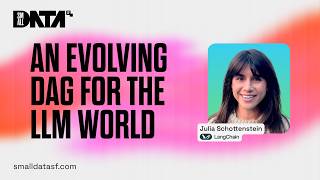
Directed Acyclic Graphs (DAGs) are the foundation of most orchestration frameworks. But what happens when you allow an LLM to act as the router? Acyclic graphs now become cyclic, which means you have to design for the challenges resulting from all this extra power. We'll cover the ins and outs of agentic applications and how to best use them in your work as a data practitioner or developer building today.
➡️ Follow Us LinkedIn: https://www.linkedin.com/company/small-data-sf/ X/Twitter : https://twitter.com/smalldatasf Website: https://www.smalldatasf.com/
Discover LangChain, the open-source framework for building powerful agentic systems. Learn how to augment LLMs with your private data, moving beyond their training cutoffs. We'll break down how LangChain uses "chains," which are essentially Directed Acyclic Graphs (DAGs) similar to data pipelines you might recognize from dbt. This structure is perfect for common patterns like Retrieval Augmented Generation (RAG), where you orchestrate steps to fetch context from a vector database and feed it to an LLM to generate an informed response, much like preparing data for analysis.
Dive into the world of AI agents, where the LLM itself determines the application's control flow. Unlike a predefined DAG, this allows for dynamic, cyclic graphs where an agent can iterate and improve its response based on previous attempts. We'll explore the core challenges in building reliable agents: effective planning and reflection, managing shared memory across multiple agents in a cognitive architecture, and ensuring reliability against task ambiguity. Understand the critical trade-offs between the dependability of static chains and the flexibility of dynamic LLM agents.
Introducing LangGraph, a framework designed to solve the agent reliability problem by balancing agent control with agency. Through a live demo in LangGraph Studio, see how to build complex AI applications using a cyclic graph. We'll demonstrate how a router agent can delegate tasks, execute a research plan with multiple steps, and use cycles to iterate on a problem. You'll also see how human-in-the-loop intervention can steer the agent for improved performance, a critical feature for building robust and observable agentic systems.
Explore some of the most exciting AI agents in production today. See how Roblox uses an AI assistant to generate virtual worlds from a prompt, how TripAdvisor’s agent acts as a personal travel concierge to create custom itineraries, and how Replit’s coding agent automates code generation and pull requests. These real-world examples showcase the practical power of moving from simple DAGs to dynamic, cyclic graphs for solving complex, agentic problems.
Bruce Kasman and Joe Lupton discuss how the activity data continues to show resilience, an encouraging development that will help weather the coming US policy storm. Whether it is enough to support the transition to the trade war is the central question. Regardless, even absent recession, the risk of an extended period of soft growth should also be a concern. One factor underlying this risk is a lack of potential policy offsets, particularly in the US where the Fed is likely to remain on extended hold.
This podcast was recorded on May 2, 2025.
This communication is provided for information purposes only. Institutional clients please visit www.jpmm.com/research/disclosures for important disclosures. © 2025 JPMorgan Chase & Co. All rights reserved. This material or any portion hereof may not be reprinted, sold or redistributed without the written consent of J.P. Morgan. It is strictly prohibited to use or share without prior written consent from J.P. Morgan any research material received from J.P. Morgan or an authorized third-party (“J.P. Morgan Data”) in any third-party artificial intelligence (“AI”) systems or models when such J.P. Morgan Data is accessible by a third-party. It is permissible to use J.P. Morgan Data for internal business purposes only in an AI system or model that protects the confidentiality of J.P. Morgan Data so as to prevent any and all access to or use of such J.P. Morgan Data by any third-party.
In this episode of Data Unchained, host Molly Presley sits down with Brett Ferrin, VP of Sales at Traffic Logix, to uncover how a company that once molded rubber products evolved into a cloud-based, data-driven traffic safety powerhouse. From speed cameras and pedestrian tracking to AI-enabled traffic insights, Brett shares how Traffic Logix is leveraging distributed data systems to make roads safer while navigating privacy regulations and digital transformation.
DataUnchained #TrafficLogix #SmartCities #DataDrivenDecisions #CloudComputing #AIAnalytics #EdgeToCloud #IoTInfrastructure #CIO #CTO #DigitalTransformation #MobilityTech #Hammerspace #DataStrategy #PublicSafetyTech
Cyberpunk by jiglr | https://soundcloud.com/jiglrmusic Music promoted by https://www.free-stock-music.com Creative Commons Attribution 3.0 Unported License https://creativecommons.org/licenses/by/3.0/deed.en_US Hosted on Acast. See acast.com/privacy for more information.
Agentic AI is here, but what is it? What are the differences between the traditional LLMs and this new agentic AI we're hearing about? With AI systems making autonomous decisions, driving analytics, and reshaping data strategies, what does this mean for analysts? We're joined by Vin Vashishta, CEO at V Squared and an expert in AI strategy and data science. Vin's book, From Data to Profit, lays out a roadmap for turning AI and analytics into real business value. AI isn't just a tool anymore; it's becoming a collaborator. How should we think about adapting? Don't miss his insights in this show! What You'll Learn: How Agentic AI will redefine the role of analysts in analytics. What makes an AI 'agent' different from a traditional LLM? Why knowledge graphs are the key to AI's next leap forward. How to future-proof your career in analytics. Register for free to be part of the next live session: https://bit.ly/3XB3A8b Follow us on Socials: LinkedIn YouTube Instagram (Mavens of Data) Instagram (Maven Analytics) TikTok Facebook Medium X/Twitter
In this episode of Hub & Spoken, Jason Foster, CEO of Cynozure, goes solo and explores one of the most critical yet under-discussed business skills...decision making. Drawing on real-world examples, research, and personal experience, Jason unpacks why so many organisations struggle to make effective decisions, despite it being core to leadership, innovation, and progress. From decision paralysis to overconfidence, and data overload to gut instinct, he looks at the formal frameworks and informal dynamics that shape how choices are made across all levels of a business. The episode delves into the role of vision, bias, data literacy, and emotional intelligence, and outlines the essential skills leaders need to build confidence, clarity and adaptability into their decision-making culture. Whether you're leading a team, shaping strategy, or navigating change, this episode is packed with practical ideas to help you make better, faster, and more informed decisions. 🎧 Tune in now to rethink how decisions really get made, and how to make yours count. ***** Cynozure is a leading data, analytics and AI company that helps organisations to reach their data potential. It works with clients on data and AI strategy, data management, data architecture and engineering, analytics and AI, data culture and literacy, and data leadership. The company was named one of The Sunday Times' fastest-growing private companies in both 2022 and 2023 and recognised as The Best Place to Work in Data by DataIQ in 2023 and 2024. Cynozure is a certified B Corporation.