Are Vision-Language Models Ready for Physical AI? Humans easily understand how objects move, rotate, and shift while current AI models that connect vision and language still make mistakes in what seem like simple situations: deciding “left” versus “right” when something is moving, recognizing how perspective changes, or keeping track of motion over time. To reveal these kinds of limitations, we created VLM4D, a testing suite made up of real-world and synthetic videos, each paired with questions about motion, rotation, perspective, and continuity. When we put modern vision-language models through these challenges, they performed far below human levels, especially when visual cues must be combined or the sequence of events must be maintained. But there is hope: new methods such as reconstructing visual features in 4D and fine-tuning focused on space and time show noticeable improvement, bringing us closer to AI that truly understands a dynamic physical world.
 talk-data.com
Topic
AI/ML
Artificial Intelligence/Machine Learning
9014
tagged
Activity Trend
Top Events
Are Vision-Language Models Ready for Physical AI? Humans easily understand how objects move, rotate, and shift while current AI models that connect vision and language still make mistakes in what seem like simple situations: deciding left versus right when something is moving, recognizing how perspective changes, or keeping track of motion over time. To reveal these kinds of limitations, we created VLM4D, a testing suite made up of real-world and synthetic videos, each paired with questions about motion, rotation, perspective, and continuity. When we put modern vision-language models through these challenges, they performed far below human levels, especially when visual cues must be combined or the sequence of events must be maintained. But there is hope: new methods such as reconstructing visual features in 4D and fine-tuning focused on space and time show noticeable improvement, bringing us closer to AI that truly understands a dynamic physical world.
Are Vision-Language Models Ready for Physical AI? Humans easily understand how objects move, rotate, and shift while current AI models that connect vision and language still make mistakes in what seem like simple situations: deciding “left” versus “right” when something is moving, recognizing how perspective changes, or keeping track of motion over time. To reveal these kinds of limitations, we created VLM4D, a testing suite made up of real-world and synthetic videos, each paired with questions about motion, rotation, perspective, and continuity. When we put modern vision-language models through these challenges, they performed far below human levels, especially when visual cues must be combined or the sequence of events must be maintained. But there is hope: new methods such as reconstructing visual features in 4D and fine-tuning focused on space and time show noticeable improvement, bringing us closer to AI that truly understands a dynamic physical world.
Jovita Tam, data and AI advisor with a background in engineering, law, and finance, joined Yuliia and Dumke to challenge how organizations approach governance. Jovita argues that data governance is a way of thinking, not a tool you purchase, explaining why culture eats strategy and why most governance programs fail at the checkbox exercise. Jovita shares her approach to helping executives understand that governance should be an enabler, not an obstacle, and why treating it as purely compliance or cost center misses the point entirely. Jovita's Linkedin - https://www.linkedin.com/in/jovitatam/
Data science leadership is about more than just technical expertise—it’s about building trust, embracing AI, and delivering real business impact. As organizations evolve toward AI-first strategies, data teams have an unprecedented opportunity to lead that transformation. But how do you turn a traditional analytics function into an AI-driven powerhouse that drives decision-making across the business? What’s the right structure to balance deep technical specialization with seamless business integration? From building credibility through high-impact forecasting to creating psychological safety around AI adoption, effective data leadership today requires both technical rigor and visionary communication. The landscape is shifting fast, but with the right approach, data science can stand as a true pillar of innovation alongside engineering, product, and design. Bilal Zia is currently the Head of Data Science & Analytics at Duolingo, an EdTech company whose mission is to develop the best education in the world and make it universally available. Previously, he spent two years helping to build and lead an interdisciplinary Central Science team at Amazon, comprising economists, data and applied scientists, survey specialists, user researchers, and engineers. Before that, he spent fifteen years in the Research Department of the World Bank in Washington, D.C., pursuing an applied academic career. He holds a Ph.D. in Economics from the Massachusetts Institute of Technology, and his interests span economics, data science, machine learning/AI, psychology, and user research. In the episode, Richie and Bilal explore rebuilding an underperforming data team, fostering trust with leadership, embedding data scientists within product teams, leveraging AI for productivity, the future of synthetic A/B testing, and much more. Links Mentioned in the Show: DuolingoDuolingo Blog: How machine learning supercharged our revenue by millions of dollarsConnect with BilalAI-Native Course: Intro to AI for WorkRelated Episode: The Future of Data & AI Education Just Arrived with Jonathan Cornelissen & Yusuf SaberRewatch RADAR AI New to DataCamp? Learn on the go using the DataCamp mobile appEmpower your business with world-class data and AI skills with DataCamp for business
Summary In this crossover episode, Max Beauchemin explores how multiplayer, multi‑agent engineering is transforming the way individuals and teams build data and AI systems. He digs into the shifting boundary between data and AI engineering, the rise of “context as code,” and how just‑in‑time retrieval via MCP and CLIs lets agents gather what they need without bloating context windows. Max shares hard‑won practices from going “AI‑first” for most tasks, where humans focus on orchestration and taste, and the new bottlenecks that appear — code review, QA, async coordination — when execution accelerates 2–10x. He also dives deep into Agor, his open‑source agent orchestration platform: a spatial, multiplayer workspace that manages Git worktrees and live dev environments, templatizes prompts by workflow zones, supports session forking and sub‑sessions, and exposes an internal MCP so agents can schedule, monitor, and even coordinate other agents.
Announcements Hello and welcome to the Data Engineering Podcast, the show about modern data managementData teams everywhere face the same problem: they're forcing ML models, streaming data, and real-time processing through orchestration tools built for simple ETL. The result? Inflexible infrastructure that can't adapt to different workloads. That's why Cash App and Cisco rely on Prefect. Cash App's fraud detection team got what they needed - flexible compute options, isolated environments for custom packages, and seamless data exchange between workflows. Each model runs on the right infrastructure, whether that's high-memory machines or distributed compute. Orchestration is the foundation that determines whether your data team ships or struggles. ETL, ML model training, AI Engineering, Streaming - Prefect runs it all from ingestion to activation in one platform. Whoop and 1Password also trust Prefect for their data operations. If these industry leaders use Prefect for critical workflows, see what it can do for you at dataengineeringpodcast.com/prefect.Data migrations are brutal. They drag on for months—sometimes years—burning through resources and crushing team morale. Datafold's AI-powered Migration Agent changes all that. Their unique combination of AI code translation and automated data validation has helped companies complete migrations up to 10 times faster than manual approaches. And they're so confident in their solution, they'll actually guarantee your timeline in writing. Ready to turn your year-long migration into weeks? Visit dataengineeringpodcast.com/datafold today for the details.Composable data infrastructure is great, until you spend all of your time gluing it together. Bruin is an open source framework, driven from the command line, that makes integration a breeze. Write Python and SQL to handle the business logic, and let Bruin handle the heavy lifting of data movement, lineage tracking, data quality monitoring, and governance enforcement. Bruin allows you to build end-to-end data workflows using AI, has connectors for hundreds of platforms, and helps data teams deliver faster. Teams that use Bruin need less engineering effort to process data and benefit from a fully integrated data platform. Go to dataengineeringpodcast.com/bruin today to get started. And for dbt Cloud customers, they'll give you $1,000 credit to migrate to Bruin Cloud.Your host is Tobias Macey and today I'm interviewing Maxime Beauchemin about the impact of multi-player multi-agent engineering on individual and team velocity for building better data systemsInterview IntroductionHow did you get involved in the area of data management?Can you start by giving an overview of the types of work that you are relying on AI development agents for?As you bring agents into the mix for software engineering, what are the bottlenecks that start to show up?In my own experience there are a finite number of agents that I can manage in parallel. How does Agor help to increase that limit?How does making multi-agent management a multi-player experience change the dynamics of how you apply agentic engineering workflows?Contact Info LinkedInLinks AgorApache AirflowApache SupersetPresetClaude CodeCodexPlaywright MCPTmuxGit WorktreesOpencode.aiGitHub CodespacesOnaThe intro and outro music is from The Hug by The Freak Fandango Orchestra / CC BY-SA
In this episode, Tristan Handy sits down with Chang She — a co-creator of Pandas and now CEO of LanceDB — to explore the convergence of analytics and AI engineering. The team at LanceDB is rebuilding the data lake from the ground up with AI as a first principle, starting with a new AI-native file format called Lance. Tristan traces Chang's journey as one of the original contributors to the pandas library to building a new infrastructure layer for AI-native data. Learn why vector databases alone aren't enough, why agents require new architecture, and how LanceDB is building a AI lakehouse for the future. For full show notes and to read 6+ years of back issues of the podcast's companion newsletter, head to https://roundup.getdbt.com. The Analytics Engineering Podcast is sponsored by dbt Labs.
The data of activity past has begun. This week’s payroll report is only one month and stale (Sept), but on the margin tempers some downside risk. Combined with the bulk of data coming after the Fed’s Dec meeting, a pause looks sensible. Asia views are upgraded, but possibly with a little too much verve.
Speakers:
Bruce Kasman
Joseph Lupton
This podcast was recorded on November 11, 2025.
This communication is provided for information purposes only. Institutional clients please visit www.jpmm.com/research/disclosures for important disclosures. © 2025 JPMorgan Chase & Co. All rights reserved. This material or any portion hereof may not be reprinted, sold or redistributed without the written consent of J.P. Morgan. It is strictly prohibited to use or share without prior written consent from J.P. Morgan any research material received from J.P. Morgan or an authorized third-party (“J.P. Morgan Data”) in any third-party artificial intelligence (“AI”) systems or models when such J.P. Morgan Data is accessible by a third-party. It is permissible to use J.P. Morgan Data for internal business purposes only in an AI system or model that protects the confidentiality of J.P. Morgan Data so as to prevent any and all access to or use of such J.P. Morgan Data by any third-party.
What happens when AI meets the frontline? Discover how to unlock productivity and efficiency with innovative AI-powered solutions tailored for frontline-specific workflows and mobile-first experiences, without compromising security and control. Learn practical approaches to modernizing your frontline through smart, simple, secure solutions with Microsoft 365, and simplifying IT complexity to deploy and manage at scale.
Discover how you can use AI for PowerShell and Azure CLI to boost automation and simplify complex commands. We’ll showcase how AI can generate scripts on demand, guide you through best practices, and help enforce governance and security policies confidently. Through practical demos, see how natural language prompts can automate tasks, apply guardrails, and secure your estate.
Discover how Microsoft and top media partners are reshaping Media & Entertainment with AI and the Microsoft Cloud. Learn how Azure, Fabric, and generative AI are powering faster content creation, smarter workflows, and immersive audience experiences—featuring real-world innovations in storytelling, distribution, and monetization.
Learn how to build an advanced AI agent using Azure Database for PostgreSQL and the new Microsoft Agent Framework. This hands-on lab walks you through integrating Retrieval-Augmented Generation (RAG), semantic re-ranking, Semantic Operators, and GraphRAG (using Apache AGE) to enable intelligent legal question-answering using real case data. Gain practical AI implementation skills with your own PostgreSQL-backed applications.
Please RSVP and arrive at least 5 minutes before the start time, at which point remaining spaces are open to standby attendees.
In this hands-on lab, discover how to govern AI Apps & Agents using AI Gateway in Azure API Management. Learn to apply governance best practices by onboarding AI models, monitoring and controlling token usage, enforcing safety and compliance, and boosting performance with semantic caching. You’ll also govern MCP-based agent architectures by creating secure, efficient servers from APIs or connecting to backend MCP servers, equipping you to deliver responsible, resilient AI solutions at scale.
Please RSVP and arrive at least 5 minutes before the start time, at which point remaining spaces are open to standby attendees.
Join this session to learn the best practices and tools to build highly available and scalable agents to tackle critical workloads. As AI agents increasingly drive critical workflows—from frontline operations to executive decision-making—ensuring continuous availability at scale.
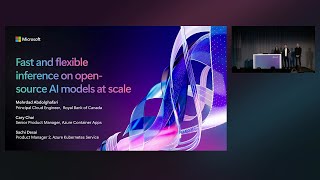
Run open-source AI models of your choice with flexibility—from local environments to cloud deployments using Azure Container Apps and serverless GPUs for fast, cost-efficient inferencing. You will also learn how AKS powers scalable, high-performance LLM operations with fine-tuned control, giving you confidence to deploy your models your way. You’ll leave with a clear path to run custom and OSS models with agility and cost clarity.
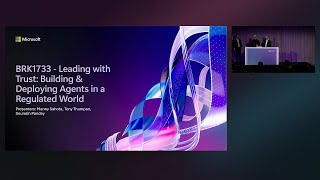
AI and cyber regulations are accelerating worldwide. Learn how Microsoft Purview Compliance Manager, Regulatory Navigator, and Defender for Cloud align controls to laws like the EU AI Act, NIS2, DORA, and DPDP India; monitor posture in real time; and embed Responsible AI—turning regulatory resilience into cyber resilience and trusted innovation.
Whether you have basic or mature cloud cost management practices in your organization, AI workloads add specific considerations. Learn how AI usage correlates to cost, what to monitor, and how to drive accountability for your AI investment, with Azure tools and industry best practices.
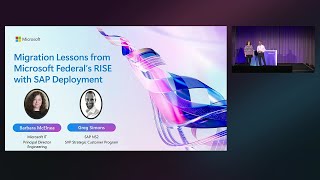
Learn how the Microsoft Federal team is modernizing SAP ERP with RISE on Microsoft Cloud. This includes High SLA infrastructure on Azure Government, SAP BTP integration, and AI-powered monitoring. Discover how Defender and Sentinel secure workloads, and how sovereignty solutions support compliance. Gain practical lessons and insights from a real-world deployment for regulated industries.
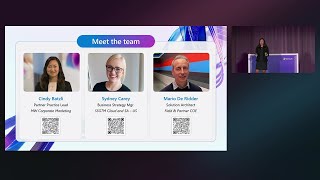
AI is redefining how customers work, secure, and manage their digital environments—and partners are key to unlocking that transformation. In this session, we’ll explore how Cloud and AI Endpoints across Windows 365, AVD, and Intune Suite are reshaping service delivery and customer value. Join us to gain actionable insights to evolve your practice, align with Microsoft’s strategic investments, get go-to-market guidance, and hear from partners achieving success in the Cloud-first, AI era.
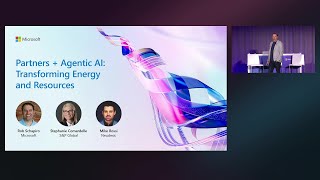
Energy and resources companies are using AI and agents to shape the new energy future by unlocking new levels of efficiency, resilience, and innovation. In this session, we will dive into Microsoft and partner solutions powering AI transformation and how energy and resource companies are becoming Frontier Firms.