talk-data.com talk-data.com

Topic

Analytics

data_analysis insights metrics

4552

tagged

Activity Trend

398 peak/qtr
2020-Q1 2026-Q1

Activities

4552 activities · Newest first

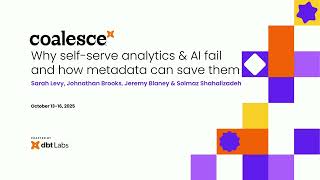
Why self-serve analytics & AI fail -- and how metadata can save them

Self-serve analytics promises speed. But without clear guidance, it often leads to hidden obstacles like cluttered dashboards, runaway costs, and a loss of trust in the data. Add AI to the mix, and those faults become fractures. In this session, we'll unpack why self-serve efforts stall, with lessons from real-world teams at Shopify and Tableau. We’ll also explore how BetterHelp uses dbt alongside Euno’s lineage and usage insights to declutter, cut compute costs, and determine which data assets and reports teams (and AI agents) can trust.

Brought to You By: •⁠ Statsig ⁠ — ⁠ The unified platform for flags, analytics, experiments, and more. Something interesting is happening with the latest generation of tech giants. Rather than building advanced experimentation tools themselves, companies like Anthropic, Figma, Notion and a bunch of others… are just using Statsig. Statsig has rebuilt this entire suite of data tools that was available at maybe 10 or 15 giants until now. Check out Statsig. •⁠ Linear – The system for modern product development. Linear is just so fast to use – and it enables velocity in product workflows. Companies like Perplexity and OpenAI have already switched over, because simplicity scales. Go ahead and check out Linear and see why it feels like a breeze to use. — What is it really like to be an engineer at Google? In this special deep dive episode, we unpack how engineering at Google actually works. We spent months researching the engineering culture of the search giant, and talked with 20+ current and former Googlers to bring you this deepdive with Elin Nilsson, tech industry researcher for The Pragmatic Engineer and a former Google intern. Google has always been an engineering-driven organization. We talk about its custom stack and tools, the design-doc culture, and the performance and promotion systems that define career growth. We also explore the culture that feels built for engineers: generous perks, a surprisingly light on-call setup often considered the best in the industry, and a deep focus on solving technical problems at scale. If you are thinking about applying to Google or are curious about how the company’s engineering culture has evolved, this episode takes a clear look at what it was like to work at Google in the past versus today, and who is a good fit for today’s Google. Jump to interesting parts: (13:50) Tech stack (1:05:08) Performance reviews (GRAD) (2:07:03) The culture of continuously rewriting things — Timestamps (00:00) Intro (01:44) Stats about Google (11:41) The shared culture across Google (13:50) Tech stack (34:33) Internal developer tools and monorepo (43:17) The downsides of having so many internal tools at Google (45:29) Perks (55:37) Engineering roles (1:02:32) Levels at Google  (1:05:08) Performance reviews (GRAD) (1:13:05) Readability (1:16:18) Promotions (1:25:46) Design docs (1:32:30) OKRs (1:44:43) Googlers, Nooglers, ReGooglers (1:57:27) Google Cloud (2:03:49) Internal transfers (2:07:03) Rewrites (2:10:19) Open source (2:14:57) Culture shift (2:31:10) Making the most of Google, as an engineer (2:39:25) Landing a job at Google — The Pragmatic Engineer deepdives relevant for this episode: •⁠ Inside Google’s engineering culture •⁠ Oncall at Google •⁠ Performance calibrations at tech companies •⁠ Promotions and tooling at Google •⁠ How Kubernetes is built •⁠ The man behind the Big Tech comics: Google cartoonist Manu Cornet — Production and marketing by ⁠⁠⁠⁠⁠⁠⁠⁠https://penname.co/⁠⁠⁠⁠⁠⁠⁠⁠. For inquiries about sponsoring the podcast, email [email protected].

Get full access to The Pragmatic Engineer at newsletter.pragmaticengineer.com/subscribe

Teams across industries spend countless hours every week, month, and quarter creating data-driven slide decks and documents for leadership reviews, business updates, and client reporting—even though the data lives in their BI tools. This “last mile” of data reporting remains highly manual, repetitive, and a drain on strategic bandwidth. In this session, we’ll share how leading companies are automating this process with Rollstack: Sony Music’s The Orchard streamlines leadership business reviews and scales reporting across its network of labels, enabling its lean Analytics team to focus on insights instead of slide production. CarGurus empowers its Customer Success teams to scale client QBR reporting, ensuring consistent, reliable outputs while saving hours of manual work. Join us to see how these organizations are transforming reporting workflows and giving their teams more time to focus on decisions that move the business forward—instead of being stuck as PowerPoint jockeys.

Dexcom’s journey to modernize manufacturing data analytics

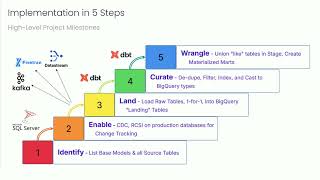
Learn how a small team at Dexcom used dbt to unify hundreds of global manufacturing data tables into 30 analytics-ready models—delivering sub-15-minute freshness and complex processing at scale. The result: faster, smarter manufacturing decisions that support the timely delivery of technology that has transformed how people manage diabetes and track their glucose.

From merge to momentum: How Virgin Media O2 built scalable self-service with dbt across two orgs

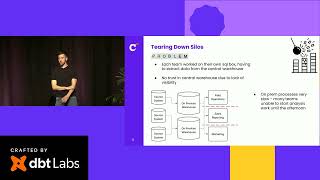
Merging two large organizations with different tools, teams, and data practices is never simple. At Virgin Media O2, we used dbt to help bring consistency to that complexity, building a hybrid data mesh that supported self-serve analytics across domains. In this session, we’ll share how we gave teams clearer ownership, put governance in place using dbt, and set up secure data sharing through GCP’s Analytics Hub. If you’re working in a federated or fast-changing environment, this session offers practical lessons for making self-serve work at scale.

Step into a dynamic, interactive session where you'll experience the data transformation journey from multiple angles: Data Engineer, Manager, Analytics VP, and Chief Data Officer. This immersive tabletop exercise isn’t your typical panel or demo—it’s a high-empathy, scenario-driven experience designed to build cross-role understanding and alignment across the modern data stack. Each scene drops you into a real-world challenge—whether it's data trust issues, managing cost pressures, or preparing for an AI initiative—and forces a go/no-go decision with your peers. You’ll explore how your choices impact others across the org, from the technical trenches to the boardroom. Whether you're a practitioner, leader, or executive, this session will help you see data not just as pipelines and dashboards, but as a 360-degree opportunity to drive business change. Walk away with a clear picture of the capabilities your team needs (without naming products) and a roadmap for building champions across your org.

Get certified at Coalesce! Choose from two certification exams: The dbt Analytics Engineering Certification Exam is designed to evaluate your ability to: Build, test, and maintain models to make data accessible to others Use dbt to apply engineering principles to analytics infrastructure We recommend that you have at least SQL proficiency and have had 6+ months of experience working in dbt (self-hosted dbt or the dbt platform) before attempting the exam. The dbt Architect Certification Exam assesses your ability to: Design secure, scalable dbt implementations, with a focus on environment orchestration Role-based access control Integrations with other tools Collaborative development workflows aligned with best practices What to expect Your purchase includes sitting for one attempt at one of the two in-person exams at Coalesce You will let the proctor know which certification you are sitting for Please arrive on time, this is a closed-door certification, and attendees will not be let in after the doors are closed What to bring You will need to bring your own laptop to take the exam Duration: 2 Hours Fee: $100 Trainings and certifications are not offered separately and must be purchased with a Coalesce pass Trainings and certifications are not available for Coalesce Online passes If you no-show your certification, you will not be refunded

How to scale dbt across independent teams with IaC

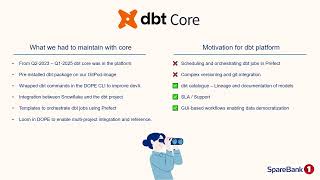
How do you deliver a modern, governed analytics stack to dozens of independent and competing companies, each with their own priorities, budgets, and data platforms? SpareBank 1 built a platform-as-a-service using Infrastructure as Code to provision dbt environments on demand. This session shares how SB1 modernized legacy data warehouses and scaled dbt across a network of banks, offering lessons for any organization supporting multiple business units or regions.

  • Mat-adata Yoga is currently full * If you are still interested in this class, complete THIS FORM to be added to the waitlist. The Coalesce team will be in touch via email if a spot opens up. Start your Coalesce day by untangling more than just your joins. In this structured yoga flow, we’ll stretch out the tension that’s been building from waiting on AI analytics to actually work. Just like data teams use Euno to unlock the power of the metadata they already have for governance and AI, this session will surface the strength you didn’t realize you’ve been storing. No yoga experience (or data catalog) required. Just bring yourself and a willingness to commit a few commits to your own wellbeing. As our guru/CEO likes to say: clear mind, clear context. Hosted by Euno 💜

The world of data is being reset by AI, and the infrastructure needs to evolve with it. I sit down with streaming legend Tyler Akidau to discuss how the principles of stream processing are forming the foundation for the next generation of "agentic AI" systems. Tyler, who was an AI cynic until recently, explains why he's now convinced that AI agents will fundamentally change how businesses operate and what problems we need to solve to deploy them safely. Key topics we explore: From Human Analytics to Agentic Systems: How data architectures built for human analysis must be re-imagined for a world with thousands of AI agents operating at machine speed.Auditing Everything: Why managing AI requires a new level of governance where we must record all data an agent touches, not just metadata, to diagnose its complex and opaque behaviorThe End of Windowing's Dominance: Tyler reflects on the influential Dataflow paper he co-authored and explains why he now sees a table-based abstraction as a more powerful and user-friendly model than focusing on windowing.The D&D Alignment of AI: Tyler's brilliant analogy for why enterprises are struggling to adopt AI: we're trying to integrate "chaotic" agents into systems built for "lawful good" employees.A Reset for the Industry: Why the rise of AI feels like the early 2010s of streaming, where the problems are unsolved and everyone is trying to figure out the answers.

Data interviews do not have to feel messy. In this episode, I share a simple AI Interview Copilot that works for data analyst, data scientist, analytics engineer, product analyst, and marketing analyst roles. What you will learn today: How to Turn a Job Post into a Skills Map: Know Exactly What to Study First.How to build role-specific SQL drills (joins, window functions, cohorts, retention, time series).How to practice product/case questions that end with a decision and a metric you can defend.How to prepare ML/experimentation basics (problem framing, features, success metrics, A/B test sanity checks).How to plan take-home assignments (scope, assumptions, readable notebook/report structure).How to create a 6-story STAR bank with real numbers and clear outcomes.How to follow a 7-day rhythm so you make steady progress without burnout.How to keep proof of progress so your confidence comes from evidence, not hope.Copy-and-use prompts from the show: JD → Skills Map: “Parse this job post. Table: Skill/Theme | Where mentioned | My level (guess) | Study action | Likely interview questions. Then give 5 bullets: what they are really hiring for.”SQL Drill Factory (Analyst/Product/Marketing): “Create 20 SQL tasks + hint + how to check results using orders, users, events, campaigns. Emphasize joins, windows, conditional agg, cohorts, funnels, retention, time windows.”Case Coach (Data/Product): “Run a 15-minute case: key metric is down. Ask one question at a time. Score clarity, structure, metrics, trade-offs. End with gaps + practice list.”ML/Experimentation Basics (Data Science): “Create a 7-step outline for framing a modeling problem (goal, data, features, baseline, evaluation, risks, comms). Add an A/B test sanity checklist (power, SRM, population, metric guardrails).”Take-Home Planner: “Given this brief, propose scope, data assumptions, 3–5 analysis steps, visuals, and a short results section. Output a clear report outline.”Behavioral STAR Bank: “Draft 6 STAR stories (120s) for conflict, ambiguity, failure, leadership without title, stakeholder influence, measurable impact. Put numbers in Results.”

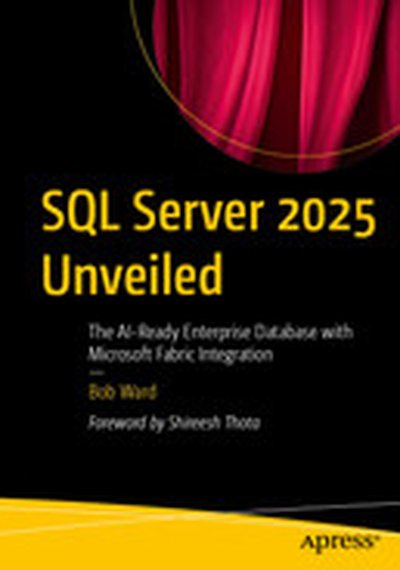
SQL Server 2025 Unveiled: The AI-Ready Enterprise Database with Microsoft Fabric Integration

Unveil the data platform of the future with SQL Server 2025—guided by one of its key architects . With built-in AI for application development and advanced analytics powered by Microsoft Fabric, SQL Server 2025 empowers you to innovate—securely and confidently. This book shows you how. Author Bob Ward, Principal Architect for the Microsoft Azure Data team, shares exclusive insights drawn from over three decades at Microsoft. Having worked on every version of SQL Server since OS/2 1.1, Ward brings unmatched expertise and practical guidance to help you navigate this transformative release. Ward covers everything from setup and upgrades to advanced features in performance, high availability, and security. He also highlights what makes this the most developer-friendly release in a decade: support for JSON, RegEx, REST APIs, and event streaming. Most critically, Ward explores SQL Server 2025’s advanced, scalable AI integrations, showing you how to build AI-powered applications deeply integrated with the SQL engine—and elevate your analytics to the next level. But innovation doesn’t come at the cost of safety: this release is built on a foundation of enterprise-grade security, helping you adopt AI safely and responsibly. You control which models to use, how they interact with your data, and where they run—from ground to cloud, or integrated with Microsoft Fabric. With built-in features like Row-Level Security (RLS), Transparent Data Encryption (TDE), Dynamic Data Masking, and SQL Server Auditing, your data remains protected at every layer. The AI age is here. Make sure your SQL Server databases are ready—and built for secure, scalable innovation . What You Will Learn [if !supportLists] · [endif]Grasp the fundamentals of AI to leverage AI with your data, using the industry-proven security and scale of SQL Server [if !supportLists] · [endif]Utilize AI models of your choice, services, and frameworks to build new AI applications [if !supportLists] · [endif]Explore new developer features such as JSON, Regular Expressions, REST API, and Change Event Streaming [if !supportLists] · [endif]Discover SQL Server 2025's powerful new engine capabilities to increase application concurrency [if !supportLists] · [endif]Examine new high availability features to enhance uptime and diagnose complex HADR configurations [if !supportLists] · Use new query processing capabilities to extend the performance of your application [if !supportLists] · [endif]Connect SQL Server to Azure with Arc for advanced management and security capabilities [if !supportLists] · [endif]Secure and govern your data using Microsoft Entra [if !supportLists] · [endif]Achieve near-real-time analytics with the unified data platform Microsoft Fabric [if !supportLists] · [endif]Integrate AI capabilities with SQL Server for enterprise AI [if !supportLists] · [endif]Leverage new tools such as SQL Server Management Studio and Copilot experiences to assist your SQL Server journey Who This Book Is For The SQL Server community, including DBAs, architects, and developers eager to stay ahead with the latest advancements in SQL Server 2025, and those interested in the intersection of AI and data, particularly how artificial intelligence (AI) can be seamlessly integrated with SQL Server to unlock deeper insights and smarter solutions

Tuesday afternoon keynote: Rewrite what's possible

The future of AI is here. Join AI and data industry thought leader Ashley Kramer from OpenAI as she shares how AI-powered development and intelligent systems act as force multipliers for organizations—and how to confidently embrace these accelerants at scale. In the second half of the keynote, she'll be joined by a panel of product leaders from across the data stack for a discussion on the future of analytics in an AI-driven world and how dbt and ecosystem partners are innovating to rewrite what’s possible: turning yesterday's science fiction into today's reality. For our Coalesce Online attendees, join us on Slack in #coalesce-2025 to stay connected during keynote!

Ascending data Everest: Ericsson's climb to scalable analytics

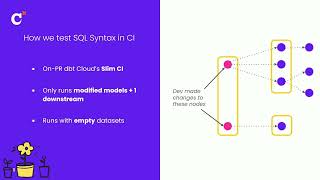
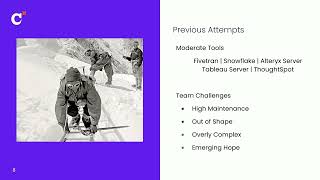
Learn how Ericsson’s Enterprise Wireless Solutions team modernized its analytics stack, replacing legacy tools like Alteryx and ThoughtSpot with scalable, modular data models powered by the dbt platform. With a lean team, we tackled SOX compliance, streamlined operations, and expanded from internal analytics to external analytics. Now we're starting to use the new dbt Fusion engine to accelerate development and more tightly manage costs. Find out how we climbed from legacy limitations to enterprise-grade analytics performance.

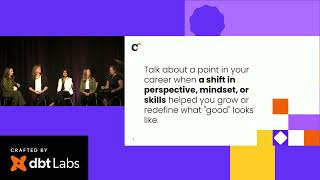
Women in data: Redefining influence in technical data roles

In data and analytics, influence often shows up in less visible ways, through the systems you build, the decisions you shape, and the trust you earn. This panel brings together women working across the data stack to talk candidly about how they’ve made an impact in their roles.

What’s the big deal about Apache Iceberg anyway? "Might Iceberg solve problems for my team?" "I’m using Iceberg already, but I find it lacking in key areas!" If you have any of the above thoughts, this peer exchange is for you! Last year’s peer exchange on Apache Iceberg was standing room only given all the hype surrounding the open table format. However, when participants were asked asked when they might start testing Iceberg capabilities, most said: “wait at least a few months for the dust to settle”. So now we’re a year later, the dust has settled, adoption of Iceberg by analytics engineers continue to grow. But, there’s still some open questions and product integrations to be built. Join your peers in socially constructing knowledge that’ll inform you for the year to come and beyond!

Get certified at Coalesce! Choose from two certification exams: The dbt Analytics Engineering Certification Exam is designed to evaluate your ability to: Build, test, and maintain models to make data accessible to others Use dbt to apply engineering principles to analytics infrastructure We recommend that you have at least SQL proficiency and have had 6+ months of experience working in dbt (self-hosted dbt or the dbt platform) before attempting the exam. The dbt Architect Certification Exam assesses your ability to: Design secure, scalable dbt implementations, with a focus on environment orchestration Role-based access control Integrations with other tools Collaborative development workflows aligned with best practices What to expect Your purchase includes sitting for one attempt at one of the two in-person exams at Coalesce You will let the proctor know which certification you are sitting for Please arrive on time, this is a closed-door certification, and attendees will not be let in after the doors are closed What to bring You will need to bring your own laptop to take the exam Duration: 2 Hours Fee: $100 Trainings and certifications are not offered separately and must be purchased with a Coalesce pass Trainings and certifications are not available for Coalesce Online passes If you no-show your certification, you will not be refunded