talk-data.com talk-data.com

Topic

Analytics

data_analysis insights metrics

4552

tagged

Activity Trend

398 peak/qtr
2020-Q1 2026-Q1

Activities

4552 activities · Newest first

Hands-On Healthcare Data

Healthcare is the next frontier for data science. Using the latest in machine learning, deep learning, and natural language processing, you'll be able to solve healthcare's most pressing problems: reducing cost of care, ensuring patients get the best treatment, and increasing accessibility for the underserved. But first, you have to learn how to access and make sense of all that data. This book provides pragmatic and hands-on solutions for working with healthcare data, from data extraction to cleaning and harmonization to feature engineering. Author Andrew Nguyen covers specific ML and deep learning examples with a focus on producing high-quality data. You'll discover how graph technologies help you connect disparate data sources so you can solve healthcare's most challenging problems using advanced analytics. You'll learn: Different types of healthcare data: electronic health records, clinical registries and trials, digital health tools, and claims data The challenges of working with healthcare data, especially when trying to aggregate data from multiple sources Current options for extracting structured data from clinical text How to make trade-offs when using tools and frameworks for normalizing structured healthcare data How to harmonize healthcare data using terminologies, ontologies, and mappings and crosswalks

Snowflake: The Definitive Guide

Snowflake's ability to eliminate data silos and run workloads from a single platform creates opportunities to democratize data analytics, allowing users at all levels within an organization to make data-driven decisions. Whether you're an IT professional working in data warehousing or data science, a business analyst or technical manager, or an aspiring data professional wanting to get more hands-on experience with the Snowflake platform, this book is for you. You'll learn how Snowflake users can build modern integrated data applications and develop new revenue streams based on data. Using hands-on SQL examples, you'll also discover how the Snowflake Data Cloud helps you accelerate data science by avoiding replatforming or migrating data unnecessarily. You'll be able to: Efficiently capture, store, and process large amounts of data at an amazing speed Ingest and transform real-time data feeds in both structured and semistructured formats and deliver meaningful data insights within minutes Use Snowflake Time Travel and zero-copy cloning to produce a sensible data recovery strategy that balances system resilience with ongoing storage costs Securely share data and reduce or eliminate data integration costs by accessing ready-to-query datasets available in the Snowflake Marketplace

In this episode, we’re talking to Brook Lovatt, Chief Executive Officer at Cloudentity. Cloudentity is a company that provides application and security teams with a better way to automate and control how information is shared over APIs.   We talk about the problems Cloudentity solves and how it came to be, along with the options available to today’s SaaS companies when it comes to building a security authorization layer. Brook shares some of the positive impacts of facilitating data sharing.   We discuss the differences between data and API, how SaaS has changed over time, the shift towards more product-oriented CEOs (and the advantages of this as a company scales), and the trend of selling software directly to developers.   Finally, we look at the growing importance of being a product specialist, and what the future holds for SaaS and developers.   This episode is brought to you by Qrvey The tools you need to take action with your data, on a platform built for maximum scalability, security, and cost efficiencies. If you’re ready to reduce complexity and dramatically lower costs, contact us today at qrvey.com. Qrvey, the modern no-code analytics solution for SaaS companies on AWS. 

Today, I chat with Manav Misra, Chief Data and Analytics Officer at Regions Bank. I begin by asking Manav what it was like to come in and implement a user-focused mentality at Regions, driven by his experience in the software industry. Manav details his approach, which included developing a new data product partner role and using effective communication to gradually gain trust and cooperation from all the players on his team. 

Manav then talks about how, over time, he solidified a formal framework for his team to be trained to use this approach and how his hiring is influenced by a product orientation. We also discuss his definition of data product at Regions, which I find to be one of the best I’ve heard to date. Today, Region Bank’s data products are delivering tens of millions of dollars in additional revenue to the bank. Given those results, I also dig into the role of design and designers to better understand who is actually doing the designing of Regions’ data products to make them so successful. Later, I ask Manav what it’s like when designers and data professionals work on the same team and how UX and data visualization design are handled at the bank. 

Towards the end, Manav shares what he has learned from his time at Regions and what he would implement in a new organization if starting over. He also expounds on the importance of empowering his team to ask customers the right questions and how a true client/stakeholder partnership has led to Manav’s most successful data products.

Highlights / Skip to:

Brief history of decision science and how it influenced the way data science and analytics work has been done (and unfortunately still is in many orgs) (1:47) Manav’s philosophy and methods for changing the data science culture at Regions Bank to being product and user-driven (5:19) Manav talks about the size of his team and the data product role within the team as well as what he had to do to convince leadership to buy in to the necessity of the data product partner role (10:54) Quantifying and measuring the value of data products at Regions and some of his results (which include tens of millions of dollars in additional revenue) (13:05) What’s a “data product” at Regions? Manav shares his definition (13:44) Who does the designing of data products at Regions? (17:00) The challenges and benefits of having a team comprised of both designers and data scientists (20:10) Lessons Manav has learned from building his team and culture at Regions (23:09) How Manav coaches his team and gives them the confidence to ask the right questions (27:17) How true partnership has led to Manav’s most successful data products (31:46)

Quotes from Today’s Episode Re: how traditional, non-product oriented enterprises do data work: “As younger people come out of data science programs…that [old] culture is changing. The folks coming into this world now are looking to make an impact and then they want to see what this can do in the real world.” — Manav 

On the role of the Data Product Partner: “We brought in people that had both business knowledge as well as the technical knowledge, so with a combination of both they could talk to the ‘Internal customers,’ of our data products, but they could also talk to the data scientists and our developers and communicate in both directions in order to form that bridge between the two.” — Manav

“There are products that are delivering tens of millions of dollars in terms of additional revenue, or stopping fraud, or any of those kinds of things that the products are designed to address, they’re delivering and over-delivering on the business cases that we created.” — Manav 

“The way we define a data product is this: an end-to-end software solution to a problem that the business has. It leverages data and advanced analytics heavily in order to deliver that solution.” — Manav 

“The deployment and operationalization is simply part of the solution. They are not something that we do after; they’re something that we design in from the start of the solution.” — Brian 

“Design is a team sport. And even if you don’t have a titled designer doing the work, if someone is going to use the solution that you made, whether it’s a dashboard, or report, or an email, or notification, or an application, or whatever, there is a design, whether you put intention behind it or not.” — Brian

“As you look at interactive components in your data product, which are, you know, allowing people to ask questions and then get answers, you really have to think through what that interaction will look like, what’s the best way for them to get to the right answers and be able to use that in their decision-making.” — Manav 

“I have really instilled in my team that tools will come and go, technologies will come and go, [and so] you’ll have to have that mindset of constantly learning new things, being able to adapt and take on new ideas and incorporate them in how we do things.” — Manav

Links Regions Bank: https://www.regions.com/ LinkedIn: https://www.linkedin.com/in/manavmisra/

Effective Data Science Infrastructure

Simplify data science infrastructure to give data scientists an efficient path from prototype to production. In Effective Data Science Infrastructure you will learn how to: Design data science infrastructure that boosts productivity Handle compute and orchestration in the cloud Deploy machine learning to production Monitor and manage performance and results Combine cloud-based tools into a cohesive data science environment Develop reproducible data science projects using Metaflow, Conda, and Docker Architect complex applications for multiple teams and large datasets Customize and grow data science infrastructure Effective Data Science Infrastructure: How to make data scientists more productive is a hands-on guide to assembling infrastructure for data science and machine learning applications. It reveals the processes used at Netflix and other data-driven companies to manage their cutting edge data infrastructure. In it, you’ll master scalable techniques for data storage, computation, experiment tracking, and orchestration that are relevant to companies of all shapes and sizes. You’ll learn how you can make data scientists more productive with your existing cloud infrastructure, a stack of open source software, and idiomatic Python. The author is donating proceeds from this book to charities that support women and underrepresented groups in data science. About the Technology Growing data science projects from prototype to production requires reliable infrastructure. Using the powerful new techniques and tooling in this book, you can stand up an infrastructure stack that will scale with any organization, from startups to the largest enterprises. About the Book Effective Data Science Infrastructure teaches you to build data pipelines and project workflows that will supercharge data scientists and their projects. Based on state-of-the-art tools and concepts that power data operations of Netflix, this book introduces a customizable cloud-based approach to model development and MLOps that you can easily adapt to your company’s specific needs. As you roll out these practical processes, your teams will produce better and faster results when applying data science and machine learning to a wide array of business problems. What's Inside Handle compute and orchestration in the cloud Combine cloud-based tools into a cohesive data science environment Develop reproducible data science projects using Metaflow, AWS, and the Python data ecosystem Architect complex applications that require large datasets and models, and a team of data scientists About the Reader For infrastructure engineers and engineering-minded data scientists who are familiar with Python. About the Author At Netflix, Ville Tuulos designed and built Metaflow, a full-stack framework for data science. Currently, he is the CEO of a startup focusing on data science infrastructure. Quotes By reading and referring to this book, I’m confident you will learn how to make your machine learning operations much more efficient and productive. - From the Foreword by Travis Oliphant, Author of NumPy, Founder of Anaconda, PyData, and NumFOCUS Effective Data Science Infrastructure is a brilliant book. It’s a must-have for every data science team. - Ninoslav Cerkez, Logit More data science. Less headaches. - Dr. Abel Alejandro Coronado Iruegas, National Institute of Statistics and Geography of Mexico Indispensable. A copy should be on every data engineer’s bookshelf. - Matthew Copple, Grand River Analytics

podcast_episode
by Dante DeAntonio (Moody's Analytics) , Cris deRitis , Mark Zandi (Moody's Analytics) , Marisa DiNatale (Moody's Analytics) , Ryan Sweet

Mark, Ryan and Cris welcome colleagues, Marisa DiNatale and Dante DeAntonio, to dig deep into the July U.S. employment report. They also discuss what the new data tells us about a recession, productivity and what it means for the Federal Reserve.  Follow Mark Zandi @MarkZandi, Ryan Sweet @RealTime_Econ and Cris deRitis @MiddleWayEcon for additional insight.

Questions or Comments, please email us at [email protected]. We would love to hear from you.    To stay informed and follow the insights of Moody's Analytics economists, visit Economic View.

In this episode, we’re talking to Ken Babcock, Co-Founder of Tango. Tango is a platform for building beautiful step-by-step how-to guides with screenshots, in seconds.   Ken talks about meeting his co-founders at Harvard Business School and how the project got started, and we go on to discuss how well-defined processes and documentation can make a company much more scalable. How has the pandemic and the rise of remote work affected the need for clear instructions and documentation?   We talk about how SaaS companies can help other businesses transition to the digital world and the role well-documented processes play here. Is there a difference between B2B and B2C SaaS companies when it comes to digital transformation? We also discuss how companies might sometimes grow too fast and hinder progress this way.   Finally, we talk about the pros and cons of VC funding and what the near future holds for Tango.   This episode is brought to you by Qrvey The tools you need to take action with your data, on a platform built for maximum scalability, security, and cost efficiencies. If you’re ready to reduce complexity and dramatically lower costs, contact us today at qrvey.com. Qrvey, the modern no-code analytics solution for SaaS companies on AWS. 

Professional sports have undergone a true data revolution over the last two decades. Today, all major sports teams, regardless of sports code, use analytics and data science to drive team performance, optimise game outcomes and scout young talent. Why has analytics become so popular in professional sports and how does it help drive a competitive edge? To answer these questions and many more relating to the sports analytics, I recently spoke to Ari Kaplan. Ari has spent more than three decades using analytics to measure and understand human ability, scout future superstars and win professional sports titles. He is known as “The Real Moneyball Guy” because of his work in baseball and his involvement in making the Hollywood classic Moneyball. Today, Ari is Global AI Evangelist at DataRobot. Listen to this episode of Leaders of Analytics to learn: How Ari became “the Real Moneyball Guy”The analytics the Chicago Cubs used to break a 108-year drought by winning the World Series in 2016The evolution of analytics and data science in sportsWhat the business world can learn from sports in terms of using analytics to gain a competitive edgeWhere sports analytics is going in the future, and much more.

One of the biggest challenges facing the adoption of machine learning and AI in Data Science is understanding, interpreting, and explaining models and their outcomes to produce higher certainty, accountability, and fairness.

Serg Masis is a Climate & Agronomic Data Scientist at Syngenta and the author of the book, Interpretable Machine Learning with Python. For the last two decades, Serg has been at the confluence of the internet, application development, and analytics. Serg is a true polymath. Before his current role, he co-founded a search engine startup incubated by Harvard Innovation Labs, was the proud owner of a Bubble Tea shop, and more.

Throughout the episode, Serg spoke about the different challenges affecting model interpretability in machine learning, how bias can produce harmful outcomes in machine learning systems, the different types of technical and non-technical solutions to tackling bias, the future of machine learning interpretability, and much more.

podcast_episode
by Cris deRitis , Mark Zandi (Moody's Analytics) , Alan S. Blinder (Princeton University)

Mark and Cris welcome Alan Blinder, Professor of Economics and Public Affairs at Princeton University, to discuss the prospects for recession, inflation, monetary policy and financial conditions. Follow Mark Zandi @MarkZandi, Ryan Sweet @RealTime_Econ and Cris deRitis @MiddleWayEcon for additional insight.

Questions or Comments, please email us at [email protected]. We would love to hear from you.    To stay informed and follow the insights of Moody's Analytics economists, visit Economic View.

Send us a text Datatopics is a podcast presented by Kevin Missoorten to talk about the fuzzy and misunderstood concepts in the world of data, analytics and AI and get to the bottom of things. In this summer episode we are joined by Toby Nguyen, Founder of DAIRE. Together Kevin, Murilo Cunha and Toby - a true Metaverse expert - zoom in on the Metaverse and more specifically on the role of data & AI in the Metaverse and vice versa.

Datatopics is brought to you by Dataroots Music: The Gentlemen - DivKidThe thumbnail is generated by DALLE-2

Katie was a founding member of Reddit's data science team and, currently, as Twitter's Data Science Manager, she leads the company's infrastructure data science and analytics organization. In this conversation with Tristan and Julia, Katie explores how, as a manager, to help data people (especially those new to the field!) do their best work. For full show notes and to read 6+ years of back issues of the podcast's companion newsletter, head to https://roundup.getdbt.com.  The Analytics Engineering Podcast is sponsored by dbt Labs.

Simplifying Data Engineering and Analytics with Delta

This book will guide you through mastering Delta, a robust and versatile protocol for data engineering and analytics. You'll discover how Delta simplifies data workflows, supports both batch and streaming data, and is optimized for analytics applications in various industries. By the end, you will know how to create high-performing, analytics-ready data pipelines. What this Book will help me do Understand Delta's unique offering for unifying batch and streaming data processing. Learn approaches to address data governance, reliability, and scalability challenges. Gain technical expertise in building data pipelines optimized for analytics and machine learning use. Master core concepts like data modeling, distributed computing, and Delta's schema evolution features. Develop and deploy production-grade data engineering solutions leveraging Delta for business intelligence. Author(s) Anindita Mahapatra is an experienced data engineer and author with years of expertise in working on Delta and data-driven solutions. Her hands-on approach to explaining complex data concepts makes this book an invaluable resource for professionals in data engineering and analytics. Who is it for? Ideal for data engineers, data analysts, and anyone involved in AI/BI workflows, this book suits learners with some basic knowledge of SQL and Python. Whether you're an experienced professional or looking to upgrade your skills with Delta, this book will provide practical insights and actionable knowledge.

Welcome to the latest episode of SaaS Scaled. Today we’re joined by Chris Wacker, CEO at Laserfiche, the leading SaaS provider of intelligent content management and business process automation.   We chat about how Laserfiche came into being, how SaaS has changed and impacted business over the years, the impact of Covid, and the impact of widespread digital transformation on the world. Chris shares some of the key principles that make a SaaS team and product successful.   We go on to discuss the difference between short- and long-term thinking with SaaS and how to strike the right balance here, both in SaaS and in business generally. Finally, Chris shares a book that has had a big impact on him.   This episode is brought to you by Qrvey The tools you need to take action with your data, on a platform built for maximum scalability, security, and cost efficiencies. If you’re ready to reduce complexity and dramatically lower costs, contact us today at qrvey.com. Qrvey, the modern no-code analytics solution for SaaS companies on AWS.   

podcast_episode
by Val Kroll , Julie Hoyer , Tim Wilson (Analytics Power Hour - Columbus (OH) , Moe Kiss (Canva) , Michael Helbling (Search Discovery)

We've always said that the genesis of this podcast was the lobby bar of analytics conferences across multiple continents, and this year's Marketing Analytics Summit in Las Vegas was a reminder of our roots on that front. All three co-hosts made the trip to Caesars Palace for the event. Moe presented on bringing a product mindset to analytics (by "presented on," we mean "workshopped content for a future podcast episode"), and the closing keynote was a recording of the show in front of a live (and thoughtful and engaged) audience. Give it a listen, and it will almost be like you were there! For complete show notes, including links to items mentioned in this episode and a transcript of the show, visit the show page.

In today’s episode of SaaS Scaled, we’re talking to Maria Thomas. Maria is Chief Product Officer at Buffer, a SaaS company building a social media and organic marketing platform for small businesses. Maria focuses on the design elements of marketing and engineering.    We chat about the main problems Buffer solves and how it came into being, and Maria talks about the importance of transparency within SaaS companies and the benefits of being a value-driven company.   We go on to discuss the future — how are Web3, decentralization, and other emerging technologies changing the way the internet works and how people monetize their work? Maria talks about vision and how Buffer defines its vision in a more narrow sense.   This episode is brought to you by Qrvey The tools you need to take action with your data, on a platform built for maximum scalability, security, and cost efficiencies. If you’re ready to reduce complexity and dramatically lower costs, contact us today at qrvey.com. Qrvey, the modern no-code analytics solution for SaaS companies on AWS. 

podcast_episode
by Cris deRitis , Scott Hoyt (Moody's Analytics) , Mark Zandi (Moody's Analytics) , Ryan Sweet

Mark, Ryan, and Cris welcome colleague, Scott Hoyt, Senior Director at Moody's Analytics, to dissect the state of American consumers and how they are the firewall to avoiding a U.S. recession. Full Episode transcript Follow Mark Zandi @MarkZandi, Ryan Sweet @RealTime_Econ and Cris deRitis @MiddleWayEcon for additional insight.

Questions or Comments, please email us at [email protected]. We would love to hear from you.    To stay informed and follow the insights of Moody's Analytics economists, visit Economic View.

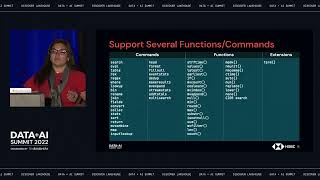
Cutting the Edge in Fighting Cybercrime: Reverse-Engineering a Search Language to Cross-Compile

Traditional cybersecurity Security Information and Event Management (SIEM) ways do not scale well for data sources with 30TiB per day, leading HSBC to create a Cybersecurity Lakehouse with Delta and Spark. Creating a platform to overcome several conventional technical constraints, the limitation in the amount of data for long-term analytics available in traditional platforms and query languages is difficult to scale and time-consuming to run. In this talk, we’ll learn how to implement (or actually reverse-engineer) a language with Scala and translate it into what Apache Spark understands, the Catalyst engine. We’ll guide you through the technical journey of building equivalents of a query language into Spark. We’ll learn how HSBC business benefited from this cutting-edge innovation, like decreasing time and resources for Cyber data processing migration, improving Cyber threat Incident Response, and fast onboarding of HSBC Cyber Analysts on Spark with Cybersecurity Lakehouse platform.

Connect with us: Website: https://databricks.com Facebook: https://www.facebook.com/databricksinc Twitter: https://twitter.com/databricks LinkedIn: https://www.linkedin.com/company/data... Instagram: https://www.instagram.com/databricksinc/

It’s no secret that data and analytics can be used to create a competitive advantage for almost any modern business. In fact, the customer data you capture in the course of doing business is one of the strongest differentiators between you and the competition. So, how do we build an organisation that is capable of both producing and consuming truly differentiating data products? It’s not enough to just have a great analytics team that is capable of producing high quality work. We also need an organisation that is able to consume this output, however advanced it might be. Back by popular demand, analytics executive and author of ‘Building Analytics Teams’ John Thompson is returning to Leaders of Analytics to talk about the future of analytics leadership. In this episode, we discuss: Where analytics teams should sit in the organisational structureThe typical mistakes businesses make when designing analytics teams and embedding them in the organisationHow we plant the seed of advanced analytics and build a data-driven cultureHow we select and prioritise the right data and analytics projects to work onThe main purpose and remit of a Chief Data & Analytics OfficerWhat the perfect data-driven organisation looks like, and much more.John on LinkedIn: https://www.linkedin.com/in/johnkthompson/ John's book 'Building Analytics Teams': https://www.packtpub.com/product/building-analytics-teams/9781800203167 Defensive vs. offensive data & analytics: https://hbr.org/2017/05/whats-your-data-strategy

Send us a text Hey Folks! Back to school replay here while we edit some of our recent guests.  Enjoy!

Want to be featured as a guest on Making Data Simple? Reach out to us at [[email protected]] or for faster response, complete this form and tell us why you should be next.

Abstract Making Data Simple Podcast is hosted by Al Martin, WW VP Account Technical Leader IBM Technology Sales, where we explore trending technologies, business innovation, and leadership ... while keeping it simple & fun. This week on Making Data Simple, we have Ayal Steinburg VP, WW Data, AI, and Automation Sales Leader Global Markets. Ayal started off in music and then in the late 1990’s shifted to retail where he learned about data and analytics. In the past 20 years Ayal has held various sales rolls during his career.  Show Notes 9:18 – Ayal’s history11:50 – Ayal talks about his portfolio 16:16 – Market expansion and reducing costs19:02 – Platform and one product21:50 – Why IBM technologies?24:20 – Why are customers moving data?27:56 – Is “Switzerland” a hard or easy sell?30:52 – What is your biggest challenge right now?IBM Connect with the Team Producer Kate Brown - LinkedIn. Host Al Martin - LinkedIn and Twitter.  Want to be featured as a guest on Making Data Simple? Reach out to us at [email protected] and tell us why you should be next. The Making Data Simple Podcast is hosted by Al Martin, WW VP Technical Sales, IBM, where we explore trending technologies, business innovation, and leadership ... while keeping it simple & fun.