talk-data.com talk-data.com

Topic

Analytics

data_analysis insights metrics

4552

tagged

Activity Trend

398 peak/qtr
2020-Q1 2026-Q1

Activities

4552 activities · Newest first

Accelerating Analytics: Integrating BI and Partner Tools to Databricks SQL

This session is repeated. Did you know that you can integrate with your favorite BI tools directly from Databricks SQL? You don’t even need to stand up an additional warehouse. This session shows the integrations with Microsoft Power Platform, Power BI, Tableau and dbt so you can have a seamless integration experience. Directly connect your Databricks workspace with Fabric and Power BI workspaces or Tableau to publish and sync data models, with defined primary and foreign keys, between the two platforms.

In this course, you’ll learn how to orchestrate data pipelines with Lakeflow Jobs (previously Databricks Workflows) and schedule dashboard updates to keep analytics up-to-date. We’ll cover topics like getting started with Lakeflow Jobs, how to use Databricks SQL for on-demand queries, and how to configure and schedule dashboards and alerts to reflect updates to production data pipelines. Pre-requisites: Beginner familiarity with the Databricks Data Intelligence Platform (selecting clusters, navigating the Workspace, executing notebooks), cloud computing concepts (virtual machines, object storage, etc.), production experience working with data warehouses and data lakes, intermediate experience with basic SQL concepts (select, filter, groupby, join, etc), beginner programming experience with Python (syntax, conditions, loops, functions), beginner programming experience with the Spark DataFrame API (Configure DataFrameReader and DataFrameWriter to read and write data, Express query transformations using DataFrame methods and Column expressions, etc.) Labs: No Certification Path: Databricks Certified Data Engineer Associate

Getting Started With Lakeflow Connect

Hundreds of customers are already ingesting data with Lakeflow Connect from SQL Server, Salesforce, ServiceNow, Google Analytics, SharePoint, PostgreSQL and more to unlock the full power of their data. Lakeflow Connect introduces built-in, no-code ingestion connectors from SaaS applications, databases and file sources to help unlock data intelligence. In this demo-packed session, you’ll learn how to ingest ready-to-use data for analytics and AI with a few clicks in the UI or a few lines of code. We’ll also demonstrate how Lakeflow Connect is fully integrated with the Databricks Data Intelligence Platform for built-in governance, observability, CI/CD, automated pipeline maintenance and more. Finally, we’ll explain how to use Lakeflow Connect in combination with downstream analytics and AI tools to tackle common business challenges and drive business impact.

Sponsored by: Lovelytics | Predict and Mitigate Asset Risk: Unlock Geospatial Analytics with GenAI

Discover how Xcel Energy and Lovelytics leveraged the power of geospatial analytics and GenAI to tackle one of the energy sector’s most pressing challenges—wildfire prevention. Transitioning from manual processes to automated GenAI unlocked transformative business value, delivering over 3x greater data coverage, over 4x improved accuracy, and 64x faster processing of geospatial data. In this session, you'll learn how Databricks empowers data leaders to transform raw data, like location information and visual imagery, into actionable insights that save costs, mitigate risks, and enhance customer service. Walk away with strategies for scaling geospatial workloads efficiently, building GenAI-driven solutions, and driving innovation in energy and utilities.

Sponsored by: Qlik | Turning Data into Business Impact: How to Build AI-Ready, Trusted Data Products on Databricks

Explore how to build use case-specific data products designed to power everything from traditional BI dashboards to machine learning and LLM-enabled applications. Gain an understanding of what data products are and why they are essential for delivering AI-ready data that is integrated, timely, high-quality, secure, contextual, and easily consumable. Discover strategies for unlocking business data from source systems to enable analytics and AI use cases, with a deep dive into the three-tiered data product architecture: the Data Product Engineering Plane (where data engineers ingest, integrate, and transform data), the Data Product Management Plane (where teams manage the full lifecycle of data products), and the Data Product Marketplace Plane (where consumers search for and use data products). Discover how a flexible, composable data architecture can support organizations at any stage of their data journey and drive impactful business outcomes.

The Future of Real Time Insights with Databricks and SAP

Tired of waiting on SAP data? Join this session to see how Databricks and SAP make it easy to query business-ready data—no ETL. With Databricks SQL, you’ll get instant scale, automatic optimizations, and built-in governance across all your enterprise analytics data. Fast and AI-powered insights from SAP data are finally possible—and this is how.

ThredUp’s Journey with Databricks: Modernizing Our Data Infrastructure

Building an AI-ready data platform requires strong governance, performance optimization, and seamless adoption of new technologies. At ThredUp, our Databricks journey began with a need for better data management and evolved into a full-scale transformation powering analytics, machine learning, and real-time decision-making. In this session, we’ll cover: Key inflection points: Moving from legacy systems to a modernized Delta Lake foundation Unity Catalog’s impact: Improving governance, access control, and data discovery Best practices for onboarding: Ensuring smooth adoption for engineering and analytics teams What’s next? Serverless SQL and conversational analytics with Genie Whether you’re new to Databricks or scaling an existing platform, you’ll gain practical insights on navigating the transition, avoiding pitfalls, and maximizing AI and data intelligence.

Transforming Credit Analytics With a Compliant Lakehouse at Rabobank

This presentation outlines Rabobank Credit analytics transition to a secure, audit-ready data architecture using Unity Catalog (UC), addressing critical regulatory challenges in credit analytics for IRB and IFRS9 regulatory modeling. Key technical challenges included legacy infrastructure (Hive metastore, ADLS mounts using Service Principals and Credential passthrough) lacking granular access controls, data access auditing and limited visibility into lineage, creating governance and compliance gaps. Details cover a framework for phased migration to UC. Outcomes include data lineage mapping demonstrating compliance with regulatory requirements, granular role based access control and unified audit trails. Next steps involve a lineage visualization toolkit (custom app for impact analysis and reporting) and lineage expansion to incorporate upstream banking systems.

Transforming Government With Data and AI: Singapore GovTech's Journey With Databricks

GovTech is an agency in the Singapore Government focused on tech for good. The GovTech Chief Data Office (CDO) has built the GovTech Data Platform with Databricks at the core. As the government tech agency, we safeguard national-level government and citizen data. A comprehensive data strategy is essential to uplifting data maturity. GovTech has adopted the service model approach where data services are offered to stakeholders based on their data maturity. Their maturity is uplifted through partnership, readying them for more advanced data analytics. CDO offers a plethora of data assets in a “data restaurant” ranging from raw data to data products, all delivered via Databricks and enabled through fine-grained access control, underpinned by data management best practices such as data quality, security and governance. Within our first year on Databricks, CDO was able to save 8,000 man-hours, democratize data across 50% of the agency and achieve six-figure savings through BI consolidation.

podcast_episode
by Cris deRitis , Mark Zandi (Moody's Analytics) , Marisa DiNatale (Moody's Analytics) , Justin Begley (Moody's Analytics) , Sharon Parrott (Center on Budget and Policy Priorities)

Sharon Parrott, President of CBPP joins the Inside Economics team to consider the big package of tax and government spending provisions making its way through the legislative process. She explains why she’s not a fan, from its implications for the nation’s already dire fiscal situation to its hit to programs benefitting lower-income Americans, such as Medicaid and food assistance. Guests: Sharon Parrot - President of the Center on Budget and Policy Priorities and Justin Begley - Economist and U.S. fiscal policy SME, Moody's Analytics    Additional resources from Center on Budget and Policy Priorities By the Numbers: House Bill Takes Health Coverage Away From Millions of People and Raises Families' Health Care Costs 2025 Budget Impacts: House Bill Would Cut Assistance for Children, Raise Costs for Families House Republican Reconciliation Bill Would Hard Rural Households, Communities, and Economies   Hosts: Mark Zandi – Chief Economist, Moody’s Analytics, Cris deRitis – Deputy Chief Economist, Moody’s Analytics, Marisa DiNatale – Senior Director - Head of Global Forecasting, Moody’s Analytics Follow Mark Zandi on 'X', BlueSky or LinkedIn @MarkZandi, Cris deRitis on LinkedIn, and Marisa DiNatale on LinkedIn

Questions or Comments, please email us at [email protected]. We would love to hear from you.    To stay informed and follow the insights of Moody's Analytics economists, visit Economic View.

Today, I’m responding to a listener's question about what it takes to succeed as a data or AI product manager, especially if you’re coming from roles like design/BI/data visualization, data science/engineering, or traditional software product management. This reader correctly observed that most of my content “seems more targeted at senior leadership” — and had asked if I could address this more IC-oriented topic on the show. I’ll break down why technical chops alone aren’t enough, and how user-centered thinking, business impact, and outcome-focused mindsets are key to real success — and where each of these prior roles brings strengths and/or weaknesses. I’ll also get into the evolving nature of PM roles in the age of AI, and what I think the super-powered AI product manager will look like.

Highlights/ Skip to:

Who can transition into an AI and data product management role? What does it take? (5:29) Software product managers moving into  AI product management (10:05) Designers moving into data/AI product management (13:32) Moving into the AI PM role from the engineering side (21:47) Why the challenge of user adoption and trust is often the blocker to the business value (29:56) Designing change management into AI/data products as a skill (31:26) The challenge of value creation vs. delivery work — and how incentives are aligned for ICs  (35:17) Quantifying the financial value of data and AI product work(40:23)

Quotes from Today’s Episode

“Who can transition into this type of role, and what is this role? I’m combining these two things. AI product management often seems closely tied to software companies that are primarily leveraging AI, or trying to, and therefore, they tend to utilize this AI product management role. I’m seeing less of that in internal data teams, where you tend to see data product management more, which, for me, feels like an umbrella term that may include traditional analytics work, data platforms, and often AI and machine learning. I’m going to frame this more in the AI space, primarily because I think AI tends to capture the end-to-end product than data product management does more frequently.” — Brian (2:55)

“There are three disciplines I’m going to talk about moving into this role. Coming into AI and data PM from design and UX, coming into it from data engineering (or just broadly technical spaces), and then coming into it from software product management. I think software product management and moving into the AI product management - as long as you’re not someone that has two years of experience, and then 18 years of repeating the second year of experience over and over again - and you’ve had a robust product management background across some different types of products; you can show that the domain doesn’t necessarily stop you from producing value. I think you will have the easiest time moving into AI product management because you’ve shown that you can adapt across different industries.” - Brian (9:45)

“Let’s talk about designers next. I’m going to include data visualization, user experience research, user experience design, product design, all those types of broad design, category roles. Moving into data and/or AI product management, first of all, you don’t see too many—I don’t hear about too many designers wanting to move into DPM roles, because oftentimes I don’t think there’s a lot of heavy UI and UX all the time in that space. Or at least the teams that are doing that work feel that’s somebody else’s job because they’re not doing end-to-end product thinking the way I talk about it, so therefore, a lot of times they don’t see the application, the user experience, the human adoption, the change management, they’re just not looking at the world that way, even though I think they should be.” - Brian (13:32)

“Coming at this from the data and engineering side, this is the classic track for data product management. At least that is the way I tend to see it. I believe most companies prefer to develop this role in-house. My biggest concern is that you end up with job title changes, but not necessarily the benefits that are supposed to come with this. I do like learning by doing, but having a coach and someone senior who can coach your other PMs is important because there’s a lot of information that you won’t necessarily get in a class or a course. It’s going to come from experience doing the work.” - Brian (22:26)

“This value piece is the most important thing, and I want to focus on that. This is something I frequently discuss in my training seminar: how do we attach financial value to the work we’re doing? This is both art and science, but it’s a language that anyone in a product management role needs to be comfortable with. If you’re finding it very hard to figure out how your data product contributes financial value because it’s based on this waterfalling of “We own the model, and it’s deployed on a platform.” The platform then powers these other things, which in turn power an application. How do we determine the value of our tool? These things are challenging, and if it’s challenging for you, guess how hard it will be for stakeholders downstream if you haven’t had the practice and the skills required to understand how to estimate value, both before we build something as well as after?” - Brian (31:51)

“If you don’t want to spend your time getting to know how your business makes money or creates value, then [AI and data product management work] is not for you. It’s just not. I would stay doing what you’re doing already or find a different thing because a lot of your time is going to be spent “managing up” for half the time, and then managing the product stuff “down.” Then, sitting in this middle layer, trying to explain to the business what’s going to come out and what the impact is going to be, in language that they care about and understand. You can't be talking about models, model accuracy, data pipelines, and all that stuff. They’re not going to care about any of that. - Brian (34:08)

In this course, you’ll learn how to use the features Databricks provides for business intelligence needs: AI/BI Dashboards and AI/BI Genie. As a Databricks Data Analyst, you will be tasked with creating AI/BI Dashboards and AI/BI Genie Spaces within the platform, managing the access to these assets by stakeholders and necessary parties, and maintaining these assets as they are edited, refreshed, or decommissioned over the course of their lifespan. This course intends to instruct participants on how to design dashboards for business insights, share those with collaborators and stakeholders, and maintain those assets within the platform. Participants will also learn how to utilize AI/BI Genie Spaces to support self-service analytics through the creation and maintenance of these environments powered by the Databricks Data Intelligence Engine. Pre-requisites: The content was developed for participants with these skills/knowledge/abilities: A basic understanding of SQL for querying existing data tables in Databricks. Prior experience or basic familiarity with the Databricks Workspace UI. A basic understanding of the purpose and use of statistical analysis results. Familiarity with the concepts around dashboards used for business intelligence. Labs: Yes

AI/BI for Self-Service Analytics

In this course, you will learn how to self-serve business insights from your company’s Databricks Data Intelligence Platform using AI/BI. After a tour of the fundamental components of the platform, you’ll learn how to interact with pre-created AI/BI Dashboards to explore your company’s data through existing charts and visualizations. You’ll also learn how to use AI/BI Genie to go beyond dashboards by asking follow-up questions in natural language to self-serve new insights, create visualizations, and share them with your colleagues. Pre-requisites: A working understanding of your organization’s business and key performance indicators. Labs: No Certification Path: N/A

In this decades-spanning episode, Tristan Handy sits down with Lonne Jaffe, Managing Director at Insight Partners and former CEO of Syncsort (now Precisely), to trace the history of the data ecosystem—from its mainframe origins to its AI-infused future. Lonne reflects on the evolution of ETL, the unexpected staying power of legacy tech, and why AI may finally erode the switching costs that have long protected incumbents. For full show notes and to read 6+ years of back issues of the podcast's companion newsletter, head to https://roundup.getdbt.com. The Analytics Engineering Podcast is sponsored by dbt Labs.

podcast_episode
by Dante DeAntonio (Moody's Analytics) , Cris deRitis , Mark Zandi (Moody's Analytics) , Marisa DiNatale (Moody's Analytics)

Dante joins Mark and Marisa for a rare Cris-free Saturday morning podcast to discuss the May jobs report. Given the report's weakness, the team is equally baffled by the positive news headlines and surging stock market on Friday. The team dissects the large downward revisions to the payroll numbers in recent months and whether this signals a recession ahead. They also debate whether the low unemployment rate is giving a false signal about underlying weakness in the labor market.    Guest: Dante DeAntonio, Senior Director of Economic Research, Moody's Analytics Hosts: Mark Zandi – Chief Economist, Moody’s Analytics, Cris deRitis – Deputy Chief Economist, Moody’s Analytics, and Marisa DiNatale – Senior Director - Head of Global Forecasting, Moody’s Analytics Follow Mark Zandi on 'X' and BlueSky @MarkZandi, Cris deRitis on LinkedIn, and Marisa DiNatale on LinkedIn

Questions or Comments, please email us at [email protected]. We would love to hear from you.    To stay informed and follow the insights of Moody's Analytics economists, visit Economic View.

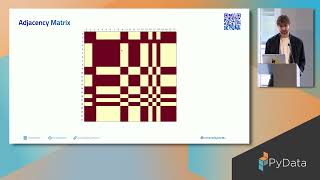
NetworkX is Fast Now: Zero Code Change Acceleration

Have you ever wondered how to find connections in your data and to gain insights from them? Come discover how NetworkX makes this easy (and fast!).

This talk is broadly divided into two parts. First we will talk about the power of graph analytics and how you can use tools like NetworkX to extract information from your data, and then we will talk about how we made the machinery behind NetworkX work with heterogeneous backends like GraphBLAS (CPU optimized) and cuGraph (GPU optimized).

Cutting Edge Football Analytics using Polars, Keras and Spektral

Football analytics has rapidly evolved over the past five years, becoming a crucial part of professional and fan discourse. While much of the cutting-edge research remains hidden behind the fences of club training grounds, a growing ecosystem of open-source tools now enables anyone to develop advanced football analytics models.

In this talk, I'll showcase key open-source libraries—Polars for high-performance data processing, Keras for deep learning, and Spektral for Graph Neural Networks (GNNs)—to analyze millions of player coordinates from publicly available high-frequency positional tracking data. I'll demonstrate how these tools can be used to build in-game prediction models and extract advanced football metrics that only the most advanced football clubs currently use.

Data professionals often excel at technical skills but struggle to connect their work to broader business goals. In this show, we're joined by Jordan Morrow, Senior VP of Data and AI Transformation at AgileOne and author of Business 101 for the Data Professional, to discuss bridging the gap between data and strategy. Jordan offers practical advice on developing business acumen, aligning data work with organizational goals, and communicating effectively with stakeholders. Whether you're a data scientist, analyst, or aspiring leader, this conversation will help you unlock the full potential of your data career. What You'll Learn: The essential business skills every data professional needs How to align data projects with organizational goals Strategies for effective communication with non-technical stakeholders Common pitfalls data professionals face when navigating business challenges—and how to avoid them Actionable tips to become a more strategic, business-savvy data professional   Register for free to be part of the next live session: https://bit.ly/3XB3A8b   Follow us on Socials: LinkedIn YouTube Instagram (Mavens of Data) Instagram (Maven Analytics) TikTok Facebook Medium X/Twitter