talk-data.com talk-data.com

Topic

CRM

Customer Relationship Management (CRM)

sales marketing customer_service

10

tagged

Activity Trend

12 peak/qtr
2020-Q1 2026-Q1

Activities

Showing filtered results

Filtering by: O'Reilly Data Science Books ×
Transitioning to Microsoft Power Platform: An Excel User Guide to Building Integrated Cloud Applications in Power BI, Power Apps, and Power Automate

Welcome to this step-by-step guide for Excel users, data analysts, and finance specialists. It is designed to take you through practical report and development scenarios, including both the approach and the technical challenges. This book will equip you with an understanding of the overall Power Platform use case for addressing common business challenges. While Power BI continues to be an excellent tool of choice in the BI space, Power Platform is the real game changer. Using an integrated architecture, a small team of citizen developers can build solutions for all kinds of business problems. For small businesses, Power Platform can be used to build bespoke CRM, Finance, and Warehouse management tools. For large businesses, it can be used to build an integration point for existing systems to simplify reporting, operation, and approval processes. The author has drawn on his15 years of hands-on analytics experience to help you pivot from the traditional Excel-based reporting environment. By using different business scenarios, this book provides you with clear reasons why a skill is important before you start to dive into the scenarios. You will use a fast prototyping approach to continue to build exciting reporting, automation, and application solutions and improve them while you acquire new skill sets. The book helps you get started quickly with Power BI. It covers data visualization, collaboration, and governance practices. You will learn about the most practical SQL challenges. And you will learn how to build applications in PowerApps and Power Automate. The book ends with an integrated solution framework that can be adapted to solve a wide range of complex business problems. What You Will Learn Develop reporting solutions and business applications Understand the Power Platform licensing and development environment Apply Data ETL and modeling in Power BI Use Data Storytelling and dashboard design to better visualize data Carry out data operations with SQL and SharePoint lists Develop useful applications using Power Apps Develop automated workflows using Power Automate Integrate solutions with Power BI, Power Apps, and Power Automate to build enterprise solutions Who This Book Is For Next-generation data specialists, including Excel-based users who want to learn Power BI and build internal apps; finance specialists who want to take a different approach to traditional accounting reports; and anyone who wants to enhance their skill set for the future job market.
Google Analytics Breakthrough

A complete, start-to-finish guide to Google Analytics instrumentation and reporting Google Analytics Breakthrough is a much-needed comprehensive resource for the world's most widely adopted analytics tool. Designed to provide a complete, best-practices foundation in measurement strategy, implementation, reporting, and optimization, this book systematically demystifies the broad range of Google Analytics features and configurations. Throughout the end-to-end learning experience, you'll sharpen your core competencies, discover hidden functionality, learn to avoid common pitfalls, and develop next-generation tracking and analysis strategies so you can understand what is helping or hindering your digital performance and begin driving more success. Google Analytics Breakthrough offers practical instruction and expert perspectives on the full range of implementation and reporting skills: Learn how to campaign-tag inbound links to uncover the email, social, PPC, and banner/remarketing traffic hiding as other traffic sources and to confidently measure the ROI of each marketing channel Add event tracking to capture the many important user interactions that Google Analytics does not record by default, such as video plays, PDF downloads, scrolling, and AJAX updates Master Google Tag Manager for greater flexibility and process control in implementation Set up goals and Enhanced Ecommerce tracking to measure performance against organizational KPIs and configure conversion funnels to isolate drop-off Create audience segments that map to your audience constituencies, amplify trends, and help identify optimization opportunities Populate custom dimensions that reflect your organization, your content, and your visitors so Google Analytics can speak your language Gain a more complete view of customer behavior with mobile app and cross-device tracking Incorporate related tools and techniques: third-party data visualization, CRM integration for long-term value and lead qualification, marketing automation, phone conversion tracking, usability, and A/B testing Improve data storytelling and foster analytics adoption in the enterprise As many as 10-25 million organizations have installed Google Analytics, including an estimated 67 percent of Fortune 500 companies, but deficiencies plague most implementations, and inadequate reporting practices continue to hinder meaningful analysis. By following the strategies and techniques in Google Analytics Breakthrough, you can address the gaps in your own still set, transcend the common limitations, and begin using Google Analytics for real competitive advantage. Critical contributions from industry luminaries such as Brian Clifton, Tim Ash, Bryan and Jeffrey Eisenberg, and Jim Sterne – and a foreword by Avinash Kaushik – enhance the learning experience and empower you to drive consistent, real-world improvement through analytics.

Enhancing Enterprise Intelligence: Leveraging ERP, CRM, SCM, PLM, BPM, and BI

Enhancing Enterprise Intelligence: Leveraging ERP, CRM, SCM, PLM, BPM, and BI takes a fresh look at the benefits of enterprise systems (ES), focusing on the fact that ES collectively contribute to enhancing the intelligence quotient of an enterprise. The book provides an overview of the characteristics and essential strengths of various categories of ES, namely, Enterprise Resource Planning (ERP), Customer Relationship Management (CRM), Supply-Chain Management (SCM), Product LifeCycle Management (PLM), Business Process Management (BPM), and Business Intelligence (BI).

Effective CRM using Predictive Analytics

A step-by-step guide to data mining applications in CRM. Following a handbook approach, this book bridges the gap between analytics and their use in everyday marketing, providing guidance on solving real business problems using data mining techniques. The book is organized into three parts. Part one provides a methodological roadmap, covering both the business and the technical aspects. The data mining process is presented in detail along with specific guidelines for the development of optimized acquisition, cross/ deep/ up selling and retention campaigns, as well as effective customer segmentation schemes. In part two, some of the most useful data mining algorithms are explained in a simple and comprehensive way for business users with no technical expertise. Part three is packed with real world case studies which employ the use of three leading data mining tools: IBM SPSS Modeler, RapidMiner and Data Mining for Excel. Case studies from industries including banking, retail and telecommunications are presented in detail so as to serve as templates for developing similar applications. Key Features: Includes numerous real-world case studies which are presented step by step, demystifying the usage of data mining models and clarifying all the methodological issues. Topics are presented with the use of three leading data mining tools: IBM SPSS Modeler, RapidMiner and Data Mining for Excel. Accompanied by a website featuring material from each case study, including datasets and relevant code. Combining data mining and business knowledge, this practical book provides all the necessary information for designing, setting up, executing and deploying data mining techniques in CRM. Effective CRM using Predictive Analytics will benefit data mining practitioners and consultants, data analysts, statisticians, and CRM officers. The book will also be useful to academics and students interested in applied data mining.

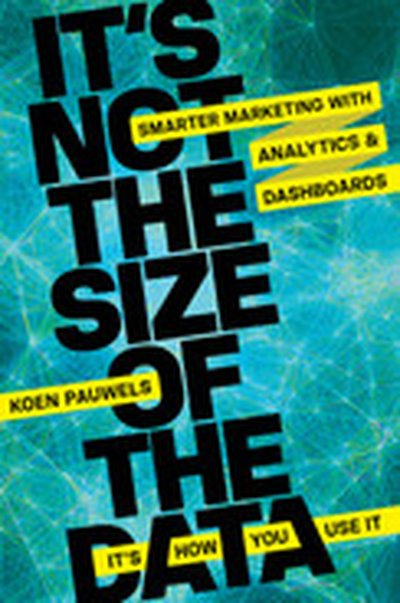
It's Not the Size of the Data -- It's How You Use It
Brand tracking, CRM programs, trade shows, online behavior tracking, satisfaction studies. Mounds of marketing metrics are generated across touchpoints and channels. It can be information overload--too much, too scattered. But locked in the vast quantity of information are accurate, data-driven answers to every marketing question. Analytic dashboards are transformative web-based tools that gather, syn the size, and visually display essential data in real time, directly connecting marketing with performance. World renowned marketing expert Koen Pauwels supplies a simple yet rigorous methodology and wealth of case studies to help any size organization, in any industry, turn data into productive action. He explains step by step how to: ● Gain crucial IT support ● Build a rock-solid database ● Select key leading performance indicators ● Design the optimal dashboard layout ● Use marketing analytics to improve decisions and reap rewards Gut decisions are outdated and downright dangerous. Whether you're trying to allocate resources between online and offline marketing, measure the ROI of specific efforts, or scale up a creative campaign, dashboard analytics bring scientific precision and insight to marketing efforts--with far better results.
Segmentation and Lifetime Value Models Using SAS

Help your organization determine the value of its customer relationships with Segmentation and Lifetime Value Models Using SAS. This book contains a wealth of information that will help you perform analyses to identify your customers and make informed marketing investments. It answers core questions on customer relationship management (CRM), provides an overall framework for thinking about CRM, and offers real-world examples across a variety of industries.

Edward C. Malthouse introduces you to a number of useful models, ranging from simple to more complicated examples, and discusses their applications. You'll learn about segmentation models for identifying groups of customers and about lifetime value models for estimating the future value of the segments. You'll learn how to prepare data and estimate models using Base SAS, SAS/STAT, SAS/IML, and SQL.

Marketing analysts, CRM analysts, database managers, and anyone looking to address the challenges of allocating marketing resources to different customer groups will benefit from the concepts and exercises in this book. Analysts will learn how to approach unique business problems. Managers will gain a sense of what's possible and what to ask of their analytics departments.

This book is part of the SAS Press program.

Customer Segmentation and Clustering Using SAS Enterprise Miner, Second Edition, 2nd Edition
In Customer Segmentation and Clustering Using SAS Enterprise Miner, Second Edition, Randy Collica employs SAS Enterprise Miner and the most commonly available techniques for customer relationship management (CRM). You will learn how to segment customers more intelligently and to achieve, or at least get closer to, the one-to-one customer relationship that today's businesses want. Step-by-step examples and exercises clearly illustrate the concepts of segmentation and clustering in the context of CRM. The book is divided into four parts. Part 1 reviews the basics of segmentation and clustering at an introductory level, providing examples from a variety of industries. Part 2 offers an in-depth treatment of segmentation with practical topics such as when and how to update your models and clustering with many attributes. Part 3 goes beyond traditional segmentation practices to introduce recommended strategies for clustering product affinities, handling missing data, and incorporating textual records into your predictive model with SAS Text Miner software. Part 4 takes segmentation to a new level with advanced techniques such as clustering of product associations, developing segmentation scoring models from customer survey data, combining segmentations using ensemble segmentation, and segmentation of customer transactions.

Updates to the second edition include four new chapters in Part 4, Chapters 13-16, that introduce new and advanced analytic techniques that can be valuable in many customer segmentation applications. In addition, Chapter 9 has a new section on using the Imputation node in SAS Enterprise Miner to accomplish missing data imputation, compared to PROC MI used in earlier sections of Chapter 9. Also included are business insights and motivations for selection settings and analytical decisions on many of the examples included in this second edition.

This straightforward guide will appeal to anyone who seeks to better understand customers or prospective customers. Additionally, professors and students will find the book well suited for a business data mining analytics course in an MBA program or related course of study. You should understand basic statistics, but no prior knowledge of data mining or SAS Enterprise Miner is required.

This book is part of the SAS Press program.

Google Analytics

Do you know what people do when they visit your website or web app? Or how much the site contributes to your bottom line? Google Analytics keeps track and makes it easy for you to learn precisely what's happening. This hands-on guide shows you how to get the most out of this free and powerful tool -- whether you're new to Google Analytics or have been using it for years. Google Analytics shows you how to track different market segments and analyze conversion rates, and reveals advanced techniques such as marketing-campaign tracking, a valuable feature that most people overlook. And this practical book not only provides complete code samples for web developers, it also explains the concepts behind the code to marketers, managers, and others on your team. Discover exactly how the Google Analytics system works Learn how to configure the system to measure data most relevant to your business goals Track online marketing activities, including cost-per-click ads, email, and internal campaigns Track events -- rather than page views -- on sites with features such as maps, embedded video, and widgets Configure Google Analytics to track enterprise data, including multiple domains Use advanced techniques such as custom variables and CRM integration

Oracle CRM On Demand Dashboards

Design and Deliver Oracle CRM On Demand Dashboards Create custom, interactive dashboards to deliver actionable business intelligence directly to end users with help from this Oracle Press guide. Oracle CRM On Demand Dashboards provides comprehensive coverage of the versatile features available in Oracle Answers On Demand coupled with detailed planning and design strategies for building and deploying reports and dashboards with Oracle CRM On Demand. Real-world examples and time-saving formatting tips are included throughout this practical resource. Configure administrative settings to access report and dashboard development tools Take advantage of built-in dashboards Plan dashboards and reports based on business needs Create, edit, manage, save, and delete custom dashboards Configure dashboard properties and pages Add and configure dashboard objects, such as guided navigation, links, images, and folders Display and arrange reports on dashboards Develop dashboard filter prompts Deploy dashboards to Oracle CRM On Demand end users