talk-data.com talk-data.com

Topic

data-science-tasks

849

tagged

Activity Trend

1 peak/qtr
2020-Q1 2026-Q1

Activities

849 activities · Newest first

Statistics for Sport and Exercise Studies

Statistics for Sport and Exercise Studies guides the student through the full research process, from selecting the most appropriate statistical procedure, to analysing data, to the presentation of results, illustrating every key step in the process with clear examples, case-studies and data taken from real sport and exercise settings. Every chapter includes a range of features designed to help the student grasp the underlying concepts and relate each statistical procedure to their own research project, including definitions of key terms, practical exercises, worked examples and clear summaries. The book also offers an in-depth and practical guide to using SPSS in sport and exercise research, the most commonly used data analysis software in sport and exercise departments. In addition, a companion website includes more than 100 downloadable data sets and work sheets for use in or out of the classroom, full solutions to exercises contained in the book, plus over 1,300 PowerPoint slides for use by tutors and lecturers. Statistics for Sport and Exercise Studies is a complete, user-friendly introduction to the use of statistical tests, techniques and procedures in sport, exercise and related subjects. Visit the companion website at: www.routledge.com/cw/odonoghue
Understanding The New Statistics

This is the first book to introduce the new statistics - effect sizes, confidence intervals, and meta-analysis - in an accessible way. It is chock full of practical examples and tips on how to analyze and report research results using these techniques. The book is invaluable to readers interested in meeting the new APA Publication Manual guidelines by adopting the new statistics - which are more informative than null hypothesis significance testing, and becoming widely used in many disciplines. Accompanying the book is the Exploratory Software for Confidence Intervals (ESCI) package, free software that runs under Excel and is accessible at www.thenewstatistics.com. The book’s exercises use ESCI's simulations, which are highly visual and interactive, to engage users and encourage exploration. Working with the simulations strengthens understanding of key statistical ideas. There are also many examples, and detailed guidance to show readers how to analyze their own data using the new statistics, and practical strategies for interpreting the results. A particular strength of the book is its explanation of meta-analysis, using simple diagrams and examples. Understanding meta-analysis is increasingly important, even at undergraduate levels, because medicine, psychology and many other disciplines now use meta-analysis to assemble the evidence needed for evidence-based practice. The book’s pedagogical program, built on cognitive science principles, reinforces learning: Boxes provide "evidence-based" advice on the most effective statistical techniques. Numerous examples reinforce learning, and show that many disciplines are using the new statistics. Graphs are tied in with ESCI to make important concepts vividly clear and memorable. Opening overviews and end of chapter take-home messages summarize key points. Exercises encourage exploration, deep understanding, and practical applications. This highly accessible book is intended as the core text for any course that emphasizes the new statistics, or as a supplementary text for graduate and/or advanced undergraduate courses in statistics and research methods in departments of psychology, education, human development , nursing, and natural, social, and life sciences. Researchers and practitioners interested in understanding the new statistics, and future published research, will also appreciate this book. A basic familiarity with introductory statistics is assumed.

Statistical Techniques for Forensic Accounting: Understanding the Theory and Application of Data Analysis

Master powerful statistical techniques for uncovering fraud or misrepresentation in complex financial data. The discipline of statistics has developed sophisticated, well-accepted approaches for identifying financial fraud and demonstrating that it is deliberate. Statistical Techniques for Forensic Accounting is the first comprehensive guide to these tools and techniques. Leading expert Dr. Saurav Dutta explains their mathematical underpinnings, shows how to use them properly, and guides you in communicating your findings to other interested and knowledgeable parties, or assessing others' analyses. Dutta is singularly well-qualified to write this book: he has been engaged as an expert in many of the world's highest-profile financial fraud cases, including Worldcom, Global Crossing, Cendant, and HealthSouth. Here, he covers everything professionals need to know to construct and conduct valid and defensible statistical tests, perform analyses, and interpret others' analyses. Coverage includes: exploratory data analysis to identify the "Fraud Triangle" and other red flags… data mining tools, usage, and limitations… statistical terms and methods applicable to forensic accounting… relevant uncertainty and probability concepts… Bayesian analysis and networks… statistical inference, sampling, sample size, estimation, regression, correlation, classification, prediction, and much more. For all forensic accountants, auditors, investigators, and litigators involved with corporate financial reporting; and for all students interested in forensic accounting and related fields.

Applied Data Mining

Data mining has witnessed substantial advances in recent decades. New research questions and practical challenges have arisen from emerging areas and applications within the various fields closely related to human daily life, e.g. social media and social networking. This book aims to bridge the gap between traditional data mining and the latest advances in newly emerging information services. It explores the extension of well-studied algorithms and approaches into these new research arenas.

Applied Multiple Regression/Correlation Analysis for the Behavioral Sciences, 3rd Edition

This classic text on multiple regression is noted for its nonmathematical, applied, and data-analytic approach. Readers profit from its verbal-conceptual exposition and frequent use of examples. The applied emphasis provides clear illustrations of the principles and provides worked examples of the types of applications that are possible. Researchers learn how to specify regression models that directly address their research questions. An overview of the fundamental ideas of multiple regression and a review of bivariate correlation and regression and other elementary statistical concepts provide a strong foundation for understanding the rest of the text. The third edition features an increased emphasis on graphics and the use of confidence intervals and effect size measures, and an accompanying website with data for most of the numerical examples along with the computer code for SPSS, SAS, and SYSTAT, at www.psypress.com/9780805822236 . Applied Multiple Regression serves as both a textbook for graduate students and as a reference tool for researchers in psychology, education, health sciences, communications, business, sociology, political science, anthropology, and economics. An introductory knowledge of statistics is required. Self-standing chapters minimize the need for researchers to refer to previous chapters.

Measuring Sustainability

' Measuring the sustainability of development is crucial to achieving it, and is one of the most actively studied issues in the area. To date, most studies of measurements or indicators have been largely theoretical.

However, this book, a follow-on to Bell and Morse's highly influential Sustainability Indicators (1999), presents valuable practical advice on how to develop measurements that will work in real-life development contexts. It describes and analyses how to derive, validate and apply indicators in the course of an actual development project - in this case the Mediterranean Action Plan in Malta.

The authors explain the trade-offs and constraints involved and how it is possible to combine the open-ended and flexible perspectives of sustainability with the more linear processes and fixed targets of specific projects through the use of pragmatic and reflective methodologies.

Navigating Strategic Decisions

Based on forty years of experience and research, this book provides guidance on forecasting for strategic decision making. It includes methodology, tools, and models. It also explains how to apply sanity checks to existing forecasts to rank project valuations, identify project risks, and select the higher value creation projects. The author discusses how to assess the feasibility of large projects, analyze forecasting models to determine controllable levers, and create the conditions needed for forecasts to materialize.

Improving Surveys with Paradata: Analytic Uses of Process Information

Explore the practices and cutting-edge research on the new and exciting topic of paradata Paradata are measurements related to the process of collecting survey data. Improving Surveys with Paradata: Analytic Uses of Process Information is the most accessible and comprehensive contribution to this up-and-coming area in survey methodology. Featuring contributions from leading experts in the field, Improving Surveys with Paradata: Analytic Uses of Process Information introduces and reviews issues involved in the collection and analysis of paradata. The book presents readers with an overview of the indispensable techniques and new, innovative research on improving survey quality and total survey error. Along with several case studies, topics include: Using paradata to monitor fieldwork activity in face-to-face, telephone, and web surveys Guiding intervention decisions during data collection Analysis of measurement, nonresponse, and coverage error via paradata Providing a practical, encompassing guide to the subject of paradata, the book is aimed at both producers and users of survey data. Improving Surveys with Paradata: Analytic Uses of Process The book also serves as an excellent resource for courses on data collection, survey methodology, and nonresponse and measurement error.

Excel Dashboards and Reports, 2nd Edition

Learn to use Excel dashboards and reports to better conceptualize data Updated for all the latest features and capabilities of Excel 2013, this go-to resource provides you with in-depth coverage of the individual functions and tools that can be used to create compelling Excel reports. Veteran author Michael Alexander walks you through the most effective ways to present and report data. Featuring a comprehensive review of a wide array of technical and analytical concepts, this essential guide helps you go from reporting data with simple tables full of dull numbers to presenting key information through the use of high-impact, meaningful reports and dashboards that will wow management both visually and substantively. Details how to analyze large amounts of data and report the results in a way that is both visually attractive and effective Describes how to use different perspectives to achieve better visibility into data, as well as how to slice data into various views on the fly Shows how to automate redundant reporting and analysis processes Walks you through creating impressive dashboards, eye-catching visualizations, and real-world What-If analyses Excel Dashboards and Reports, Second Edition is part technical manual, part analytical guidebook, and exactly what you need to become your organization's dashboard dynamo!

Handbook of Statistics

Statistical learning and analysis techniques have become extremely important today, given the tremendous growth in the size of heterogeneous data collections and the ability to process it even from physically distant locations. Recent advances made in the field of machine learning provide a strong framework for robust learning from the diverse corpora and continue to impact a variety of research problems across multiple scientific disciplines. The aim of this handbook is to familiarize beginners as well as experts with some of the recent techniques in this field. The Handbook is divided in two sections: Theory and Applications, covering machine learning, data analytics, biometrics, document recognition and security. very relevant to current research challenges faced in various fields self-contained reference to machine learning emphasis on applications-oriented techniques

Microsoft Visio 2013 Step by Step

The smart way to learn Microsoft Visio 2013—one step at a time! Experience learning made easy—and quickly teach yourself how to create professional-looking business and technical diagrams with Visio 2013. With Step by Step, you set the pace—building and practicing the skills you need, just when you need them! Create dynamic organization charts with Visio Make charts with wizards or build them by hand Build drawings using Visio themes and effects Use data-driven drawings in Microsoft SharePoint Import, manipulate, and visualize business data Draw and then execute SharePoint 2013 workflows

Statistics and Probability with Applications for Engineers and Scientists

Introducing the tools of statistics and probability from the ground up An understanding of statistical tools is essential for engineers and scientists who often need to deal with data analysis over the course of their work. Statistics and Probability with Applications for Engineers and Scientists walks readers through a wide range of popular statistical techniques, explaining step-by-step how to generate, analyze, and interpret data for diverse applications in engineering and the natural sciences. Unique among books of this kind, Statistics and Probability with Applications for Engineers and Scientists covers descriptive statistics first, then goes on to discuss the fundamentals of probability theory. Along with case studies, examples, and real-world data sets, the book incorporates clear instructions on how to use the statistical packages Minitab and Microsoft Office Excel to analyze various data sets. The book also features: Detailed discussions on sampling distributions, statistical estimation of population parameters, hypothesis testing, reliability theory, statistical quality control including Phase I and Phase II control charts, and process capability indices A clear presentation of nonparametric methods and simple and multiple linear regression methods, as well as a brief discussion on logistic regression method Comprehensive guidance on the design of experiments, including randomized block designs, one- and two-way layout designs, Latin square designs, random effects and mixed effects models, factorial and fractional factorial designs, and response surface methodology A companion website containing data sets for Minitab and Microsoft Office Excel, as well as JMP routines and results Assuming no background in probability and statistics, Statistics and Probability with Applications for Engineers and Scientists features a unique, yet tried-and-true, approach that is ideal for all undergraduate students as well as statistical practitioners who analyze and illustrate real-world data in engineering and the natural sciences.

Visual Intelligence: Microsoft Tools and Techniques for Visualizing Data

Go beyond design concepts and learn to build state-of-the-art visualizations The visualization experts at Microsoft's Pragmatic Works have created a full-color, step-by-step guide to building specific types of visualizations. The book thoroughly covers the Microsoft toolset for data analysis and visualization, including Excel, and explores best practices for choosing a data visualization design, selecting tools from the Microsoft stack, and building a dynamic data visualization from start to finish. You'll examine different types of visualizations, their strengths and weaknesses, and when to use each one. Data visualization tools unlock the stories within the data, enabling you to present it in a way that is useful for making business decisions This full-color guide introduces data visualization design concepts, then explains the various Microsoft tools used to store and display data Features a detailed discussion of various classes of visualizations, their uses, and the appropriate tools for each Includes practical implementations of various visualizations and best practices for using them Covers out-of-the-box Microsoft tools, custom-developed illustrations and implementations, and code examples Visual Intelligence: Microsoft Tools and Techniques for Visualizing Data arms you with best practices and the knowledge to choose and build dynamic data visualizations.

An Accidental Statistician: The Life and Memories of George E. P. Box

Celebrating the life of an admired pioneer in statistics In this captivating and inspiring memoir, world-renowned statistician George E. P. Box offers a firsthand account of his life and statistical work. Writing in an engaging, charming style, Dr. Box reveals the unlikely events that led him to a career in statistics, beginning with his job as a chemist conducting experiments for the British army during World War II. At this turning point in his life and career, Dr. Box taught himself the statistical methods necessary to analyze his own findings when there were no statisticians available to check his work. Throughout his autobiography, Dr. Box expertly weaves a personal and professional narrative to illustrate the effects his work had on his life and vice-versa. Interwoven between his research with time series analysis, experimental design, and the quality movement, Dr. Box recounts coming to the United States, his family life, and stories of the people who mean the most to him. This fascinating account balances the influence of both personal and professional relationships to demonstrate the extraordinary life of one of the greatest and most influential statisticians of our time. An Accidental Statistician also features: Two forewords written by Dr. Box's former colleagues and closest confidants Personal insights from more than a dozen statisticians on how Dr. Box has influenced and continues to touch their careers and lives Numerous, previously unpublished photos from the author's personal collection An Accidental Statistician is a compelling read for statisticians in education or industry, mathematicians, engineers, and anyone interested in the life story of an influential intellectual who altered the world of modern statistics.

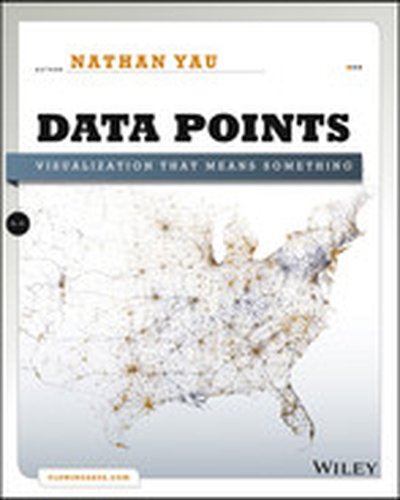
Data Points: Visualization That Means Something

A fresh look at visualization from the author of Visualize This Whether it's statistical charts, geographic maps, or the snappy graphical statistics you see on your favorite news sites, the art of data graphics or visualization is fast becoming a movement of its own. In Data Points: Visualization That Means Something, author Nathan Yau presents an intriguing complement to his bestseller Visualize This, this time focusing on the graphics side of data analysis. Using examples from art, design, business, statistics, cartography, and online media, he explores both standard-and not so standard-concepts and ideas about illustrating data. Shares intriguing ideas from Nathan Yau, author of Visualize This and creator of flowingdata.com, with over 66,000 subscribers Focuses on visualization, data graphics that help viewers see trends and patterns they might not otherwise see in a table Includes examples from the author's own illustrations, as well as from professionals in statistics, art, design, business, computer science, cartography, and more Examines standard rules across all visualization applications, then explores when and where you can break those rules Create visualizations that register at all levels, with Data Points: Visualization That Means Something.

Success Probability Estimation with Applications to Clinical Trials

Provides an introduction to the various statistical techniques involved in medical research and drug development with a focus on estimating the success probability of an experiment Success Probability Estimation with Applications to Clinical Trials details the use of success probability estimation in both the planning and analyzing of clinical trials and in widely used statistical tests. Devoted to both statisticians and non-statisticians who are involved in clinical trials, Part I of the book presents new concepts related to success probability estimation and their usefulness in clinical trials, and each section begins with a non-technical explanation of the presented concepts. Part II delves deeper into the techniques for success probability estimation and features applications to both reproducibility probability estimation and conservative sample size estimation. Success Probability Estimation with Applications to Clinical Trials: Addresses the theoretical and practical aspects of the topic and introduces new and promising techniques in the statistical and pharmaceutical industries Features practical solutions for problems that are often encountered in clinical trials Includes success probability estimation for widely used statistical tests, such as parametric and nonparametric models Focuses on experimental planning, specifically the sample size of clinical trials using phase II results and data for planning phase III trials Introduces statistical concepts related to success probability estimation and their usefulness in clinical trials Success Probability Estimation with Applications to Clinical Trials is an ideal reference for statisticians and biostatisticians in the pharmaceutical industry as well as researchers and practitioners in medical centers who are actively involved in health policy, clinical research, and the design and evaluation of clinical trials.

Optimal Resource Allocation: With Practical Statistical Applications and Theory

A UNIQUE ENGINEERING AND STATISTICAL APPROACH TO OPTIMAL RESOURCE ALLOCATION Optimal Resource Allocation: With Practical Statistical Applications and Theory features the application of probabilistic and statistical methods used in reliability engineering during the different phases of life cycles of technical systems. Bridging the gap between reliability engineering and applied mathematics, the book outlines different approaches to optimal resource allocation and various applications of models and algorithms for solving real-world problems. In addition, the fundamental background on optimization theory and various illustrative numerical examples are provided. The book also features: An overview of various approaches to optimal resource allocation, from classical Lagrange methods to modern algorithms based on ideas of evolution in biology Numerous exercises and case studies from a variety of areas, including communications, transportation, energy transmission, and counterterrorism protection The applied methods of optimization with various methods of optimal redundancy problem solutions as well as the numerical examples and statistical methods needed to solve the problems Practical thoughts, opinions, and judgments on real-world applications of reliability theory and solves practical problems using mathematical models and algorithms Optimal Resource Allocation is a must-have guide for electrical, mechanical, and reliability engineers dealing with engineering design and optimal reliability problems. In addition, the book is excellent for graduate and PhD-level courses in reliability theory and optimization.

Applied Logistic Regression, 3rd Edition

A new edition of the definitive guide to logistic regression modeling for health science and other applications This thoroughly expanded Third Edition provides an easily accessible introduction to the logistic regression (LR) model and highlights the power of this model by examining the relationship between a dichotomous outcome and a set of covariables. Applied Logistic Regression, Third Edition emphasizes applications in the health sciences and handpicks topics that best suit the use of modern statistical software. The book provides readers with state-of-the-art techniques for building, interpreting, and assessing the performance of LR models. New and updated features include: A chapter on the analysis of correlated outcome data A wealth of additional material for topics ranging from Bayesian methods to assessing model fit Rich data sets from real-world studies that demonstrate each method under discussion Detailed examples and interpretation of the presented results as well as exercises throughout Applied Logistic Regression, Third Edition is a must-have guide for professionals and researchers who need to model nominal or ordinal scaled outcome variables in public health, medicine, and the social sciences as well as a wide range of other fields and disciplines.

Practical Time Series Analysis Using SAS

Anders Milhøj's Practical Time Series Analysis Using SAS explains and demonstrates through examples how you can use SAS for time series analysis. It offers modern procedures for forecasting, seasonal adjustments, and decomposition of time series that can be used without involved statistical reasoning. The book teaches, with numerous examples, how to apply these procedures with very simple coding. In addition, it also gives the statistical background for interested readers. Beginning with an introductory chapter that covers the practical handling of time series data in SAS using the TIMESERIES and EXPAND procedures, it goes on to explain forecasting, which is found in the ESM procedure; seasonal adjustment, including trading-day correction using PROC X12; and unobserved component models using the UCM procedure.

This book is part of the SAS Press program.