talk-data.com talk-data.com

Topic

data-science

2252

tagged

Activity Trend

1 peak/qtr
2020-Q1 2026-Q1

Activities

2252 activities · Newest first

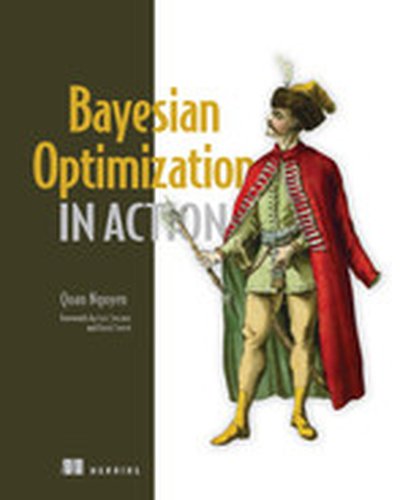
Bayesian Optimization in Action

Bayesian optimization helps pinpoint the best configuration for your machine learning models with speed and accuracy. Put its advanced techniques into practice with this hands-on guide. In Bayesian Optimization in Action you will learn how to: Train Gaussian processes on both sparse and large data sets Combine Gaussian processes with deep neural networks to make them flexible and expressive Find the most successful strategies for hyperparameter tuning Navigate a search space and identify high-performing regions Apply Bayesian optimization to cost-constrained, multi-objective, and preference optimization Implement Bayesian optimization with PyTorch, GPyTorch, and BoTorch Bayesian Optimization in Action shows you how to optimize hyperparameter tuning, A/B testing, and other aspects of the machine learning process by applying cutting-edge Bayesian techniques. Using clear language, illustrations, and concrete examples, this book proves that Bayesian optimization doesn’t have to be difficult! You’ll get in-depth insights into how Bayesian optimization works and learn how to implement it with cutting-edge Python libraries. The book’s easy-to-reuse code samples let you hit the ground running by plugging them straight into your own projects. About the Technology In machine learning, optimization is about achieving the best predictions—shortest delivery routes, perfect price points, most accurate recommendations—in the fewest number of steps. Bayesian optimization uses the mathematics of probability to fine-tune ML functions, algorithms, and hyperparameters efficiently when traditional methods are too slow or expensive. About the Book Bayesian Optimization in Action teaches you how to create efficient machine learning processes using a Bayesian approach. In it, you’ll explore practical techniques for training large datasets, hyperparameter tuning, and navigating complex search spaces. This interesting book includes engaging illustrations and fun examples like perfecting coffee sweetness, predicting weather, and even debunking psychic claims. You’ll learn how to navigate multi-objective scenarios, account for decision costs, and tackle pairwise comparisons. What's Inside Gaussian processes for sparse and large datasets Strategies for hyperparameter tuning Identify high-performing regions Examples in PyTorch, GPyTorch, and BoTorch About the Reader For machine learning practitioners who are confident in math and statistics. About the Author Quan Nguyen is a research assistant at Washington University in St. Louis. He writes for the Python Software Foundation and has authored several books on Python programming. Quotes Using a hands-on approach, clear diagrams, and real-world examples, Quan lifts the veil off the complexities of Bayesian optimization. - From the Foreword by Luis Serrano, Author of Grokking Machine Learning This book teaches Bayesian optimization, starting from its most basic components. You’ll find enough depth to make you comfortable with the tools and methods and enough code to do real work very quickly. - From the Foreword by David Sweet, Author of Experimentation for Engineers Combines modern computational frameworks with visualizations and infographics you won’t find anywhere else. It gives readers the confidence to apply Bayesian optimization to real world problems! - Ravin Kumar, Google
Distributed Machine Learning with PySpark: Migrating Effortlessly from Pandas and Scikit-Learn

Migrate from pandas and scikit-learn to PySpark to handle vast amounts of data and achieve faster data processing time. This book will show you how to make this transition by adapting your skills and leveraging the similarities in syntax, functionality, and interoperability between these tools. Distributed Machine Learning with PySpark offers a roadmap to data scientists considering transitioning from small data libraries (pandas/scikit-learn) to big data processing and machine learning with PySpark. You will learn to translate Python code from pandas/scikit-learn to PySpark to preprocess large volumes of data and build, train, test, and evaluate popular machine learning algorithms such as linear and logistic regression, decision trees, random forests, support vector machines, Naïve Bayes, and neural networks. After completing this book, you will understand the foundational concepts of data preparation and machine learning and will have the skills necessary toapply these methods using PySpark, the industry standard for building scalable ML data pipelines. What You Will Learn Master the fundamentals of supervised learning, unsupervised learning, NLP, and recommender systems Understand the differences between PySpark, scikit-learn, and pandas Perform linear regression, logistic regression, and decision tree regression with pandas, scikit-learn, and PySpark Distinguish between the pipelines of PySpark and scikit-learn Who This Book Is For Data scientists, data engineers, and machine learning practitioners who have some familiarity with Python, but who are new to distributed machine learning and the PySpark framework.

Alteryx Designer: The Definitive Guide

Analytics projects are frequently long, drawn-out affairs, requiring multiple teams and skills to clean, join, and eventually turn data into analysis for timely decision-making. Alteryx Designer changes all of that. With this low-code, self-service, drag-and-drop workflow platform, new and experienced data and business analysts can deliver results in hours instead of weeks. This practical book shows you how to master all areas of Alteryx Designer quickly. Author and Alteryx ACE Joshua Burkhow starts with the basics of building a workflow, then introduces more than 200 tools for working with intermediate and advanced analytics functionality. With Alteryx Designer's all-in-one toolkit, you'll migrate from legacy analytics software or Excel with ease. Ready to work with data quickly and efficiently? This guide gets you started. Learn the fundamentals of cleaning, prepping, and analyzing data with Alteryx Designer Install, navigate, and quickly become competent with the Alteryx Designer layout and functionality Construct accurate, performant, reliable, and well-documented workflows that automate business processes Learn intermediate techniques using spatial analytics, reporting, and in-database tools Dive into advanced Alteryx capabilities, including predictive and machine learning tools Get introduced to the entire Alteryx Analytic Process Automation (APA) Platform

Artificial Intelligence for Business

This book is a valuable resource for academics, researchers, professionals, and policymakers who are interested in understanding the potential of AI in the business world. The contributions from leading experts and researchers provide a comprehensive overview of AI in business applications, and how it is transforming different sectors.

Near Extensions and Alignment of Data in R(superscript)n

Near Extensions and Alignment of Data in Rn Comprehensive resource illustrating the mathematical richness of Whitney Extension Problems, enabling readers to develop new insights, tools, and mathematical techniques Near Extensions and Alignment of Data in Rn demonstrates a range of hitherto unknown connections between current research problems in engineering, mathematics, and data science, exploring the mathematical richness of near Whitney Extension Problems, and presenting a new nexus of applied, pure and computational harmonic analysis, approximation theory, data science, and real algebraic geometry. For example, the book uncovers connections between near Whitney Extension Problems and the problem of alignment of data in Euclidean space, an area of considerable interest in computer vision. Written by a highly qualified author, Near Extensions and Alignment of Data in Rn includes information on: Areas of mathematics and statistics, such as harmonic analysis, functional analysis, and approximation theory, that have driven significant advances in the field Development of algorithms to enable the processing and analysis of huge amounts of data and data sets Why and how the mathematical underpinning of many current data science tools needs to be better developed to be useful New insights, potential tools, and mathematical techniques to solve problems in Whitney extensions, signal processing, shortest paths, clustering, computer vision, optimal transport, manifold learning, minimal energy, and equidistribution Providing comprehensive coverage of several subjects, Near Extensions and Alignment of Data in Rn is an essential resource for mathematicians, applied mathematicians, and engineers working on problems related to data science, signal processing, computer vision, manifold learning, and optimal transport.

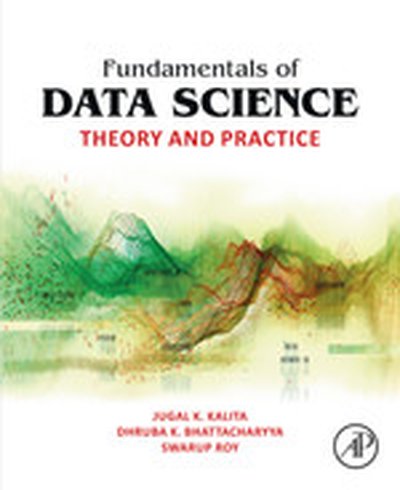
Fundamentals of Data Science

Fundamentals of Data Science: Theory and Practice presents basic and advanced concepts in data science along with real-life applications. The book provides students, researchers and professionals at different levels a good understanding of the concepts of data science, machine learning, data mining and analytics. Users will find the authors’ research experiences and achievements in data science applications, along with in-depth discussions on topics that are essential for data science projects, including pre-processing, that is carried out before applying predictive and descriptive data analysis tasks and proximity measures for numeric, categorical and mixed-type data. The book's authors include a systematic presentation of many predictive and descriptive learning algorithms, including recent developments that have successfully handled large datasets with high accuracy. In addition, a number of descriptive learning tasks are included. Presents the foundational concepts of data science along with advanced concepts and real-life applications for applied learning Includes coverage of a number of key topics such as data quality and pre-processing, proximity and validation, predictive data science, descriptive data science, ensemble learning, association rule mining, Big Data analytics, as well as incremental and distributed learning Provides updates on key applications of data science techniques in areas such as Computational Biology, Network Intrusion Detection, Natural Language Processing, Software Clone Detection, Financial Data Analysis, and Scientific Time Series Data Analysis Covers computer program code for implementing descriptive and predictive algorithms

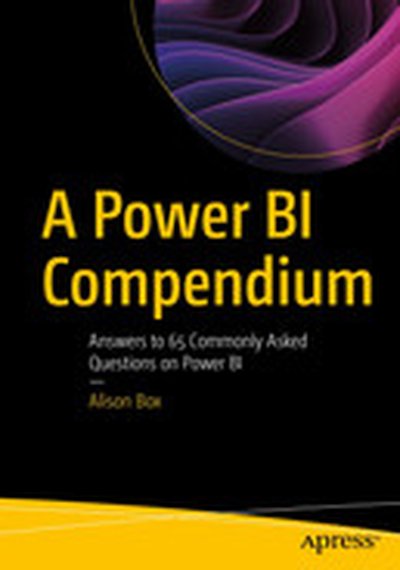
A Power BI Compendium: Answers to 65 Commonly Asked Questions on Power BI

Are you a reasonably competent Power BI user but still struggling to generate reports that truly tell the story of your data? Or do you simply want to extend your knowledge of Power BI by exploring more complex areas of visualizations, data modelling, DAX, and Power Query? If so, this book is for you. This book serves as a comprehensive resource for users to implement more challenging visuals, build better data models, use DAX with more confidence, and execute more complex queries so they can find and share important insights into their data. The contents of the chapters are in a question-and-answer format that explore everyday data analysis scenarios in Power BI. These questions have been generated from the author’s own client base and from commonly sought-for information from the Power BI community. They cover a wide and diverse range of topics that many Power BI users often struggle to get to grips with or don’t fully understand. Examples of suchquestions are: How can I generate dynamic titles for visuals? How can I control subtotals in a Matrix visual? Why do I need a date dimension? How can I show the previous N month’s sales in a column chart?Why do I need a Star Schema? Why aren't my totals correct? How can I bin measures into numeric ranges? Can I import a Word document? Can I dynamically append data from different source files? Solutions to these questions and many more are presented in non-technical and easy-to-follow explanations negating the requirement to perform tiresome and fruitless “google” searches. There are also companion Power BI Desktop files that set out the answers to each question so you can follow along with the examples given in the book.. After working through this book, you will have extended your knowledge of Power BI to an expert level, alleviating your existing frustrations and so enabling you to design Power BI reports where you are no longer limited by your lack of knowledge or experience. Who is This Book For: Power BI users who can build reports and now want to extend their knowledge of Power BI.

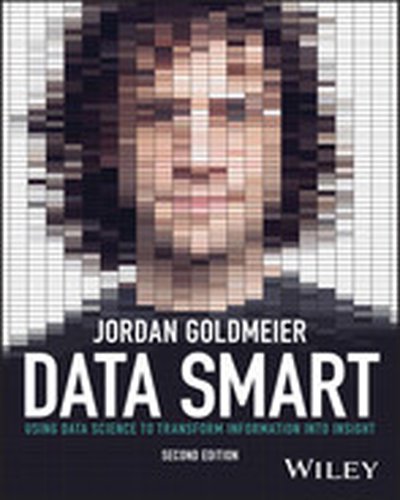
Data Smart, 2nd Edition
book
by Jordan Goldmeier (Booz Allen Hamilton; The Perduco Group; EY; Excel TV; Wake Forest University; Anarchy Data)

Want to jump into data science but don't know where to start? Let's be real, data science is presented as something mystical and unattainable without the most powerful software, hardware, and data expertise. Real data science isn't about technology. It's about how you approach the problem. In this updated edition of Data Smart: Using Data Science to Transform Information into Insight, award-winning data scientist and bestselling author Jordan Goldmeier shows you how to implement data science problems using Excel while exposing how things work behind the scenes. Data Smart is your field guide to building statistics, machine learning, and powerful artificial intelligence concepts right inside your spreadsheet. Inside you'll find: Four-color data visualizations that highlight and illustrate the concepts discussed in the book Tutorials explaining complicated data science using just Microsoft Excel How to take what you’ve learned and apply it to everyday problems at work and life Advice for using formulas, Power Query, and some of Excel's latest features to solve tough data problems Smart data science solutions for common business challenges Explanations of what algorithms do, how they work, and what you can tweak to take your Excel skills to the next level Data Smart is a must-read for students, analysts, and managers ready to become data science savvy and share their findings with the world.

Leading in Analytics

A step-by-step guide for business leaders who need to manage successful big data projects Leading in Analytics: The Critical Tasks for Executives to Master in the Age of Big Data takes you through the entire process of guiding an analytics initiative from inception to execution. You’ll learn which aspects of the project to pay attention to, the right questions to ask, and how to keep the project team focused on its mission to produce relevant and valuable project. As an executive, you can’t control every aspect of the process. But if you focus on high-impact factors that you can control, you can ensure an effective outcome. This book describes those factors and offers practical insight on how to get them right. Drawn from best-practice research in the field of analytics, the Manageable Tasks described in this book are specific to the goal of implementing big data tools at an enterprise level. A dream team of analytics and business experts have contributed their knowledge to show you how to choose the right business problem to address, put together the right team, gather the right data, select the right tools, and execute your strategic plan to produce an actionable result. Become an analytics-savvy executive with this valuable book. Ensure the success of analytics initiatives, maximize ROI, and draw value from big data Learn to define success and failure in analytics and big data projects Set your organization up for analytics success by identifying problems that have big data solutions Bring together the people, the tools, and the strategies that are right for the job By learning to pay attention to critical tasks in every analytics project, non-technical executives and strategic planners can guide their organizations to measurable results.

Data Science: The Hard Parts

This practical guide provides a collection of techniques and best practices that are generally overlooked in most data engineering and data science pedagogy. A common misconception is that great data scientists are experts in the "big themes" of the discipline—machine learning and programming. But most of the time, these tools can only take us so far. In practice, the smaller tools and skills really separate a great data scientist from a not-so-great one. Taken as a whole, the lessons in this book make the difference between an average data scientist candidate and a qualified data scientist working in the field. Author Daniel Vaughan has collected, extended, and used these skills to create value and train data scientists from different companies and industries. With this book, you will: Understand how data science creates value Deliver compelling narratives to sell your data science project Build a business case using unit economics principles Create new features for a ML model using storytelling Learn how to decompose KPIs Perform growth decompositions to find root causes for changes in a metric Daniel Vaughan is head of data at Clip, the leading paytech company in Mexico. He's the author of Analytical Skills for AI and Data Science (O'Reilly).

Alteryx Designer Cookbook

This book, Alteryx Designer Cookbook, provides over 60 practical and detailed recipes that guide you in conquering data accessibility, preparation, and insights generation through Alteryx Designer. You will learn how to manipulate, blend, and analyze data sources effectively, improving your analytical productivity. What this Book will help me do Master efficient methods for cleaning, preparing, and shaping data accurately. Combine multiple data sources seamlessly using Alteryx Designer's blending tools. Implement essential data transformations such as pivoting and restructuring for analyses. Create reusable, automated solutions for repeated tasks using Alteryx macros. Generate rich, data-driven reports to enhance business intelligence efficiently. Author(s) None Guisande is an experienced data analytics professional with years of hands-on expertise in implementing data workflows using Alteryx Designer. Passionate about simplifying complex operations, None brings a practical approach to teaching, ensuring that readers can apply their skills immediately. Who is it for? This book is ideal for data analysts, professionals in business intelligence, and anyone proficient in Alteryx Designer's basics looking to deepen their understanding. If you aim to enhance your productivity and manual data tasks into efficient automated workflows, this book is a perfect fit.

Automate Testing for Power Apps

Are you looking to step up your Power Apps development game? "Automate Testing for Power Apps" is your comprehensive guide to leveraging low-code automation testing tools and techniques. Learn practical steps to integrate these methods into your workflow, ensuring your Power Apps are efficient, effective, and top-notch in quality. What this Book will help me do Master automation testing principles tailored specifically for Power Apps applications. Leverage tools like Test Studio and Test Engine to efficiently test Canvas apps. Learn advanced automation testing techniques for PCF components and model-driven apps. Incorporate robust testing procedures into software deployment for improved workflows. Enhance Power Apps quality and efficiency, reducing emergency fixes and improving user satisfaction. Author(s) César Calvo and Carlos de Huerta have deep expertise in Power Apps development and testing. With years of industry experience, they have honed their skills in creating robust apps and ensure quality through advanced testing techniques. Their approachable teaching style ensures learners grasp complex concepts effectively. Who is it for? This book is for Power Apps developers and IT professionals aiming to enhance their testing knowledge. Whether you're a beginner looking to grasp the basics or an advanced user exploring new automation possibilities, you'll find this guide invaluable. A basic understanding of Power Apps and Power Platform concepts will be beneficial.

Beginning Power BI for Business Users

Discover the utility of your organization’s data with Microsoft Power BI In Beginning Power BI for Business Users: Learning to Turn Data into Insights, accomplished data professional and business intelligence expert Paul Fuller delivers an intuitive and accessible handbook for professionals seeking to use Microsoft’s Power BI to access, analyze, understand, report, and act on the data available to their organizations. In the book, you’ll discover Power BI’s robust feature set, learn to ingest and model data, visualize and report on that data, and even use the DAX scripting language to unlock still more utility from Microsoft’s popular program. Beginning with general principles geared to readers with no or little experience with reporting or data analytics tools, the author walks you through how to manipulate common, publicly available data sources—including Excel files and relational databases. You’ll also learn to: Use the included and tested sample code to work through the helpful examples included by the author Conduct data orchestration and visualization to better understand and gain insights from your data An essential resource for business analysts and Excel power users reaching the limits of that program’s capabilities, Beginning Power BI for Business Users will also benefit data analysts who seek to prepare reports for their organizations using Microsoft’s flexible and intuitive software.

R Bioinformatics Cookbook - Second Edition

R Bioinformatics Cookbook is your guide to leveraging the power of R for advanced bioinformatics tasks. This updated second edition uses a recipe-based method to teach data analysis, visualization, and machine learning tailored for biological datasets. You'll gain hands-on experience with popular tools like Bioconductor, ggplot2, and tidyverse to solve real-world genomics problems. What this Book will help me do Set up a reproducible bioinformatics analysis environment using R. Clean, analyze, and visualize biological data with R's powerful packages. Apply RNA-seq and ChIP-seq workflows to study genetic information effectively. Incorporate machine learning techniques into bioinformatics pipelines using R. Automate tasks and create professional-grade reports using functional programming and reporting tools. Author(s) The author, None MacLean, brings years of expertise in bioinformatics and computational biology. Known for clear explanations and practical approaches, they ensure the material is accessible yet challenging. With a strong focus on real-world applications, this book reflects their commitment to bridging bioinformatics and modern data science. Who is it for? This book is perfect for bioinformaticians, researchers, and data scientists with prior R experience. It's tailored for those looking to delve deeper into genomics, data visualization, and bioinformatics techniques. Intermediate knowledge of bioinformatics concepts and familiarity with R programming are assumed for readers to fully benefit from the content.

Machine Learning with Qlik Sense

Machine Learning with Qlik Sense introduces practical applications of machine learning within the Qlik platform. Through this book, you will gain a thorough understanding of fundamental ML concepts, learn to apply these within Qlik Sense, and see how to use predictive analytics to solve real-world problems. The hands-on examples ensure you can translate learnings into actionable insights. What this Book will help me do Understand the key principles of machine learning and how to apply them using the Qlik platform. Develop skills in data preprocessing and analysis to prepare datasets for machine learning models. Learn to validate and interpret machine learning models and evaluate their performance. Master advanced visualization techniques for presenting insights derived from data. Apply newfound knowledge to practical business problems through real-world use-case examples. Author(s) Hannu Ranta is an expert in data analytics and has extensive experience utilizing the Qlik platform to derive actionable insights from data. With years of practical exposure and a focus on teaching, Hannu brings a clear and structured approach to using machine learning for analytics. His writing seeks to empower readers to achieve practical solutions using Qlik's powerful tools. Who is it for? This book is perfect for data analysts, data scientists, or anyone working in data analytics who wants to incorporate machine learning into their skill set. It is especially suited to those with a basic familiarity with Qlik tools or data analysis concepts. Beginners in machine learning can also benefit because the book starts from foundational concepts and builds step-by-step.

The Statistics and Machine Learning with R Workshop

This book guides readers through the essentials of applied statistics and machine learning using the R programming language. By delving into robust data processing techniques, visualization, and statistical modeling with R, you will develop skills to effectively analyze data and design predictive models. Each chapter includes hands-on exercises to reinforce the concepts in a practical, intuitive way. What this Book will help me do Understand and apply key statistical concepts such as probability distributions and hypothesis testing to analyze data. Master foundational mathematical principles like linear algebra and calculus relevant to data science and machine learning. Develop proficiency in data manipulation and visualization using robust R libraries such as dplyr and ggplot2. Build predictive models through practical exercises and learn advanced concepts like Bayesian statistics and linear regression. Gain the practical knowledge needed to apply statistical and machine learning methodologies in real-world scenarios. Author(s) Liu Peng is an accomplished author with a strong academic and practical background in statistics and data science. Armed with extensive experience in applying R to real-world problems, he brings a blend of technical mastery and teaching expertise. His commitment is to transform complex concepts into accessible, enriching learning experiences for readers. Who is it for? This book is ideal for data scientists and analysts ranging from beginners to those at an intermediate level. It caters especially to those interested in practicing statistical modeling and learning R in depth. If you have basic familiarity with statistics and are looking to expand your data science capabilities using R, this book is well-suited for you.

Machine and Deep Learning Using MATLAB

MACHINE AND DEEP LEARNING In-depth resource covering machine and deep learning methods using MATLAB tools and algorithms, providing insights and algorithmic decision-making processes Machine and Deep Learning Using MATLAB introduces early career professionals to the power of MATLAB to explore machine and deep learning applications by explaining the relevant MATLAB tool or app and how it is used for a given method or a collection of methods. Its properties, in terms of input and output arguments, are explained, the limitations or applicability is indicated via an accompanied text or a table, and a complete running example is shown with all needed MATLAB command prompt code. The text also presents the results, in the form of figures or tables, in parallel with the given MATLAB code, and the MATLAB written code can be later used as a template for trying to solve new cases or datasets. Throughout, the text features worked examples in each chapter for self-study with an accompanying website providing solutions and coding samples. Highlighted notes draw the attention of the user to critical points or issues. Readers will also find information on: Numeric data acquisition and analysis in the form of applying computational algorithms to predict the numeric data patterns (clustering or unsupervised learning) Relationships between predictors and response variable (supervised), categorically sub-divided into classification (discrete response) and regression (continuous response) Image acquisition and analysis in the form of applying one of neural networks, and estimating net accuracy, net loss, and/or RMSE for the successive training, validation, and testing steps Retraining and creation for image labeling, object identification, regression classification, and text recognition Machine and Deep Learning Using MATLAB is a useful and highly comprehensive resource on the subject for professionals, advanced students, and researchers who have some familiarity with MATLAB and are situated in engineering and scientific fields, who wish to gain mastery over the software and its numerous applications.