talk-data.com talk-data.com

Topic

data

3406

tagged

Activity Trend

3 peak/qtr
2020-Q1 2026-Q1

Activities

Showing filtered results

Filtering by: O'Reilly Data Engineering Books ×
An Introduction to Search Engines and Web Navigation

This book is a second edition, updated and expanded to explain the technologies that help us find information on the web. Search engines and web navigation tools have become ubiquitous in our day to day use of the web as an information source, a tool for commercial transactions and a social computing tool. Moreover, through the mobile web we have access to the web's services when we are on the move. This book demystifies the tools that we use when interacting with the web, and gives the reader a detailed overview of where we are and where we are going in terms of search engine and web navigation technologies.

Professional Microsoft® Search: FAST Search, SharePoint® Search, and Search Server

Use Microsoft's latest search-based technology-FAST search-to plan, customize, and deploy your search solution FAST is Microsoft's latest intelligent search-based technology that boasts robustness and an ability to integrate business intelligence with Search. This in-depth guide provides you with advanced coverage on FAST search and shows you how to use it to plan, customize, and deploy your search solution, with an emphasis on SharePoint 2010 and Internet-based search solutions. With a particular appeal for anyone responsible for implementing and managing enterprise search, this book presents the key features and functions that are available with FAST search. Real-world examples show you how the technology works and the author team of experts demonstrates how FAST can be used to solve key challenges in the Enterprise. FAST search is Microsoft's latest search-based technology that enables large companies to filter through enormous amounts of data to find very specific pieces of information Reviews the key features and functions of FAST and provides examples of how FAST can be used to solve common challenges you may face Covers Enterprise Search and the Microsoft search product line, SharePoint-focused Enterprise search, and FAST search for Internet business Demonstrates how to implement and manage an enterprise system with FAST search Addresses the future of Enterprise search and the role FAST search will play Don't waste any time! This book will help you act fast so you can get started implementing FAST search today.

Oracle Database Administration for Microsoft SQL Server DBAs

Apply Your SQL Server DBA Skills to Oracle Database Administration Use your SQL Server experience to set up and maintain a high-performance Oracle Database environment. Written by a DBA with expertise in both platforms, Oracle Database Administration for Microsoft SQL Server DBAs illustrates each technique with clear explanations, examples, and comparison tables. Get full details on Oracle Database intervals, creation assistants, management techniques, and query tools. High availability, disaster recovery, and security procedures are also extensively covered in this comprehensive Oracle Press guide. Install and configure Oracle Database on Windows or Linux systems Administer and monitor databases from Oracle Enterprise Manager Implement robust security using roles, permissions, and privileges Back up and restore databases with Oracle Recovery Manager Use the Oracle cost-based optimizer to tune performance Write, debug, and execute PL/SQL queries using Oracle SQL Developer Maximize availability with Oracle Real Application Clusters Build standby and failover servers using Oracle Data Guard

Hadoop: The Definitive Guide, 2nd Edition

Discover how Apache Hadoop can unleash the power of your data. This comprehensive resource shows you how to build and maintain reliable, scalable, distributed systems with the Hadoop framework -- an open source implementation of MapReduce, the algorithm on which Google built its empire. Programmers will find details for analyzing datasets of any size, and administrators will learn how to set up and run Hadoop clusters. This revised edition covers recent changes to Hadoop, including new features such as Hive, Sqoop, and Avro. It also provides illuminating case studies that illustrate how Hadoop is used to solve specific problems. Looking to get the most out of your data? This is your book. Use the Hadoop Distributed File System (HDFS) for storing large datasets, then run distributed computations over those datasets with MapReduce Become familiar with Hadoop’s data and I/O building blocks for compression, data integrity, serialization, and persistence Discover common pitfalls and advanced features for writing real-world MapReduce programs Design, build, and administer a dedicated Hadoop cluster, or run Hadoop in the cloud Use Pig, a high-level query language for large-scale data processing Analyze datasets with Hive, Hadoop’s data warehousing system Take advantage of HBase, Hadoop’s database for structured and semi-structured data Learn ZooKeeper, a toolkit of coordination primitives for building distributed systems "Now you have the opportunity to learn about Hadoop from a master -- not only of the technology, but also of common sense and plain talk." --Doug Cutting, Cloudera

Pro Oracle Database 11g RAC on Linux

Pro Oracle Database 11g RAC on Linux provides full-life-cycle guidance on implementing Oracle Real Application Clusters in a Linux environment. Real Application Clusters, commonly abbreviated as RAC, is Oracle's industry-leading architecture for scalable and fault-tolerant databases. RAC allows you to scale up and down by simply adding and subtracting inexpensive Linux servers. Redundancy provided by those multiple, inexpensive servers is the basis for the failover and other fault-tolerance features that RAC provides. Written by authors well-known for their talent with RAC, Pro Oracle Database 11g RAC on Linux gives you a rock-solid and technically flawless foundation on which to build your RAC-management skills. Authors Julian Dyke and Steve Shaw share their hard-won experience in building RAC clusters, showing you how to build for success using the very latest Oracle technologies, such as Automatic Storage Management (ASM) and Oracle Clusterware. You'll learn to troubleshoot performance and other problems. You'll even learn how to correctly deploy RAC in a virtual-machine environment based upon Oracle VM, which is the only virtualization solution supported by Oracle Corporation. RAC is a complex and powerful technology. It demands expertise in its deployment. You can't just "wing it" in creating a RAC solution. Julian and Steve have earned the right to term themselves expert—in Pro Oracle Database 11g RAC on Linux, they offer a rigorous and technically-correct treatment of RAC that helps you build a solid foundation of expertise and achieve success. Rigorous and technically accurate content Complete coverage of RAC, from planning to implementation to rollout to ongoing maintenance and troubleshooting Up-to-date with the very latest RAC features

The Definitive Guide to MongoDB: The NoSQL Database for Cloud and Desktop Computing

MongoDB, a cross-platform NoSQL database, is the fastest-growing new database in the world. MongoDB provides a rich document orientated structure with dynamic queries that you'll recognize from RDMBS offerings such as MySQL. In other words, this is a book about a NoSQL database that does not require the SQL crowd to re-learn how the database world works! MongoDB has reached 1.0 and already boasts 50,000+ users. The community is strong and vibrant and MongoDB is improving at a fast rate. With scalable and fast databases becoming critical for today's applications, this book shows you how to install, administer and program MongoDB without pretending SQL never existed.

Practical DMX Queries for Microsoft SQL Server Analysis Services 2008

250+ Ready-to-Use, Powerful DMX Queries Transform data mining model information into actionable business intelligence using the Data Mining Extensions (DMX) language. Practical DMX Queries for Microsoft SQL Server Analysis Services 2008 contains more than 250 downloadable DMX queries you can use to extract and visualize data. The application, syntax, and results of each query are described in detail. The book emphasizes DMX for use in SSMS against SSAS, but the queries also apply to SSRS, SSIS, DMX in SQL, WinForms, WebForms, and many other applications. Techniques for generating DMX syntax from graphical tools are also demonstrated in this valuable resource. View cases within data mining structures and models using DMX Case queries Examine the content of a data mining model with DMX Content queries Perform DMX Prediction queries based on the Decision Trees algorithm and the Time Series algorithm Run Prediction and Cluster queries based on the Clustering algorithm Execute Prediction queries with Association and Sequence Clustering algorithms Use DMX DDL queries to create, alter, drop, back up, and restore data mining objects Display various parameters for each algorithm with Schema queries Examine the values of discrete, discretized, and continuous structure columns using Column queries Use graphical interfaces to generate Prediction, Content, Cluster, and DDL queries Deliver DMX query results to end users Download the source code from www.mhprofessional.com/computingdownload

MongoDB: The Definitive Guide

How does MongoDB help you manage a huMONGOus amount of data collected through your web application? With this authoritative introduction, you'll learn the many advantages of using document-oriented databases, and discover why MongoDB is a reliable, high-performance system that allows for almost infinite horizontal scalability. Written by engineers from 10gen, the company that develops and supports this open source database, MongoDB: The Definitive Guide provides guidance for database developers, advanced configuration for system administrators, and an overview of the concepts and use cases for other people on your project. Learn how easy it is to handle data as self-contained JSON-style documents, rather than as records in a relational database. Explore ways that document-oriented storage will work for your project Learn how MongoDB’s schema-free data model handles documents, collections, and multiple databases Execute basic write operations, and create complex queries to find data with any criteria Use indexes, aggregation tools, and other advanced query techniques Learn about monitoring, security and authentication, backup and repair, and more Set up master-slave and automatic failover replication in MongoDB Use sharding to scale MongoDB horizontally, and learn how it impacts applications Get example applications written in Java, PHP, Python, and Ruby

The Business Analyst's Guide to Oracle Hyperion Interactive Reporting 11

The Business Analyst's Guide to Oracle Hyperion Interactive Reporting 11 is your go-to resource for mastering this powerful Oracle business intelligence tool. Within these pages, you'll explore the Interactive Reporting Web Client software to its fullest potential, learning how to gather, analyze, and visually present data effectively. What this Book will help me do Navigate through the Oracle Hyperion interface and utilize key functionalities with confidence. Develop and optimize data models and queries to extract meaningful insights. Integrate external data and analyze results using advanced SQL capabilities. Create compelling dashboards and customize interactive visualizations for impactful presentations. Build highly detailed and professional-quality reports that address complex analytical needs. Author(s) Edward Cody is a seasoned data analysis expert with years of hands-on experience teaching and working with Oracle Hyperion products. His pragmatic approach to reporting challenges is evident in his professional achievements and consulting projects. Edward enjoys sharing his expertise to empower others to harness the potential of cutting-edge data tools. Who is it for? This book is ideal for business analysts, data professionals, and enterprise users aiming to master Oracle Hyperion Interactive Reporting 11. Whether you are new to the software or looking to deepen your expertise, it provides incremental learning for progressively building skills that turn data into strategic decisions.

Quick Start Guide to Oracle Fusion Development

Get Started with Oracle Fusion Development Written by a Group Product Manager at Oracle, this Oracle Press guide gets you up and running quickly with your first Oracle Fusion applications. Quick Start Guide to Oracle Fusion Development provides only the essential information you need to build applications in a matter of hours. Rapidly learn the building blocks and functionality you’ll use most of the time. The progression of topics closely matches the application building process, taking you through a typical developer scenario from start to completion. Quick Start Guide to Oracle Fusion Development features Concise and friendly format providing the essentials needed to start building applications right away Chapters that build on each other to illustrate a typical development scenario from start to finish Unique author insights gained from hours of one-on-one meetings with customers and work in Oracle’s usability labs The perfect entry point to Oracle Fusion development Introduction to Fusion and the Fusion Technologies; Introduction to JDeveloper and Oracle ADF; Finding your Way Around JDeveloper; Building Business Services; Introducing ADF Business Components; The Role of the Entity; A View of your Data – The View Object; The Application Module; Implementing Business Service Validation; More View Object Features; Building the User Interface; Introducing ADF Face Rich Client; ADF Model; Building Typical ADF Pages; Building Application Flow; Menus, Toolbars and Buttons; Advanced UI Techniques; Data Visualization and Other Rich UI Components; Application Look and Feel; Common Coding Patterns; Common Business Service Coding Examples; Common View Coding Examples

IBM Lotus Notes 8.5 User Guide

IBM Lotus Notes 8.5 User Guide is your comprehensive resource for efficiently mastering Lotus Notes. This practical guide provides step-by-step instructions for daily tasks, tips for boosting productivity, and expert advice on features like email, calendars, widgets, and more. What this Book will help me do Effortlessly organize your workday with Lotus Notes' advanced calendar and scheduling tools. Communicate effectively using Lotus Notes' email features, complete with time-saving automation tips. Streamline your workflow by customizing Lotus Notes widgets and preferences. Enhance team collaboration with practical setups for Sametime and Notes applications. Be productive remotely by leveraging Lotus Notes' remote work capabilities and Symphony office suite. Author(s) Karen Hooper, an experienced Lotus Notes practitioner, brings years of expertise in business software to this guide. With a focus on simplicity and user accessibility, she demystifies technology, helping users unlock their potential. Her empathetic and hands-on approach ensures every reader feels empowered. Who is it for? This book is ideal for business users, whether beginners or experienced, looking to optimize their use of Lotus Notes. It suits professionals aiming to save time and boost efficiency. Readers will find actionable insights and solutions to common challenges, tailored to varying skill levels.

Managing Time in Relational Databases

Managing Time in Relational Databases: How to Design, Update and Query Temporal Data introduces basic concepts that will enable businesses to develop their own framework for managing temporal data. It discusses the management of uni-temporal and bi-temporal data in relational databases, so that they can be seamlessly accessed together with current data; the encapsulation of temporal data structures and processes; ways to implement temporal data management as an enterprise solution; and the internalization of pipeline datasets. The book is organized into three parts. Part 1 traces the history of temporal data management and presents a taxonomy of bi-temporal data management methods. Part 2 provides an introduction to Asserted Versioning, covering the origins of Asserted Versioning; core concepts of Asserted Versioning; the schema common to all asserted version tables, as well as the various diagrams and notations used in the rest of the book; and how the basic scenario works when the target of that activity is an asserted version table. Part 3 deals with designing, maintaining, and querying asserted version databases. It discusses the design of Asserted Versioning databases; temporal transactions; deferred assertions and other pipeline datasets; Allen relationships; and optimizing Asserted Versioning databases. Integrates an enterprise-wide viewpoint with a strong conceptual model of temporal data management allowing for realistic implementation of database application development. Provides a true practical guide to the different possible methods of time-oriented databases with techniques of using existing funtionality to solve real world problems within an enterprise data architecture environment. Written by IT professionals for IT professionals, this book employs a heavily example-driven approach which reinforces learning by showing the results of puting the techniques discussed into practice.

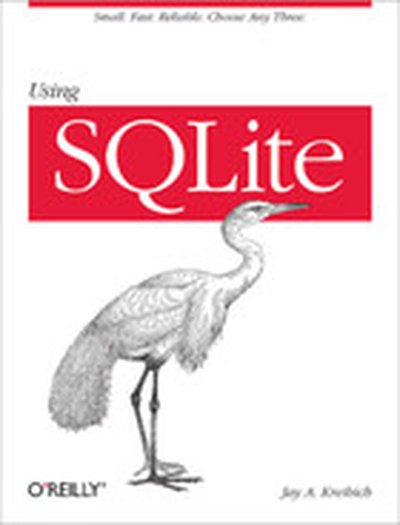
Using SQLite

Application developers, take note: databases aren't just for the IS group any more. You can build database-backed applications for the desktop, Web, embedded systems, or operating systems without linking to heavy-duty client-server databases such as Oracle and MySQL. This book shows you how to use SQLite, a small and lightweight relational database engine that you can build directly into your application. With SQLite, you'll discover how to develop a database-backed application that remains manageable in size and complexity. This book guides you every step of the way. You'll get a crash course in data modeling, become familiar with SQLite's dialect of the SQL database language, and much more. Learn how to maintain localized storage in a single file that requires no configuration Build your own SQLite library or use a precompiled distribution in your application Get a primer on SQL, and learn how to use several language functions and extensions Work with SQLite using a scripting language or a C-based language such as C# or Objective-C Understand the basics of database design, and learn how to transfer what you already know to SQLite Take advantage of virtual tables and modules "Complex SQL concepts explained clearly." --D. Richard Hipp, creator of SQLite

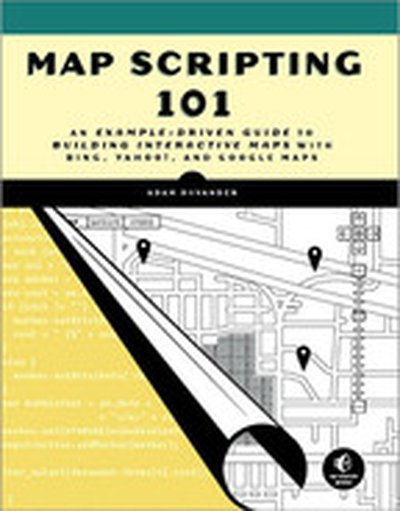
Map Scripting 101

Map Scripting 101 uses a project-based approach to teach you how to create useful and fun online map mashups like weather maps and local concert trackers. Author Adam DuVander shows you how to use Mapstraction, an open source JavaScript library, to create and manipulate basic maps by setting zoom levels, showing and hiding markers, geocoding addresses, customizing maps for visitors based on their locales, and so on. You'll also learn to handle complex GIS (geographic information system) data and formats like KML and GeoRSS, and to create graphical overlays to make sense of data and trends. This is a perfect book for any web developer, whether their goal is to build a map to track earthquakes around the world, or to simply mark the best coffee shops in town.

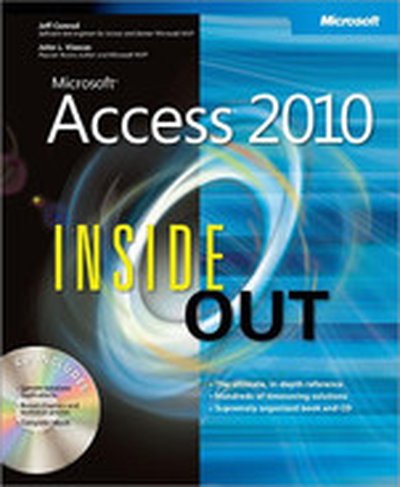
Microsoft® Access® 2010 Inside Out

You're beyond the basics, so dive right in and really put your database skills to work! This supremely organized reference is packed with hundreds of timesaving solutions, troubleshooting tips, and workarounds. It's all muscle and no fluff. Discover how the experts tackle Access 2010 -- and challenge yourself to new levels of mastery! Master essential data management and design techniques Import and link to data from spreadsheets, databases, text files, and other sources Use action queries to quickly insert, update, or delete entire sets of data Create custom forms to capture and display data Design reports to calculate, summarize, and highlight critical data--and learn advanced techniques Automate your application with macros and Visual Basic for Applications (VBA) Use Access Services to extend your database application to the Web Try out the sample client and web database applications in both 32-bit and 64-bit versions A Note Regarding the CD or DVD The print version of this book ships with a CD or DVD. The sample client and web database applications are provided in both 32-bit and 64-bit versions. Note that while we provide as much of the media content as we are able via free download, we are sometimes limited by licensing restrictions. For customers who purchase an ebook version of this title, instructions for downloading the CD files can be found in the ebook.

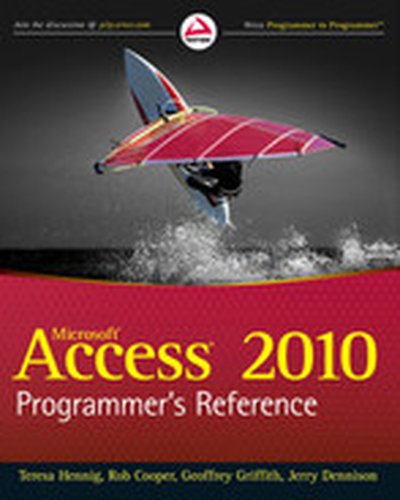
Microsoft® Access® 2010 Programmer's Reference

A comprehensive guide to programming for Access 2010 and 2007 Millions of people use the Access database applications, and hundreds of thousands of developers work with Access daily. Access 2010 brings better integration with SQL Server and enhanced XML support; this Wrox guide shows developers how to take advantage of these and other improvements. With in-depth coverage of VBA, macros, and other programming methods for building Access applications, this book also provides real-world code examples to demonstrate each topic. Access 2010 Programmer's Reference is a comprehensive guide to the best-of-breed techniques for programming Access applications. Coverage Includes: Introduction to Microsoft Access 2010 New Features Upgrading and Converting to Access 2010 Macros in Access 2010 Using the VBA Editor VBA Basics Using VBA in Access Creating Classes in VBA Extending VBA with APIs Working with the Windows Registry Using DAO to Access Data Using ADO to Access Data Using SQL with VBA Using VBA to Enhance Forms Enhancing Reports with VBA Customizing the Ribbon Customizing the Office Backstage Working with Office 2010 Working with SharePoint Working with .NET Building Client-Server Applications with Access The Access 2010 Templates Access Runtime Deployment Database Security Access 2010 Security Features

Privacy Means Profit: Prevent Identity Theft and Secure You and Your Bottom Line

Bulletproof your organization against data breach, identity theft, and corporate espionage In this updated and revised edition of Privacy Means Profit, John Sileo demonstrates how to keep data theft from destroying your bottom line, both personally and professionally. In addition to sharing his gripping tale of losing $300,000 and his business to data breach, John writes about the risks posed by social media, travel theft, workplace identity theft, and how to keep it from happening to you and your business. By interlacing his personal experience with cutting-edge research and unforgettable stories, John not only inspires change inside of your organization, but outlines a simple framework with which to build a Culture of Privacy. This book is a must-read for any individual with a Social Security Number and any business leader who doesn't want the negative publicity, customer flight, legal battles and stock depreciation resulting from data breach. Protect your net worth and bottom line using the 7 Mindsets of a Spy Accumulate Layers of Privacy Eliminate the Source Destroy Data Risk Lock Your Assets Evaluate the Offer Interrogate the Enemy Monitor the Signs In this revised edition, John includes an 8th Mindset, Adaptation, which serves as an additional bridge between personal protection and bulletproofing your organization. Privacy Means Profit offers a one-stop guide to protecting what's most important and most at risk-your essential business and personal data.

Database Modeling and Design, 4th Edition

Database Modeling and Design, Fourth Edition, the extensively revised edition of the classic logical database design reference, explains how you can model and design your database application in consideration of new technology or new business needs. It is an ideal text for a stand-alone data management course focused on logical database design, or a supplement to an introductory text for introductory database management. This book features clear explanations, lots of terrific examples and an illustrative case, and practical advice, with design rules that are applicable to any SQL-based system. The common examples are based on real-life experiences and have been thoroughly class-tested. The text takes a detailed look at the Unified Modeling Language (UML-2) as well as the entity-relationship (ER) approach for data requirements specification and conceptual modeling - complemented with examples for both approaches. It also discusses the use of data modeling concepts in logical database design; the transformation of the conceptual model to the relational model and to SQL syntax; the fundamentals of database normalization through the fifth normal form; and the major issues in business intelligence such as data warehousing, OLAP for decision support systems, and data mining. There are examples for how to use the most popular CASE tools to handle complex data modeling problems, along with exercises that test understanding of all material, plus solutions for many exercises. Lecture notes and a solutions manual are also available. This edition will appeal to professional data modelers and database design professionals, including database application designers, and database administrators (DBAs); new/novice data management professionals, such as those working on object oriented database design; and students in second courses in database focusing on design.+ a detailed look at the Unified Modeling Language (UML-2) as well as the entity-relationship (ER) approach for data requirements specification and conceptual modeling--with examples throughout the book in both approaches! + the details and examples of how to use data modeling concepts in logical database design, and the transformation of the conceptual model to the relational model and to SQL syntax; + the fundamentals of database normalization through the fifth normal form; + practical coverage of the major issues in business intelligence--data warehousing, OLAP for decision support systems, and data mining; + examples for how to use the most popular CASE tools to handle complex data modeling problems. + Exercises that test understanding of all material, plus solutions for many exercises.

InfoSphere DataStage Parallel Framework Standard Practices

In this IBM® Redbooks® publication, we present guidelines for the development of highly efficient and scalable information integration applications with InfoSphere™ DataStage® (DS) parallel jobs. InfoSphere DataStage is at the core of IBM Information Server, providing components that yield a high degree of freedom. For any particular problem there might be multiple solutions, which tend to be influenced by personal preferences, background, and previous experience. All too often, those solutions yield less than optimal, and non-scalable, implementations. This book includes a comprehensive detailed description of the components available, and descriptions on how to use them to obtain scalable and efficient solutions, for both batch and real-time scenarios. The advice provided in this document is the result of the combined proven experience from a number of expert practitioners in the field of high performance information integration, evolved over several years. This book is intended for IT architects, Information Management specialists, and Information Integration specialists responsible for delivering cost-effective IBM InfoSphere DataStage performance on all platforms.