talk-data.com talk-data.com

Topic

data

2093

tagged

Activity Trend

3 peak/qtr
2020-Q1 2026-Q1

Activities

Showing filtered results

Filtering by: O'Reilly Data Science Books ×
IBM Cognos 10 Report Studio Cookbook - Second Edition

This cookbook is a comprehensive guide to mastering IBM Cognos 10 Report Studio, enabling users to become proficient in developing professional-grade reports. Through practical recipes, you will learn how to harness the full potential of Report Studio, mastering both fundamental and advanced features for real-world application. What this Book will help me do Efficiently organize and process data using advanced sorting and filtering techniques. Create visually engaging and functional reports, including dynamic drill-through links and enhanced formatting options. Master the use of conditional formatting, cascaded prompts, and master-detailed queries in your reports. Enhance reports with Active Reports, direct XML editing, and by integrating JavaScript and HTML elements. Adopt industry best practices for report development, including version control and regression testing. Author(s) The author of this cookbook is an experienced IBM Cognos consultant with years of experience in developing business intelligence solutions and creating comprehensive reports. They focus on combining technical expertise with practical examples, presenting information in an approachable and user-friendly manner. Who is it for? This book is ideal for Business Intelligence Developers with a working knowledge of IBM Cognos 10 who seek to enhance their report-building skills. It also serves Business Analysts or Power Users familiar with basic report authoring who aim to explore advanced features. Prior knowledge of IBM Cognos 10 architecture and basic Report Studio functionalities is assumed.

Big Data Analytics

Big Data Analytics will assist managers in providing an overview of the drivers for introducing big data technology into the organization and for understanding the types of business problems best suited to big data analytics solutions, understanding the value drivers and benefits, strategic planning, developing a pilot, and eventually planning to integrate back into production within the enterprise. Guides the reader in assessing the opportunities and value proposition Overview of big data hardware and software architectures Presents a variety of technologies and how they fit into the big data ecosystem

Handbook of Economic Forecasting

The highly prized ability to make financial plans with some certainty about the future comes from the core fields of economics. In recent years the availability of more data, analytical tools of greater precision, and ex post studies of business decisions have increased demand for information about economic forecasting. Volumes 2A and 2B, which follows Nobel laureate Clive Granger's Volume 1 (2006), concentrate on two major subjects. Volume 2A covers innovations in methodologies, specifically macroforecasting and forecasting financial variables. Volume 2B investigates commercial applications, with sections on forecasters' objectives and methodologies. Experts provide surveys of a large range of literature scattered across applied and theoretical statistics journals as well as econometrics and empirical economics journals. The Handbook of Economic Forecasting Volumes 2A and 2B provide a unique compilation of chapters giving a coherent overview of forecasting theory and applications in one place and with up-to-date accounts of all major conceptual issues. Focuses on innovation in economic forecasting via industry applications Presents coherent summaries of subjects in economic forecasting that stretch from methodologies to applications Makes details about economic forecasting accessible to scholars in fields outside economics

Handbook of Economic Forecasting

The highly prized ability to make financial plans with some certainty about the future comes from the core fields of economics. In recent years the availability of more data, analytical tools of greater precision, and ex post studies of business decisions have increased demand for information about economic forecasting. Volumes 2A and 2B, which follows Nobel laureate Clive Granger's Volume 1 (2006), concentrate on two major subjects. Volume 2A covers innovations in methodologies, specifically macroforecasting and forecasting financial variables. Volume 2B investigates commercial applications, with sections on forecasters' objectives and methodologies. Experts provide surveys of a large range of literature scattered across applied and theoretical statistics journals as well as econometrics and empirical economics journals. The Handbook of Economic Forecasting Volumes 2A and 2B provide a unique compilation of chapters giving a coherent overview of forecasting theory and applications in one place and with up-to-date accounts of all major conceptual issues. Focuses on innovation in economic forecasting via industry applications Presents coherent summaries of subjects in economic forecasting that stretch from methodologies to applications Makes details about economic forecasting accessible to scholars in fields outside economics

Credible Checklists and Quality Questionnaires

Credible Checklists and Quality Questionnaires starts off with an examination of the critical but commonly overlooked checklist method. In the second chapter, questionnaires and surveys are discussed. Asking questions sounds simple, but the hard truth is that asking questions (and designing questionnaires) is a difficult task. This chapter discusses being mindful of the choice of words, order of questions and how early questions influence later questions, answer scales and how they impact the user response, questionnaire design, and much more. The final chapter provides examples of some common questionnaires (both free and fee-based) for assessing the usability of products. After reading this book, readers will be able to use these user design tools with greater confidence and certainty.

A/B Testing: The Most Powerful Way to Turn Clicks Into Customers

A guide to delivering a better user experience through A/B testing A/B Testing outlines a simple way to test several different versions of a web page with live traffic, and then measure the effect each version has on visitors. Using A/B testing you can determine the most effective way to increase conversion rate—the rate at which visitors convert into customers. The average conversion rate across the web is only 2%. That means 98% of visitors to most websites don't end up converting. Using A/B testing, companies can improve the effectiveness of their marketing and user experience and in doing so can sometimes double or triple their conversion rates. In the past, marketing teams were dependent on IT and engineering to implement A/B tests, and that proved to be a costly bottleneck. Today, the market for A/B testing is growing very fast, in no small part due to this transition from IT to marketing. Offers best practices and lessons learned from over 100,000 experiments run by over 2,000 Optimizely customers Details a roadmap for how to use A/B testing to personalize your customer's web experience and a practical guide to start A/B testing today Authors Dan Siroker and Pete Koomen are cofounders of Optimizely.com, an user-friendly testing system that more than 2,000 organizations use Marketers and web professionals will become obsolete if they don't embrace a data-driven approach to decision making. This book shows you how, no matter your technical expertise.

Demand-Driven Forecasting: A Structured Approach to Forecasting, 2nd Edition

An updated new edition of the comprehensive guide to better business forecasting Many companies still look at quantitative forecasting methods with suspicion, but a new awareness is emerging across many industries as more businesses and professionals recognize the value of integrating demand data (point-of-sale and syndicated scanner data) into the forecasting process. Demand-Driven Forecasting equips you with solutions that can sense, shape, and predict future demand using highly sophisticated methods and tools. From a review of the most basic forecasting methods to the most advanced and innovative techniques in use today, this guide explains demand-driven forecasting, offering a fundamental understanding of the quantitative methods used to sense, shape, and predict future demand within a structured process. Offering a complete overview of the latest business forecasting concepts and applications, this revised Second Edition of Demand-Driven Forecasting is the perfect guide for professionals who need to improve the accuracy of their sales forecasts. Completely updated to include the very latest concepts and methods in forecasting Includes real case studies and examples, actual data, and graphical displays and tables to illustrate how effective implementation works Ideal for CEOs, CFOs, CMOs, vice presidents of supply chain, vice presidents of demand forecasting and planning, directors of demand forecasting and planning, supply chain managers, demand planning managers, marketing analysts, forecasting analysts, financial managers, and any other professional who produces or contributes to forecasts Accurate forecasting is vital to success in today's challenging business climate. Demand-Driven Forecasting offers proven and effective insight on making sure your forecasts are right on the money.

Tableau 8: The Official Guide

Present a unified view of complex BI using the entire Tableau 8 toolkit Create and distribute dynamic, feature-rich data visualizations and highly interactive BI dashboards—quickly and easily! Tableau 8: The Official Guide provides the hands-on instruction and best practices you need to meet your business intelligence objectives and drive better decision making. Discover how to work from the Tableau GUI, load BI from disparate sources, drag and drop to analyze data, set up custom visualizations, and build robust dashboards. This practical guide shows you, step by step, how to design and publish meaningful business communications to end users across your enterprise. Navigate the Tableau user interface and data window Connect to spreadsheets, databases, and other sources Select data fields and drag them to desired screen locations Work with pre-defined visualizations and sample workbooks Display background maps and perform geographic analysis Add calculated fields, graphs, charts, tables, and statistics Combine multiple data sources into real-time dashboards Export your visualizations to the Web or in various file formats Electronic content includes: Videos that demonstrate the techniques presented in the book Sample Tableau workbooks

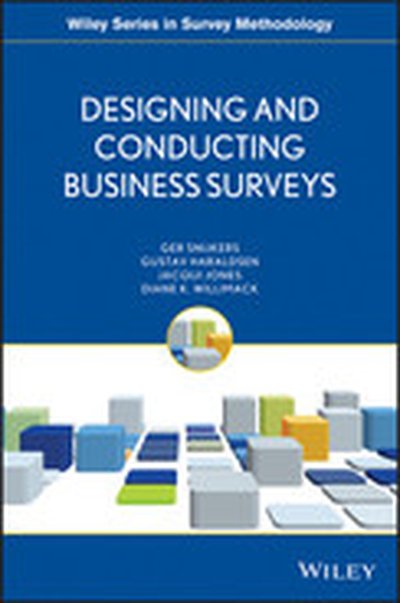
Designing and Conducting Business Surveys

Designing and Conducting Business Surveys provides a coherent overview of the business survey process, from start to finish. It uniquely integrates an understanding of how businesses operate, a total survey error approach to data quality that focuses specifically on business surveys, and sound project management principles. The book brings together what is currently known about planning, designing, and conducting business surveys, with producing and disseminating statistics or other research results from the collected data. This knowledge draws upon a variety of disciplines such as survey methodology, organizational sciences, sociology, psychology, and statistical methods. The contents of the book formulate a comprehensive guide to scholarly material previously dispersed among books, journal articles, and conference papers. This book provides guidelines that will help the reader make educated trade-off decisions that minimize survey errors, costs, and response burden, while being attentive to survey data quality. Major topics include: Determining the survey content, considering user needs, the business context, and total survey quality Planning the survey as a project Sampling frames, procedures, and methods Questionnaire design and testing for self-administered paper, web, and mixed-mode surveys Survey communication design to obtain responses and facilitate the business response process Conducting and managing the survey using paradata and project management tools Data processing, including capture, editing, and imputation, and dissemination of statistical outputs Designing and Conducting Business Surveys is an indispensable resource for anyone involved in designing and/or conducting business or organizational surveys at statistical institutes, central banks, survey organizations, etc.; producing statistics or other research results from business surveys at universities, research organizations, etc.; or using data produced from business surveys. The book also lays a foundation for new areas of research in business surveys.

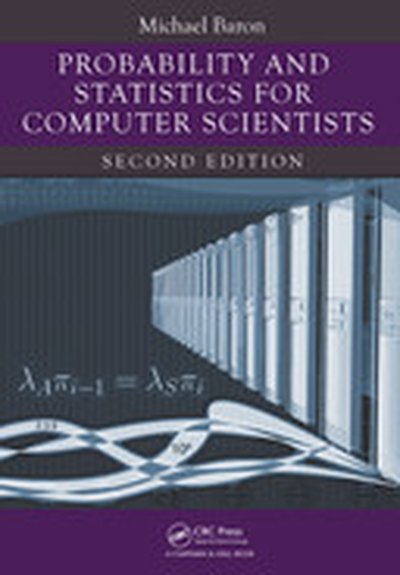
Probability and Statistics for Computer Scientists, 2nd Edition

Student-Friendly Coverage of Probability, Statistical Methods, Simulation, and Modeling ToolsIncorporating feedback from instructors and researchers who used the previous edition, Probability and Statistics for Computer Scientists, Second Edition helps students understand general methods of stochastic modeling, simulation, and data analysis; make o

Bioinformatics for Biomedical Science and Clinical Applications

Contemporary biomedical and clinical research is undergoing constant development thanks to the rapid advancement of various high throughput technologies at the DNA, RNA and protein levels. These technologies can generate vast amounts of raw data, making bioinformatics methodologies essential in their use for basic biomedical and clinical applications. Bioinformatics for biomedical science and clinical applications demonstrates what these cutting-edge technologies can do and examines how to design an appropriate study, including how to deal with data and address specific clinical questions. The first two chapters consider Bioinformatics and analysis of the human genome. The subsequent three chapters cover the introduction of Transcriptomics, Proteomics and Systems biomedical science. The remaining chapters move on to critical developments, clinical information and conclude with domain knowledge and adaptivity. A coherent presentation of concepts, methodologies and practical tools that systematically lead to significant discoveries in the biomedical and clinical area Real examples of cutting edge discoveries The introduction of study types and technologies for all the DNA, RNA and protein levels

Adobe® Analytics Quick-Reference Guide: Market Reports and Analytics (formerly SiteCatalyst)

Companies face the challenge of measuring and analyzing the near-overwhelming quantities of data generated from their online businesses and then using that data to gain critical insights into their customersvto drive sales. Adobe Analytics (formerly SiteCatalyst) provides product and content managers, marketers, and analysts with real-time intelligence on customers’online behavior, helps businesses anticipate what their customers will want, personalizes their onlinev experience, and delivers relevant content across web and mobile channels. This quick lookup guide by Adobe Analytics expert Shane Closser uses clear, concise explanations and an easy-to-use format to jump in and start using Adobe’s powerful web analytics tool. You’ll learn the quickest way to: Create metrics Run and set options for reports Measure the effectiveness of marketing campaigns Engage and retain customers Track customers through the conversion funnel Share reports and set up dashboards

Biostatistics For Dummies

Score your highest in biostatistics Biostatistics is a required course for students of medicine, epidemiology, forestry, agriculture, bioinformatics, and public health. In years past this course has been mainly a graduate-level requirement; however its application is growing and course offerings at the undergraduate level are exploding. Biostatistics For Dummies is an excellent resource for those taking a course, as well as for those in need of a handy reference to this complex material. Biostatisticians—analysts of biological data—are charged with finding answers to some of the world's most pressing health questions: how safe or effective are drugs hitting the market today? What causes autism? What are the risk factors for cardiovascular disease? Are those risk factors different for men and women or different ethnic groups? Biostatistics For Dummies examines these and other questions associated with the study of biostatistics. Provides plain-English explanations of techniques and clinical examples to help Serves as an excellent course supplement for those struggling with the complexities of the biostatistics Tracks to a typical, introductory biostatistics course Biostatistics For Dummies is an excellent resource for anyone looking to succeed in this difficult course.

Point and Figure Charting: The Essential Application for Forecasting and Tracking Market Prices, 4th Edition

An up-to-date look at point and figure charting from one of the foremost authorities in the field If you're looking for an investment approach that has stood the test of time—during both bull and bear markets—and is easy enough to learn, whether you're an expert or aspiring investor, then Point and Figure Charting, Fourth Edition is the book for you. Filled with in-depth insights and expert advice, this practical guide will help you grow your assets in any market. In this reliable resource, the world's top point and figure charting expert, Tom Dorsey returns to explain how traders and investors alike can use this classic technique—borne out of the irrefutable laws of supply and demand—to identify and capitalize on market trends. Describes, step-by-step, how to create, maintain, and interpret your own point and figure charts with regard to markets, sectors, and individual securities Explains how to use other indicators, including moving averages, advance-decline lines, and relative strength to augment point and figure analysis Reveals how to use this approach to track and forecast market prices and develop an overall investment strategy Skillfully explains how to use point and figure analysis to evaluate the strength of international markets and rotate exposure from country to country Today's investment arena is filled with a variety of strategies that never seem to deliver on what they promise. But there is one approach to investment analysis that has proven itself in all types of markets, and it's found right here in Point and Figure Charting, Fourth Edition.

Visio® 2013 Absolute Beginner’s Guide

Make the most of Visio 2013– without becoming a technical expert! This book is the fastest way to master Visio and use it to build powerful, useful diagrams, org charts, and flowcharts of all kinds! Even if you’ve never used Visio before, you’ll learn how to do what you want, one incredibly clear and easy step at a time. Visio has never, ever been this simple! Who knew how simple Visio 2013 could be? This is the easiest, most practical beginner’s guide to using Microsoft Visio 2013...simple, reliable instructions for doing everything you really want to do! Here’s a small sample of what you’ll learn: Master new tools for creating intuitive, visually appealing diagrams Learn high-efficiency touch features for Windows 8 and tablets Create business and engineering diagrams, flowcharts, maps, floor plans, network diagrams, schedules, and more Instantly set or change diagram designs with enhanced templates and themes Simplify diagramming with built-in shapes and stencils–or create your own Craft more sophisticated diagrams with containers, callouts, screentips, and layers Import external images, from SVG graphics to AutoCAD drawings Visually present Excel spreadsheet data in Visio drawings Dynamically update diagrams with real-time data to support better decision-making Share diagrams to improve team collaboration

Segmentation and Lifetime Value Models Using SAS

Help your organization determine the value of its customer relationships with Segmentation and Lifetime Value Models Using SAS. This book contains a wealth of information that will help you perform analyses to identify your customers and make informed marketing investments. It answers core questions on customer relationship management (CRM), provides an overall framework for thinking about CRM, and offers real-world examples across a variety of industries.

Edward C. Malthouse introduces you to a number of useful models, ranging from simple to more complicated examples, and discusses their applications. You'll learn about segmentation models for identifying groups of customers and about lifetime value models for estimating the future value of the segments. You'll learn how to prepare data and estimate models using Base SAS, SAS/STAT, SAS/IML, and SQL.

Marketing analysts, CRM analysts, database managers, and anyone looking to address the challenges of allocating marketing resources to different customer groups will benefit from the concepts and exercises in this book. Analysts will learn how to approach unique business problems. Managers will gain a sense of what's possible and what to ask of their analytics departments.

This book is part of the SAS Press program.

Numbersense: How to Use Big Data to Your Advantage

How to make simple sense of complex statistics--from the author of Numbers Rule Your World We live in a world of Big Data--and it's getting bigger every day. Virtually every choice we make hinges on how someone generates data . . . and how someone else interprets it--whether we realize it or not. Where do you send your child for the best education? Big Data. Which airline should you choose to ensure a timely arrival? Big Data. Who will you vote for in the next election? Big Data. The problem is, the more data we have, the more difficult it is to interpret it. From world leaders to average citizens, everyone is prone to making critical decisions based on poor data interpretations. In Numbersense, expert statistician Kaiser Fung explains when you should accept the conclusions of the Big Data "experts"--and when you should say, "Wait . . . what?" He delves deeply into a wide range of topics, offering the answers to important questions, such as: How does the college ranking system really work? Can an obesity measure solve America's biggest healthcare crisis? Should you trust current unemployment data issued by the government? How do you improve your fantasy sports team? Should you worry about businesses that track your data? Don't take for granted statements made in the media, by our leaders, or even by your best friend. We're on information overload today, and there's a lot of bad information out there. Numbersense gives you the insight into how Big Data interpretation works--and how it too often doesn't work. You won't come away with the skills of a professional statistician. But you will have a keen understanding of the data traps even the best statisticians can fall into, and you'll trust the mental alarm that goes off in your head when something just doesn't seem to add up. Praise for Numbersense " Numbersense correctly puts the emphasis not on the size of big data, but on the analysis of it. Lots of fun stories, plenty of lessons learned—in short, a great way to acquire your own sense of numbers!" Thomas H. Davenport, coauthor of Competing on Analytics and President’s Distinguished Professor of IT and Management, Babson College "Kaiser’s accessible business book will blow your mind like no other. You’ll be smarter, and you won’t even realize it. Buy. It. Now." Avinash Kaushik, Digital Marketing Evangelist, Google, and author, Web Analytics 2.0 "Each story in Numbersense goes deep into what you have to think about before you trust the numbers. Kaiser Fung ably demonstrates that it takes skill and resourcefulness to make the numbers confess their meaning." John Sall, Executive Vice President, SAS Institute "Kaiser Fung breaks the bad news—a ton more data is no panacea—but then has got your back, revealing the pitfalls of analysis with stimulating stories from the front lines of business, politics, health care, government, and education. The remedy isn’t an advanced degree, nor is it common sense. You need Numbersense." Eric Siegel, founder, Predictive Analytics World, and author, Predictive Analytics "I laughed my way through this superb-useful-fun book and learned and relearned a lot. Highly recommended!" Tom Peters, author of In Search of Excellence

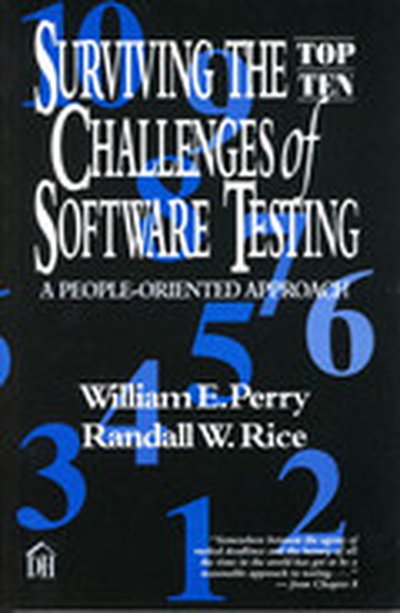
Surviving the Top Ten Challenges of Software Testing: A People-Oriented Approach

This is the digital version of hte printed book (Copyright © 1997). Software testers require technical and political skills to survive what can often be a lose-lose relationship with developers and managers. Whether testing is your specialty or your stepping stone to a career as a developer, there's no better way to survive the pressures put on testers than to meet the ten challenges described in this practical handbook. This book goes beyond the technical skills required for effective testing to address the political realities that can't be solved by technical knowledge alone. Communication and negotiation skills must be in every tester's tool kit. Authors Perry and Rice compile a "top ten" list of the challenges faced by testers and offer tactics for success. They combine their years of experience in developing testing processes, writing books and newsletters on testing, and teaching seminars on how to test. The challenges are addressed in light of the way testing fits into the context of software development and how testers can maximize their relationships with managers, developers, and customers. In fact, anyone who works with software testers should read this book for insight into the unique pressures put on this part of the software development process. "Somewhere between the agony of rushed deadlines and the luxury of all the time in the world has got to be a reasonable approach to testing."—from Chapter 8 The Top Ten People Challenges Facing Testers Challenge #10: Getting Trained in Testing Challenge #9: Building Relationships with Developers Challenge #8: Testing Without Tools Challenge #7: Explaining Testing to Managers Challenge #6: Communicating with Customers—And Users Challenge #5: Making Time for Testing Challenge #4: Testing What's Thrown Over the Wall Challenge #3: Hitting a Moving Target Challenge #2: Fighting a Lose-Lose Situation Challenge #1: Having to Say No

Decision Trees for Analytics Using SAS Enterprise Miner

Decision Trees for Analytics Using SAS Enterprise Miner is the most comprehensive treatment of decision tree theory, use, and applications available in one easy-to-access place. This book illustrates the application and operation of decision trees in business intelligence, data mining, business analytics, prediction, and knowledge discovery. It explains in detail the use of decision trees as a data mining technique and how this technique complements and supplements data mining approaches such as regression, as well as other business intelligence applications that incorporate tabular reports, OLAP, or multidimensional cubes.

An expanded and enhanced release of Decision Trees for Business Intelligence and Data Mining Using SAS Enterprise Miner, this book adds up-to-date treatments of boosting and high-performance forest approaches and rule induction. There is a dedicated section on the most recent findings related to bias reduction in variable selection. It provides an exhaustive treatment of the end-to-end process of decision tree construction and the respective considerations and algorithms, and it includes discussions of key issues in decision tree practice.

Analysts who have an introductory understanding of data mining and who are looking for a more advanced, in-depth look at the theory and methods of a decision tree approach to business intelligence and data mining will benefit from this book.

This book is part of the SAS Press program.