talk-data.com talk-data.com

Topic

Data Lakehouse

data_architecture data_warehouse data_lake

489

tagged

Activity Trend

118 peak/qtr
2020-Q1 2026-Q1

Activities

489 activities · Newest first

Large Language Models (LLMs) are transformative, but static knowledge and hallucinations limit their direct enterprise use. Retrieval-Augmented Generation (RAG) is the standard solution, yet moving from prototype to production is fraught with challenges in data quality, scalability, and evaluation.

This talk argues the future of intelligent retrieval lies not in better models, but in a unified, data-first platform. We'll demonstrate how the Databricks Data Intelligence Platform, built on a Lakehouse architecture with integrated tools like Mosaic AI Vector Search, provides the foundation for production-grade RAG.

Looking ahead, we'll explore the evolution beyond standard RAG to advanced architectures like GraphRAG, which enable deeper reasoning within Compound AI Systems. Finally, we'll show how the end-to-end Mosaic AI Agent Framework provides the tools to build, govern, and evaluate the intelligent agents of the future, capable of reasoning across the entire enterprise.

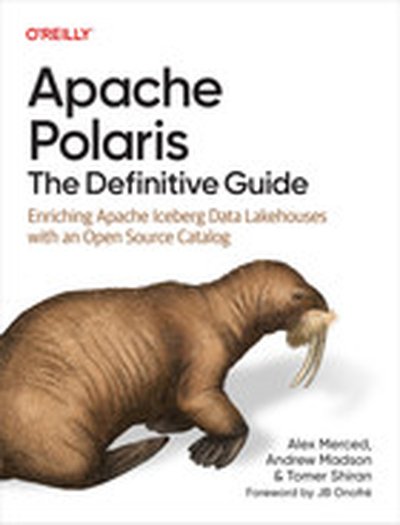
Apache Polaris: The Definitive Guide

Revolutionize your understanding of modern data management with Apache Polaris (incubating), the open source catalog designed for data lakehouse industry standard Apache Iceberg. This comprehensive guide takes you on a journey through the intricacies of Apache Iceberg data lakehouses, highlighting the pivotal role of Iceberg catalogs. Authors Alex Merced, Andrew Madson, and Tomer Shiran explore Apache Polaris's architecture and features in detail, equipping you with the knowledge needed to leverage its full potential. Data engineers, data architects, data scientists, and data analysts will learn how to seamlessly integrate Apache Polaris with popular data tools like Apache Spark, Snowflake, and Dremio to enhance data management capabilities, optimize workflows, and secure datasets. Get a comprehensive introduction to Iceberg data lakehouses Understand how catalogs facilitate efficient data management and querying in Iceberg Explore Apache Polaris's unique architecture and its powerful features Deploy Apache Polaris locally, and deploy managed Apache Polaris from Snowflake and Dremio Perform basic table operations on Apache Spark, Snowflake, and Dremio

Summary In this episode of the Data Engineering Podcast Hannes Mühleisen and Mark Raasveldt, the creators of DuckDB, share their work on Duck Lake, a new entrant in the open lakehouse ecosystem. They discuss how Duck Lake, is focused on simplicity, flexibility, and offers a unified catalog and table format compared to other lakehouse formats like Iceberg and Delta. Hannes and Mark share insights into how Duck Lake revolutionizes data architecture by enabling local-first data processing, simplifying deployment of lakehouse solutions, and offering benefits such as encryption features, data inlining, and integration with existing ecosystems.

Announcements Hello and welcome to the Data Engineering Podcast, the show about modern data managementData teams everywhere face the same problem: they're forcing ML models, streaming data, and real-time processing through orchestration tools built for simple ETL. The result? Inflexible infrastructure that can't adapt to different workloads. That's why Cash App and Cisco rely on Prefect. Cash App's fraud detection team got what they needed - flexible compute options, isolated environments for custom packages, and seamless data exchange between workflows. Each model runs on the right infrastructure, whether that's high-memory machines or distributed compute. Orchestration is the foundation that determines whether your data team ships or struggles. ETL, ML model training, AI Engineering, Streaming - Prefect runs it all from ingestion to activation in one platform. Whoop and 1Password also trust Prefect for their data operations. If these industry leaders use Prefect for critical workflows, see what it can do for you at dataengineeringpodcast.com/prefect.Data migrations are brutal. They drag on for months—sometimes years—burning through resources and crushing team morale. Datafold's AI-powered Migration Agent changes all that. Their unique combination of AI code translation and automated data validation has helped companies complete migrations up to 10 times faster than manual approaches. And they're so confident in their solution, they'll actually guarantee your timeline in writing. Ready to turn your year-long migration into weeks? Visit dataengineeringpodcast.com/datafold today for the details. Your host is Tobias Macey and today I'm interviewing Hannes Mühleisen and Mark Raasveldt about DuckLake, the latest entrant into the open lakehouse ecosystemInterview IntroductionHow did you get involved in the area of data management?Can you describe what DuckLake is and the story behind it?What are the particular problems that DuckLake is solving for?How does this compare to the capabilities of MotherDuck?Iceberg and Delta already have a well established ecosystem, but so does DuckDB. Who are the primary personas that you are trying to focus on in these early days of DuckLake?One of the major factors driving the adoption of formats like Iceberg is cost efficiency for large volumes of data. That brings with it challenges of large batch processing of data. How does DuckLake account for these axes of scale?There is also a substantial investment in the ecosystem of technologies that support Iceberg. The most notable ecosystem challenge for DuckDB and DuckLake is in the query layer. How are you thinking about the evolution and growth of that capability beyond DuckDB (e.g. support in Trino/Spark/Flink)?What are your opinions on the viability of a future where DuckLake and Iceberg become a unified standard and implementation? (why can't Iceberg REST catalog implementations just use DuckLake under the hood?)Digging into the specifics of the specification and implementation, what are some of the capabilities that it offers above and beyond Iceberg?Is it now possible to enforce PK/FK constraints, indexing on underlying data?Given that DuckDB has a vector type, how do you think about the support for vector storage/indexing?How do the capabilities of DuckLake and the integration with DuckDB change the ways that data teams design their data architecture and access patterns?What are your thoughts on the impact of "data gravity" in today's data ecosystem, with engines like DuckDB, KuzuDB, LanceDB, etc. available for embedded and edge use cases?What are the most interesting, innovative, or unexpected ways that you have seen DuckLake used?What are the most interesting, unexpected, or challenging lessons that you have learned while working on DuckLake?When is DuckLake the wrong choice?What do you have planned for the future of DuckLake?Contact Info HannesWebsiteMarkWebsiteParting Question From your perspective, what is the biggest gap in the tooling or technology for data management today?Closing Announcements Thank you for listening! Don't forget to check out our other shows. Podcast.init covers the Python language, its community, and the innovative ways it is being used. The AI Engineering Podcast is your guide to the fast-moving world of building AI systems.Visit the site to subscribe to the show, sign up for the mailing list, and read the show notes.If you've learned something or tried out a project from the show then tell us about it! Email [email protected] with your story.Links DuckDBPodcast EpisodeDuckLakeDuckDB LabsMySQLCWIMonetDBIcebergIceberg REST CatalogDeltaHudiLanceDuckDB Iceberg ConnectorACID == Atomicity, Consistency, Isolation, DurabilityMotherDuckMotherDuck Managed DuckLakeTrinoSparkPrestoSpark DuckLake DemoDelta KernelArrowdltS3 TablesAttribute Based Access Control (ABAC)ParquetArrow FlightHadoopHDFSDuckLake RoadmapThe intro and outro music is from The Hug by The Freak Fandango Orchestra / CC BY-SA

Summary In this episode of the Data Engineering Podcast Serge Gershkovich, head of product at SQL DBM, talks about the socio-technical aspects of data modeling. Serge shares his background in data modeling and highlights its importance as a collaborative process between business stakeholders and data teams. He debunks common misconceptions that data modeling is optional or secondary, emphasizing its crucial role in ensuring alignment between business requirements and data structures. The conversation covers challenges in complex environments, the impact of technical decisions on data strategy, and the evolving role of AI in data management. Serge stresses the need for business stakeholders' involvement in data initiatives and a systematic approach to data modeling, warning against relying solely on technical expertise without considering business alignment.

Announcements Hello and welcome to the Data Engineering Podcast, the show about modern data managementData migrations are brutal. They drag on for months—sometimes years—burning through resources and crushing team morale. Datafold's AI-powered Migration Agent changes all that. Their unique combination of AI code translation and automated data validation has helped companies complete migrations up to 10 times faster than manual approaches. And they're so confident in their solution, they'll actually guarantee your timeline in writing. Ready to turn your year-long migration into weeks? Visit dataengineeringpodcast.com/datafold today for the details.Enterprises today face an enormous challenge: they’re investing billions into Snowflake and Databricks, but without strong foundations, those investments risk becoming fragmented, expensive, and hard to govern. And that’s especially evident in large, complex enterprise data environments. That’s why companies like DirecTV and Pfizer rely on SqlDBM. Data modeling may be one of the most traditional practices in IT, but it remains the backbone of enterprise data strategy. In today’s cloud era, that backbone needs a modern approach built natively for the cloud, with direct connections to the very platforms driving your business forward. Without strong modeling, data management becomes chaotic, analytics lose trust, and AI initiatives fail to scale. SqlDBM ensures enterprises don’t just move to the cloud—they maximize their ROI by creating governed, scalable, and business-aligned data environments. If global enterprises are using SqlDBM to tackle the biggest challenges in data management, analytics, and AI, isn’t it worth exploring what it can do for yours? Visit dataengineeringpodcast.com/sqldbm to learn more.Your host is Tobias Macey and today I'm interviewing Serge Gershkovich about how and why data modeling is a sociotechnical endeavorInterview IntroductionHow did you get involved in the area of data management?Can you start by describing the activities that you think of when someone says the term "data modeling"?What are the main groupings of incomplete or inaccurate definitions that you typically encounter in conversation on the topic?How do those conceptions of the problem lead to challenges and bottlenecks in execution?Data modeling is often associated with data warehouse design, but it also extends to source systems and unstructured/semi-structured assets. How does the inclusion of other data localities help in the overall success of a data/domain modeling effort?Another aspect of data modeling that often consumes a substantial amount of debate is which pattern to adhere to (star/snowflake, data vault, one big table, anchor modeling, etc.). What are some of the ways that you have found effective to remove that as a stumbling block when first developing an organizational domain representation?While the overall purpose of data modeling is to provide a digital representation of the business processes, there are inevitable technical decisions to be made. What are the most significant ways that the underlying technical systems can help or hinder the goals of building a digital twin of the business?What impact (positive and negative) are you seeing from the introduction of LLMs into the workflow of data modeling?How does tool use (e.g. MCP connection to warehouse/lakehouse) help when developing the transformation logic for achieving a given domain representation? What are the most interesting, innovative, or unexpected ways that you have seen organizations address the data modeling lifecycle?What are the most interesting, unexpected, or challenging lessons that you have learned while working with organizations implementing a data modeling effort?What are the overall trends in the ecosystem that you are monitoring related to data modeling practices?Contact Info LinkedInParting Question From your perspective, what is the biggest gap in the tooling or technology for data management today?Links sqlDBMSAPJoe ReisERD == Entity Relation DiagramMaster Data ManagementdbtData ContractsData Modeling With Snowflake book by Serge (affiliate link)Type 2 DimensionData VaultStar SchemaAnchor ModelingRalph KimballBill InmonSixth Normal FormMCP == Model Context ProtocolThe intro and outro music is from The Hug by The Freak Fandango Orchestra / CC BY-SA
Summary In this episode of the Data Engineering Podcast Akshay Agrawal from Marimo discusses the innovative new Python notebook environment, which offers a reactive execution model, full Python integration, and built-in UI elements to enhance the interactive computing experience. He discusses the challenges of traditional Jupyter notebooks, such as hidden states and lack of interactivity, and how Marimo addresses these issues with features like reactive execution and Python-native file formats. Akshay also explores the broader landscape of programmatic notebooks, comparing Marimo to other tools like Jupyter, Streamlit, and Hex, highlighting its unique approach to creating data apps directly from notebooks and eliminating the need for separate app development. The conversation delves into the technical architecture of Marimo, its community-driven development, and future plans, including a commercial offering and enhanced AI integration, emphasizing Marimo's role in bridging the gap between data exploration and production-ready applications.

Announcements Hello and welcome to the Data Engineering Podcast, the show about modern data managementTired of data migrations that drag on for months or even years? What if I told you there's a way to cut that timeline by up to 6x while guaranteeing accuracy? Datafold's Migration Agent is the only AI-powered solution that doesn't just translate your code; it validates every single data point to ensure perfect parity between your old and new systems. Whether you're moving from Oracle to Snowflake, migrating stored procedures to dbt, or handling complex multi-system migrations, they deliver production-ready code with a guaranteed timeline and fixed price. Stop burning budget on endless consulting hours. Visit dataengineeringpodcast.com/datafold to book a demo and see how they're turning months-long migration nightmares into week-long success stories.Your host is Tobias Macey and today I'm interviewing Akshay Agrawal about Marimo, a reusable and reproducible Python notebook environmentInterview IntroductionHow did you get involved in the area of data management?Can you describe what Marimo is and the story behind it?What are the core problems and use cases that you are focused on addressing with Marimo?What are you explicitly not trying to solve for with Marimo?Programmatic notebooks have been around for decades now. Jupyter was largely responsible for making them popular outside of academia. How have the applications of notebooks changed in recent years?What are the limitations that have been most challenging to address in production contexts?Jupyter has long had support for multi-language notebooks/notebook kernels. What is your opinion on the utility of that feature as a core concern of the notebook system?Beyond notebooks, Streamlit and Hex have become quite popular for publishing the results of notebook-style analysis. How would you characterize the feature set of Marimo for those use cases?For a typical data team that is working across data pipelines, business analytics, ML/AI engineering, etc. How do you see Marimo applied within and across those contexts?One of the common difficulties with notebooks is that they are largely a single-player experience. They may connect into a shared compute cluster for scaling up execution (e.g. Ray, Dask, etc.). How does Marimo address the situation where a data platform team wants to offer notebooks as a service to reduce the friction to getting started with analyzing data in a warehouse/lakehouse context?How are you seeing teams integrate Marimo with orchestrators (e.g. Dagster, Airflow, Prefect)?What are some of the most interesting or complex engineering challenges that you have had to address while building and evolving Marimo?\What are the most interesting, innovative, or unexpected ways that you have seen Marimo used?What are the most interesting, unexpected, or challenging lessons that you have learned while working on Marimo?When is Marimo the wrong choice?What do you have planned for the future of Marimo?Contact Info LinkedInParting Question From your perspective, what is the biggest gap in the tooling or technology for data management today?Closing Announcements Thank you for listening! Don't forget to check out our other shows. Podcast.init covers the Python language, its community, and the innovative ways it is being used. The AI Engineering Podcast is your guide to the fast-moving world of building AI systems.Visit the site to subscribe to the show, sign up for the mailing list, and read the show notes.If you've learned something or tried out a project from the show then tell us about it! Email [email protected] with your story.Links MarimoJupyterIPythonStreamlitPodcast.init EpisodeVector EmbeddingsDimensionality ReductionKagglePytestPEP 723 script dependency metadataMatLabVisicalcMathematicaRMarkdownRShinyElixir LivebookDatabricks NotebooksPapermillPluto - Julia NotebookHexDirected Acyclic Graph (DAG)Sumble Kaggle founder Anthony Goldblum's startupRayDaskJupytextnbdevDuckDBPodcast EpisodeIcebergSupersetjupyter-marimo-proxyJupyterHubBinderNixAnyWidgetJupyter WidgetsMatplotlibAltairPlotlyDataFusionPolarsMotherDuckThe intro and outro music is from The Hug by The Freak Fandango Orchestra / CC BY-SA
iKang Healthcare Group, serving nearly 10 million patients annually, built a centralized healthcare data hub powered by Apache Airflow to support its large-scale, real-time clinical operations. The platform integrates batch and streaming data in a lakehouse architecture, orchestrating complex workflows from data ingestion (HL7/FHIR) to clinical decision support. Healthcare data’s inherent complexity—spanning structured lab results to unstructured clinical notes—requires dynamic, reliable orchestration. iKang uses Airflow’s DAGs, extensibility, and workflow-as-code capabilities to address challenges like multi-system coordination, semantic data linking, and fault-tolerant automation. iKang extended Airflow with cross-DAG event triggers, task priority weights, LLM-driven clinical text processing, and a visual drag-and-drop DAG builder for medical teams. These innovations improved diagnostic turnaround, patient safety, and cross-system workflow visibility. iKang’s work demonstrates Airflow’s power in transforming healthcare data infrastructure and advancing intelligent, scalable patient care.

Meridian Energy, New Zealand’s leader in 100% renewable generation, adopted Denodo as a unified semantic data layer to accelerate the delivery of diverse use cases across its lakehouse environment. From security risk modelling to incident management, ESG compliance and more, Denodo enables governed, real-time access to data without replication – reducing ETL overhead, empowering self-service, and ensuring consistent metrics. Business teams are continuing to explore and advance data-driven solutions, supporting Meridian’s shift to a governed lakehouse architecture.

Capitalizing Alternatives Data on the Addepar Platform: Private Markets Benchmarking

Addepar possesses an enormous private investment data set with 40% of the $7T assets on the platform allocated to alternatives. Leveraging the Addepar Data Lakehouse (ADL), built on Databricks, we have built a scalable data pipeline that assesses millions of private fund investment cash flows and translates it to a private fund benchmarks data offering. Investors on the Addepar platform can leverage this data seamlessly integrated against their portfolio investments and obtain actionable investment insights. At a high-level, this data offering consists of an extensive data aggregation, filtering, and construction logic that dynamically updates for clients through the Databricks job workflows. This derived dataset has gone through several iterations with investment strategists and academics that leveraged delta shared tables. Irrespective of the data source, the data pipeline coalesces all relevant cash flow activity against a unique identifier before constructing the benchmarks.

Sponsored by: C2S Technologies Inc. | Qbeast: Lakehouse Acceleration as a Service

While modern lakehouse architectures and open-table formats provide flexibility, they are often challenging to manage. Data layouts, clustering, and small files need to be managed for efficiency. Qbeast’s platform-independent patented muti-column indexing optimizes lakehouse data layout, accelerates queries, and sharply reduces compute cost — without disrupting existing architectures. Qbeast also handles high-cardinality clustering and supports incremental updates. Join us to explore how Qbeast enables efficient, scalable, AI-ready data infrastructure — reducing compute costs independent of data platform and compute engine.

Welcome Lakehouse, from a DWH transformation to a M&A data sharing

At DXC, we helped our customer FastWeb with their "Welcome Lakehouse" project - a data warehouse transformation from on-premises to Databricks on AWS. But the implementation became something more. Thanks to features such as Lakehouse Federation and Delta Sharing, from the first day of the Fastweb+Vodafone merger, we have been able to connect two different platforms with ease and make the business focus on the value of data and not on the IT integration. This session will feature our customer Alessandro Gattolin of Fastweb to talk about the experience.

Daft and Unity Catalog: A Multimodal/AI-Native Lakehouse

Modern data organizations have moved beyond big data analytics to also incorporate advanced AI/ML data workloads. These workflows often involve multimodal datasets containing documents, images, long-form text, embeddings, URLs and more. Unity Catalog is an ideal solution for organizing and governing this data at scale. When paired with the Daft open source data engine, you can build a truly multimodal, AI-ready data lakehouse. In this session, we’ll explore how Daft integrates with Unity Catalog’s core features (such as volumes and functions) to enable efficient, AI-driven data lakehouses. You will learn how to ingest and process multimodal data (images, text and videos), run AI/ML transformations and feature extractions at scale, and maintain full control and visibility over your data with Unity Catalog’s fine-grained governance.

Databricks + Apache Iceberg™: Managed and Foreign Tables in Unity Catalog

Unity Catalog support for Apache Iceberg™ brings open, interoperable table formats to the heart of the Databricks Lakehouse. In this session, we’ll introduce new capabilities that allow you to write Iceberg tables from any REST-compatible engine, apply fine-grained governance across all data, and unify access to external Iceberg catalogs like AWS Glue, Hive Metastore, and Snowflake Horizon. Learn how Databricks is eliminating data silos, simplifying performance with Predictive Optimization, and advancing a truly open lakehouse architecture with Delta and Iceberg side by side.

lightning_talk
by Robert Pack (Databricks) , Denny Lee (Databricks) , Tyler Croy (Scribd, Inc.)

Join us for an in-depth Ask Me Anything (AMA) on how Rust is revolutionizing Lakehouse formats like Delta Lake and Apache Iceberg through projects like delta-rs and iceberg-rs! Discover how Rust’s memory safety, zero-cost abstractions and fearless concurrency unlock faster development and higher-performance data operations. Whether you’re a data engineer, Rustacean or Lakehouse enthusiast, bring your questions on how Rust is shaping the future of open table formats!

Sponsored by: DataHub | Beyond the Lakehouse: Supercharging Databricks with Contextual Intelligence

While Databricks powers your data lakehouse, DataHub delivers the critical context layer connecting your entire ecosystem. We'll demonstrate how DataHub extends Unity Catalog to provide comprehensive metadata intelligence across platforms. DataHub's real-time platform:Cut AI model time-to-market with our unified REST and GraphQL APIs that ensure models train on reliable and compliant data from across platforms, with complete lineage trackingDecrease data incidents by 60% using our event-driven architecture that instantly propagates changes across systems*Transform data discovery from days to minutes with AI-powered search and natural language interfaces.Leaders use DataHub to transform Databricks data into integrated insights that drive business value. See our demo of syncback technology—detecting sensitive data and enforcing Databricks access controls automatically—plus our AI assistant that enhances' LLMs with cross-platform metadata.

Sponsored by: definity | How You Could Be Saving 50% of Your Spark Costs

Enterprise lakehouse platforms are rapidly scaling – and so are complexity and cost. After monitoring over 1B vCore-hours across Databricks and other Apache Spark™ environments, we consistently saw resource waste, preventable data incidents, and painful troubleshooting. Join this session to discover how definity’s unique full-stack observability provides job-level visibility in-motion, unifying infrastructure performance, pipeline execution, and data behavior, and see how enterprise teams use definity to easily optimize jobs and save millions – while proactively ensuring SLAs, preventing issues, and simplifying RCA.

In this session, we’ll introduce Zerobus Direct Write API, part of Lakeflow Connect, which enables you to push data directly to your lakehouse and simplify ingestion for IOT, clickstreams, telemetry, and more. We’ll start with an overview of the ingestion landscape to date. Then, we'll cover how you can “shift left” with Zerobus, embedding data ingestion into your operational systems to make analytics and AI a core component of the business, rather than an afterthought. The result is a significantly simpler architecture that scales your operations, using this new paradigm to skip unnecessary hops. We'll also highlight one of our early customers, Joby Aviation and how they use Zerobus. Finally, we’ll provide a framework to help you understand when to use Zerobus versus other ingestion offerings—and we’ll wrap up with a live Q&A so that you can hit the ground running with your own use cases.

Sponsored by: Soda Data Inc. | Clean Energy, Clean Data: How Data Quality Powers Decarbonization

Drawing on BDO Canada’s deep expertise in the electricity sector, this session explores how clean energy innovation can be accelerated through a holistic approach to data quality. Discover BDO’s practical framework for implementing data quality and rebuilding trust in data through a structured, scalable approach. BDO will share a real-world example of monitoring data at scale—from high-level executive dashboards to the details of daily ETL and ELT pipelines. Learn how they leveraged Soda’s data observability platform to unlock near-instant insights, and how they moved beyond legacy validation pipelines with built-in checks across their production Lakehouse. Whether you're a business leader defining data strategy or a data engineer building robust data products, this talk connects the strategic value of clean data with actionable techniques to make it a reality.