Learn to build an autonomous data science agent from scratch using open-source models and modern AI tools. This hands-on workshop will guide you through implementing a ReAct-based agent that can perform end-to-end data analysis tasks, from data cleaning to model training, using natural language reasoning and Python code generation. We'll explore the CodeAct framework, where the agent "thinks" through problems and then generates executable Python code as actions. You'll discover how to safely execute AI-generated code using Together Code Interpreter, creating a modular and maintainable system that can handle complex analytical workflows. Perfect for data scientists, ML engineers, and developers interested in agentic AI, this workshop combines practical implementation with best practices for building reasoning-driven AI assistants. By the end, you'll have a working data science agent and understand the fundamentals of agent architecture design. What you'll learn: ReAct framework implementation Safe code execution in AI systems Agent evaluation and optimization techniques Building transparent, "hackable" AI agents No advanced AI background required, just familiarity with Python and data science concepts.
 talk-data.com
Topic
Data Science
1516
tagged
Activity Trend
Top Events
Help us become the #1 Data Podcast by leaving a rating & review! We are 67 reviews away! I wouldn't try to become a data analyst next here. Here's 4 reasons why and what I'd do instead. 👩💻 Want to land a data job in less than 90 days? 👉 https://www.datacareerjumpstart.com/daa ⌚ TIMESTAMPS 00:32 - Reason 1 not to be data scientist 03:22 - Reason 2 not to be data scientist 04:55 - Reason 3 not to be data scientist 07:33 - Reason 4 not to be data scientist 11:28 - What to do instead 🍿 OTHER EPISODES MENTIONED Data Analyst Roadmap: https://datacareerpodcast.com/episode/136-how-i-would-become-a-data-analyst-in-2025-if-i-had-to-start-over-again Get Paid to Learn Data: https://datacareerpodcast.com/episode/137-get-paid-1000s-to-master-data-analytics-skills-in-2025 Get You Master's Paid For (Thomas): https://datacareerpodcast.com/episode/128-meet-the-math-teacher-who-landed-a-data-job-in-60-days-thomas-gresco Get You Master's Paid For (Rachael): https://datacareerpodcast.com/episode/125-how-she-landed-a-business-intelligence-analyst-job-in-less-than-100-days-w-rachael-finch My review of Georgia Tech's Master's: https://datacareerpodcast.com/episode/38-masters-in-data-analytics-from-georgia-tech-is-it-worth-it 💌 Join 30k+ aspiring data analysts & get my tips in your inbox weekly 👉 https://www.datacareerjumpstart.com/newsletter 🆘 Feeling stuck in your data journey? Come to my next free "How to Land Your First Data Job" training 👉 https://www.datacareerjumpstart.com/training 👩💻 Want to land a data job in less than 90 days? 👉 https://www.datacareerjumpstart.com/daa 👔 Ace The Interview with Confidence 👉 https://www.datacareerjumpstart.com//interviewsimulator 🔗 CONNECT WITH AVERY 🎥 YouTube Channel 🤝 LinkedIn 📸 Instagram 🎵 TikTok 💻 Website Mentioned in this episode: Join the last cohort of 2025! The LAST cohort of The Data Analytics Accelerator for 2025 kicks off on Monday, December 8th and enrollment is officially open!
To celebrate the end of the year, we’re running a special End-of-Year Sale, where you’ll get: ✅ A discount on your enrollment 🎁 6 bonus gifts, including job listings, interview prep, AI tools + more
If your goal is to land a data job in 2026, this is your chance to get ahead of the competition and start strong.
👉 Join the December Cohort & Claim Your Bonuses: https://DataCareerJumpstart.com/daa https://www.datacareerjumpstart.com/daa
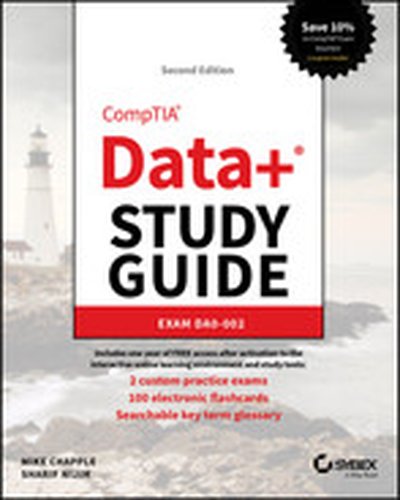
Prepare for the CompTIA Data+ exam, as well as a new career in data science, with this effective study guide In the newly revised second edition of CompTIA Data+ Study Guide: Exam DA0-002, veteran IT professionals Mike Chapple and Sharif Nijim provide a powerful, one-stop resource for anyone planning to pursue the CompTIA Data+ certification and go on to an exciting new career in data science. The authors walk you through the info you need to succeed on the exam and in your first day at a data science-focused job. Complete with two online practice tests, this book comprehensively covers every objective tested by the updated DA0-002 exam, including databases and data acquisition, data quality, data analysis and statistics, data visualization, and data governance. You'll also find: Efficient and comprehensive content, helping you get up-to-speed as quickly as possible Bite-size chapters that break down essential topics into manageable and accessible lessons Complimentary access to Sybex' famous online learning environment, with practice questions, a complete glossary of common industry terminology, hundreds of flashcards, and more A practical and hands-on pathway to the CompTIA Data+ certification, as well as a new career in data science, the CompTIA Data+ Study Guide, Second Edition, offers the foundational knowledge, skills, and abilities you need to get started in an exciting and rewarding new career.
I've spent around 30 years working in data science, and the past decade focused mainly on geo-spatial applications. In this session I'll give a whistle-stop tour of some of the projects I've been involved in, from volcano motion detection and algal bloom prediction to ground movement monitoring, maritime data analysis, and the use of geo-spatial data for machine learning.
In an era where data is abundant but meaningful insights are rare, this session reframes the role of data professionals, shifting the focus from complexity to clarity, from algorithms to outcomes. Learn how aligning data work with business goals, ethical values, and societal needs leads to solutions that truly matter. Through a practical framework, compelling case studies, and expert perspectives, you'll explore how understanding business problems and user needs, alongside stakeholder engagement, domain knowledge, and strategic thinking, can elevate your technical skills into meaningful impact. Whether you're just starting your data journey or driving innovation, this talk will help you connect the dots between data and purpose.
In this talk, we will begin with an overview of the P&D sector, the Strategy team, and the ongoing research projects. Next, we delve into planning use cases, where we apply data science methods to support critical decision-making processes. These include a digital twin of our new-build supply chain for assessing buffer and capacity strategies, the application of deep reinforcement learning for optimizing inventory planning policies, and the development of a simulation model and optimization methodology to improve production order release planning for complex modules.
Détails sur nos formations: Développement Web, Data Analyse, Data Science, Growth.
In this talk, Sebastian, a bioinformatics researcher and software engineer, shares his inspiring journey from wet lab biotechnology to computational bioinformatics. Hosted by Data Talks Club, this session explores how data science, AI, and open-source tools are transforming modern biological research — from DNA sequencing to metagenomics and protein structure prediction.
You’ll learn about: - The difference between wet lab and dry lab workflows in biotechnology - How bioinformatics enables faster insights through data-driven modeling - The MCW2 Graph Project and its role in studying wastewater microbiomes - Using co-abundance networks and the CC Lasso algorithm to map microbial interactions - How AlphaFold revolutionized protein structure prediction - Building scientific knowledge graphs to integrate biological metadata - Open-source tools like VueGen and VueCore for automating reports and visualizations - The growing impact of AI and large language models (LLMs) in research and documentation - Key differences between R (BioConductor) and Python ecosystems for bioinformatics
This talk is ideal for data scientists, bioinformaticians, biotech researchers, and AI enthusiasts who want to understand how data science, AI, and biology intersect. Whether you work in genomics, computational biology, or scientific software, you’ll gain insights into real-world tools and workflows shaping the future of bioinformatics.
Links: - MicW2Graph: https://zenodo.org/records/12507444 - VueGen: https://github.com/Multiomics-Analytics-Group/vuegen - Awesome-Bioinformatics: https://github.com/danielecook/Awesome-Bioinformatics
TIMECODES00:00 Sebastian’s Journey into Bioinformatics06:02 From Wet Lab to Computational Biology08:23 Wet Lab vs Dry Lab Explained12:35 Bioinformatics as Data Science for Biology15:30 How DNA Sequencing Works19:29 MCW2 Graph and Wastewater Microbiomes23:10 Building Microbial Networks with CC Lasso26:54 Protein–Ligand Simulation Basics29:58 Predicting Protein Folding in 3D33:30 AlphaFold Revolution in Protein Prediction36:45 Inside the MCW2 Knowledge Graph39:54 VueGen: Automating Scientific Reports43:56 VueCore: Visualizing OMIX Data47:50 Using AI and LLMs in Bioinformatics50:25 R vs Python in Bioinformatics Tools53:17 Closing Thoughts from Ecuador Connect with Sebastian Twitter - https://twitter.com/sayalaruanoLinkedin - https://linkedin.com/in/sayalaruano Github - https://github.com/sayalaruanoWebsite - https://sayalaruano.github.io/ Connect with DataTalks.Club: Join the community - https://datatalks.club/slack.htmlSubscribe to our Google calendar to have all our events in your calendar - https://calendar.google.com/calendar/r?cid=ZjhxaWRqbnEwamhzY3A4ODA5azFlZ2hzNjBAZ3JvdXAuY2FsZW5kYXIuZ29vZ2xlLmNvbQCheck other upcoming events - https://lu.ma/dtc-eventsGitHub: https://github.com/DataTalksClubLinkedIn - https://www.linkedin.com/company/datatalks-club/Twitter - https://twitter.com/DataTalksClub - Website - https://datatalks.club/
When we at Bol decided to personalize campaign banners, we did what many companies do: bought an expensive solution. As a software engineering team with zero data science experience, we integrated a third-party recommender system for €1 million annually, built the cloud infrastructure, and waited for results. After our first season, the data told a harsh truth—the third-party tool wasn't delivering value proportional to its cost. We faced a crossroads: accept mediocrity or build our own solution from scratch, tailored to our requirements and architecture.\n\nWe'll walk you through our journey of building a more intelligent and flexible recommendation system from the ground up, and how this journey saved us over a million euros per year. We will share the incremental steps that shaped our journey, alongside the valuable lessons learned along the way.
In this episode, we explore how data science is helping researchers simulate and understand some of the most extreme physical events on Earth, from floods in Texas to hypersonic flight. Our guests are Stephen Baek, a leading expert in geometric deep learning and associate professor of data science at the University of Virginia, and Jack Beerman, a Ph.D. student whose work is already shaping real-world applications.
Together, they discuss how AI is transforming fields like weather forecasting, materials design, sports performance, and military innovation—and why graduate researchers like Jack are essential to moving this work forward.
We will be hosting an information session to discuss the program in more detail.
This week, we’re zooming in on one of the most underrated skills in data science: communicating your project effectively.
The data world has long been divided, with data engineers and data scientists working in silos. This fragmentation creates a long, difficult journey from raw data to machine learning models. We've unified these worlds through the Google Cloud and dbt partnership. In this session, we'll show you an end-to-end workflow that simplifies data to AI journey. The availability of dbt Cloud on Google Cloud Marketplace streamlines getting started, and its integration with BigQuery's new Apache Iceberg tables creates an open foundation. We'll also highlight how BigQuery DataFrames' integration with dbt Python models lets you perform complex data science at scale, all within a single, streamlined process. Join us to learn how to build a unified data and AI platform with dbt on Google Cloud.
Data interviews do not have to feel messy. In this episode, I share a simple AI Interview Copilot that works for data analyst, data scientist, analytics engineer, product analyst, and marketing analyst roles. What you will learn today: How to Turn a Job Post into a Skills Map: Know Exactly What to Study First.How to build role-specific SQL drills (joins, window functions, cohorts, retention, time series).How to practice product/case questions that end with a decision and a metric you can defend.How to prepare ML/experimentation basics (problem framing, features, success metrics, A/B test sanity checks).How to plan take-home assignments (scope, assumptions, readable notebook/report structure).How to create a 6-story STAR bank with real numbers and clear outcomes.How to follow a 7-day rhythm so you make steady progress without burnout.How to keep proof of progress so your confidence comes from evidence, not hope.Copy-and-use prompts from the show: JD → Skills Map: “Parse this job post. Table: Skill/Theme | Where mentioned | My level (guess) | Study action | Likely interview questions. Then give 5 bullets: what they are really hiring for.”SQL Drill Factory (Analyst/Product/Marketing): “Create 20 SQL tasks + hint + how to check results using orders, users, events, campaigns. Emphasize joins, windows, conditional agg, cohorts, funnels, retention, time windows.”Case Coach (Data/Product): “Run a 15-minute case: key metric is down. Ask one question at a time. Score clarity, structure, metrics, trade-offs. End with gaps + practice list.”ML/Experimentation Basics (Data Science): “Create a 7-step outline for framing a modeling problem (goal, data, features, baseline, evaluation, risks, comms). Add an A/B test sanity checklist (power, SRM, population, metric guardrails).”Take-Home Planner: “Given this brief, propose scope, data assumptions, 3–5 analysis steps, visuals, and a short results section. Output a clear report outline.”Behavioral STAR Bank: “Draft 6 STAR stories (120s) for conflict, ambiguity, failure, leadership without title, stakeholder influence, measurable impact. Put numbers in Results.”
Continuation of the conference with multiple advanced sessions and talks.
Conference officially opens with two keynote speakers.
In this episode, we chat with Dashel Ruiz, whose journey spans semiconductors, machine learning, and teaching. Dashel shares how he transitioned from hardware to data science, navigated complex projects in diverse industries, and now combines technical expertise with a passion for teaching. Tune in to hear insights on building a career in data, mastering new technologies, and making an impact both in the lab and the classroom.
TIMECODES 00:00 Dashel's unique career path from music to semiconductors 06:16 The transition into data and software engineering at Microchip 11:44 Discovering machine learning to solve real problems in semiconductor manufacturing 20:40 How Dashel found and his experience with the Machine Learning Zoomcamp 29:33 The practical advantages of DataTalks.Club courses over other platforms 39:52 Overcoming challenges and the value of the learning community 48:10 Hands-on project experience: From image classification to Kaggle competitions 54:12 Staying motivated throughout the long-term course 59:55 The importance of deployment and full-stack ML skills 1:07:36 Closing thoughts on teaching and future courses
Connect with Dashel Linkedin - https://www.linkedin.com/in/dashel-ruiz-perez-2b036172/ Connect with DataTalks.Club: Join the community - https://datatalks.club/slack.htmlSubscribe to our Google calendar to have all our events in your calendar - https://calendar.google.com/calendar/r?cid=ZjhxaWRqbnEwamhzY3A4ODA5azFlZ2hzNjBAZ3JvdXAuY2FsZW5kYXIuZ29vZ2xlLmNvbQCheck other upcoming events - https://lu.ma/dtc-eventsGitHub: https://github.com/DataTalksClubLinkedIn - https://www.linkedin.com/company/datatalks-club/ Twitter - https://twitter.com/DataTalksClub Website - https://datatalks.club/
If you're thinking about Data Analyst or Data Scientist career paths, then this one is for you! In this episode with Data Career Jumpstart Founder Avery Smith, you'll learn about the differences between Analyst and Data Scientist career paths, and hear some practical advice to help you on your journey. You'll leave with a better understanding of different data roles, which might be the better fit for you, and a concrete roadmap for taking action and accelerating your career. What You'll Learn: Key differences between Data Analyst and Data Science roles The critical tools to focus on to land a job in either role A step by step playbook for building the skills you need to succeed This session was part of our OPEN CAMPUS week in October, which included 6 days of live expert sessions. Register for free to be part of the next live session: https://bit.ly/3XB3A8b
Follow us on Socials: LinkedIn YouTube Instagram (Mavens of Data) Instagram (Maven Analytics) TikTok Facebook Medium X/Twitter